


Why Online Banking Rewards Programs Are Worth Your Attention
Online banking rewards programs have quietly become one of the smartest ways to earn extra money from the accounts you already use every day.
Here’s a quick look at the most common types and what they offer:
| Program Type | How You Earn | What You Get |
|---|---|---|
| Cash back checking | Debit card purchases | 1–3% cash back |
| Points-based credit cards | Credit card spending | Points for travel, gift cards, statement credits |
| High-yield rewards checking | Debit transactions + online login | Up to 4.05% APY |
| Tiered relationship programs | Combined bank + investment balances | Bonus rewards, fee waivers, subscription credits |
| Referral programs | Referring friends to the bank | $50–$150 per qualifying referral |
Think of it this way: you’re already paying bills, making purchases, and keeping money in a checking account. The only question is whether your bank is paying you back for it.
The numbers back this up. 70% of customers say rewards from financial institutions influence their banking decisions. And with fintech competition pushing banks to offer better perks than ever, there has never been a better time to make sure your bank is working as hard as you are.
For retirees and pre-retirees especially, these programs can act like a quiet, low-effort income stream — no market risk, no property headaches. Just rewards that stack up from everyday spending and account balances you already maintain.
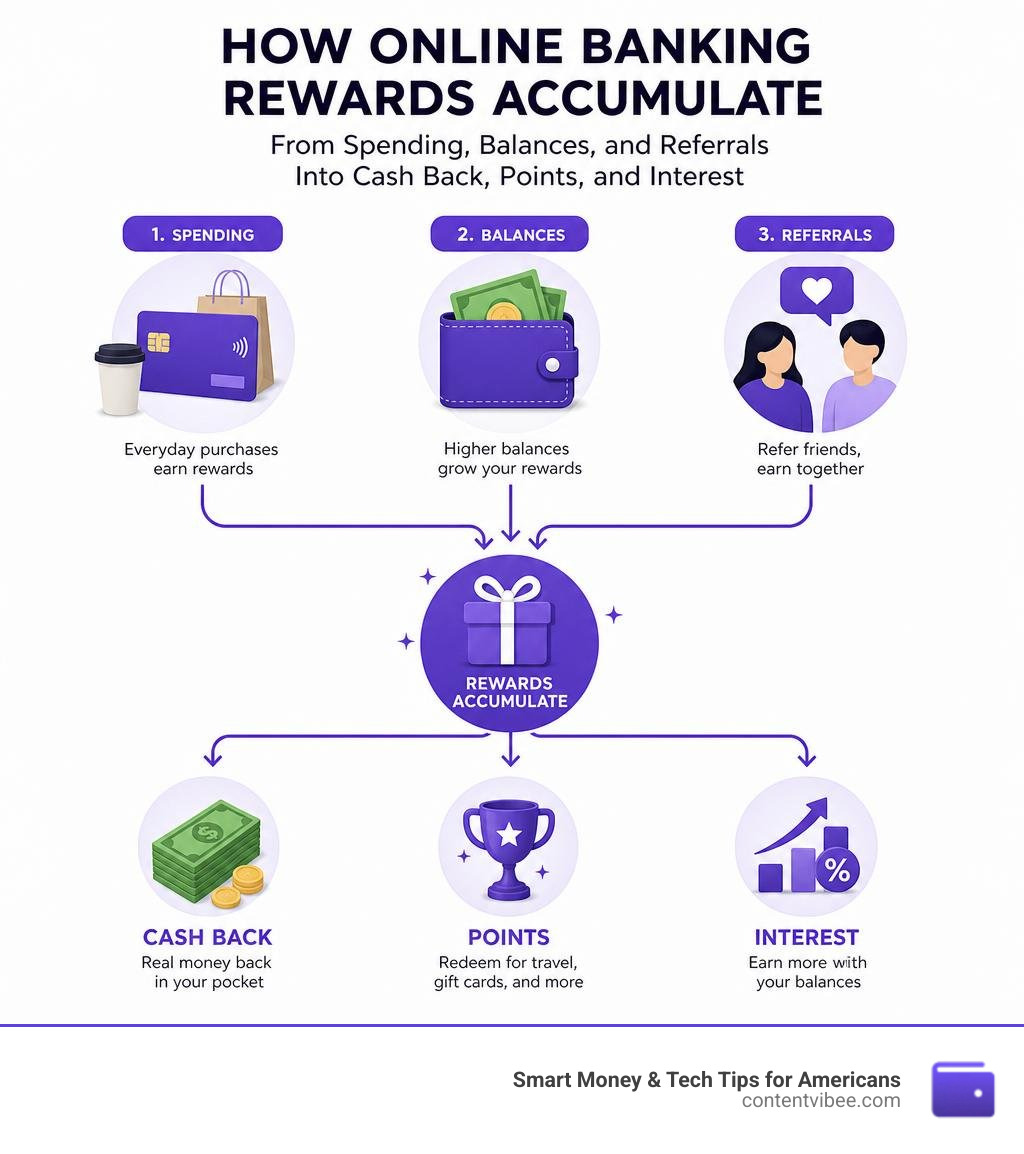
Quick look at online banking rewards programs:
Maximizing Value with Online Banking Rewards Programs
To get the absolute most out of modern banking, we have to look at reward optimization as a system. The days of carrying a physical coupon book or waiting for a paper statement to see your points are long gone. Today, maximizing your return requires a blend of smart consumer behavior, mobile banking integration, and digital wallets.
Since the massive digital shift where fintech app interaction increased by 73% following the coronavirus outbreak, banks have poured millions into making their mobile apps the nerve center for rewards. When you link your rewards-bearing cards to digital wallets like Apple Pay or Google Pay, you ensure that you never miss a point, even if you leave your physical wallet at home. Furthermore, many mobile apps now feature real-time, location-based offers. If you walk near a partner retailer, your banking app might send a notification letting you know you can activate a limited-time 5% cash back deal.
Understanding consumer behavior is key here. Data shows that 20% of customers agree they would be more likely to spend more if offered relevant and personalized rewards. Banks know this, which is why they are moving away from one-size-fits-all rewards and toward highly customized offers. If you want to maximize your returns, you must actively engage with these personalized dashboards. It only takes a few taps in your app each week to activate these specialized merchant offers, but it can easily double your monthly cash back.
To learn more about boosting your initial balances when switching to a new institution, check out our guide on Online Bank Account Bonuses: Easy Ways to Boost Your Balance.
Key Types of Online Banking Rewards Programs
When we look across the financial landscape in 2026, we see that online banking rewards programs generally fall into four primary categories. Understanding how these function is the first step to choosing the right partner for your wallet:
- Cash Back Programs: These are the most straightforward. You spend money on your debit or credit card, and a percentage of that spend (typically 1% to 3%) is returned to you as cold, hard cash.
- Points-Based Programs: Programs like Citibank’s Citi ThankYou Rewards or Capital One Rewards let you accumulate points for every dollar spent. These points live in a digital vault until you decide to redeem them for travel, gift cards, or partner transfers.
- High-Yield Rewards Checking: This is where online checking accounts shine. Instead of earning points on what you spend, you earn an exceptionally high interest rate on your entire account balance—provided you meet monthly activity requirements.
- Interest Rewards: Similar to high-yield checking, these programs pay a boosted Annual Percentage Yield (APY) on your savings or checking balance as a reward for your loyalty.
Many institutions combine these types. For instance, you can read about how various institutions structure their loyalty offerings in this comprehensive look at Bank loyalty programs: 10 successful examples in 2026 .
Earning and Redeeming Your Points
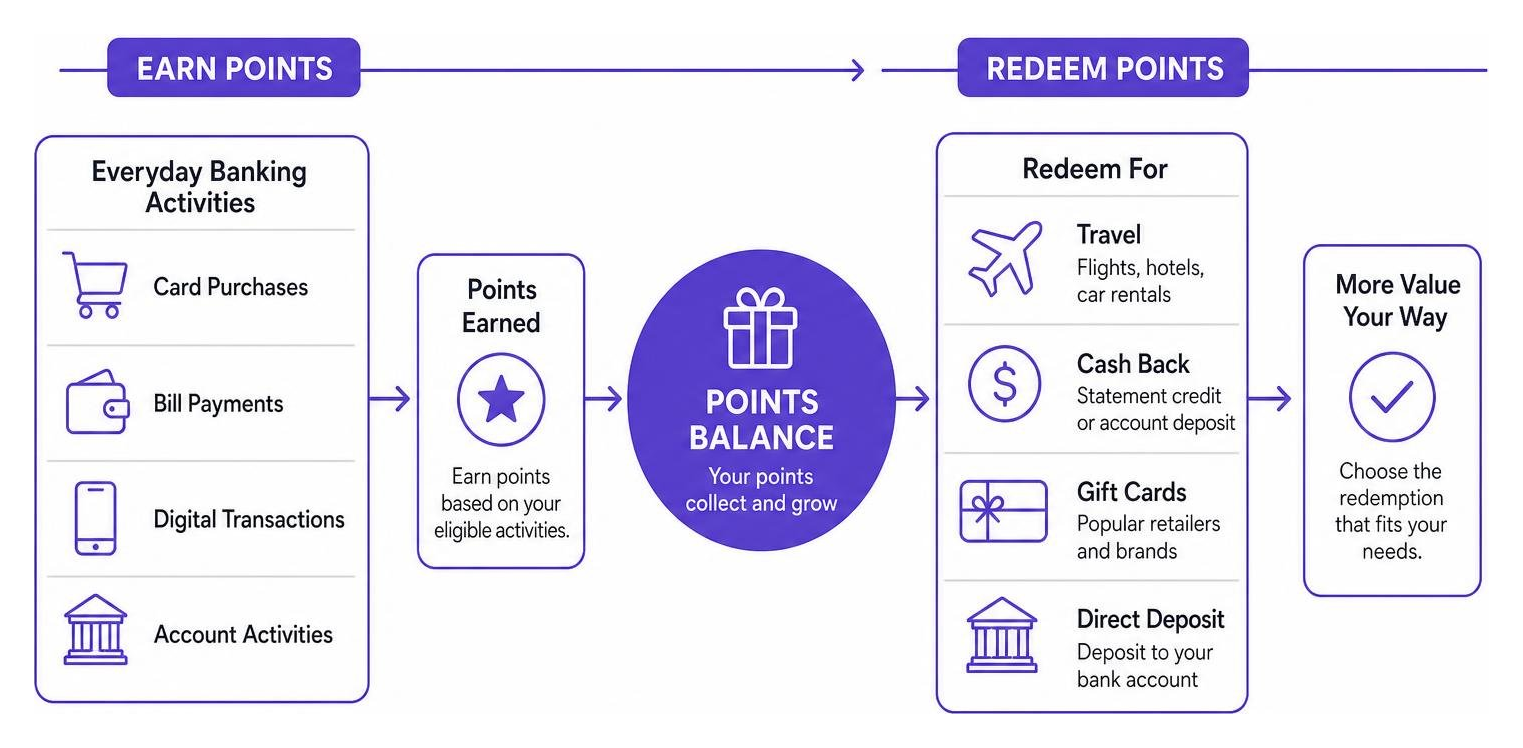
Earning rewards is only half the battle; knowing how to redeem them is where the real strategy lies. If you are participating in a points-based program, you generally have several redemption pathways:
- Statement Credits: The simplest option. You apply your points directly to your card balance to lower your monthly bill.
- Gift Cards: Most major banks offer gift cards to popular retailers, often starting at low thresholds like $10.
- Travel Transfers: For advanced rewards enthusiasts, transferring points to airline and hotel partners often yields the highest value per point.
- Direct Account Deposits: Depositing your rewards directly into a linked savings or checking account to let them earn interest.
For example, the Wells Fargo Rewards program allows you to redeem points to cover past eligible purchases, check out with PayPal, or book travel directly through their portal. If you prefer to keep things simple, you can even redeem rewards as a direct credit to your eligible accounts.
Point pooling is another essential feature to look out for. Many top-tier programs allow you to pool points across multiple cards held by the same primary account holder. If you have both a cash-back card and a travel card with the same issuer, combining those points into a single bucket can help you reach high-value travel redemptions much faster.
However, you must pay close attention to expiration policies. While many modern rewards programs boast that points do not expire as long as your account remains open and active, some regional banks or older credit card programs still enforce a 24-to-36-month expiration window.
Tiered and Relationship-Based Banking Benefits
If you really want to supercharge your earnings, you need to look beyond standalone cards and explore tiered, relationship-based rewards. This is where banks reward you for the depth of your relationship rather than just your monthly spending.
By consolidating your assets—such as your everyday checking, emergency savings, Certificates of Deposit (CDs), and even brokerage or wealth management accounts—into a single financial institution, you can unlock premium tiers that offer massive benefits.
How Relationship Tiers Multiply Your Earnings
Relationship rewards programs operate on a simple premise: the more money you keep with the bank, the higher your reward multiplier.
A prime example of this is the Bank of America Preferred Rewards program (detailed on the BofA Rewards – Personalized Banking Benefits & Rewards page). They look at your combined 3-month average balance across Bank of America deposit accounts and Merrill investment accounts to place you into one of their tiers:
- Member Tier: No minimum balance; provides a 10% credit card rewards bonus.
- Preferred Plus ($30K+): Unlocks a 25% credit card rewards bonus.
- Preferred Honors ($100K+): Unlocks a 50% credit card rewards bonus, plus up to $96 in annual subscription credits.
- Premier ($1M+): Unlocks a massive 75% credit card rewards bonus, up to $180 in annual subscription credits, and waived fees on international wire transfers.
Similarly, the U.S. Bank Smart Rewards program (which you can explore on the Smart Rewards for Checking Accounts | U.S. Bank page) automatically enrolls checking customers and assigns them to one of five tiers (Bronze to Platinum Plus) based on their Combined Qualifying Balances. Higher tiers enjoy waived monthly maintenance fees, free paper checks, and waived non-network ATM fees.
These programs are incredibly lucrative because they multiply the rewards you are already earning on your credit cards. A card that normally earns 1.5% cash back suddenly earns 2.62% cash back if you are in the Premier or Platinum Honors tier.
How to Compare Online Banking Rewards Programs
When comparing different online banking rewards programs, it is easy to get blinded by a flashy headline APY. To make an apples-to-apples comparison, we must look at the fine print:
- APY vs. Requirements: A bank offering 4.05% APY might sound better than one offering 3.00% APY, but what are the hoops you have to jump through?
- Qualification Cycles: Most rewards checking accounts require you to meet specific criteria during each monthly qualification cycle. This usually includes a set number of debit card transactions (typically 5 to 12), enrollment in eStatements, and at least one direct deposit or online banking login.
- ATM Fee Refunds: If you use ATMs frequently, look for accounts that offer nationwide ATM fee refunds. Some accounts, like those at Axos Bank, offer unlimited domestic ATM fee reimbursements, while others cap it at $15 or $20 per month.
Let’s look at a few real-world examples of how regional and online banks structure these accounts:
- Progressive Bank: Their Rewards Interest Checking offers an impressive 4.05% APY on balances up to $25,000, provided you make at least 12 debit card purchases, have one direct deposit or automatic debit, and log into online banking once per cycle. If you fail to meet these, the balance earns just 0.05% APY. You can read more on their Personal Checking | Progressive Bank (Monroe, LA) page.
- Harleysville Bank: Offers 3.75% APY on balances up to $25,000 with similar requirements, including 12 debit card purchases and eStatement enrollment, as outlined on the Harleysville Cash Rewards | Harleysville Bank page.
- Brentwood Bank: Offers 3.00% APY on balances up to $25,000, but with a much lower hurdle—only requiring 5 debit card purchases of $5 or more per month, plus online banking and eStatements. Check out the Interest Rewards Checking Account | Brentwood Bank page for details.
- Axos Bank: Known for its flexible online accounts, Axos offers up to 1.00% APY on checking balances and unlimited ATM fee refunds, which you can compare on the Online Checking Accounts | Compare & Open Today | Axos Bank page.
To ensure you are getting the absolute best return on your liquid cash, we recommend reading our detailed analysis of how to Maximize Your Yield with Top Online Banking Interest Rates.
Credit Card vs. Debit Card Rewards: Key Differences
One of the most common questions we get is whether it is better to chase rewards through a credit card or a debit card. Historically, credit cards held a massive monopoly on rewards, but debit card rewards programs have made a major comeback in 2026.
The fundamental difference lies in how banks make money. Credit card rewards are largely funded by interchange fees (the fees merchants pay when you swipe) and interest charges from users who carry a balance. Because credit card interchange fees are higher, banks can afford to offer much higher rewards rates—often 2% to 5% in specific categories.
Debit cards, on the other hand, are capped by federal regulations on how much interchange they can charge. Therefore, debit rewards are typically lower (often capped at 1% cash back or a maximum of $10 per month) or structured as interest-based rewards on your account balance rather than transaction-based cash back.
To protect your hard-earned money from the eroding effects of rising prices, you should couple your rewards checking with a solid savings vehicle. Take a look at our guide: Don’t Let Inflation Win with These High-Interest Savings Accounts.
Here is a side-by-side comparison to help you decide which tool is right for each transaction:
| Feature | Credit Card Rewards | Debit Card Rewards |
|---|---|---|
| Earning Potential | High (uncapped cash back or points) | Moderate (often capped monthly or tied to APY) |
| Consumer Protection | Excellent (zero-liability fraud protection) | Good (but funds are tied up during disputes) |
| Credit Building | Yes (helps build and maintain credit history) | No (does not impact credit score) |
| Debt Risk | High (accrues interest if not paid in full) | Low (you can only spend what you have) |
| Qualification Hurdle | Requires credit approval | Easy (available with standard checking) |
If you are looking for the absolute best credit card rewards programs available right now, it is important to compare options from major issuers to find the one that aligns best with your spending habits.
Frequently Asked Questions about Bank Rewards
Do online banking rewards points expire?
In most major programs, including Citi ThankYou Rewards, Capital One, and Wells Fargo, rewards points do not expire as long as your account remains open, active, and in good standing. However, if you close your account or if it becomes completely inactive for a long period (usually 12 to 24 months), the bank reserves the right to forfeit your accumulated points. Always check the specific terms of your bank’s program to understand their exact point preservation rules.
Are bank rewards taxable?
The IRS treats credit card and debit card purchase rewards as “rebates” on money you have spent, meaning they are generally not taxable. However, there is a major exception: interest rewards and sign-up bonuses that do not require spending (such as a bonus just for opening a checking account) are considered taxable income. Your bank will issue a Form 1099-INT or 1099-MISC at the end of the year if your taxable rewards exceed $10.
Can I earn rewards without a credit card?
Absolutely! As we’ve highlighted, many of the best online banking rewards programs are built around debit card usage and checking account balances. Programs like U.S. Bank Smart Rewards, Progressive Bank Rewards Checking, and Harleysville Cash Rewards allow you to earn high interest rates, cash back, and fee waivers entirely through checking account activity and debit transactions—no credit check or credit card required.
Conclusion
At ContentVibee, we believe that financial optimization shouldn’t feel like a second job. By aligning your everyday spending and savings habits with the right online banking rewards programs, you can easily pocket hundreds of extra dollars each year with minimal effort. Whether you choose to consolidate your assets to climb relationship tiers or simply opt for a high-yield rewards checking account, the key is to stop leaving free money on the table.
Ready to see how these extra rewards and interest payments can accelerate your long-term financial goals? Use our free personal finance calculator to model your savings growth and start making smarter money decisions today!