


What the 2026 COLA Increase Estimate Means for Your Retirement Check
The 2026 COLA increase estimate came in at 2.8% — slightly higher than the 2.5% adjustment retirees received in 2025.
Here’s what that means at a glance:
| Detail | Figure |
|---|---|
| Official 2026 COLA | 2.8% |
| 2025 COLA (for comparison) | 2.5% |
| Average monthly benefit after COLA | $2,071 |
| Average monthly dollar increase | ~$54.70 |
| COLA announcement date | October 2025 |
| Effective date | January 2026 |
If you’re trying to figure out how much your Social Security check will grow — or why the number keeps changing in the news — you’re not alone.
COLA estimates shift every month as new inflation data comes in. Independent forecasters like The Senior Citizens League and analyst Mary Johnson tracked the number all year, watching it climb from around 2.3% early in 2025 to the final 2.8%.
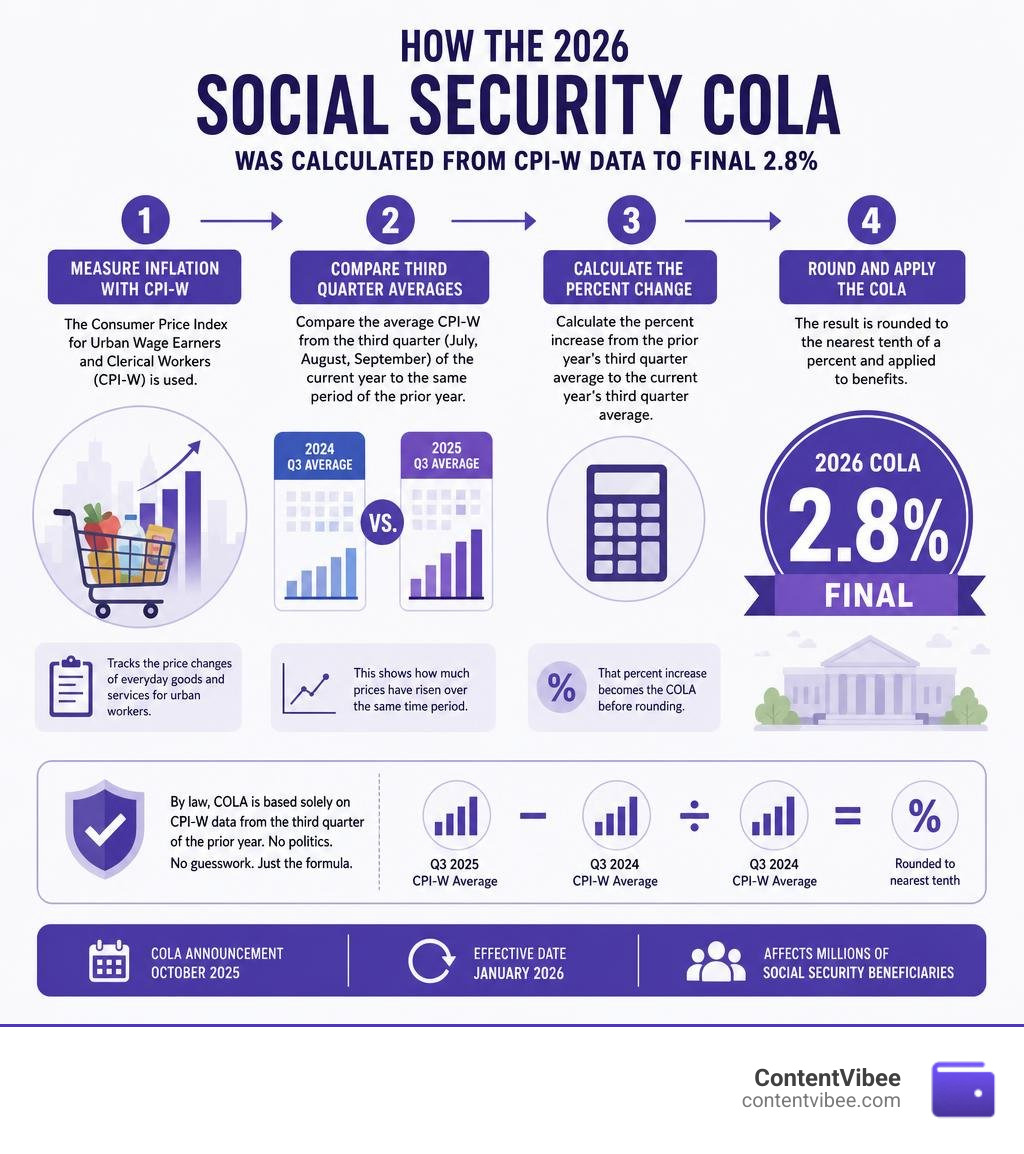
The official figure is always based on one thing: how much the CPI-W (a specific consumer price index) rose during the third quarter of the prior year. No politics. No guesswork. Just a formula.
This guide breaks down exactly how the 2026 number was reached, what it means for your monthly budget, and what early forecasts say about 2027.
Deciphering the 2026 COLA Increase Estimate and Final Numbers
When we look at the official 2026 Social Security cost-of-living adjustment (COLA), the final 2.8% rate represents a modest but welcome step up from the 2.5% bump we saw in 2025. For the average retired worker, this boost translates directly into more breathing room at the grocery store and gas pump.
However, the annual COLA is about much more than just the percentage increase applied to your monthly check. It triggers a cascade of policy shifts across the Social Security system, affecting tax limits, maximum benefit caps, and eligibility thresholds. To help you visualize these changes, we have put together a comprehensive comparison of how the system transitioned from 2025 into 2026.
| Social Security Metric | 2025 Value | 2026 Value (With 2.8% COLA) |
|---|---|---|
| Average Monthly Retired Worker Benefit | $1,907 | $2,071 |
| Average Aged Couple Monthly Benefit | $3,120 | $3,208 |
| Average Disabled Worker Monthly Benefit | $1,586 | $1,630 |
| Average Aged Widow(er) Monthly Benefit | $1,867 | $1,919 |
| Maximum Taxable Earnings (OASDI Cap) | $176,100 | $184,500 |
| Maximum Monthly Benefit (at Full Retirement Age) | $4,018 | $4,152 |
| SSI Federal Payment Standard (Individual) | $967 | $994 |
| Substantial Gainful Activity (SGA) – Non-Blind | $1,620 / month | $1,690 / month |
| Retirement Earnings Test Exempt Amount | $23,400 / year | $24,480 / year |
As we analyze these numbers, several trends emerge. First, the maximum taxable earnings cap rose significantly to $184,500. This means higher-income earners contribute payroll taxes on a larger portion of their income to help fund the system.
Second, if you are planning to claim benefits at your Full Retirement Age (FRA) in 2026, the maximum possible monthly payout jumped to $4,152. For those receiving Supplemental Security Income (SSI), the individual federal baseline rose to $994 per month, providing critical support to our most vulnerable seniors and disabled individuals.
How the 2026 COLA Was Calculated and Predicted
Understanding how we arrive at these numbers requires pulling back the curtain on the federal government’s calculation mechanics. The Social Security Administration (SSA) does not pull the COLA out of a hat, nor is it subject to congressional debates or presidential vetoes. It is governed by a strict, formulaic process tied directly to inflation.
The core metric used is the Consumer Price Index for Urban Wage Earners and Clerical Workers (CPI-W), compiled monthly by the Bureau of Labor Statistics (BLS). To calculate the COLA, the SSA compares the average CPI-W reading from the third quarter (July, August, and September) of the current year against the average CPI-W reading from the third quarter of the last year a COLA was determined.
If prices rose, the percentage increase is rounded to the nearest tenth of a percent and becomes the next year’s COLA. If prices stayed flat or fell (deflation), the COLA is 0.0%, as we saw during the low-inflation years of 2010, 2011, and 2016.
Interestingly, during the run-up to the 2026 calculation, the BLS faced severe staffing shortages and budget constraints. This forced the agency to rely more heavily on statistical estimation models rather than physical, in-person price tracking at local businesses. Senior advocacy groups raised concerns that these data-gathering hurdles might have caused the index to slightly underestimate the real-world inflation seniors were experiencing on the ground.
To see how these predictions evolved in the spring leading up to the final decision, you can read the 2026 COLA Prediction Update April | The Senior Citizens League to explore the early modeling.
The Role of Independent Forecasts in the 2026 COLA Increase Estimate
Before the official numbers are published in mid-October, independent organizations work around the clock to analyze monthly CPI data and predict where the COLA will land. The two most prominent voices in this arena are The Senior Citizens League (TSCL) and independent policy analyst Mary Johnson.
Throughout 2025, these experts tracked a slow but steady upward march in inflation. Early in the year, TSCL’s statistical model (which incorporates CPI, Federal Reserve interest rates, and unemployment data) predicted a modest 2.3% to 2.4% COLA. However, as spring transitioned into summer, both TSCL and Mary Johnson adjusted their models upward.
By mid-2025, Mary Johnson’s forecast aligned at 2.8%, while TSCL hovered around 2.7%. The slight variance came down to how their respective models weighted late-summer energy and shelter spikes. The actual inflation data from the third quarter validated the higher 2.8% projection, demonstrating just how accurate these independent trackers can be when utilizing refined forecasting models like TSCL’s v1.2.
Economic Drivers Behind the 2026 COLA Increase Estimate
Why did the 2026 COLA increase estimate end up higher than the previous year’s 2.5% rate? The answer lies in several persistent economic pressures that refused to cool down:
- Shelter Inflation: Housing and rent costs remained stubbornly high, with trailing 12-month shelter inflation sitting at a hefty 3.6%. Because housing represents a massive portion of typical household budgets, this kept upward pressure on the CPI-W.
- Medical Care Costs: Healthcare services and medical commodities rose by an average of 4.2% over the year. This sector disproportionately impacts seniors, who spend a much larger share of their income on clinical care and prescriptions than younger workers.
- Tariff Policies: The implementation of new trade tariffs began filtering down to consumer goods in 2025, raising the baseline cost of imported items and materials.
- Energy and Food Volatility: While supply chains largely normalized, localized grocery prices and municipal utility rates continued to tick upward, preventing the overall inflation rate from dropping back to the Federal Reserve’s 2.0% target.
Real-World Impact of the 2026 COLA on Retiree Budgets
While a 2.8% raise sounds positive on paper, we must examine how these dollars translate to real life. For a retired worker receiving the average benefit, a 2.8% increase adds approximately $54.70 per month to their check, bumping their monthly income from $2,016 to $2,071.

While $54 extra a month helps, it is quickly swallowed up by basic living expenses. A trip to the grocery store or a single utility bill increase can easily wipe out that entire gain.
In fact, senior surveys conducted by advocacy groups reveal that a staggering 80% of retirees felt that actual inflation in their communities was far higher than the government’s official CPI metric. Even worse, research shows that Social Security benefits have lost roughly 14% of their purchasing power since 2016. Because the CPI-W is based on the spending habits of working-age urban employees, it fails to accurately weight the heavy healthcare and housing expenses that dominate retiree budgets.
How Rising Medicare Premiums Offset Your COLA Raise
The most frustrating aspect of the annual COLA raise for many seniors is the “Medicare clawback.” Most retirees have their Medicare Part B premiums deducted directly from their Social Security checks. When Medicare costs rise, they eat into the COLA increase before the beneficiary ever sees a dime of it.
For 2026, this offset was particularly painful. The standard monthly Medicare Part B premium jumped by $21.50, rising from $185.00 to $206.50 per month. Additionally, some private Medicare Part D prescription drug plans saw premium increases of up to $50 per month.
To see how this math plays out for the average retiree, let’s look at this step-by-step breakdown:
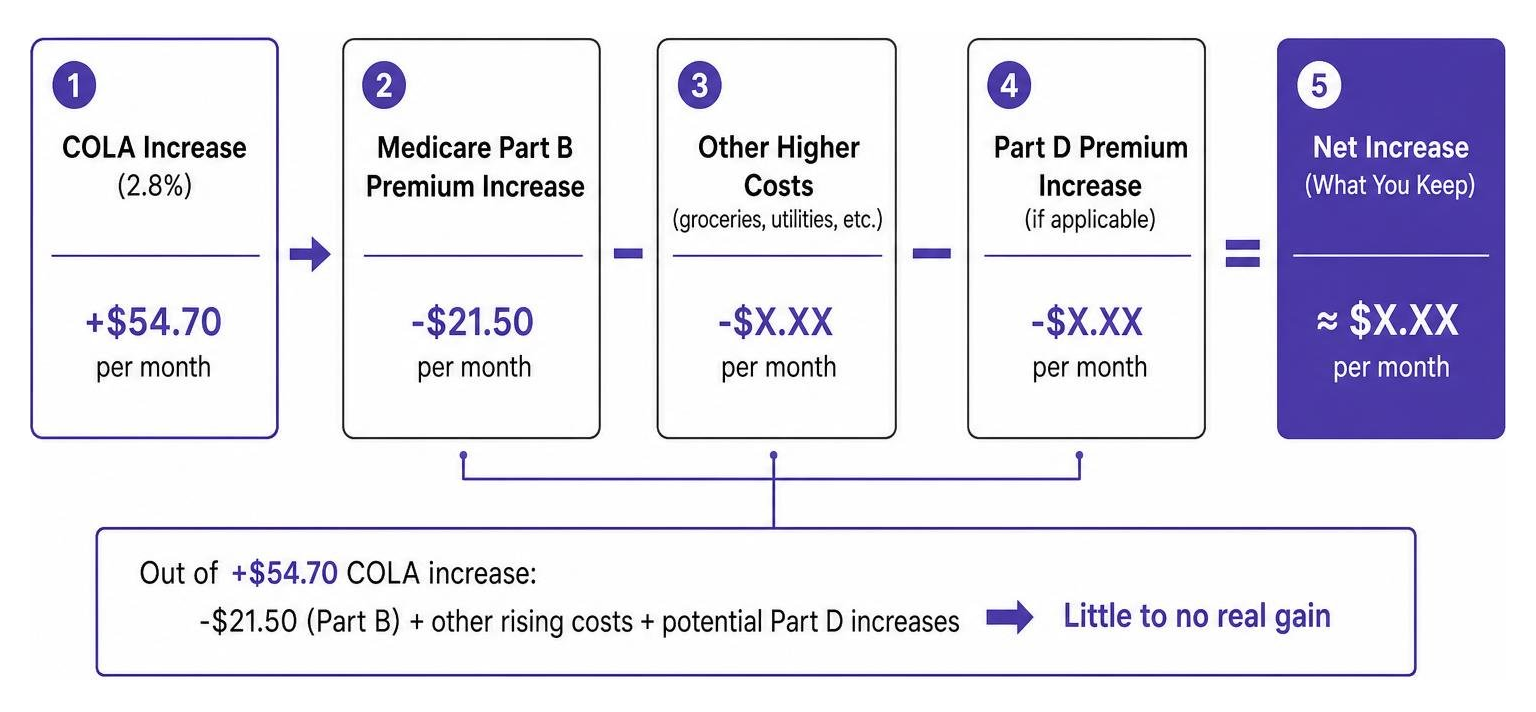
As the diagram illustrates, out of a nominal $54.70 monthly increase, nearly 40% ($21.50) is immediately diverted to cover the Medicare Part B increase. Once you factor in rising grocery bills, higher home heating costs, and potential Part D prescription premium hikes, the actual net gain to a retiree’s disposable income is practically non-existent. This is why so many seniors feel like they are running on a financial treadmill—moving forward in nominal dollars but staying in the exact same place in terms of purchasing power.
Frequently Asked Questions About the 2026 COLA
What was the final 2026 Social Security COLA percentage?
The final, official Social Security cost-of-living adjustment (COLA) for 2026 is 2.8%. This increase went into effect with the payments delivered in January 2026. This adjustment was calculated based on the year-over-year increase in the CPI-W during the third quarter of 2025 compared to the third quarter of 2024.
How does the 2026 COLA compare to historical increases?
The 2.8% increase for 2026 fits comfortably near the 20-year historical average of 2.6%. However, it marks a continued stabilization from the massive, inflation-driven spikes we experienced earlier in the decade:
- 2023 COLA: 8.7% (a 41-year high driven by post-pandemic inflation)
- 2024 COLA: 3.2%
- 2025 COLA: 2.5%
- 2026 COLA: 2.8%
Interestingly, this consecutive run of five years with a COLA of 2.5% or higher (starting in 2022) is a rare economic phenomenon. We have not witnessed a sustained five-year stretch of inflation adjustments this high since the period of 1988 to 1997.
What are the early projections for the 2027 COLA?
As of our current vantage point in July 2026, early projections for the 2027 COLA are climbing rapidly. Due to escalating geopolitical conflicts in the Middle East, West Texas Intermediate (WTI) crude oil prices have surged past $94 per barrel, driving wholesale natural gas prices up by as much as 75%.
Consequently, independent forecasters are already projecting a much higher 2027 COLA. The Senior Citizens League’s preliminary estimates range from 3.8% to 3.9%, while other analysts suggest it could climb as high as 4.2% to 4.7% if energy and food costs continue their current upward trajectory through the third quarter of 2026. While a larger check in 2027 sounds like good news, it is a double-edged sword: higher COLAs are reactive, meaning they only arrive after seniors have already spent a year enduring painful price hikes.
Conclusion
Navigating the annual shifts in Social Security can feel overwhelming, but staying informed is your best defense against inflation. While the 2.8% COLA for 2026 offers some assistance, the reality of rising Medicare premiums and everyday expenses means retirees must be highly strategic with their financial planning.
At ContentVibee, we believe that understanding the numbers is only the first step. To truly secure your financial future, you need to know how to maximize every dollar you are entitled to receive.
Are you ready to take control of your retirement income and build a plan that stands up to inflation? Discover actionable, step-by-step strategies to get the most out of your hard-earned benefits and optimize your retirement planning today.