


What It Really Means to Move Your 403(b) to a Roth IRA
Moving your 403b to a Roth IRA is absolutely possible — and for many pre-retirees, it can be one of the smartest tax moves available.
Here’s the quick answer:
Can you convert a 403(b) to a Roth IRA?
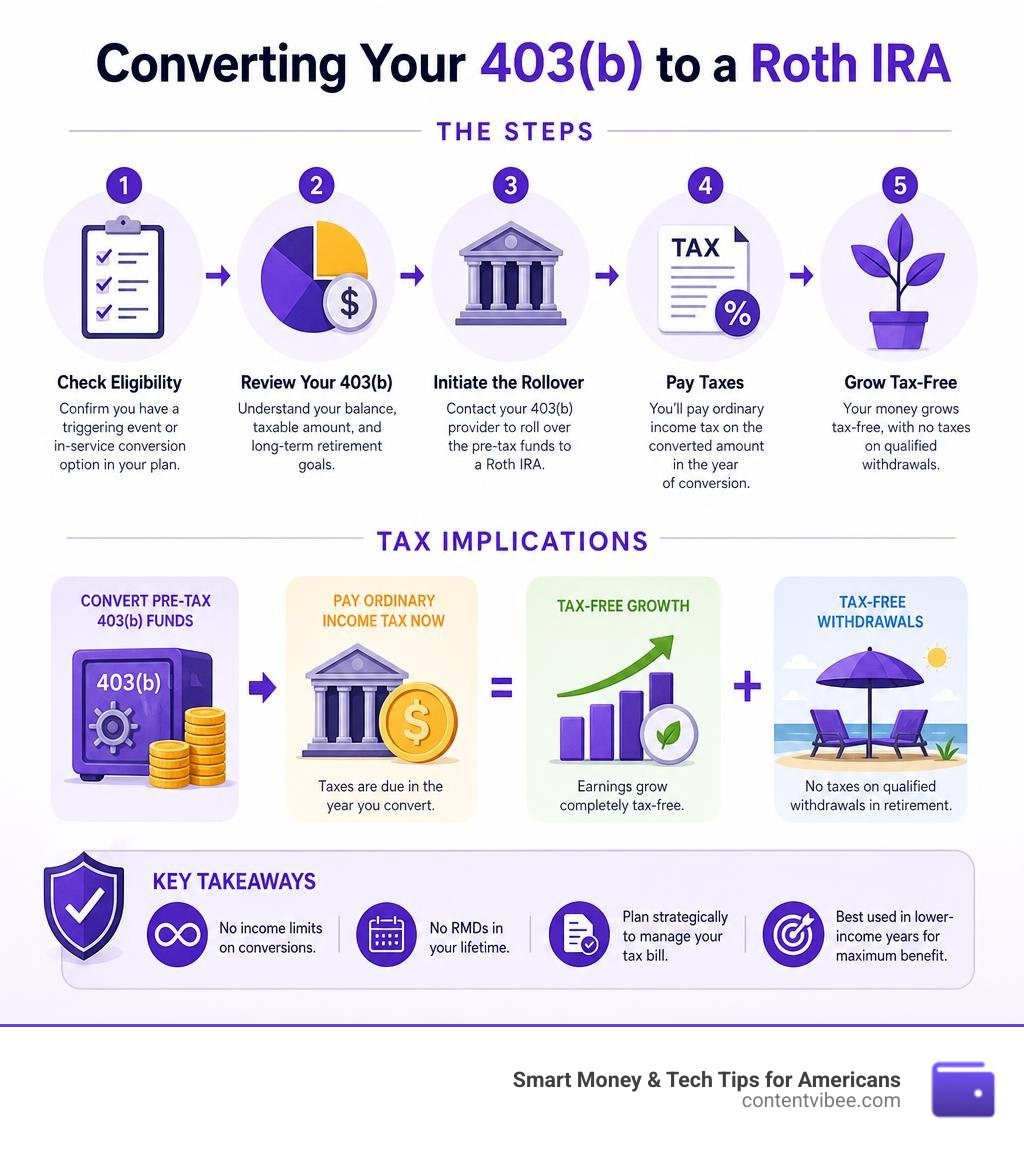
- Yes. Any traditional 403(b) balance can be rolled over to a Roth IRA.
- You pay ordinary income tax on the converted amount in the year you convert.
- After that, your money grows completely tax-free — and you owe nothing when you withdraw it in retirement.
- There are no income limits on conversions (unlike direct Roth IRA contributions).
- You need a triggering event — such as leaving your employer, retiring, or reaching age 59½ — unless your plan allows in-service conversions.
That last point trips a lot of people up. You can’t always just move the money whenever you feel like it. Timing matters. So do taxes.
If you’re approaching retirement and sitting on a large pre-tax 403(b) balance, you’re likely staring at a future full of required minimum distributions (RMDs), unpredictable tax bills, and the nagging question: should I pay taxes now or later?
Converting to a Roth IRA flips that equation. You pay the tax now — ideally during a lower-income year — and everything after that grows tax-free, with no RMDs during your lifetime.
It’s not right for everyone. But it’s worth understanding exactly how it works before you decide.
403b to roth ira terms to learn:
Understanding the 403(b) and Roth IRA Landscape in 2026
To understand if moving your 403b to a Roth IRA makes sense, we first need to look at how these two accounts differ. A 403(b) plan is an employer-sponsored retirement account offered primarily to employees of public schools, universities, religious organizations, and 501(c)(3) tax-exempt nonprofits. It functions quite similarly to a 401(k), allowing you to save pre-tax money directly from your paycheck.
A Roth IRA, on the other hand, is an individual retirement account you open yourself through a brokerage. It is funded with after-tax dollars, meaning you get no immediate tax break, but the reward is tax-free growth and tax-free withdrawals in retirement.
Let’s look at how these accounts compare side-by-side using the IRS thresholds for 2026:
| Feature | 403(b) Plan (2026 Limits) | Roth IRA (2026 Limits) |
|---|---|---|
| Account Type | Employer-sponsored | Individual account |
| Funding Type | Pre-tax (Traditional) or After-tax (Roth) | After-tax |
| Annual Contribution Limit | $24,500 | $7,500 |
| Catch-Up Contribution (50+) | $8,000 ($32,500 total) | $1,100 ($8,600 total) |
| Super Catch-Up (Ages 60–63) | Up to $11,250 ($35,750 total) | N/A |
| Total Annual Additions Cap | $72,000 (including employer match) | N/A |
| Income Restrictions | None | Phase-out: $153k–$168k (Single) $242k–$252k (MFJ) |
| Required Minimum Distributions | Starts at age 73 (pre-tax accounts) | None during owner’s lifetime |
As you can see, the 403(b) plan allows for massive contribution limits. If you are aged 60 to 63 in 2026, you can take advantage of the enhanced SECURE Act 2.0 catch-up contributions of up to $11,250, bringing your total potential employee contribution to $35,750. To learn more about how these contribution limits are calculated, check out our guide on calculating contributions.
However, the Roth IRA offers an unparalleled benefit: complete tax-free growth and no lifetime RMDs. Furthermore, while high earners are phased out of making direct contributions to a Roth IRA if their income exceeds the 2026 thresholds ($153,000–$168,000 for single filers; $242,000–$252,000 for married filing jointly), there are absolutely no income limits on executing a 403b to roth ira conversion.
How to Execute a 403b to Roth IRA Rollover: Step-by-Step

Before you can move your money, you must confirm that you are eligible to distribute funds from your 403(b) plan. These are known as “triggering events.” Generally, you cannot move money out of an active employer plan unless you:
- Reach age 59½.
- Leave your job (separation from service).
- Retire.
- Qualify for an “in-service withdrawal” (if permitted by your specific plan’s document).
If you have met one of these triggering events, you can proceed with the rollover. To read more about whether your plan qualifies, check out this guide on whether a 403(b) can be converted to Roth.
Here is the exact step-by-step process to move your traditional 403b to a Roth IRA:
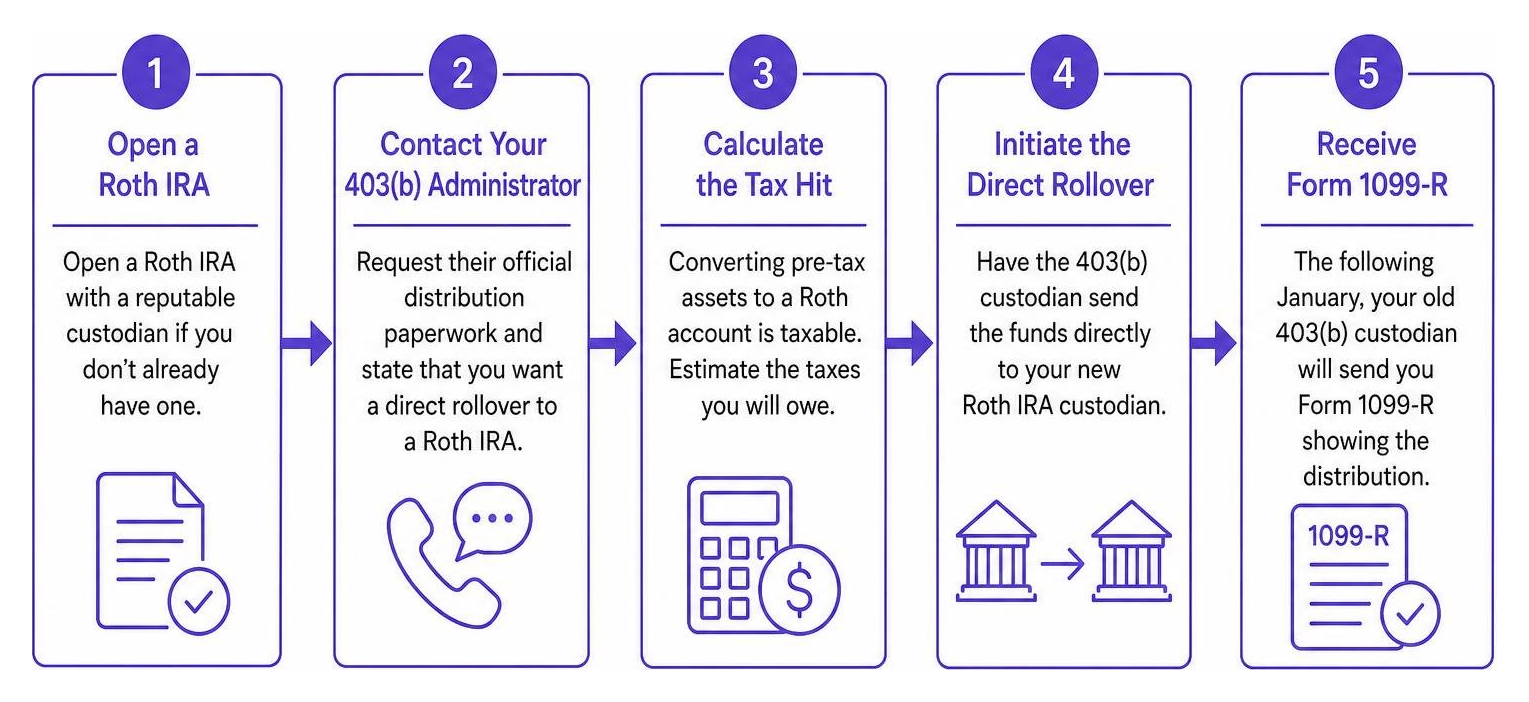
- Open a Roth IRA: If you do not already have one, open a Roth IRA with a reputable custodian of your choice.
- Contact Your 403(b) Administrator: Request their official distribution paperwork. You must explicitly state that you want to perform a direct rollover to a Roth IRA.
- Calculate the Tax Hit: Converting pre-tax assets to a Roth account is a taxable event. Estimate the taxes you will owe so you aren’t shocked when tax season arrives.
- Initiate the Direct Rollover: Have the 403(b) custodian send the funds directly to your new Roth IRA custodian.
- Receive Form 1099-R: The following January, your old 403(b) custodian will send you Form 1099-R showing the distribution. For help understanding how to read this, see our breakdown of Form 1099-R and retirement distributions.
- Report the Conversion: When you file your federal tax return (Form 1040), you must report the conversion and pay the ordinary income taxes due.
Direct vs. Indirect 403b to Roth IRA Transfers
When moving your funds, you have two choices: a direct rollover or an indirect rollover. We strongly recommend always choosing a direct rollover (also known as a trustee-to-trustee transfer).
In a direct rollover, the funds move directly from your 403(b) provider to your Roth IRA custodian. The money never touches your personal bank account. This method has several major advantages:
- No taxes are withheld automatically.
- There is no risk of missing the 60-day deadline.
- The paperwork is straightforward and processed cleanly.
In an indirect rollover, the 403(b) custodian writes a check made out directly to you. By law, the custodian must automatically withhold 20% for federal income taxes.
To complete the rollover and avoid penalties, you must deposit the entire 100% of the distribution amount into your Roth IRA within 60 days. This means you must find outside cash to make up for the 20% that was withheld. If you fail to deposit the full amount within 60 days, the missing 20% is treated as an early distribution, which will be subject to ordinary income taxes and a potential 10% early withdrawal penalty if you are under age 59½.
Required Paperwork and Deadlines for a 403b to Roth IRA Conversion
To ensure your conversion is attributed to the correct tax year, keep these key administrative rules in mind:
- The December 31 Deadline: Unlike regular IRA contributions (which you can make up until the tax filing deadline in April), a Roth conversion must be completed by December 31 of the calendar year to count for that year’s taxes. Most custodians require conversion requests to be submitted by 4:00 p.m. ET on December 31.
- Required Forms: You will need to fill out a distribution request form from your 403(b) provider. When tax season rolls around, you will report the conversion on Form 1040 and attach Form 8606 to track your non-deductible IRA assets and conversions.
Tax Implications and Strategic Planning
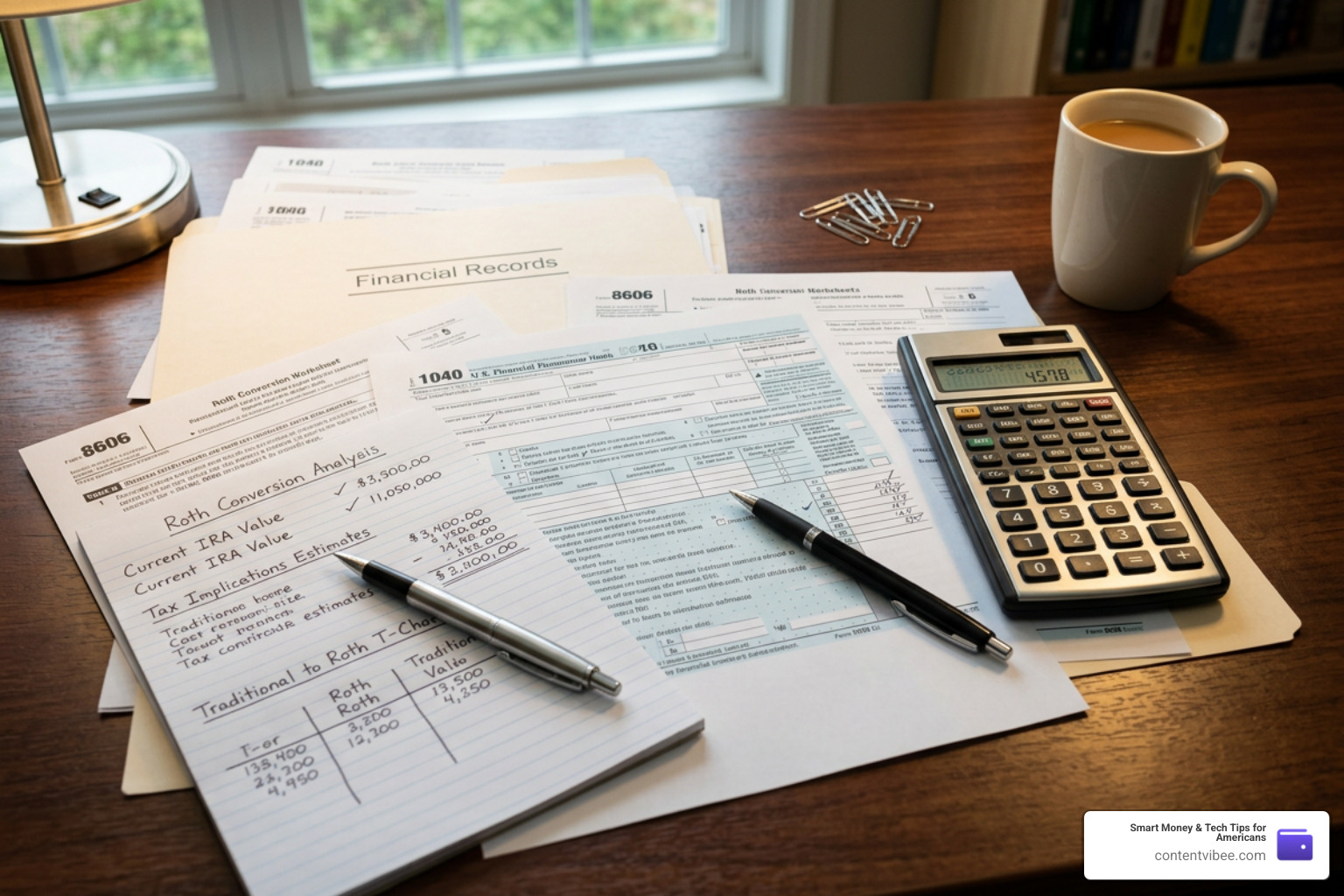
Moving your pre-tax 403b to a Roth IRA is not a tax-free transaction. The entire amount you convert will be added to your gross income for the year and taxed as ordinary income.
For example, if you convert a $100,000 pre-tax 403(b) to a Roth IRA, and you are in the 22% federal tax bracket, you could easily trigger a federal tax bill of $22,000, plus any applicable state taxes. If you want to dive deeper into how state taxes might affect your retirement savings, explore our guide on the best states for taxes in retirement.
To prevent this tax hit from pushing you into a higher tax bracket, we recommend using a partial conversion strategy. Instead of converting your entire 403(b) balance in a single year, you can spread the conversion over several tax years.
For instance, you might convert $25,000 per year over four years. This keeps your annual taxable income lower, prevents you from being bumped into a higher tax bracket, and helps manage your cash flow for paying the tax bills. To learn more about tax-minimization techniques, check out our guide on strategies to defer taxes and boost retirement savings as well as our analysis of state pension tax breaks.
For expats or non-resident aliens, these tax considerations become even more critical. You can read a highly detailed explanation of expat rollover rules in this guide on the implications of rolling over a 403b to an IRA.
Managing RMDs and the 5-Year Rule
Two major benefits of moving your 403b to a Roth IRA are the elimination of Required Minimum Distributions (RMDs) and the potential for tax-free growth. However, you must navigate two specific rules:
- Required Minimum Distributions (RMDs): Traditional 403(b) plans require you to start taking RMDs at age 73 (as of 2026). Roth IRAs, however, have no RMDs during the lifetime of the original owner. This allows your money to remain in the account and grow tax-free for as long as you live. If you are already of RMD age, you must take your RMD for the year before you can convert the remaining balance to a Roth IRA.
- The 5-Year Rule: To withdraw the earnings from your Roth IRA completely tax-free and penalty-free, the account must have been open for at least five tax years, and you must be at least age 59½. This five-year clock starts on January 1 of the tax year for which you made your first contribution or conversion to any Roth IRA.
Cross-Border Tax Rules for Expats
If you are a US expat living abroad, moving your 403b to a Roth IRA requires extra care:
- US Withholding Taxes: Non-resident aliens face a standard 30% withholding tax on US retirement distributions unless a double tax treaty applies.
- Double Tax Treaties: Many US tax treaties (such as those with the UK, Canada, and Germany) recognize the tax-exempt status of Roth IRAs, but some countries do not.
- Form W-8BEN: Expats must file Form W-8BEN to claim treaty benefits and reduce withholding taxes.
- Brokerage Restrictions: Many US brokers will freeze accounts or limit trading if the account owner moves to a foreign address. Ensure your custodian supports international clients before initiating a rollover.
Weighing the Pros, Cons, and Alternatives
Before moving your 403b to a Roth IRA, carefully weigh the advantages against the drawbacks.
Pros of Converting to a Roth IRA
- Tax-Free Growth and Withdrawals: You lock in today’s tax rates and enjoy tax-free income in retirement.
- No RMDs: You retain control over your money and don’t have to take forced withdrawals.
- Investment Freedom: 403(b) plans are notorious for offering limited, high-fee menus (often stuffed with expensive annuity contracts that drag down returns by 2% to 3% annually). An IRA gives you access to virtually any stock, ETF, or mutual fund.
- Estate Planning: You can leave a tax-free inheritance to your beneficiaries.
Cons of Converting to a Roth IRA
- Immediate Tax Bill: You must pay ordinary income taxes on the converted amount in the year of conversion.
- Loss of Creditor Protection: 403(b) plans enjoy robust federal creditor protection under ERISA. IRAs are protected under state laws, which vary significantly.
- No Loan Options: Many 403(b) plans allow you to borrow against your balance; IRAs do not allow loans.
If you are still debating whether a Roth or traditional account is right for you, we recommend reading the great retirement debate: Roth vs Traditional as well as our guide on maximizing after-tax contributions.
Alternatives to a Roth IRA Rollover
If a Roth conversion seems too expensive, you have other options:
- Leave the Money in Your 403(b): If your plan has low fees and great investment options, you can leave it alone.
- Roll Over to a Traditional IRA: This gives you the investment freedom of an IRA without triggering an immediate tax bill.
- In-Plan Roth Conversion: Some 403(b) plans allow you to convert pre-tax funds to Roth funds directly within the employer plan. You can view official 403(b) rollover options to see how these mechanics work.
Frequently Asked Questions about 403(b) Conversions
Can I convert my 403(b) to a Roth IRA while still employed?
Generally, no. Most employer plans do not allow you to roll over or convert assets while you are actively employed unless you have reached age 59½ or the plan document explicitly permits “in-service distributions.” You must check your plan’s Summary Plan Description (SPD) to see if this option is available.
Are there income limits on 403(b) to Roth IRA conversions?
No. Unlike direct contributions to a Roth IRA, which are restricted for high earners, the IRS places no income limits on Roth conversions. Anyone with an eligible 403(b) balance can convert to a Roth IRA, regardless of how much money they make.
Can I reverse a Roth IRA conversion if I change my mind?
No. Under current IRS tax laws, Roth conversions are permanent. Once you convert pre-tax 403(b) assets to a Roth IRA, you cannot “recharacterize” (undo) the transaction. You will owe the taxes on the converted amount, so make sure you have the funds available to pay the tax bill before finalizing the transfer.
Conclusion
Moving your 403b to a Roth IRA can be a phenomenal way to build a tax-free retirement nest egg, escape the burden of lifetime RMDs, and break free from high-fee employer plans. However, because conversions are permanent and trigger an immediate ordinary income tax bill, planning is everything. Spreading your conversions over multiple low-income years is often the most efficient path forward.
At ContentVibee, we want to help you make smart, actionable decisions with your money. To ensure you have all your bases covered when planning your retirement taxes, check out our guide on how Uncle Sam taxes your Social Security benefits.

