


What You’re Really Paying on a $50,000 Car Loan
A $50,000 car loan is one of the biggest financial commitments most Americans will make outside of a mortgage. And with average new car loan amounts hitting $42,600 in Q1 2026 — and climbing — more buyers than ever are financing vehicles in this range.
Before diving deep, here’s a quick snapshot of what a $50,000 auto loan actually costs you each month:
| Loan Term | 5% APR | 6% APR | 7% APR | 9% APR |
|---|---|---|---|---|
| 36 months | $1,498 | $1,521 | $1,545 | $1,590 |
| 48 months | $1,152 | $1,174 | $1,197 | $1,243 |
| 60 months | $944 | $967 | $990 | $1,037 |
| 72 months | $806 | $829 | $854 | $901 |
| 84 months | $703 | $727 | $752 | $801 |
Rates shown are for the full $50,000 principal with no down payment.
The monthly number looks manageable on a 72- or 84-month term. But here’s what most buyers miss: a longer term means you pay significantly more interest over the life of the loan. At 7% APR over 84 months, you’ll pay over $13,000 in interest alone on top of that $50,000 price tag.
Your credit score matters enormously here too. In Q1 2026, superprime borrowers (781-850) qualified for new car APRs as low as 4.55%, while subprime borrowers (501-600) faced rates of 13.44% or higher — a difference that can cost thousands of dollars on a loan this size.
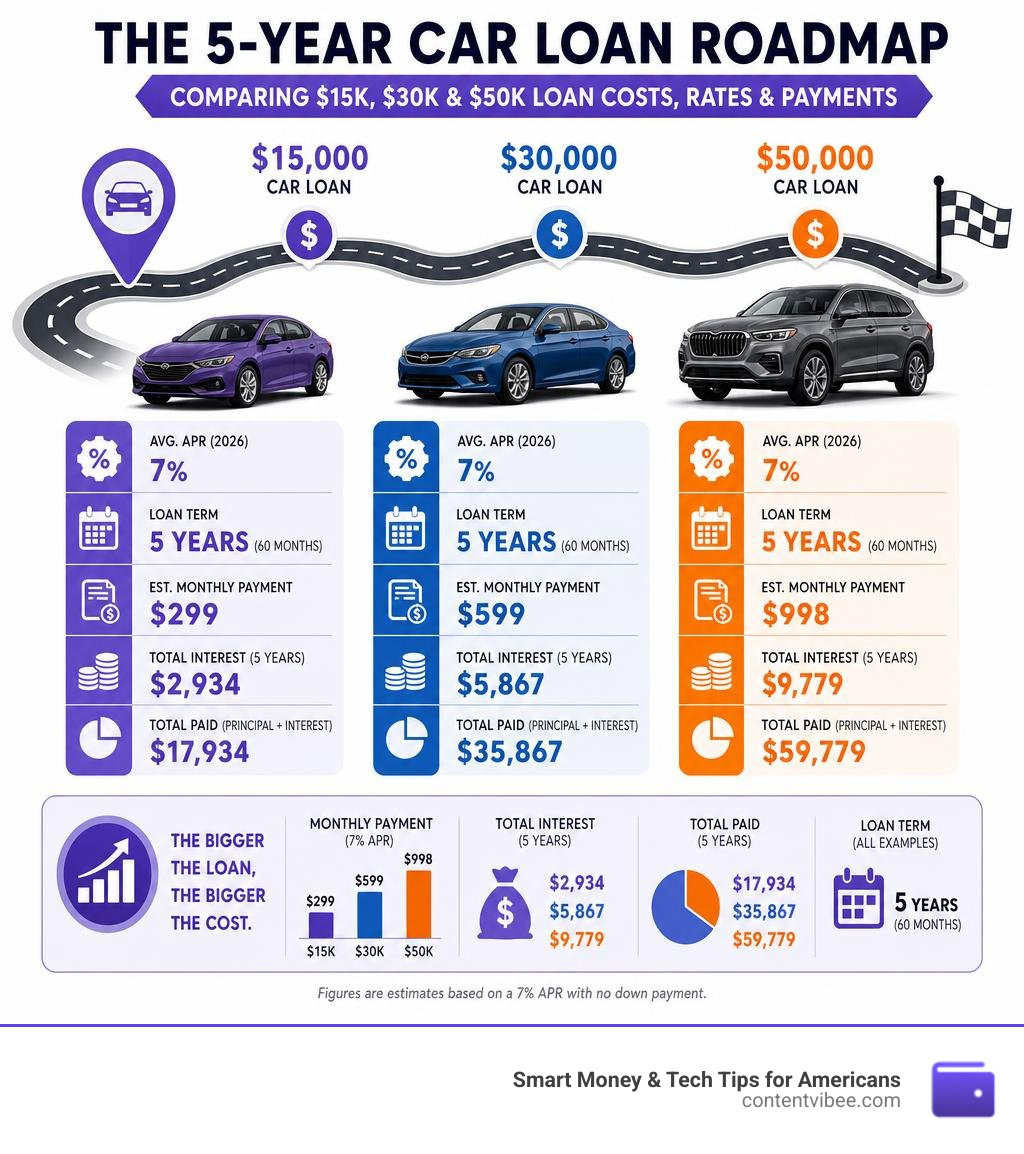
This guide walks you through the real math on $15k, $30k, and $50k auto loans, so you can make the smartest call for your budget.
The Mechanics of Auto Financing: $15k vs. $30k vs. $50k Loans
To truly understand how a 50000 car loan operates, we must first compare it to more modest financing options. Auto financing is built on three core pillars: the loan principal (the amount you borrow), the interest rate (expressed as Annual Percentage Rate, or APR), and the loan duration (the term in months).
As we scale up the principal, the financial impact of your interest rate and credit tier amplifies dramatically. Let’s look at how these variables play out across three common loan sizes over a standard 60-month (5-year) term:
| Loan Principal | APR (Superprime: 4.55%) | APR (Prime: 6.23%) | APR (Subprime: 13.44%) |
|---|---|---|---|
| $15,000 | $280/mo ($1,795 total interest) | $292/mo ($2,496 total interest) | $345/mo ($5,681 total interest) |
| $30,000 | $560/mo ($3,590 total interest) | $583/mo ($4,992 total interest) | $689/mo ($11,362 total interest) |
| $50,000 | $933/mo ($5,983 total interest) | $972/mo ($8,321 total interest) | $1,149/mo ($18,936 total interest) |
As you can see, a subprime borrower taking out a 50000 car loan will pay over $18,900 in interest alone—nearly enough to buy an entire entry-level used car outright! This is why understanding the mechanics of your loan and optimizing your rates using tools like our Explore our Finance Calculator is absolutely essential before you step foot on a dealership lot.
The $15,000 Budget: Entry-Level and Reliable Used Cars
For buyers targeting a $15,000 budget, the focus is almost entirely on the used car market. In Q1 2026, the average used car loan APR reached 8.77% for prime credit and 6.30% for superprime borrowers.
At this price point, you are looking at highly reliable, fuel-efficient commuter vehicles that have already taken their biggest hit from vehicle depreciation. A new car typically loses more than 10% of its value the second you drive it off the lot, and up to 40% of its value within the first three to four years. By purchasing a used vehicle in the $15,000 range, someone else has already paid for that depreciation.
Excellent options in this bracket include well-maintained models of the:
- Honda Civic (typically 2016–2019 models)
- Toyota Corolla (typically 2015–2018 models)
- Mazda 3 or Subaru Impreza
These vehicles are cheap to insure, easy to maintain, and hold their remaining value incredibly well.
The $30,000 Sweet Spot: Mid-Tier Sedans and Crossovers
A $30,000 budget represents the modern “sweet spot” for many American households. While the average new car loan amount reached $42,600 in Q1 2026, $30,000 allows you to secure either a highly optioned, late-model used vehicle or a solid entry-level new car.
When financing $30,000, personal finance advisers recommend keeping your monthly car budget—including loan payments, insurance, fuel, and maintenance—to less than 20% of your take-home pay. Ideally, according to NerdWallet, you should aim to spend less than 10% of your monthly take-home pay on the loan payment itself.
For a household earning the median income, a $30,000 loan at a 6.23% prime APR for 60 months results in a monthly payment of roughly $583. To comfortably afford this, your monthly take-home pay should ideally be around $5,830 (which translates to roughly an $90,000 annual pre-tax salary). If your income isn’t quite there yet, utilizing our Explore our Finance Calculator can help you adjust your down payment to bring that monthly payment into a safer zone.
Deciding on a $50,000 Car Loan: Monthly Payments and Amortization
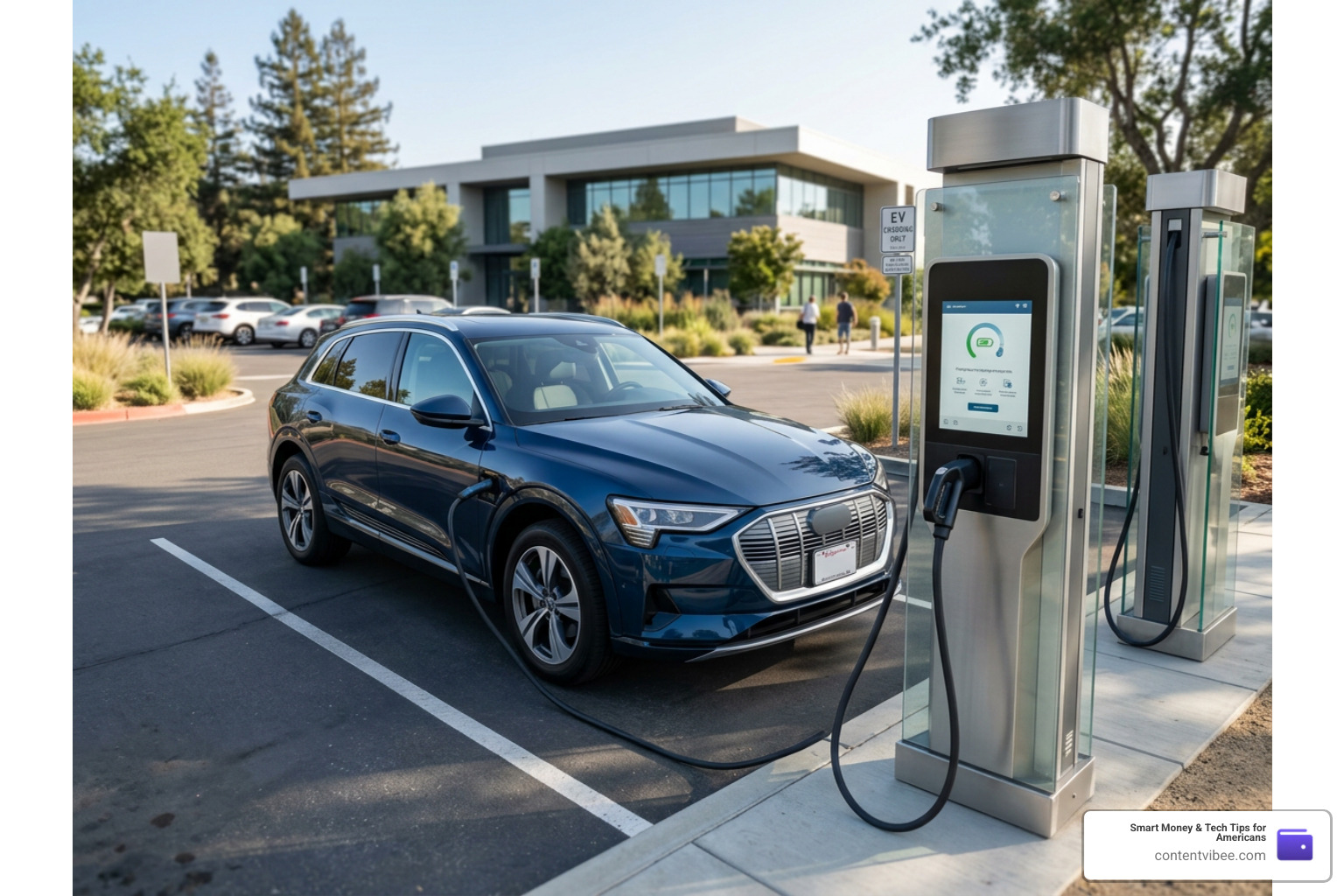
Stepping up to a 50000 car loan transitions you into the territory of luxury vehicles, large family SUVs, and highly capable electric vehicles (EVs). However, borrowing this amount requires strict financial scrutiny.
Lenders do not hand out $50,000 lightly. To secure a loan of this size, you will need a strong credit profile, a low debt-to-income (DTI) ratio (typically below 36% to 45% including your housing costs), and a stable employment history. Your credit score will directly dictate your APR, which has a massive compounding effect on a loan of this size. Let’s look at the exact math.
Calculating the Monthly Payment for a $50,000 Car Loan
When evaluating a 50000 car loan, you must look at how different APR variations and loan terms alter your monthly obligation and the total interest cost over time.
Let’s look at a few realistic financing scenarios. If you finance the full $50,000 with zero down:
- A 5% APR over a 60-month term results in a monthly payment of $943.56 and a total interest cost of $6,613.60.
- A 9% APR over a 72-month term drops your monthly payment to $901.00, but your total interest cost skyrockets to $14,892.00!
Now, let’s see what happens when you introduce a down payment or trade-in. If you use an average tax refund of approximately $3,000 plus some savings to put $5,000 down, your financed amount drops to $45,000:
- A $45,000 loan at 5% APR for 60 months results in a highly manageable $849 monthly payment and reduces your total interest to $5,952.
- Similarly, if you finance $45,000 at 6% APR over 72 months, your payment is approximately $828 monthly.
To run your own numbers and see how a trade-in or down payment affects your monthly payment, try using the $50,000 Car Loan Payment Calculator or check out the Auto Loan Calculator: Estimate Your Car Payment – NerdWallet for detailed scenario planning.
How Amortization Affects Your $50,000 Car Loan Over Time
Auto loans utilize a simple interest amortization schedule. This means interest is calculated monthly based on your remaining principal balance. Because your balance is highest at the beginning of the loan, your early payments are heavily “front-loaded” with interest.
For example, on a $50,000 loan at 5% APR for 60 months, your very first monthly payment of $943.56 consists of $208.33 in interest and $735.23 going toward your principal. By month 50, only about $45 of your monthly payment goes to interest, with the remaining $898 directly slashing your principal balance.
This front-loaded interest structure, combined with rapid off-the-lot depreciation, puts many buyers at risk of negative equity (being “underwater” on the loan, meaning you owe more than the car is worth). If you buy a new $50,000 car with $0 down, it may immediately depreciate by 10% ($5,000) the moment you drive away, while your loan balance remains at $50,000. If you need to sell or trade in the vehicle in the first two years, you will have to pay the lender out of pocket to cover the difference.
The 20/4/10 Rule and the Reality of Car Affordability

To protect yourself from becoming “car poor,” we highly recommend using the 20/4/10 rule as your financial north star. This classic personal finance guideline states:
- 20% Down Payment: Put down at least 20% of the vehicle’s purchase price (or 10% for a used car) to combat immediate depreciation and avoid negative equity.
- 4-Year Loan Term: Limit your financing term to no more than 48 months (4 years) to minimize total interest paid.
- 10% of Take-Home Pay: Keep your total monthly vehicle expenses (loan payment, insurance, fuel, and maintenance) under 10% of your take-home pay.
Let’s see how this rule applies to different income levels, and why trying to buy a $50,000 car on a $50,000 salary is a recipe for severe financial stress.
Applying the 20/4/10 Rule to a $50,000 Salary
Making $50,000 a year puts you right at the median household income in the United States. It is a solid, respectable salary, but the math behind buying a $50,000 car on this income simply does not work.
Let’s look at the take-home pay reality:
- Gross Monthly Income: $4,167
- Estimated Monthly Take-Home Pay (after taxes, health insurance, and 401k contributions): $3,273
If you apply the 10% limit of the 20/4/10 rule to your take-home pay, your entire monthly car budget—including insurance, gas, and maintenance—should not exceed $327 per month.
If you were to buy a $50,000 car, even with a massive 20% down payment ($10,000), you would still need to finance $40,000. Over a standard 48-month term at a prime rate of 6.23%, your monthly payment alone would be $944. When you add full-coverage insurance (averaging $150/month), gas ($100/month), and maintenance, your monthly vehicle costs would easily exceed $1,200—eating up nearly 37% of your entire take-home pay!
To stretch your budget safely at a $50,000 salary, your target vehicle price should be between $15,000 and $18,000. You can easily achieve this by using an average tax refund of approximately $3,000 as a down payment and financing the remaining $12,000 to $15,000 over 48 months, resulting in a safe, comfortable monthly payment of around $280 to $340.
What Lenders Look For When Approving Large Auto Loans
If you do have the income to comfortably support a 50000 car loan (ideally an annual salary of $120,000+), lenders will evaluate several key factors during the preapproval process:
- Credit Score Tiers: Lenders offer the best rates to “superprime” (781-850) and “prime” (661-780) buyers. If your score falls into nonprime or subprime territory, you may face double-digit APRs or find it difficult to get approved for a $50,000 loan without a co-signer.
- Debt-to-Income (DTI) Ratio: Lenders want to see that your recurring monthly debts (housing, student loans, credit cards, plus the new car payment) do not exceed 36% to 45% of your gross monthly income.
- Down Payment Size: Putting skin in the game reduces the lender’s risk. A larger down payment lowers your loan-to-value (LTV) ratio, making approval much easier and often unlocking lower interest rates.
Cash vs. Financing: Pros, Cons, and Cost-Reduction Strategies
When buying a $50,000 vehicle, you will face a fundamental decision: should you pay cash or finance the purchase?
Paying cash provides incredible peace of mind. You completely avoid interest payments, bypass the hassle of monthly bills, and never have to worry about repossession. However, the opportunity cost can be high. If you pull $50,000 out of your investments to buy a car, you lose out on the compound growth those funds could have generated. Furthermore, draining your liquid cash can leave you vulnerable if you do not preserve a robust emergency fund.
Financing, on the other hand, keeps your liquidity intact. It allows you to keep your cash invested or parked in high-yield savings. However, with auto loan rates averaging 6% to 8% in 2026, financing can add thousands of dollars to the total cost of your vehicle.
Impact of Taxes, Fees, and Trade-Ins on Your Loan
Many buyers calculate their budget based on the vehicle’s sticker price, only to be shocked by the “out-the-door” price at the dealership. Taxes and fees can easily add 8% to 10% to your total cost, turning a $50,000 car into a $55,000 financial obligation.
- Sales Tax: This is typically the largest fee. However, state tax laws vary. Five states (Alaska, Delaware, Montana, New Hampshire, and Oregon) charge no vehicle sales tax.
- The Trade-In Tax Credit: In most states, trading in your old vehicle can significantly reduce your tax burden. For example, if you buy a $50,000 car and trade in your old vehicle for $15,000, you only pay sales tax on the difference ($35,000). At an 8% tax rate, this trade-in tax credit saves you $1,200 in sales tax!
- Dealership Fees: Expect to pay documentation fees (ranging from $100 to $500+ depending on state regulations), registration/title fees, and destination charges. Always demand a line-item justification for any “advertising” or “dealer prep” fees, as these are often negotiable.
Actionable Strategies to Reduce Your Total Loan Cost
If you decide to finance your next vehicle, you can use several smart strategies to minimize your total out-of-pocket costs:
- Shop Around for Rates: Do not rely solely on dealership financing. Check with local credit unions and banks. For example, credit unions like Navy Federal often offer highly competitive rates; you can check their current offerings using the Auto Loan Calculator | Navy Federal Credit Union .
- Utilize the Rate-Shopping Window: When you apply for auto loans, credit bureaus treat multiple inquiries as a single hard pull if they occur within a specific window (usually 14 days). This allows you to gather multiple preapproval offers without damaging your credit score.
- Get Preapproved First: Walk into the dealership with a preapproval letter in hand. This gives you massive leverage, as the dealer must beat your preapproved APR to win your financing business. You can use the general Auto Loan Calculator to compare the dealer’s offer against your preapproved terms.
- Make a Larger Down Payment: Aim to exceed the recommended 20% down payment. This instantly reduces your monthly payment, lowers your interest charges, and keeps you from ever falling into negative equity.
Frequently Asked Questions about Auto Loans
Can I buy a $50,000 car on a $50,000 salary?
Technically, a lender might approve you if you have excellent credit, but doing so is a massive financial risk. A 50000 car loan on a $50,000 salary completely violates the 20/4/10 rule. The monthly payment, full-coverage insurance, and fuel will devour roughly 35% to 40% of your take-home pay, leaving you highly vulnerable to financial stress and unable to save for retirement or emergencies.
What is the average interest rate for a car loan in 2026?
As of Q1 2026, the average APR for new car loans is 4.55% for superprime credit (781-850) and 6.23% for prime credit (661-780). For used cars, average rates are slightly higher, reaching 6.30% for superprime and 8.77% for prime borrowers. Subprime borrowers can expect rates ranging from 13% to over 20%.
How does a trade-in affect my sales tax?
In most U.S. states, trading in your vehicle acts as a tax credit. The dealer subtracts the trade-in value from the purchase price of the new car, and you only pay sales tax on the net purchase price. This taxable amount reduction can save you hundreds or even thousands of dollars in sales tax depending on your state’s tax rate.
Conclusion
Navigating auto financing requires careful planning, strict budgeting, and a clear understanding of how interest rates and loan terms impact your long-term wealth. Whether you are looking at a modest $15,000 used commuter, a comfortable $30,000 crossover, or taking on a 50000 car loan for a luxury EV, the key to smart money decisions is running the math beforehand.
At ContentVibee, we are dedicated to helping you optimize your financial strategy so you can build real, lasting wealth. Before making your next big automotive purchase, map out your budget, check your credit score, and use our Explore our Finance Calculator to ensure your monthly payments align perfectly with your financial goals. Happy shopping!


