


Why Medicare Attorney Legal Representation Costs Catch Most Seniors Off Guard
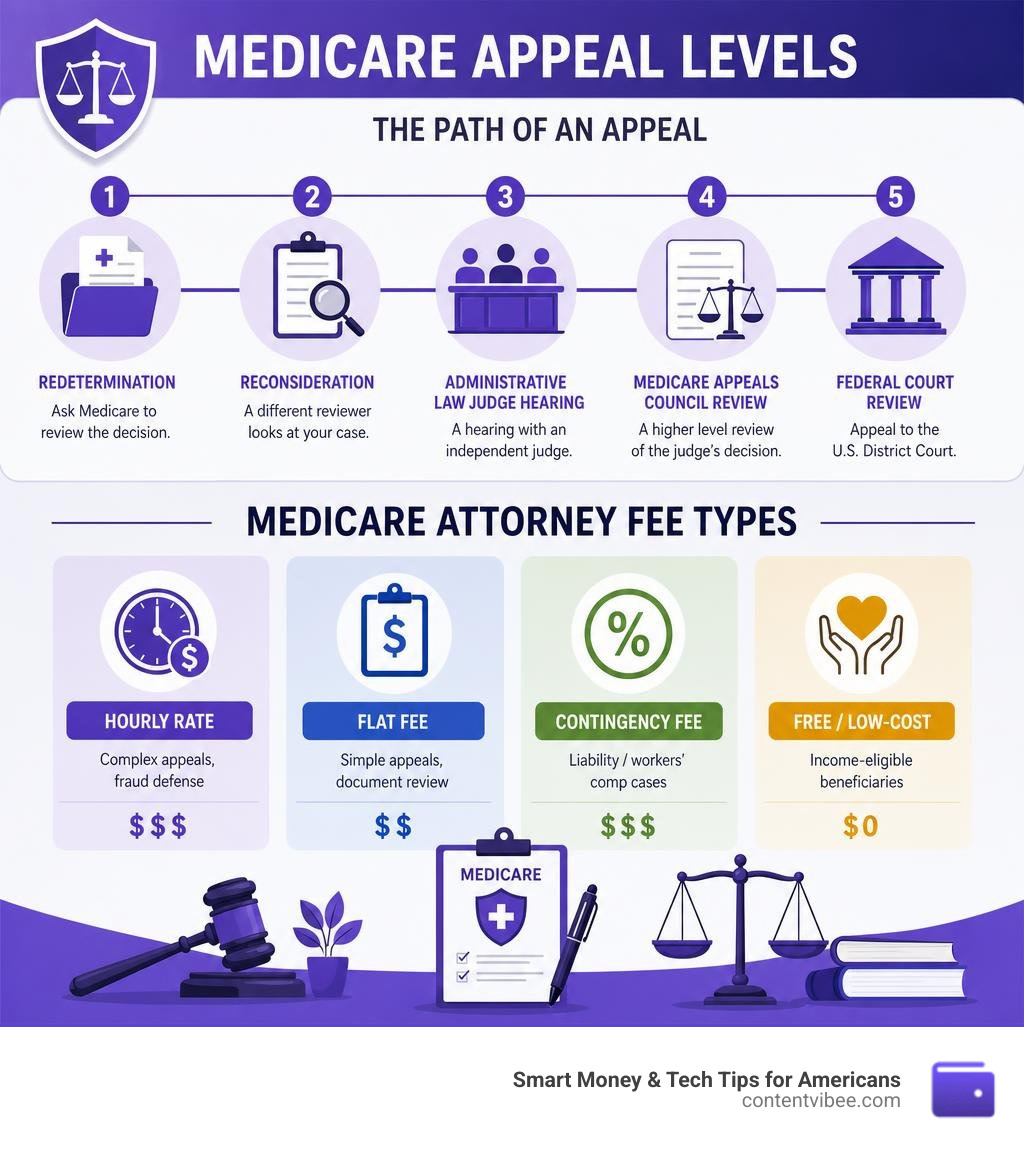
Medicare attorney legal representation costs vary widely depending on the type of case, the attorney’s experience, and how far your dispute goes in the appeals process. Here’s a quick breakdown before we dive deeper:
| Fee Type | Typical Use Case | Estimated Range |
|---|---|---|
| Hourly rate | Complex appeals, fraud defense | $150 – $500+/hour |
| Flat fee | Simple appeals, document review | $500 – $3,000+ |
| Contingency fee | Liability/workers’ comp cases | 25% – 33% of recovery |
| Free/low-cost | Income-eligible beneficiaries | $0 via legal aid or HICAP |
Medicare is one of the most complex programs in the U.S. — and the numbers back that up. Three out of four Medicare beneficiaries say the program is difficult to understand. At the same time, over one in three seniors have gone without basic necessities like food to cover healthcare costs.
When a claim gets denied or a bill looks wrong, the stakes are real. Hiring an attorney can protect your benefits — but only if you understand what it will cost you first.
This guide breaks down every major cost factor so you can make a smart, informed decision.
Medicare Attorney Legal Representation Costs: What to Expect
When navigating the maze of healthcare coverage, understanding the potential financial commitment of legal help is crucial. Many seniors and disabled beneficiaries worry that hiring an attorney will deplete their hard-earned retirement savings. However, knowing how these legal professionals structure their billing can help you plan your budget without any nasty surprises.

Medicare attorneys generally use three primary billing methods:
1. Hourly Rates
For highly complex appeals, compliance reviews, or disputes that require extensive research, many private attorneys bill by the hour. In July 2026, typical hourly rates for an experienced elder law or Medicare attorney range from $150 to $500+ per hour.
If your case requires a deep dive into medical records or representation at an Administrative Law Judge (ALJ) hearing, the hours can add up quickly. It is always wise to ask for an upfront estimate of the total hours your case might take.
2. Flat Fees
If you need help with a straightforward task—such as reviewing a coverage denial, setting up an advance directive, or drafting a power of attorney—many lawyers offer a flat fee. This structure provides peace of mind because you know the total cost upfront. Flat fees for Medicare appeal assistance typically range from $500 to $3,000, depending on the complexity of the denial.
Understanding these costs upfront is a key part of smart financial planning, especially if you are transitioning out of the workforce. For more tips on managing health coverage during major life transitions, check out our Retiring Early Here Is Your Health Care Coverage Guide.
3. Contingency Fees
In cases involving personal injury, workers’ compensation, or liability insurance where Medicare has a “recovery claim” (often referred to as a Medicare lien), attorneys usually work on a contingency fee basis. This means they only get paid if you win a settlement.
Their fee is typically a percentage—usually 25% to 33%—of the total recovery amount. In these situations, the attorney also coordinates with the Benefits Coordination & Recovery Center (BCRC) to handle Medicare secondary payer recovery issues, ensuring that Medicare is reimbursed properly from your settlement.
To learn more about the advantages of professional legal advocacy, you can read about Understanding the Benefits of Hiring a Medicare Attorney.
Key Factors That Influence Medicare Attorney Legal Representation Costs
Not all Medicare disputes are created equal, and several key factors will directly influence the overall Medicare attorney legal representation costs you might face:
- The Stage of the Appeal: The Medicare appeals process has five distinct levels. If your attorney can resolve the issue at Level 1 (Redetermination) or Level 2 (Reconsideration), your costs will be significantly lower than if the case must go to a Level 3 Administrative Law Judge (ALJ) hearing or beyond.
- Attorney Experience and Credentials: A lawyer who is a certified elder law specialist or has decades of experience navigating the Centers for Medicare & Medicaid Services (CMS) regulations will likely charge a higher hourly rate than a general practitioner. However, their specialized knowledge often means they resolve cases more efficiently.
- Geographic Location: Legal fees reflect local economic conditions. You can expect to pay higher hourly rates in major metropolitan areas like San Francisco, New York, or Los Angeles than in rural communities.
- The Type of Medicare Plan Involved: Disputes involving Original Medicare (Parts A and B) follow different regulatory pathways than those involving private Medicare Advantage (Part C) or Part D prescription drug plans. Navigating the specific rules of private insurers can sometimes add complexity—and hours—to your case. For a clearer picture of how these private options interact with your standard federal benefits, see our guide on Understanding Medicare Part B And Supplement Plans.
How to Minimize Your Medicare Attorney Legal Representation Costs
You do not have to write a blank check to get high-quality legal representation. With a proactive approach, you can keep your costs manageable:
- Demand Fee Transparency: Before signing any paperwork, ask the attorney for a detailed explanation of their billing practices. Ensure you receive a written retainer agreement that outlines the hourly rate, administrative fees (like copying or mailing costs), and how often you will be billed.
- Leverage CMS Fee Approval Rules: Under federal regulations (specifically 42 CFR 405.910(f)), any attorney wishing to charge a fee for representing a beneficiary in an ALJ hearing, an Office of Medicare Hearings and Appeals (OMHA) review, or a Medicare Appeals Council review must obtain formal fee approval from the government. This protects you from being overcharged.
- Keep Organized Records: The more time your lawyer spends sorting through unorganized boxes of medical bills and denial letters, the more money you will spend. Organize your documents chronologically, highlight key denial dates, and keep a log of every phone call you have had with Medicare or your insurance provider.
- Use Official Forms Early: If you choose to work with a representative, you will need to submit a completed Appointment of Representative Form to CMS. Having this form filled out and signed ahead of time can save billable legal hours.
For more technical details on how the federal government regulates legal services and recovery claims, you can refer directly to the official Attorney Services – CMS resource page.
Fee Structures and Government Regulations
Because Medicare is a federal program funded by taxpayers, the government closely monitors and regulates how representatives—including private attorneys—charge beneficiaries.
If your attorney represents you before the Office of Medicare Hearings and Appeals (OMHA) or the Medicare Appeals Council, they cannot simply send you an invoice and demand payment. Instead, they must submit a formal fee petition (such as Form OMHA-118) to the presiding judge or adjudicator.
The government then reviews the petition to determine if the requested fee is reasonable. When assessing the fee, federal adjudicators consider:
- The complexity of the issues involved in your appeal.
- The level of specialized skill required to resolve the dispute.
- The actual amount of time the attorney spent on your case.
- The results achieved for you (e.g., the amount of coverage reinstated).
This rigorous approval process applies specifically to Level 3 appeals and higher. It does not apply to the initial Redetermination or Reconsideration levels, nor does it apply if your attorney represents you in a federal district court proceeding.
To appoint your legal representative formally, you and your attorney must complete and file the standard CMS-1696 form. To ensure you are using the correct, up-to-date paperwork, you can access verified versions of the form through these official carrier portals:
- Appointment of Representative (Large Print)
- Appointment of Representative (Humana)
- Appointment of Representative (Sharp Medicare Advantage)
- Appointment of Representative (Horizon Blue)
Additionally, federal rules state that healthcare providers or suppliers who furnished the disputed medical items or services to you cannot charge any fee for representing you in an appeal. If a provider represents you, they must complete the waiver section on the Appointment of Representative form.
Cost Differences: Beneficiaries vs. Healthcare Providers
The legal landscape looks entirely different depending on whether you are a patient trying to get a medical bill covered or a healthcare provider defending your practice.
For beneficiaries, the financial risks are generally limited to the cost of their specific medical treatment or equipment. The legal fees are highly regulated, and many free advocacy programs exist.
For healthcare providers, however, the stakes are incredibly high. Providers face aggressive audits from government contractors, including Recovery Audit Contractors (RAC) and Unified Program Integrity Contractors (UPIC). These audits look for billing errors, lack of medical necessity, or outright fraud.
If a UPIC audit finds systemic billing issues, CMS can demand massive overpayment recoupments or even suspend the provider’s Medicare billing privileges entirely. Because of this high level of risk, healthcare providers hire specialized healthcare defense attorneys who charge premium hourly rates, often ranging from $400 to $800+ per hour. These legal teams focus on building robust compliance programs, challenging complex statistical extrapolation models, and defending against federal fraud investigations.
To understand how these legal services differ on the professional side, check out this comprehensive guide on What Does a Medicare Lawyer Do? Guide for Providers.
Free and Low-Cost Alternatives to Private Legal Representation
If you are facing a Medicare dispute but cannot afford a private attorney, you are not out of options. In fact, many beneficiaries resolve their issues successfully without ever spending a dime on private legal fees.

Health Insurance Counseling & Advocacy Program (HICAP)
For those living in California, HICAP provides free, unbiased counseling and advocacy services. Registered with the California Department of Aging, HICAP counselors can help you understand your benefits, compare supplemental plans, and write appeal letters.
If your appeal is complex and requires legal expertise, your local HICAP office can refer you directly to their in-house Medicare attorneys, who can represent you at administrative hearings for free. If you are shopping for coverage or trying to understand your local options in the Golden State, take a look at The Ultimate Guide To Shopping For Health Insurance In California.
Legal Aid Societies and the LSC
The Legal Services Corporation (LSC) funds independent legal aid societies across the United States. These non-profit organizations provide free legal help to low-income individuals, including seniors facing Medicare eligibility issues, balance billing disputes, or coverage terminations.
Area Agencies on Aging (AAA)
Your local Area Agency on Aging is a fantastic starting point. They can connect you with local pro bono (free) legal programs, senior legal hotlines, and state-specific elder law clinics designed to help older adults resolve healthcare disputes.
When to Hire a Private Lawyer vs. Seeking Free Help
While free programs are wonderful, they are often underfunded and have strict income eligibility requirements. Here is how to decide whether to use free resources or hire a private attorney:
- When to Use Free Alternatives: If you have a straightforward claim denial, need help comparing plans, or have a low income and qualify for legal aid. Free counseling is also ideal if you simply need help organizing your paperwork or writing an initial Level 1 appeal letter.
- When to Hire a Private Medicare Attorney: You should consider private representation if you are facing a high-value claim denial (e.g., a life-saving surgery costing tens of thousands of dollars), if you are accused of Medicare fraud, or if your case involves a complex web of personal injury settlements, workers’ compensation, and Medicare recovery claims.
A private attorney can dedicate unlimited hours to your case, hire independent medical experts to testify on your behalf, and provide highly personalized representation through every level of the federal court system. If you are also managing complex mental health needs and want to ensure your private insurance options are fully optimized before seeking legal help, you may find our analysis of the Best Health Insurance For Mental Health In California Our Top Picks highly useful.
Frequently Asked Questions about Medicare Legal Fees
Navigating Medicare regulations can feel overwhelming, but knowing your rights can save you time and money. Here are answers to some of the most common questions about Medicare legal fees.
Do I need a lawyer to file a Medicare appeal?
No, you do not need a lawyer to file an appeal. The Medicare appeals process is designed to be accessible to beneficiaries. Many seniors successfully navigate the first two levels of appeal (Redetermination and Reconsideration) on their own or with the help of a free HICAP counselor.
However, if your appeal reaches Level 3 (an Administrative Law Judge hearing), having an experienced attorney can significantly increase your chances of success, as they understand how to present legal arguments and cross-examine medical experts.
How does CMS regulate attorney fees?
CMS regulates attorney fees by requiring representatives to obtain formal administrative approval before charging a beneficiary for services rendered during ALJ hearings, OMHA reviews, or Medicare Appeals Council proceedings.
To charge a fee, your attorney must submit a formal fee petition (Form OMHA-118) detailing their hours and the complexity of the work. The presiding administrative judge must approve the fee as reasonable before any payment can be collected from you.
Can healthcare providers charge patients for representing them in appeals?
No. Under federal CMS regulations, healthcare providers or suppliers who furnished the disputed medical items or services to you are strictly prohibited from charging you a fee for representation.
If they choose to act as your representative in an appeal, they must officially waive their right to any fee by signing Section 3 of the Appointment of Representative form (CMS-1696).
Conclusion
Navigating Medicare can feel like learning a completely new language. When a claim is denied or a coverage dispute arises, it is easy to feel overwhelmed by the potential costs of seeking justice.
However, by understanding how Medicare attorney legal representation costs work—and knowing when to leverage free community resources—you can protect both your health and your retirement savings.
At ContentVibee, we are dedicated to helping Americans make smart money decisions and optimize their retirement strategies. Whether you are dealing with a complex medical appeal or planning your future healthcare needs, taking an active, informed role in your financial planning is the best way to secure peace of mind.
If you are currently dealing with a personal injury or a liability claim that involves Medicare recovery claims, finding the right legal team is essential. Explore our curated network of Accident and Injury Lawyers to find qualified, professional representation in your area today.


