


When Medicare Advantage Denies Your Care, You Have More Options Than You Think
Medicare Advantage attorney representation can be the difference between a denied claim and getting the care you’ve already paid for.
Here’s a quick answer if you need it fast:
When do you need a Medicare Advantage attorney?
- Your Medicare Advantage plan denied a prior authorization or claim
- You’ve already filed an appeal and lost at Level 1 or Level 2
- You’re facing an overpayment demand or audit as a provider
- You suspect your plan is engaging in improper billing or coding practices
- You need someone to represent you at an Administrative Law Judge (ALJ) hearing or federal court
Medicare Advantage (Part C) now covers roughly half of all Medicare recipients. In 2024 alone, plans processed more than 50 million prior authorization requests — and denied about 7.7% of them. That’s nearly 4 million denials in a single year.
The frustrating part? When people actually appeal those denials, more than 80% are partially or fully overturned. That means millions of people are accepting “no” when the answer should have been “yes” all along.
For retirees already managing tight budgets, a wrongful denial isn’t just an inconvenience — it can mean delayed surgery, unpaid bills, or care that simply doesn’t happen.
The appeals process has five levels, strict deadlines, and legal nuances that are easy to get wrong. That’s exactly why having the right legal help matters.
Understanding Medicare Advantage (Part C) vs. Original Medicare
To understand why denials happen, we first need to look at how Medicare Advantage differs from traditional government-run Medicare.
Original Medicare (Parts A and B) is a fee-for-service program administered directly by the federal government. If a service is medically necessary and covered under Medicare guidelines, you can see almost any doctor in the country who accepts Medicare, and the claim is typically paid without prior approval.
Medicare Advantage (Part C), on the other hand, is a managed care program. The federal government pays private insurance companies a set fee per enrollee to manage their care. These private insurers bundle Part A (hospital), Part B (medical), and usually Part D (prescription drugs) into one package.
As of July 2026, more than 34 million beneficiaries have enrolled in Medicare Advantage plans. While these plans often feature attractive perks like low premiums, dental coverage, or gym memberships, they also introduce a layer of private corporate bureaucracy. Because these insurers operate on profit margins, they use cost-containment strategies—like restricted provider networks and strict prior authorization requirements—that you won’t find in Original Medicare.
If you are planning your retirement early, navigating health insurance can be incredibly tricky. You can check out our guide to early retirement health coverage to see how Medicare fits into your long-term plans, or dive deeper into traditional options with our analysis of understanding Medicare Part B and supplement plans.
| Feature | Original Medicare (Parts A & B) | Medicare Advantage (Part C) |
|---|---|---|
| Administrator | Federal Government | Private Insurance Companies |
| Provider Network | Any doctor/hospital accepting Medicare | Restricted HMO or PPO networks |
| Prior Authorization | Rarely required | Frequently required for specialized care |
| Out-of-Pocket Limit | No annual limit (unless you have Medigap) | Has a mandatory annual out-of-pocket cap |
| Extra Benefits | None (requires separate dental/vision/drug plans) | Often includes dental, vision, and wellness perks |
Why Medicare Advantage Plans Deny Claims and Prior Authorizations
Private insurers use prior authorization as a gatekeeping mechanism. They argue it prevents unnecessary medical procedures, but for patients, it often feels like a barrier to essential treatment.
The data shows how widespread this issue has become. In 2024, Medicare Advantage providers made rulings on more than 50 million prior authorization requests, denying 7.7% of them. When these denials hit, they usually fall into one of several categories:
- Lack of Medical Necessity: The insurer’s internal medical reviewers (or automated algorithms) decide that a treatment, hospital stay, or therapy session is not “medically necessary” for your condition, even if your personal doctor insists it is.
- Out-of-Network Penalties: If you receive care from a provider outside the plan’s strict network, the insurer may refuse to pay the claim entirely.
- Administrative and Coding Errors: Simple clerical mistakes, missing medical records, or incorrect billing codes submitted by a provider’s office can trigger an automatic denial.
- Uncovered Services: The plan may claim that a specific treatment or drug is not part of their covered formulary or benefit package.

These denials can be devastating, but they are not the final word. If you are shopping for coverage and want to understand how private plans operate, our guide to California health insurance offers valuable insights into navigating managed care networks.
Navigating the Five Levels of Medicare Advantage Appeals
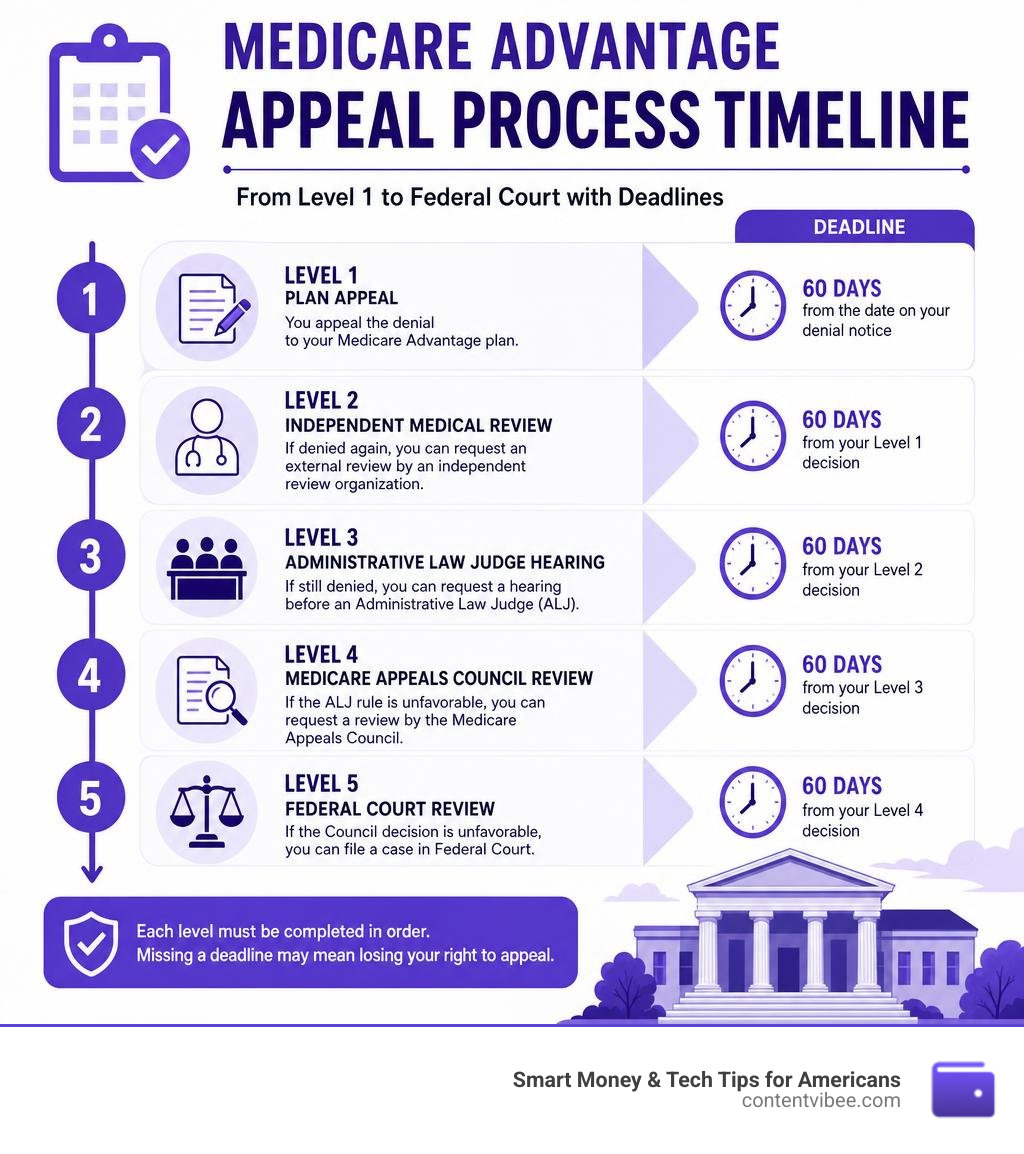
If your plan issues a denial, you have the right to fight back. However, the clock starts ticking immediately. The Medicare Advantage appeals process consists of five distinct levels, each with its own strict rules and deadlines.
Level 1: Health Plan Reconsideration
You must file a request for reconsideration with your Medicare Advantage plan within 60 days of receiving the initial denial notice (though plans often allow up to 65 days to account for mailing times). You must submit a written request along with supporting medical evidence. If your health is in immediate danger, you can request an expedited appeal, which requires the plan to make a decision within 72 hours. Otherwise, standard decisions take up to 30 days.
Level 2: Independent Review Entity (IRE)
If your plan upholds its denial at Level 1, your case is automatically forwarded to an Independent Review Entity (IRE). The IRE is an outside, independent contractor hired by the government to review the plan’s decision. You do not need to file a new request, but you can submit additional evidence to the IRE while they review your file.
Level 3: Office of Medicare Hearings and Appeals (OMHA)
If the IRE also rules against you, you can request a hearing before an Administrative Law Judge (ALJ) within 60 days of the IRE’s decision. This is a critical stage. It is the first time you get to present your case to an independent judge who is not associated with the insurance plan. Hearings are typically held via video or phone.
Level 4: Medicare Appeals Council
If the ALJ denies your claim, you have 60 days to request a review by the Medicare Appeals Council. The Council reviews the ALJ’s decision to determine if legal or procedural errors were made.
Level 5: Federal District Court
If your claim is still denied and meets a minimum dollar threshold, you have 60 days to file a civil lawsuit in U.S. District Court. This is the final level of appeal.
At the higher levels—especially during ALJ hearings and federal court reviews—the process becomes highly technical. Navigating these stages successfully requires a deep understanding of federal regulations. For a comprehensive overview of how these legal defenses are structured, refer to the CMS Appeals Process Guide.
The Critical Role of Medicare Advantage Attorney Representation
While you can technically handle an appeal on your own, having professional Medicare Advantage attorney representation dramatically increases your chances of success.
When enrollees filed appeals of Medicare Advantage prior authorization denials, the decisions were partially or fully overturned more than 80% of the time. An experienced attorney knows how to build a case that forces the insurance company to back down.
Here is how a skilled attorney can help:
- Evidence Gathering: Attorneys know exactly what evidence is missing. They will work directly with your doctors to obtain comprehensive medical records, clinical notes, and detailed letters of medical necessity that address the insurer’s specific objections.
- Challenging Algorithms: Many private insurers now use automated AI software to deny claims en masse. An attorney can expose when a plan relied on a computer algorithm rather than an individualized medical review.
- Navigating ALJ Hearings: During Level 3 appeals, an attorney will prepare you for the ALJ hearing, cross-examine medical experts, and present oral arguments based on federal Medicare regulations.
- Litigating in Federal Court: If your case reaches Level 5, you must file a lawsuit in federal court. Only a licensed attorney can represent you at this level.
Organizations like the Center for Medicare Advocacy work tirelessly to protect beneficiary rights and challenge systemic issues within the managed care system, proving how vital legal advocacy is for everyday Americans.

Appointing a Representative for Your Appeal
You don’t have to navigate this stressful process alone. You can formally appoint an attorney, a family member, or a State Health Insurance Assistance Program (SHIP) counselor to act on your behalf.
To do this, you must complete the official CMS-1696 form. This form is valid for one year from the date it is signed by both you and your representative. Once submitted, your representative can file appeals, view your medical records, and speak to the insurance plan on your behalf. You can download the official document directly via the CMS Appointment of Representative Form.
How Providers Benefit from Medicare Advantage Attorney Representation
It isn’t just patients who struggle with Medicare Advantage plans. Healthcare providers frequently find themselves locked in battles with private insurers over billing disputes, audits, and overpayment recoupment demands.
Private insurance plans routinely audit providers to claw back reimbursements, claiming that services were improperly documented or billed. A specialized healthcare attorney can help providers challenge flawed audit methodologies, dispute extrapolation techniques used to inflate overpayment demands, and represent practices during administrative appeals. Providers looking to protect their revenue and practice integrity can learn more by reading a Provider Medicare Lawyer Guide.
Risk Adjustment, Fraud Investigations, and the False Claims Act
Medicare Advantage plans are paid by the federal government using a system called “risk adjustment.” Under this model, plans receive higher monthly payments for enrollees who are diagnosed with more severe, chronic health conditions.
Unfortunately, this system has created financial incentives for some insurers to engage in improper practices. According to the Inspector General, the majority of the top ten Medicare Advantage providers overbilled the Centers for Medicare & Medicaid Services (CMS), resulting in billions of dollars in fraudulently obtained reimbursements. In fact, it is estimated that Medicare Advantage plan fraud leads to over $12 billion in overpayments annually.
Common fraud schemes include:
- Upcoding: Submitting diagnosis codes for severe illnesses that the patient does not actually have or was never treated for.
- Chart Mining: Reviewing old medical charts to find past diagnoses that are no longer active, solely to submit them to CMS for higher payments.
- In-Home Assessment Abuse: Sending nurses to conduct brief in-home visits to log chronic diagnoses without ever providing actual treatment or follow-up care.
When private citizens or healthcare employees notice these patterns, they can blow the whistle under the False Claims Act. Whistleblowers who expose Medicare Advantage fraud are legally protected against employer retaliation and are entitled to receive between 15% and 25% of the recovered funds as a reward.
If you suspect systemic overbilling, consulting a specialist in Medicare Advantage Fraud Representation is the first step toward exposing the abuse. For insurance plans and large provider groups navigating these complex audits, obtaining specialized counsel from Medicare Advantage Industry Legal Services is essential for maintaining compliance and managing self-disclosure protocols.
Compliance Audits, Star Ratings, and Medicare Advantage Attorney Representation
CMS actively monitors Medicare Advantage plans through compliance audits, secret shopper programs, and Star Quality Ratings. A plan’s Star Rating (from 1 to 5 stars) directly impacts its bottom line, as high-performing plans receive significant financial bonuses and are allowed to market their plans year-round.
When plans face CMS enforcement actions, marketing sanctions, or low Star Ratings due to compliance failures, they turn to specialized attorneys to design corrective action plans, review downstream provider contracts, and appeal negative CMS determinations.
Frequently Asked Questions About Medicare Advantage Appeals
What are the most common reasons for Medicare Advantage denials?
Medicare Advantage plans most frequently deny claims due to a purported lack of medical necessity, using out-of-network providers without prior authorization, administrative errors (like incorrect billing codes), and services or prescriptions not being covered under the plan’s specific formulary.
How long do I have to file a Medicare Advantage appeal?
You have 60 days (often extended to 65 days to account for mailing) from the date of your initial denial letter to file a Level 1 appeal. If your medical situation is urgent, you can request an expedited 72-hour appeal. Subsequent stages, such as appealing to the ALJ or federal court, also carry strict 60-day deadlines.
Can I appeal a denial for mental health services under Medicare Advantage?
Yes. Mental health services are subject to federal mental health parity laws, meaning insurers cannot place more restrictive limitations on mental health care than they do on physical medical care. If your plan denies coverage for therapy, psychiatric care, or residential mental health treatment, you can appeal. For help selecting a plan that prioritizes these benefits, read our guide on the best health insurance for mental health in California.
Conclusion
Navigating the complex, bureaucratic world of Medicare Advantage can feel like an uphill battle, especially when you are dealing with health concerns. But you don’t have to go through it alone. Whether you are a beneficiary fighting for life-saving treatment or a healthcare provider defending your practice against an unfair audit, securing professional legal representation is the smartest move you can make.
At ContentVibee, we are dedicated to helping Americans make smart personal finance, retirement planning, and healthcare decisions. Protecting your health and your savings goes hand-in-hand. If you are facing legal hurdles or need professional help securing your rights, check out our resources on how to secure your rights with accident and injury lawyers.