


Why an Automated QCD Contribution Strategy Can Save You Thousands in Taxes
An automated QCD contribution strategy is one of the smartest tax moves available to retirees aged 70½ and older — and most people are leaving serious money on the table by not using it.
Here’s the quick answer if you need it fast:
How to automate your QCD contributions (at a glance):
- Confirm eligibility — You must be at least 70½ with funds in a Traditional, Rollover, Inherited, inactive SEP, or inactive SIMPLE IRA.
- Choose a qualified charity — Must be a 501(c)(3) public charity (not a donor-advised fund or private foundation).
- Contact your IRA custodian — Request a direct transfer (check payable to the charity, not to you).
- Set up recurring or standing instructions — Ask your custodian to automate the transfer annually or on a schedule.
- Stay within limits — The 2026 limit is $111,000 per individual ($222,000 for married couples).
- Meet the deadline — All QCDs must be completed by December 31 of the tax year.
If you’re already taking Required Minimum Distributions (RMDs) from your IRA, you know the problem: that money gets added to your taxable income whether you need it or not. It can push you into a higher tax bracket, trigger Medicare premium surcharges, or reduce deductions you were counting on.
A Qualified Charitable Distribution — or QCD — solves this by sending money directly from your IRA to a charity. That amount never touches your income. It simply disappears from your taxable picture.
But most retirees do this manually, once a year, and often at the last minute. That leads to missed deadlines, wrong charity types, and lost tax savings.
Automating your QCD strategy changes that. It turns a once-a-year scramble into a reliable, year-round system that protects your income, supports causes you care about, and keeps your tax bill as low as possible.
This guide walks you through exactly how to do it.
Understanding the Basics of Qualified Charitable Distributions (QCDs)

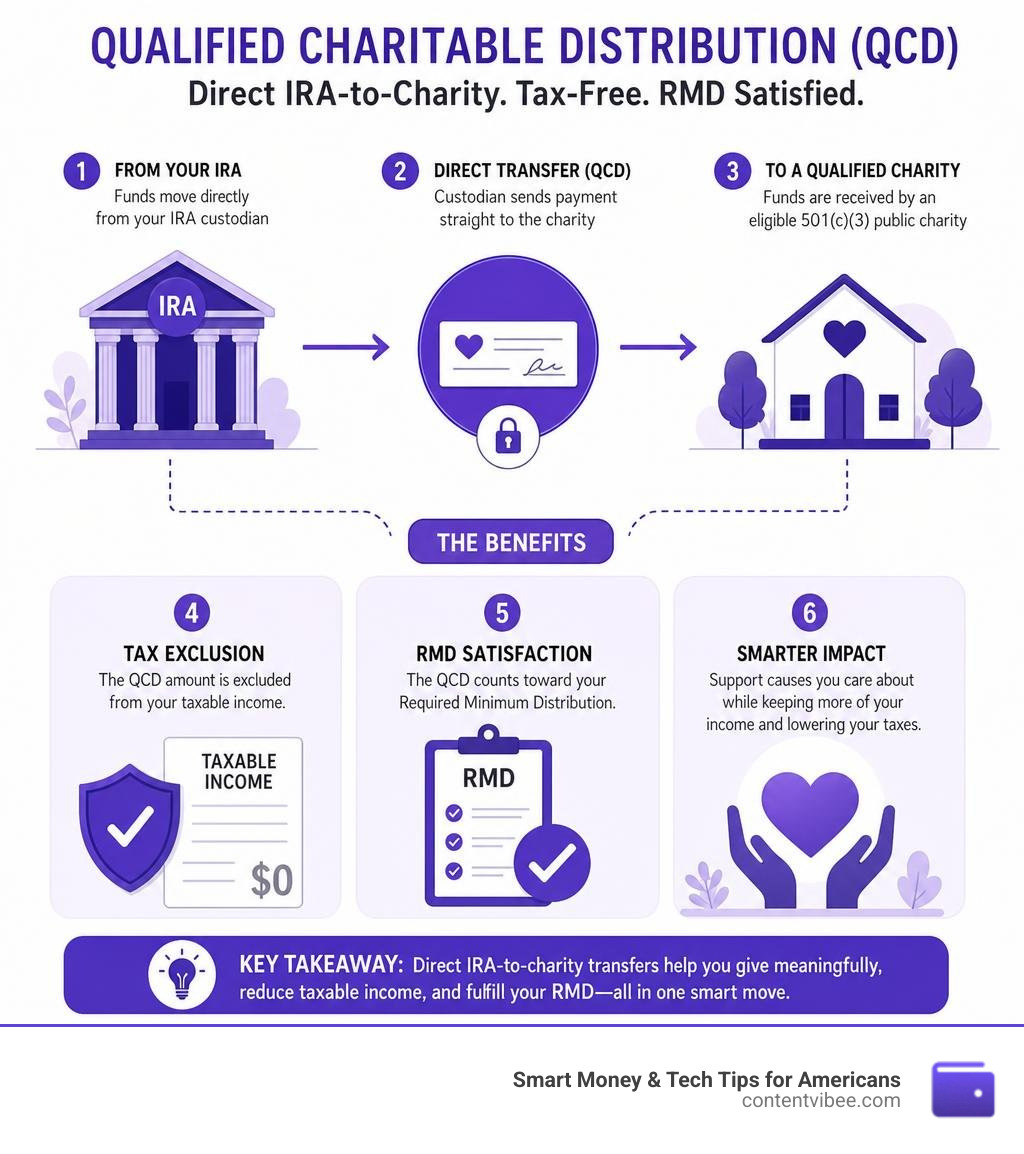
Before we build a fully automated QCD contribution strategy, we need to understand the gears under the hood. A Qualified Charitable Distribution is a direct transfer from your IRA custodian to an eligible 501(c)(3) public charity.
The magic word here is direct. If your custodian writes a check to you, and you then write a check to the charity, you have made a classic, fully taxable distribution followed by a standard donation. To reap the unique tax-free benefits of a QCD, the money must go straight from the IRA to the charity.
Why does this matter? When you make a direct transfer, the distributed amount is completely excluded from your adjusted gross income (AGI). You can learn more about how to set up these transfers directly through major custodians by reviewing the Qualified Charitable Distributions (QCDs) | planning your IRA … resource.
Eligibility Rules and Eligible Account Types
To participate in this tax-saving strategy, you must meet specific age and account requirements:
- The Age Rule: You must be at least 70½ years old on the exact day of the distribution. It is not enough to turn 70½ later in the calendar year; you must have celebrated that half-birthday milestone before the custodian processes the transfer.
- Eligible Accounts: QCDs can be made from Traditional IRAs, Rollover IRAs, and Inherited IRAs.
- Special Business IRAs: You can also use Simplified Employee Pension (SEP) IRAs and Savings Incentive Match Plan for Employees (SIMPLE) IRAs, but only if they are “inactive.” This means no employer contributions have been made to the account for the plan year ending in the tax year of the distribution.
- Roth IRAs: While technically allowed, using a Roth IRA for a QCD is generally not recommended since Roth distributions are already tax-free. Save your Roth assets for tax-free growth and use your pre-tax IRA balances instead.
For retirees looking to optimize their nest egg, coordinating these accounts is key. If you want to dive deeper into maximizing your retirement accounts, check out our guide on After Tax Contributions How to Maximize Your Retirement Nest Egg.
2026 QCD Limits, Deadlines, and Split-Interest Rules
The rules around QCDs are strict, but the limits are generous and adjust for inflation. As we navigate 2026, here are the key numbers you must keep in mind:
- The 2026 Limit: The annual QCD limit for 2026 is $111,000 per individual.
- Married Couples: If you are married and file jointly, you can each contribute up to $111,000 from your respective IRAs for a combined total of $222,000. However, you cannot split this unevenly (e.g., $150,000 from one spouse’s account and $72,000 from the other is not allowed).
- The Hard Deadline: The transfer must be completed and cleared by December 31 of the tax year. There are no extensions.
- The Split-Interest Election: Under the SECURE 2.0 Act, donors can make a one-time lifetime election of up to $55,000 (adjusted for 2026) to fund a split-interest entity. This includes a Charitable Remainder Unitrust (CRUT), a Charitable Remainder Annuity Trust (CRAT), or a Charitable Gift Annuity (CGA). This is a fantastic way to support a charity while securing a lifetime income stream for yourself.
How QCDs Satisfy RMDs and Lower Taxable Income

One of the greatest financial benefits of a QCD is its ability to satisfy your Required Minimum Distributions (RMDs). Under current tax law, RMDs begin at age 73. When you reach this age, the IRS mandates that you withdraw a specific percentage of your tax-deferred retirement accounts each year.
Normally, these withdrawals are taxed as ordinary income. But when you use a QCD, the amount transferred to charity counts directly toward satisfying your RMD for the year. For example, if your 2026 RMD is $50,000 and you execute a $50,000 QCD, your RMD obligation is fully met, and your taxable income from that distribution is exactly $0.
By keeping this money out of your Adjusted Gross Income (AGI), you enjoy several compounding tax benefits:
- Avoiding Higher Tax Brackets: Large RMDs can easily push you into a higher federal income tax bracket.
- Preventing Medicare IRMAA Surcharges: Medicare Part B and Part D premiums are tied to your AGI. A spike in income can trigger the Income-Related Monthly Adjustment Amount (IRMAA), substantially raising your monthly healthcare costs.
- Preserving Taxability of Social Security: Lowering your AGI helps minimize the percentage of your Social Security benefits subject to federal income tax.
To understand how these rules are shifting this year, take a look at the insights on Reducing RMDs With QCDs in 2026 – Charles Schwab .
Tax Reporting and Avoiding Common Pitfalls
Reporting a QCD on your federal tax return requires careful attention because IRA custodians do not flag these transactions as tax-free on your Form 1099-R.
When you receive your 1099-R at the end of the year, Box 1 will show the total distribution amount, and Box 2a will likely show that same amount as taxable. It is up to you (or your tax preparer) to report it correctly on your Form 1040.
On Line 4a, you enter the total distribution. On Line 4b, you enter the taxable amount (which will be $0 if the entire distribution was a QCD). Right next to Line 4b, you must write “QCD” to explain the difference to the IRS.
A major pitfall to avoid is the “post-70½ deductible contribution” rule. If you continue to make tax-deductible contributions to a Traditional IRA after reaching age 70½, those contributions will reduce the tax-free portion of any future QCDs you make.
Additionally, because a QCD is excluded from your income, you cannot double-dip by also claiming it as an itemized charitable deduction. However, because you do not need to itemize to benefit from a QCD, this strategy remains highly advantageous for retirees who claim the standard deduction. For broader context on managing retirement tax brackets, see our discussion on Pension vs 401k Tax Strategies for Working Retirees.
Designing an Automated QCD Contribution Strategy
Now let’s talk about the core of this guide: building a reliable, automated QCD contribution strategy.
In modern quantitative finance, systems are automated to remove human error and optimize timing. Platforms like rock-mind/autoquant or Astralchemist/Trading-System-CI use automated code to systematically manage portfolios. In the same way, you can build a systematic “algorithm” for your personal charitable giving to ensure your tax savings occur seamlessly.
Automating your QCDs prevents the “December panic” where you scramble to contact your custodian, verify the charity’s address, and hope the check clears before the ball drops on New Year’s Eve. For alternative ways to simplify and optimize your retirement accounts, check out Alternative Ways to Save for Retirement That Actually Work.
Step-by-Step Guide to Setting Up an Automated QCD Contribution Strategy
Setting up an automated or recurring QCD strategy requires establishing standing instructions with your IRA custodian. Here is the step-by-step process to put your giving on autopilot:
- Establish Standing Instructions: Contact your custodian and ask to set up a “standing instruction for recurring third-party distributions.” This authorizes your custodian to send checks directly to your chosen charities on a scheduled basis without requiring a brand-new, multi-page form every single time.
- Schedule the Transfers Early: Set your automated QCDs to execute in the first half of the year (e.g., every April or June). This ensures that the distributions satisfy your RMD before any other regular, taxable distributions occur.
- Request Direct Clearing: Many custodians now offer a checkbook feature for IRAs, allowing you to write checks directly to charities. If you write the checks yourself, make sure they are written directly to the qualified 501(c)(3) organization.
- Confirm the Delivery Pipeline: If your custodian mails the check directly to the charity, ensure they include your name and address on the check memo line so the charity can send you a timely written acknowledgment for your tax records.
Coordinating Your Automated QCD Contribution Strategy with Other Assets
Your automated QCDs should not exist in a vacuum; they must be integrated with your overall portfolio management.
- Manage Cash Drag: To fund your scheduled QCDs, you need liquid cash in your IRA. Work with your advisor to set up automated dividend harvesting. Instead of automatically reinvesting all dividends, let them accumulate in a money market fund inside the IRA to cover the upcoming QCD transfers.
- Coordinate with Rebalancing: If you need to sell assets to generate cash for your QCDs, coordinate these sales with your annual portfolio rebalancing. Sell overvalued equities or reallocate assets systematically.
- Leverage Automated Tools: Just as quant developers use tools like qts_orchestrator.py to manage trading schedules, you can use financial planning software to coordinate your cash flows. For more on managing cash-flowing assets, explore Annuities Dividends and Rentals The Passive Income Trio.
Comparing QCDs to Other Charitable Giving Methods
How does a QCD stack up against other popular ways to give? Let’s look at the numbers.
| Feature | Qualified Charitable Distribution (QCD) | Cash Donation (Itemized) | Appreciated Securities |
|---|---|---|---|
| Tax Benefit | Direct exclusion from AGI | Itemized tax deduction | Avoid capital gains tax + deduction |
| AGI Limits | None (up to $111,000/yr) | Limited to 60% of AGI | Limited to 30% of AGI |
| Standard Deduction? | Yes, fully benefits | No, requires itemizing | No, requires itemizing |
| RMD Satisfaction? | Yes | No | No |
| Setup Automation | Easy to automate | Easy to automate | Harder to automate |
As this comparison shows, the QCD is uniquely powerful because it bypasses the AGI limitations that restrict other forms of giving. Major charitable networks, such as those detailed on Qualified Charitable Distribution – Fidelity Charitable , highlight how crucial these distinctions are for high-net-worth donors looking to maximize their impact.
Why DAFs and Private Foundations Do Not Qualify for QCDs
While Donor-Advised Funds (DAFs) and private foundations are incredibly popular tools for long-term philanthropic planning, they are not eligible to receive QCDs.
The tax code explicitly states that a QCD must go to a “public charity” as defined under Section 170(b)(1)(A). Because DAFs, private foundations, and supporting organizations are designed to hold and invest money over time rather than deploying it immediately to active charitable programs, they do not qualify.
If you attempt to send a QCD to a DAF, the transaction will be treated as a fully taxable distribution, and you will owe ordinary income taxes on the entire amount. Stick to local houses of worship, food banks, universities, and established public non-profits for your automated QCD schedule.
Integrating QCDs into Your Broader Retirement Plan
An automated QCD contribution strategy is a cornerstone of smart, multi-decade retirement planning. By systematically lowering your IRA balance over time, you reduce the size of your future RMDs. This is a critical benefit for retirees who want to preserve their wealth for heirs or manage their tax brackets in later years.
For example, if you plan to execute a series of Roth IRA conversions, doing so in years when your AGI has been lowered by automated QCDs can save you thousands of dollars in conversion taxes.
To model how these distributions affect your long-term retirement sustainability, you can use our interactive The 4 Percent Retirement Withdrawal Calculator to project your cash flows and tax liabilities.
Just as advanced quantitative strategies use systems like TheOneAC/QuantGPT or vickdavinci/alpha-nextgen-v2-private to model complex market scenarios, you should model your retirement distributions systematically. For those interested in the logic of automated strategy development, you can even look at Strategy Development – QuantConnect.com to see how professionals approach algorithmic design.
Frequently Asked Questions about QCDs
Can I make a QCD from my Roth IRA?
Yes, technically you can. However, it is almost never a smart financial move. Because Roth IRA distributions are already tax-free and Roth IRAs are not subject to lifetime RMDs, using these tax-advantaged assets for charitable giving wastes their primary benefit. Keep your Roth accounts growing tax-free, and use your pre-tax Traditional IRAs for your QCDs.
What happens if my QCD exceeds my annual RMD?
If your automated QCD is larger than your RMD for the year, that is perfectly fine. The entire amount (up to the $111,000 limit) will still be excluded from your taxable income. However, you cannot “carry forward” the excess to satisfy future years’ RMDs. Each year’s RMD must be satisfied independently.
How do I report a QCD on my federal tax return?
You report the total distribution on Line 4a of your Form 1040. On Line 4b, enter the taxable amount (which should be $0 if the entire amount was a QCD). Write “QCD” next to Line 4b. Make sure to keep the written acknowledgment from the charity for your records.
Conclusion
Implementing an automated QCD contribution strategy is one of the most effective ways to align your philanthropic heart with your financial mind. It keeps your taxes low, fulfills your RMD obligations seamlessly, and ensures that the causes you support receive steady, reliable funding.
At ContentVibee, we are dedicated to helping Americans make smart money decisions and optimize their retirement strategies through clear, actionable insights. If you are looking for more ways to automate your financial life and leverage modern technology, check out our comprehensive guide on What is a Robo-Advisor? to see how automated investing can work for you.


