


Rep Sheri Biggs Bitcoin Investment Legitimacy and Fraud Risk Analysis is a topic that cuts to the heart of congressional transparency, crypto market integrity, and the real risks retail investors face when following political money.
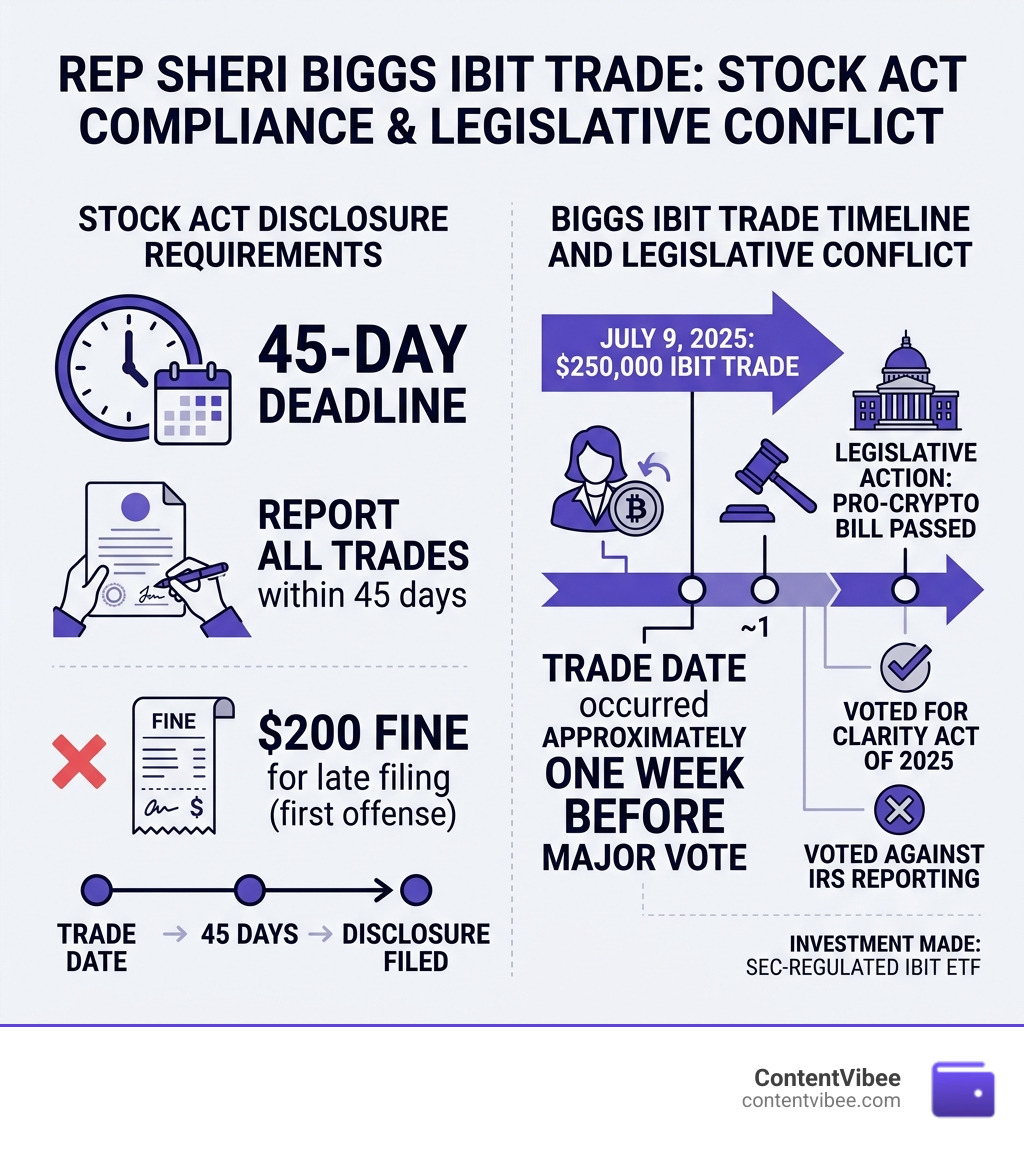
Here is a quick summary of what the evidence shows:
| Key Factor | Finding |
|---|---|
| Investment made | Up to $250,000 in iShares Bitcoin Trust (IBIT) ETF |
| Trade date | July 9, 2025 |
| Disclosure timing | Filed months late — a STOCK Act violation |
| Legislative conflict | Trade occurred ~1 week before pro-crypto bill passed |
| Fine for violation | $200 (first offense) |
| Investment vehicle | SEC-regulated ETF (BlackRock IBIT) — not a scam product |
| Fraud risk to retail investors | Moderate — delayed disclosure data, volatility, and insider timing concerns |
The investment itself — BlackRock’s IBIT — is a legitimate, regulated product. But the timing and late disclosure raise serious conflict-of-interest questions that every self-directed investor should understand before using congressional trade data to guide their own portfolio decisions.
Rep. Biggs is a documented pro-crypto legislator, having voted for the CLARITY Act of 2025, the GENIUS Act of 2025, and against expanded IRS reporting requirements for digital asset sales. Her financial exposure to the very sector she helps regulate is what makes this story worth examining closely.
This guide breaks down the facts, the risks, and what you need to know to protect yourself.
Rep Sheri Biggs Bitcoin Investment Legitimacy and Fraud Risk Analysis
When we look at the Rep Sheri Biggs Bitcoin Investment Legitimacy and Fraud Risk Analysis, we aren’t just looking at a simple stock tip. We are analyzing how a sitting member of the U.S. House of Representatives interacts with a highly volatile asset class. In early 2026, disclosures revealed that Rep. Biggs made a significant move into the crypto space, specifically through the iShares Bitcoin Trust (IBIT).
According to reports from Phemex News, Biggs allocated between $100,001 and $250,000 into this Bitcoin ETF. For many retail investors, seeing a Congresswoman drop a quarter-million dollars into Bitcoin signals a “green light” for the asset’s legitimacy. However, “legitimacy” in the eyes of a regulator doesn’t always mean “safety” for your wallet.

Rep Sheri Biggs Bitcoin Investment Legitimacy and Fraud Risk Analysis: The STOCK Act Violation
The biggest red flag in our Rep Sheri Biggs Bitcoin Investment Legitimacy and Fraud Risk Analysis isn’t the Bitcoin itself—it’s the paperwork. The STOCK Act (Stop Trading on Congressional Knowledge Act) was designed to stop insider trading by requiring members of Congress to report their trades within 45 days.
Rep. Biggs failed this test. Her July 9, 2025, purchase of the iShares Bitcoin Trust was not disclosed until mid-April 2026, months past the legal deadline. This late trade disclosure fuels public distrust. When a legislator hides a trade for nearly a year, it prevents the public from seeing if that trade was influenced by upcoming laws. In this case, the trade happened just one week before major pro-crypto legislation hit the floor.
While a $200 fine for a first-time violation might seem like a slap on the wrist, the real “cost” is the transparency gap it creates for those of us trying to manage our own risks.
Rep Sheri Biggs Bitcoin Investment Legitimacy and Fraud Risk Analysis: Conflict of Interest Assessment
We also have to consider the “why” behind the timing. Rep. Biggs has been a vocal supporter of the crypto industry. She voted for the CLARITY Act of 2025, which helped define the CFTC’s jurisdiction over digital commodities, and the GENIUS Act of 2025, which focused on stablecoin regulation.
When a lawmaker buys up to $250,000 of an asset and then votes on bills that directly increase the value or stability of that asset, it creates a potential conflict of interest. We’ve seen similar patterns in other sectors, such as energy. For example, understanding Why EnergyX Investment Risk Analysis Long-Term is vital because legislative shifts can make or break an industry. In Biggs’ case, her personal financial gain is now tied to the success of the very industry she is legislating.
Evaluating the Legitimacy of Congressional Crypto Holdings
Is the investment itself a scam? No. Unlike some “pump-and-dump” altcoins you might find on unregulated exchanges, the iShares Bitcoin Trust (IBIT) is a spot Bitcoin ETF managed by BlackRock, the world’s largest asset manager. It is SEC-regulated and trades on major exchanges.
As Bitcoin Magazine points out, Biggs is currently one of the most aggressive Bitcoin adopters in Congress. This shift toward regulated ETFs suggests that Bitcoin is moving into a phase of “institutional adoption.” For investors, this is a double-edged sword: it adds legitimacy, but it also makes the market more susceptible to political and regulatory whims.

Legislative Influence on Digital Asset Markets
Rep. Biggs hasn’t just bought the dip; she’s actively shaping the market. Her voting record shows a strong “Very Pro-Crypto” stance. According to DoTheySupportIt, she supported H.J. Res 25, which opposed the IRS’s attempts to implement more aggressive gross proceeds reporting for digital assets.
By voting against stricter IRS reporting and for self-custody rights, Biggs is helping create a more favorable environment for crypto holders—herself included. For retail investors, this means the “legitimacy” of Bitcoin is being bolstered by the very people who stand to profit from it.
Comparing Biggs to Other Congressional Investors
Biggs isn’t alone in the “late disclosure” club. We’ve seen similar headlines with names like Nancy Pelosi and Sen. Markwayne Mullin. Often, these members claim that a spouse or a third-party portfolio manager executed the trade without their immediate knowledge.
In Biggs’ case, her spouse was listed as the trader for several transactions, including sales of Apple and Microsoft to fund the move into Bitcoin. While this provides some “legal cover,” it doesn’t change the fact that the household net worth is being moved based on information that may not yet be public. If you are looking to protect your own money, you can learn more about Protecting Your Investments from Fraud and Scams to ensure you aren’t just being used as “exit liquidity” for the powerful.
Fraud Risk Analysis: Protecting Retail Investors from Political Volatility
The biggest fraud risk in our Rep Sheri Biggs Bitcoin Investment Legitimacy and Fraud Risk Analysis isn’t that the Bitcoin will disappear; it’s the risk of “insider timing.” When a retail investor sees a disclosure from April 2026 about a trade made in July 2025, they are looking at “stale” data.
If you try to “copy-trade” a politician based on late disclosures, you are often buying at the top while they are already planning their exit. This creates a market manipulation risk where the public’s reaction to old news provides the liquidity for insiders to sell.
Identifying Unauthorized Transaction Risks in Crypto ETFs
Even with regulated products like IBIT, there are digital security risks. If you are holding crypto or crypto-related ETFs in a brokerage account, you are still a target for identity theft. Unauthorized bank transactions or account takeovers can lead to the liquidation of your holdings before you even notice the breach.
We always recommend robust Identity Theft Protection for Digital Financial Assets to ensure that your “legitimate” investments stay in your hands. In 2026, hackers are increasingly targeting brokerage accounts that hold high-value Bitcoin ETFs.
How to Dispute Fraudulent Trades and Recover Assets
If you find yourself a victim of a wire transfer fraud or an unauthorized transaction while trying to buy into the crypto market, you need to act fast. Recovering money from a fraudulent crypto-related trade is notoriously difficult because of the speed of the blockchain.
However, since Biggs’ investment was through a traditional ETF, there are more protections than with “raw” Bitcoin. If you encounter an unauthorized bank transaction how to dispute and recover money USA 2026, your first step is to freeze the account and file a formal dispute with your financial institution. You can find detailed Steps to Recover from Financial Fraud and Unauthorized Transactions on our site to help navigate the legal and banking hurdles.
Frequently Asked Questions about Rep. Sheri Biggs’ Bitcoin Trades
Did Rep. Sheri Biggs violate federal law with her Bitcoin investment?
Technically, yes. By failing to disclose the trade within the 45-day window required by the STOCK Act, she violated federal transparency laws. However, the penalty is usually just a $200 fine, which many critics argue is too small to deter such behavior.
Is the iShares Bitcoin Trust (IBIT) a legitimate investment?
Yes. IBIT is a spot Bitcoin ETF issued by BlackRock. It is a legitimate financial product that is regulated by the SEC. It allows investors to gain exposure to Bitcoin’s price without having to manage private keys or use unregulated exchanges.
What are the fraud risks associated with following congressional stock trades?
The primary risk is “information asymmetry.” Because disclosures are often late, retail investors are acting on old information. There is also the risk of “pump-and-dump” dynamics where the public buys into an asset based on a politician’s trade, only for the politician to sell once the price is inflated.
Conclusion
The Rep Sheri Biggs Bitcoin Investment Legitimacy and Fraud Risk Analysis reveals a complex picture. The investment itself is legitimate, but the lack of transparency regarding the timing of the trade is a significant red flag. As self-directed investors, we must be wary of “following the leader” when the leader isn’t showing their hand until months after the game has changed.
At ContentVibee, we are dedicated to helping you navigate these murky waters. Whether you are looking for financial recovery strategies or the latest in digital financial security, we have the resources you need. Protecting your identity and your assets is more important than ever in an era where even our lawmakers are struggling to follow the rules.
For more insights on managing your portfolio safely, check out More info about money and credit services. Stay informed, stay skeptical, and always verify before you invest.


