


Yrefy Investment Reviews Risk Analysis and Investor Returns is one of the most searched topics among accredited investors who’ve heard the company’s radio and TV ads promising fixed returns as high as 10.25% annually.
Here’s the quick answer most investors need:
| Factor | Details |
|---|---|
| Investor returns offered | 7.5% (1-year) to 10.25% (5-year fixed notes) |
| Minimum investment | $50,000 (accredited investors only) |
| Business model | Buys defaulted private student loans at 35-40% discount, refinances at 1%-5.99% |
| Key risks | No FDIC insurance, no SEC oversight, illiquid, unaudited financials |
| Legitimacy signals | BBB A+ rated, but paid $750,000 Massachusetts fine in February 2025 |
| Investor protection | Promissory notes only — no government-backed protection |
| Who it suits | Risk-tolerant accredited investors who understand private placements |
Yrefy has been operating since 2017, targeting a largely ignored segment of the market — defaulted and delinquent private student loans. The pitch is compelling: high fixed returns, low borrower default rates, and a social impact angle.
But several serious red flags have emerged in 2025 and into 2026. A $750,000 regulatory fine from Massachusetts. An active federal lawsuit. Questions about whether the math behind the returns even adds up. And a business model where borrowers pay a maximum of 5.19% interest while investors are promised up to 10.25%.
As one financial commentator put it bluntly in a widely-shared LinkedIn analysis: the business model cannot cash flow even if interest were double.
This guide breaks down everything — the returns, the risks, the legal issues, and what real investors and forums are saying — so you can make a fully informed decision.
How the Yrefy Business Model Works for Investors
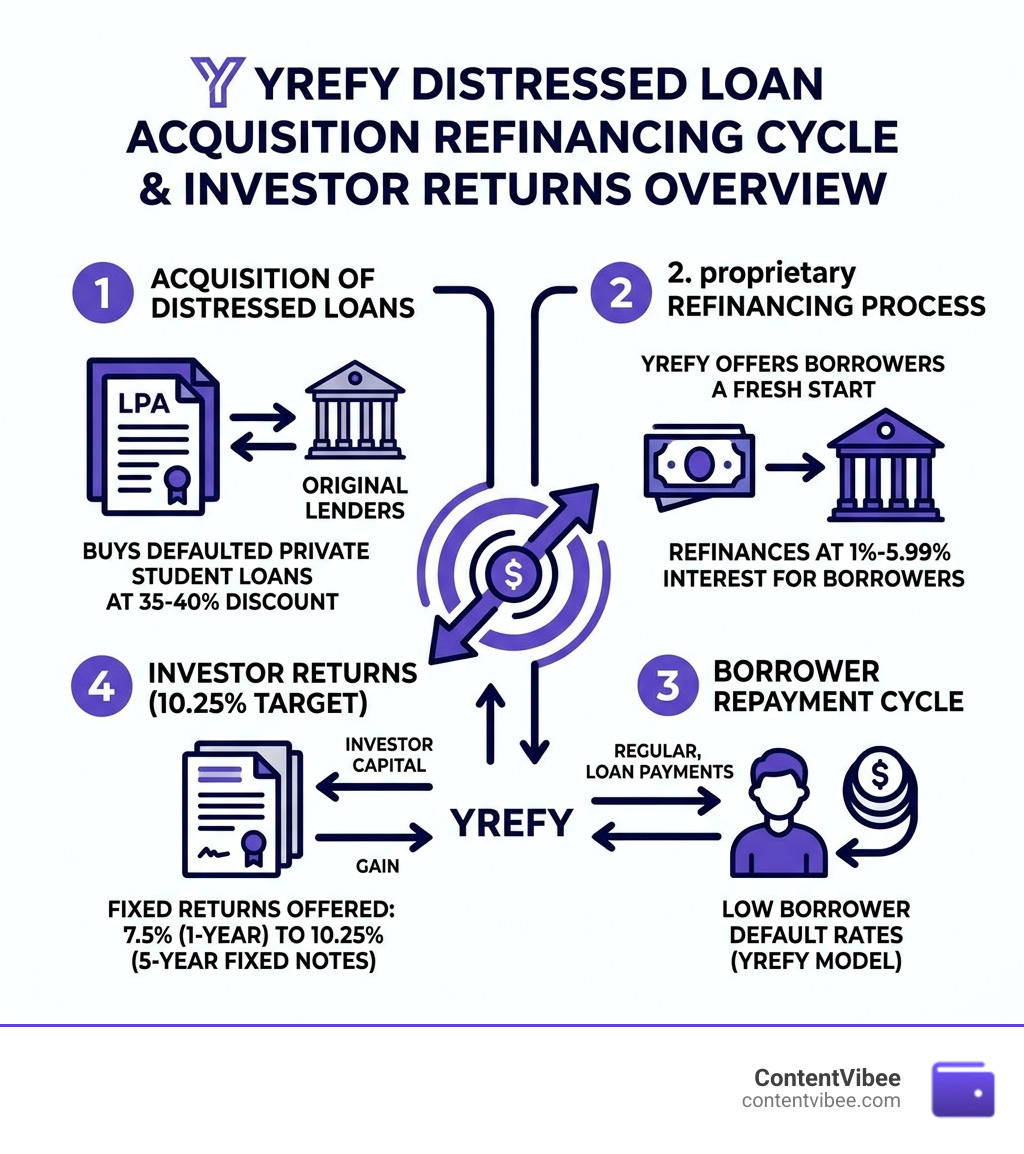
To understand Yrefy, we have to look at distressed debt. Most lenders run away from borrowers who have defaulted on their student loans. Yrefy, however, runs toward them. Their business model is built on purchasing these defaulted private student loans at a massive discount—typically between 35% and 40% of the original balance.
Once Yrefy owns the debt, they offer the borrower a “fresh start” through a proprietary refinancing process. Here is how the numbers break down for the borrower and the company:
- Refinance Rates: Borrowers are offered fixed interest rates ranging from 1% to 5.99%.
- Origination Fees: Yrefy charges a 5% origination fee, which is added to the loan balance.
- Repayment Terms: Terms can stretch up to 20 years, often including a “Skip-12” program that allows borrowers to skip one payment every six months up to 12 times.
For us as investors, the entry point is through promissory notes. When you invest, you are essentially lending money to Yrefy so they can continue buying these loan portfolios. The revenue spread comes from the difference between what Yrefy paid for the loan (the 60% discount) and the total amount they eventually collect from the borrower, including interest and the 5% origination fee.
The company claims this “rehabilitation” of the loan creates a win-win: the borrower gets a manageable payment and credit repair, while the investor receives monthly interest distributions. However, the math requires a very high volume of consistent repayments to sustain the high yields promised to investors.
Yrefy Investment Reviews Risk Analysis and Investor Returns

When we analyze Yrefy Investment Reviews Risk Analysis and Investor Returns, the headline-grabbing feature is the yield. Depending on the length of the commitment, Yrefy offers fixed returns between 7.5% and 10.25%. A five-year term currently yields that top-tier 10.25% rate.
Assessing the Returns
While these numbers look fantastic on paper—especially compared to a 4% CD or a 5% corporate bond—they come with a specific set of risks unique to alternative “Reg D” investments.
| Investment Type | Typical Yield (2026) | Liquidity | Risk Level |
|---|---|---|---|
| Traditional CD | 3.5% – 4.5% | High (with penalty) | Low (FDIC Insured) |
| Corporate Bonds | 4.0% – 6.0% | High (Marketable) | Moderate |
| Yrefy Fixed Notes | 7.5% – 10.25% | Low (1-5 Year Lock) | High (Uninsured) |
Primary Risks for Investors
- Borrower Default Risk: Even though Yrefy claims a default rate of less than 2%, they are lending to people who have already defaulted once. If the economy sours in 2026, these borrowers are often the first to stop paying.
- Lack of SEC Oversight: These are private placements under Regulation D 506(c). This means Yrefy doesn’t have to file the same rigorous public reports as a company on the stock market.
- Illiquidity: Your money is locked away. While there is an early redemption option, it comes with a 90-day processing period and potential interest penalties. There is no secondary market where you can simply sell your note if you need cash fast.
- The “Yield Gap”: This is the biggest red flag. If Yrefy is charging borrowers an average of 3.9% (capped at 5.19% for larger loans) but paying investors 10.25%, the math only works if the 40% discount on the loan purchase covers the entire difference plus company overhead and massive advertising spends.
For a deeper dive into these specific hazards, the Yrefy Risks: What You Need to Know – Student Loan Lawyer provides an excellent breakdown of the borrower-side mechanics that could impact investor safety.
Legal Red Flags and Regulatory Actions
As of April 2026, Yrefy’s track record has been marred by significant legal and regulatory hurdles. The most notable was a $750,000 administrative fine paid to the state of Massachusetts in February 2025. The state alleged that Yrefy engaged in false advertising and used celebrity endorsers to lend an air of legitimacy that the underlying financials didn’t necessarily support.
Regulatory intervention in the “Reg D” space is rare, which makes the Massachusetts action a major warning sign. Regulators found that Yrefy spent millions—over $5.4 million on TV and $348,000 on radio—using 17 different media personalities to recruit investors.
The Emonyon Lawsuit
Adding to the fire is the Emonyon et al v. Yrefy, LLC lawsuit, which remained active through late 2025 and into 2026. This case alleges breach of contract regarding refinanced loans. For investors, this raises a crucial question: if the company is tied up in litigation with the very borrowers who provide the cash flow, how secure is your 10.25% return?
Furthermore, investigations have suggested that Yrefy’s “collateral agent”—the person supposed to protect investors if the company fails—may not be a truly independent third party as claimed in marketing materials, but rather an “interested party.” This significantly weakens the “collateralized” safety net investors think they have.
Investor Sentiment and Performance Legitimacy

Investor sentiment is a mixed bag. On one hand, Yrefy maintains an A+ rating with the Better Business Bureau (BBB) and a 3.2-star rating on Trustpilot. Many investors report receiving their monthly checks on time for years.
However, a trip to the “Bogleheads” or “Reddit” finance forums reveals deep skepticism. Experienced investors often point out that a 10.25% yield in a lower-interest environment usually means “nobody else wants to touch it.” The common sentiment is that the risk of a total loss of principal is not adequately compensated by a 10% return when those loans are backed by previously defaulted borrowers.
Analyzing Yrefy Investment Reviews Risk Analysis and Investor Returns
To even get in the door, you must be an accredited investor. This means having a net worth of at least $1 million (excluding your home) or an annual income of $200,000 ($300,000 for couples). The minimum buy-in is $50,000.
The transparency concerns are real. Because Yrefy is private, they are not required to provide audited financials to the public. We have seen cases in the financial world where companies use new investor money to pay off old investors—a classic Ponzi structure—and without independent audits, it is nearly impossible for a solo investor to verify that the returns are coming purely from loan repayments.
Due Diligence: Protecting Your Capital from High-Risk Notes
Before you wire $50,000, you must perform your own due diligence. High-yield notes are a prime target for financial instability. In the same way you would protect yourself from identity theft credit report fraud, you need to guard your investment capital from non-transparent entities.
Steps to Take Before Investing:
- Request Audited Financials: Ask for at least three years of audited statements. If they refuse, that is a massive red flag.
- Verify the Collateral Agent: Ensure the agent holding the loan documents is a truly independent third-party bank or trust company.
- Check the “PPM”: Read the Private Placement Memorandum cover-to-cover. Look for language that allows the company to use new capital to pay interest to existing investors.
- Compare to Alternatives: Look at established players. For example, understanding why GS Investment Strategies fees and portfolio or how much do you need to invest with Blackstone might give you a better perspective on risk-adjusted returns.
If you have already moved funds and suspect something is wrong, treating it with the urgency of a wire transfer fraud victim is essential. Contact a financial attorney immediately if payments stop or if transparency disappears.
Final Verdict on Yrefy Investment Reviews Risk Analysis and Investor Returns
Is Yrefy a scam? No, it is a legitimate company with a real business model. However, is it a safe investment? That is much harder to say.
The 2026 economic landscape shows that while Yrefy has survived since 2017, its heavy reliance on high-interest promissory notes to fund low-interest student loans creates a “cash flow squeeze” that is inherently risky. It may suit a very small portion of a diversified portfolio for someone who is socially conscious and can afford to lose the entire $50,000. But for most, the lack of liquidity and regulatory red flags make it a “buyer beware” situation.
Frequently Asked Questions about Yrefy
Is Yrefy a legitimate company or a scam?
Yrefy is a legitimate company based in Phoenix, Arizona, and has been in business since 2017. It holds an A+ rating with the BBB. However, legitimacy does not equal safety. The company has faced a $750,000 fine for advertising violations and continues to deal with lawsuits regarding its loan practices.
What is the minimum investment for Yrefy?
The minimum initial investment is $50,000. Subsequent investments can be made in $25,000 increments. You must also prove you are an “accredited investor” under SEC guidelines to participate.
Can I withdraw my money from Yrefy early?
Yes, but it isn’t easy. There is a 90-day processing period for redemption requests. Additionally, depending on your contract, you may forfeit a portion of your interest if you exit before the 1-year, 3-year, or 5-year term is complete.
Conclusion
Navigating alternative investments requires a sharp eye and a healthy dose of skepticism. While the Yrefy Investment Reviews Risk Analysis and Investor Returns might look tempting on a radio ad, the underlying math and recent regulatory fines suggest significant headwinds.
At ContentVibee, we believe in empowering investors with data. Whether you’re looking at why energyX investment risk analysis long-term matters or trying to understand what investors need to know about Voloridge, the key is always due diligence. We provide deep insights into alternative assets, helping self-directed investors leverage tools like the Zacks Rank system to balance high-yield opportunities against verified market data. Explore more financial recovery and investment security guides to keep your capital safe in 2026 and beyond.