

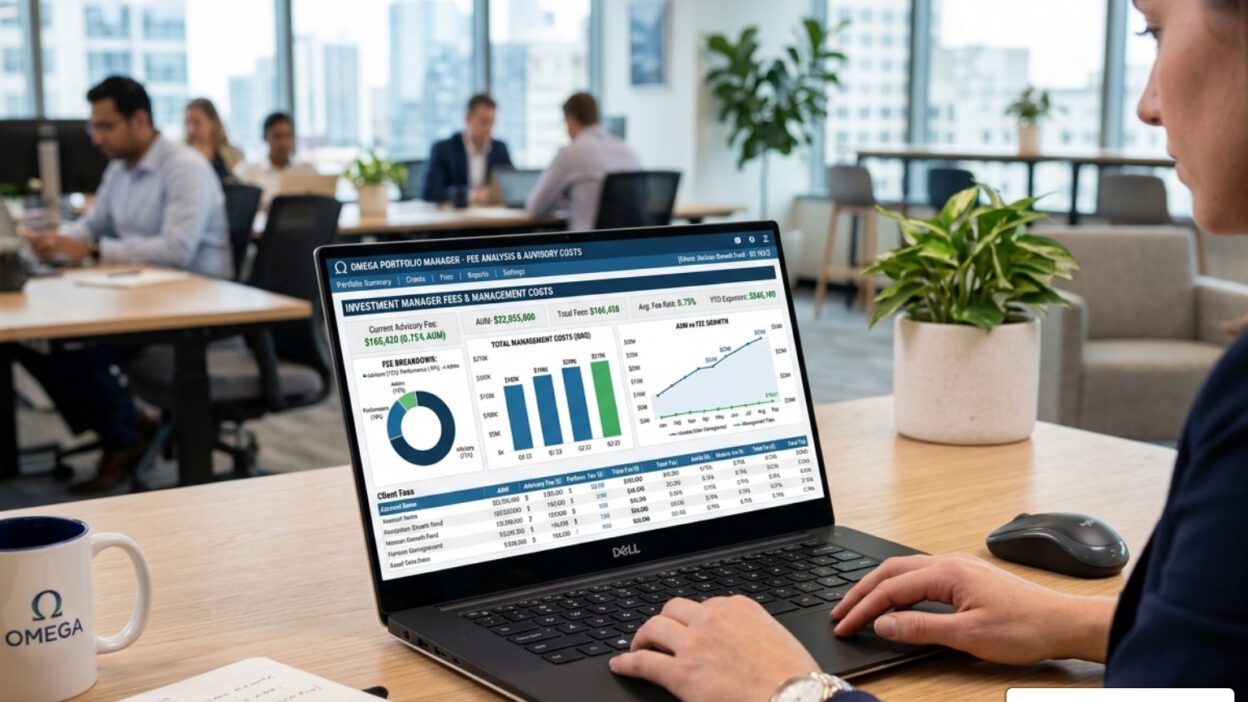
Investment Manager Software Fees and Portfolio Management Cost vary widely — from as little as $7 per month for individual investors to over $4 million per year for large institutional asset managers.
Here’s a quick breakdown to answer your question fast:
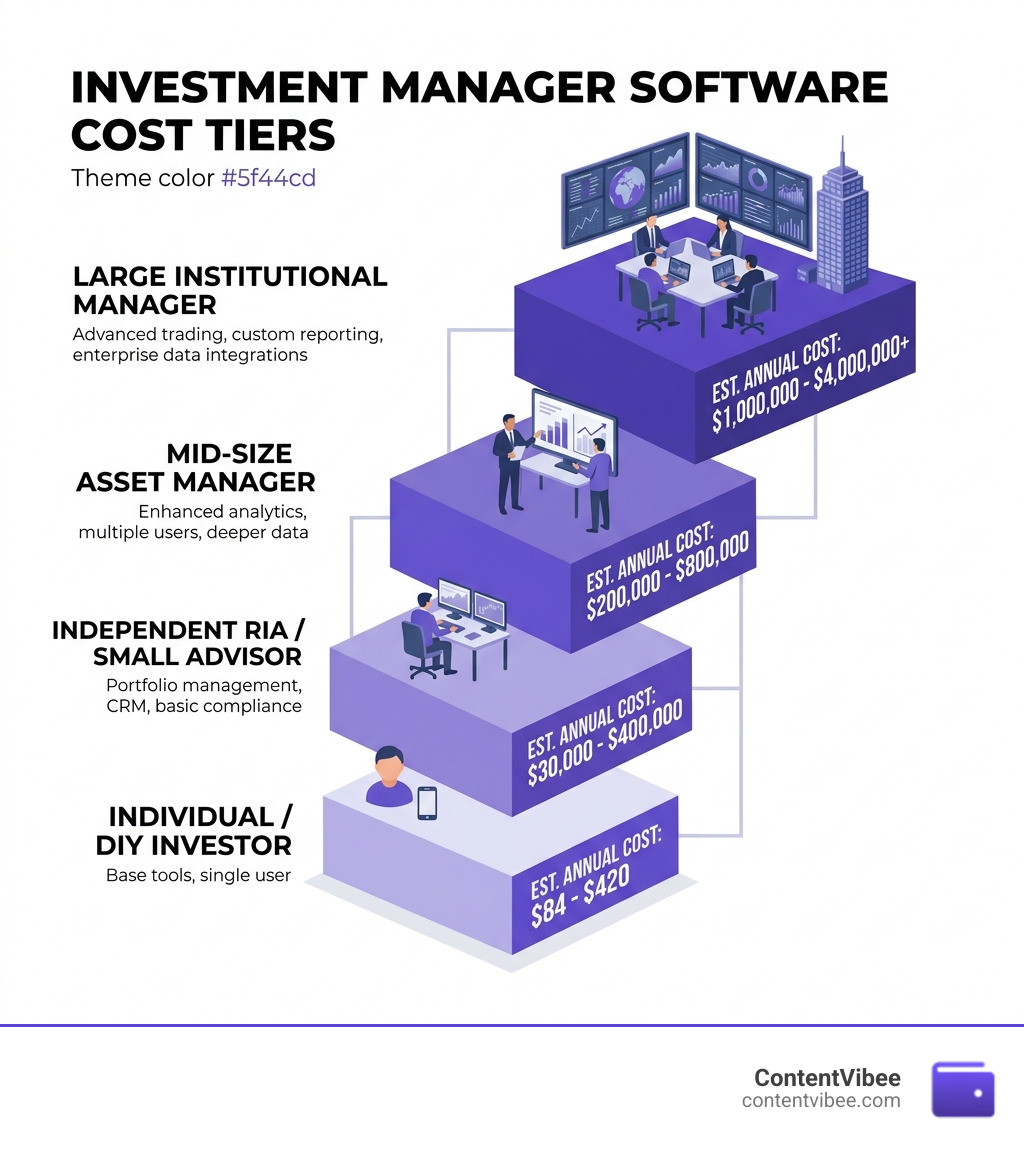
| Firm Type | Typical Annual Software Cost |
|---|---|
| Individual / DIY investor | $84 – $420/year |
| Independent RIA / small advisor | $30,000 – $400,000/year |
| Mid-size asset manager | $200,000 – $800,000/year |
| Large institutional manager | $1,000,000 – $4,000,000/year |
Key pricing models you’ll encounter:
- Per user, per month — entry-level plans range from $3 to $60+ per user
- AUM-based fees — costs scale with assets under management
- Flat subscription — fixed annual or monthly rate regardless of AUM
- One-time license — upfront purchase, less common today
Most investment professionals don’t realize how much the total cost can differ from the base subscription price. Implementation, data migration, compliance reporting, and integrations can all add up fast — sometimes doubling the sticker price.
Whether you’re a self-directed investor weighing a $35/month research tool or a growing RIA evaluating a six-figure platform, understanding exactly what you’re paying for — and what you’re not getting — is critical before signing any contract.
Understanding Investment Manager Software Fees and Portfolio Management Cost
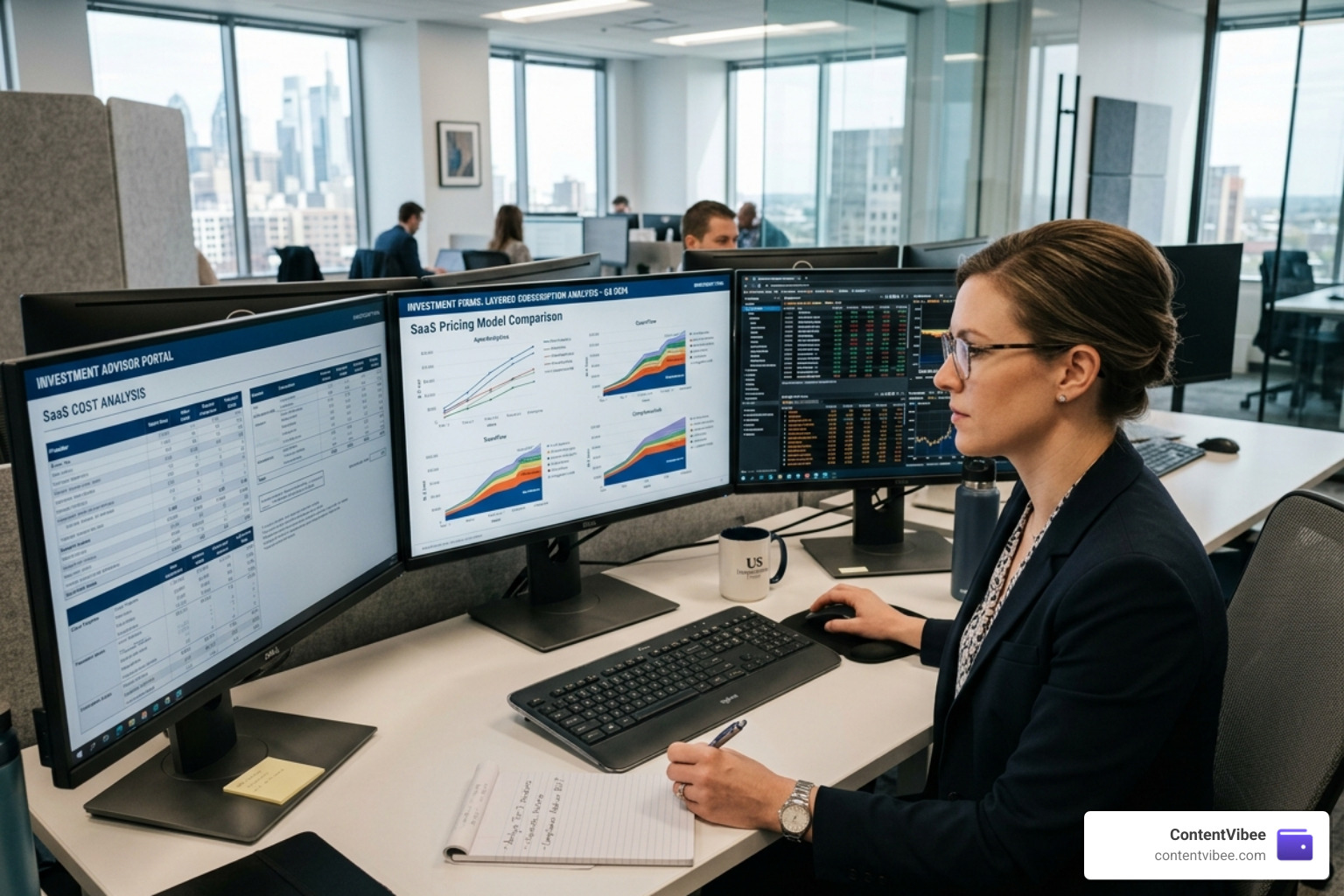
As we navigate through 2026, the wealth tech landscape has become increasingly complex. Choosing a platform isn’t just about picking a tool; it’s about understanding the long-term financial commitment. The Investment Manager Software Fees and Portfolio Management Cost are influenced by several core pricing models.
While basic personal finance tools might only cost around $8.49 per month, professional-grade systems operate on a completely different scale. Most professional platforms utilize a combination of the following:
- AUM-Based Fees: This is the “industry standard” for many Registered Investment Advisors (RIAs). The software provider takes a small percentage (often measured in basis points) of the total assets you manage on the platform.
- Subscription Tiers: Common in SaaS (Software as a Service) models, these tiers provide different feature sets—such as advanced risk analytics or client portals—at varying monthly or annual price points.
- Flat-Fee Licenses: Some “off-the-shelf” systems offer a flat annual rate, which is particularly attractive for firms with high AUM but simple operational needs.
It is also vital to distinguish between the various types of management. For instance, understanding Why Asset Management Vs Investment Management/ matters because the software requirements for a high-volume asset manager are far more intensive than those for a boutique investment firm, directly impacting the final invoice. For more information on regulatory standards, you can review the SEC’s guide on investment advisor fees.
Retail vs. Institutional Cost Benchmarks
To help you visualize the gap, consider this comparison of the current 2026 market rates:
| Feature | Retail (DIY) Software | Institutional Platforms |
|---|---|---|
| Price Range | $70 – $400 / year | $30,000 – $4M+ / year |
| Primary Goal | Tracking personal net worth | Trade execution & compliance |
| Asset Support | Stocks, ETFs, some Crypto | Alternatives, PE, VC, Derivatives |
| Reporting | Basic charts | GIPS-compliant performance |
Breakdown of Portfolio Management Software Pricing Models
When we look at the bill, the “per-user licensing” model is the most prevalent for modern cloud-based tools. Entry-level plans typically start between $3 and $60 per user per month. However, these base costs rarely tell the whole story.
Professional platforms often group their costs into “Office” categories. For example, a system focusing on the front office (trading and modeling) might seem cheaper than a front-to-back platform, but the latter eliminates the need for three separate subscriptions. Understanding the difference in professional paths, such as Why Wealth Management Vs Investment Banking/, can also help you decide if you need a specialized tool or a generalist platform.
Impact of AUM on Investment Manager Software Fees
Assets Under Management (AUM) is the primary “gravity” that pulls software costs up or down. For institutional mandates, fee resilience remains strongest in private real assets and hedge funds, while core fixed-income platforms have seen more price competition.
A 2025 study highlighted that while 39% of assets are now passively managed, a staggering 97% of fees are still paid to active managers. This means that if your firm manages active strategies, your software needs—and subsequently your Investment Manager Software Fees and Portfolio Management Cost—will likely be higher due to the need for advanced research and real-time data feeds.
Front-to-Back Office Platform Costs
For large-scale firms, a “Front-to-Back” office platform is the gold standard. These systems handle everything from the initial trade idea (Front Office) to the accounting and regulatory reporting (Back Office).
- Estimated Cost: $1,000,000 to $4,000,000 USD per annum.
- Why so expensive? These platforms manage immense operational complexity, ensuring that a trade made in London is accurately reflected in the compliance reports in New York and the tax filings in California.
Hidden Costs and Total Cost of Ownership (TCO)
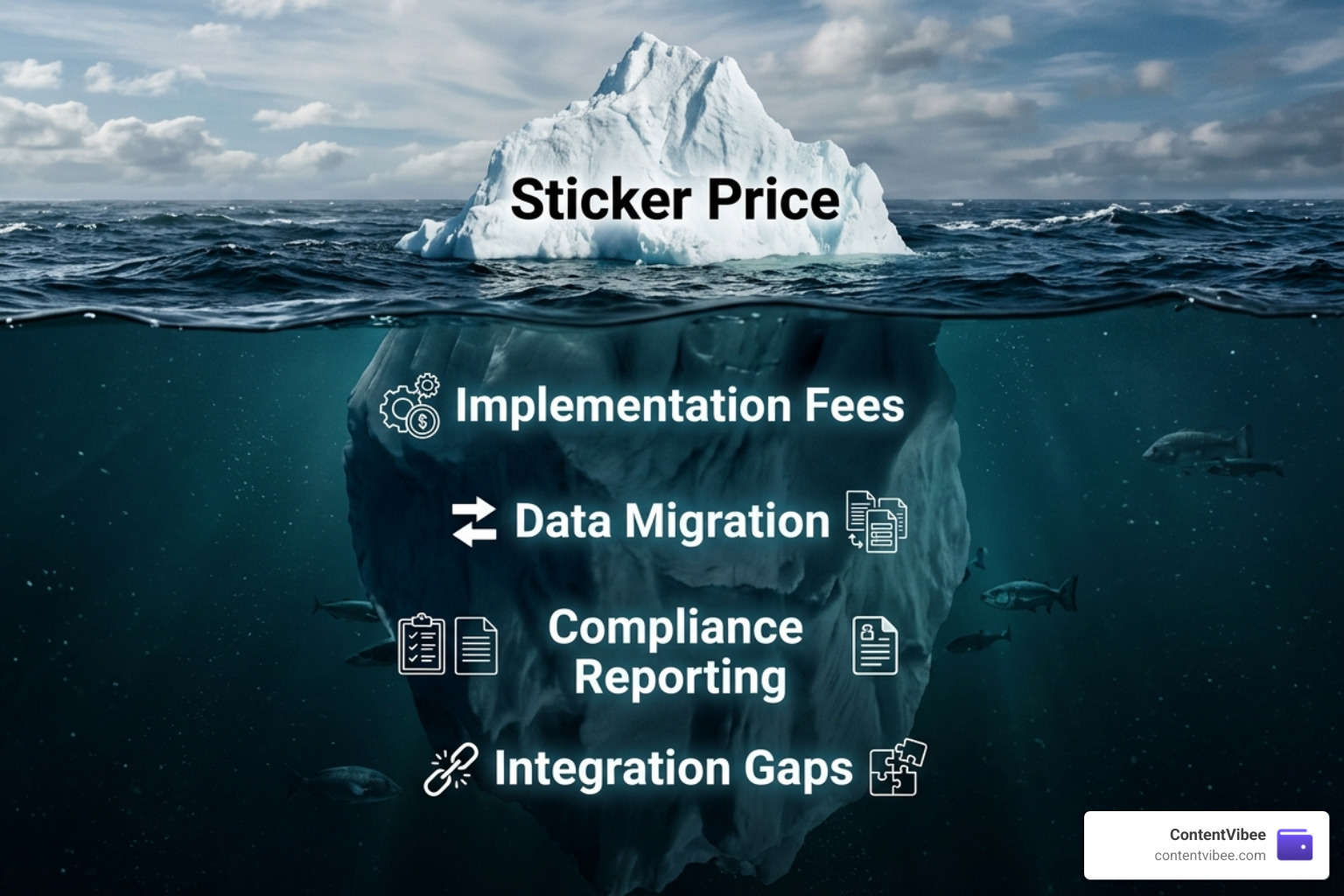
The sticker price is just the tip of the iceberg. When we calculate the Total Cost of Ownership (TCO), we must look beneath the surface at the “Hidden Cost Iceberg.”
- Implementation Fees: Setting up a professional system can take 3 to 12 months. Firms often charge a one-time fee that can range from $10,000 to $250,000 just to get the lights on.
- Data Migration: Moving decades of historical client data from an old system to a new one is a delicate, expensive process.
- Compliance Reporting: As regulations tighten in 2026, the cost of automated compliance modules – essential for avoiding SEC or FINRA fines – can add 10-20% to your annual fee.
- Integration Gaps: Many portfolio systems lack accounts payable (AP) or expense tools. You may need to add third-party automation to handle daily operations.
Calculating ROI on Portfolio Management Cost
To justify these high Investment Manager Software Fees and Portfolio Management Cost, firms look at Return on Investment (ROI). Efficiency is the biggest driver here. For instance, automation tools can reduce administrative processing time by over 50%.
If a $100,000 software suite saves your team 2,000 hours of manual data entry per year, the system pays for itself in labor savings alone. Furthermore, AI-driven insights now allow advisors to identify market patterns and tax-loss harvesting opportunities that would be impossible to spot manually, directly increasing the value provided to the client.
Security and Fraud Prevention Features in Modern Software
In 2026, digital security is not optional. A significant portion of your software fee goes toward protecting against unauthorized bank transactions, identity theft, wire fraud exposure, and account takeover risk. High-intent security features include:
- Multi-Factor Authentication (MFA) & Biometrics: Standard for all enterprise-grade tools.
- Encryption: Protecting data both “at rest” and “in transit.”
- Fraud Recovery Protocols: Many platforms now include workflows to investigate unauthorized transactions, document disputes, and support recovery efforts.
- Account Monitoring and Alerts: Tools that help detect suspicious login attempts, payment anomalies, and changes tied to potential identity theft or credit fraud.
For firms handling sensitive financial data, comparing security controls, dispute workflows, and incident response capabilities is just as important as comparing subscription pricing.
Selecting the Right Software for Your Firm Size
Not every firm needs a multi-million dollar platform. The key is matching the software’s capability to your specific operational scale.
Enterprise Solutions for Large Asset Managers
Enterprise solutions are designed for firms managing billions. These platforms offer:
- Scalability: The ability to handle hundreds of thousands of accounts without lag.
- Multi-Asset Support: Tracking everything from traditional stocks to exotic private equity and classic cars.
- Custom API Integrations: Allowing the firm to build its own proprietary tools on top of the software’s data.
Budget-Friendly Alternatives for Independent Advisors
For smaller RIAs or budget-conscious advisors, “off-the-shelf” systems provide incredible value.
- Starter Plans: Some platforms offer entry-level tracking for as low as $6.99/month.
- Portfolio Trackers: Popular for DIY investors and small advisors starting at $7.00/month.
- Research-Heavy Options: Middle-ground options exist for those who need heavy-duty research and data analytics.
Small firms can also look into Why Credit Union Investment Services Fees/ or Why Brokerage Firm Investment Fees And Account/ to see how different institutions bundle their technology costs for smaller account sizes.
Frequently Asked Questions about Investment Software
What are the typical hidden fees in portfolio software?
The most common hidden fees include data storage limits (where you pay extra for “excess” data), training fees for new staff, and “connector fees” for integrating your CRM or bank feeds. Always ask for a “all-in” TCO estimate over a three-year period.
How does AUM affect the software price for RIAs?
Most RIA-focused software uses a tiered AUM model. As your assets grow, the percentage you pay usually decreases (e.g., 0.05% for the first $100M, 0.03% for everything above that). This incentivizes firm growth while keeping the software provider’s revenue aligned with your success.
Can small firms afford enterprise-grade portfolio tools?
Generally, no—and they usually don’t need to. Enterprise tools are priced for complexity. A small firm with 50 clients would be paying for features (like international tax-lot accounting for 50 different countries) that they will never use. “Off-the-shelf” systems costing $30,000 – $100,000 are usually more than sufficient for firms under $500M AUM.
Conclusion
Understanding Investment Manager Software Fees and Portfolio Management Cost is the first step in building a sustainable, profitable investment practice in 2026. Whether you are looking at fund expense ratios to understand costs or evaluating what you are actually paying at a full-service brokerage, the goal is always the same: maximizing value while minimizing unnecessary overhead.
At ContentVibee, we believe that the right technology stack—paired with a deep understanding of institutional investment strategies and the nuances of Understanding Traditional Vs Alternative Investments/—is what separates the leaders from the laggards in the modern financial era.
For more insights on managing your firm’s finances, check out our More info about money and credit services section to stay ahead of the curve.


