


AGNC Investment Corp Dividend Yield and Mortgage REIT Risk Analysis is one of the most searched topics among self-directed income investors — and for good reason. AGNC currently pays a 12.75% trailing dividend yield ($0.12/month per share), which is more than 10x the S&P 500 average yield of ~1.2%. That kind of number grabs attention fast.
But high yield always comes with a question attached: is it safe?
Here’s a quick snapshot of where things stand as of April 2026:
| Metric | Value |
|---|---|
| Monthly dividend per share | $0.12 |
| Annualized dividend | $1.44 |
| Trailing dividend yield | 12.75% |
| Forward yield (at recent prices) | ~13.2% – 14.4% |
| Q1 2026 payout ratio | 95.9% |
| Net spread income (Q1 2026) | $0.42/share |
| Tangible book value (Mar 31, 2026) | $8.38/share |
| Q1 2026 economic return | -1.6% |
| At-risk leverage | 7.4x |
| Unencumbered cash + Agency MBS | $7.0B (60% of tangible equity) |
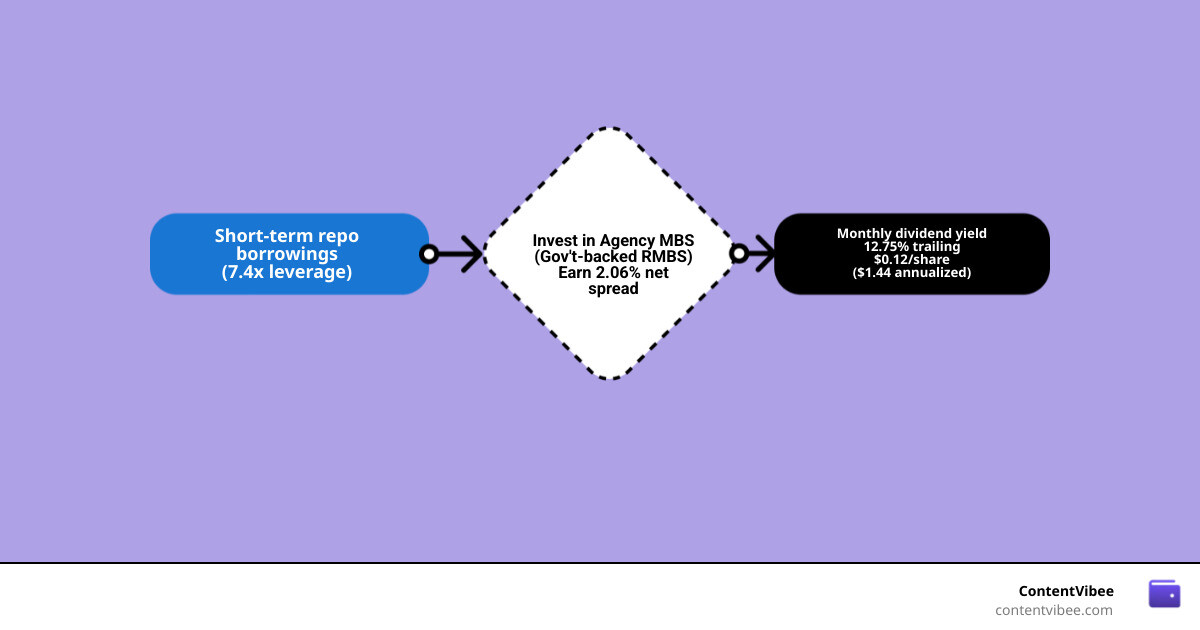
AGNC is a mortgage REIT (mREIT) — it borrows money short-term and uses that capital to buy long-duration, government-backed mortgage securities. The profit comes from the spread between what it earns on those assets and what it pays to borrow.
That model works beautifully in the right rate environment. In the wrong one, it can erode book value quickly — as Q1 2026’s -1.6% economic return showed, driven largely by spread widening tied to geopolitical volatility in March.
This guide breaks down everything you need to know: the dividend yield, what’s driving it, whether it can last, and what the real risks are — including interest rate swings, prepayment speeds, leverage, and book value erosion. We also cover AGNC’s preferred shares for investors who want the yield with less of the volatility.
AGNC Investment Corp Dividend Yield and Mortgage REIT Risk Analysis
When we look at AGNC Investment Corp Dividend Yield and Mortgage REIT Risk Analysis, we have to start with the sheer size of the payout. AGNC has maintained a monthly dividend of $0.12 per share consistently. At recent price levels, this translates to a forward yield between 13.2% and 14.4%.
While that yield is a magnet for income seekers, understand the “spread” business. AGNC doesn’t own physical property; it owns the debt on property. Specifically, it invests in Agency Mortgage-Backed Securities (MBS). These are pools of home loans guaranteed by government-sponsored enterprises (GSEs) like Fannie Mae or Freddie Mac. Because there is virtually no credit risk (the government ensures the principal is paid), the risk shifts entirely to interest rates and market volatility.

A critical metric we watch is the net interest spread, which stood at 2.06% in Q1 2026. This is the difference between the yield on their $94.7 billion portfolio and their cost of funding. When this spread tightens, the dividend comes under pressure. Currently, the payout ratio is 95.9% based on a trailing twelve-month (TTM) EPS of $1.53. This is a tight margin, but as we’ve seen in our Why SCHD Dividend ETF Yield Analysis, different investment vehicles have vastly different “safety” thresholds. For an mREIT, a payout near 100% is common because they are required by law to distribute the majority of their taxable income.
To dive deeper into the math, Evaluating AGNC’s 14.2% Yield Sustainability involves looking at net spread and dollar roll income. In Q1 2026, this came in at $0.42 per share, which comfortably covers the $0.36 quarterly dividend requirement (three months of $0.12).
Evaluating AGNC Investment Corp Dividend Yield and Mortgage REIT Risk Analysis in 2026
As we navigate through April 2026, the Q1 earnings report provides a fresh lens. AGNC generated $0.42 in net spread income per share, an improvement from $0.35 in the prior quarter. This jump was driven by a 25 basis point expansion in the net interest spread.
The AGNC’s Reaffirmed High-Yield Monthly Dividend Impact has been a stabilizing force for the stock price. By keeping the $0.12 monthly payout steady, management is signaling confidence in their cash flow metrics. However, investors should note that “income” in mREIT-land is a complex calculation involving interest income, the cost of “repo” (repurchase agreement) financing, and the gains or losses from their massive hedging book.
Macro Factors Impacting AGNC Investment Corp Dividend Yield and Mortgage REIT Risk Analysis
No mREIT exists in a vacuum. The primary headwinds for AGNC include interest rate volatility and the shape of the yield curve. When the yield curve is inverted (short-term rates higher than long-term rates), it costs more to borrow than the “natural” yield of the mortgages they buy.
We also have to consider geopolitical risks. In March 2026, conflict in the Middle East caused a sudden “risk-off” environment. This led to “spread widening”—where the gap between safe U.S. Treasuries and Agency MBS grew. When spreads widen, the market value of AGNC’s assets drops, which is exactly why the tangible book value fell by 5.6% this past quarter. Effective Investment Asset Allocation Strategy Risk Management is the only way to survive these sudden market shocks.
Navigating Interest Rate Volatility and Book Value Erosion
Book value is the “soul” of a mortgage REIT. It represents the net worth of the portfolio if everything were liquidated today. As of March 31, 2026, AGNC’s tangible net book value (TNBV) was $8.38 per share, down from $8.88 at the end of 2025.
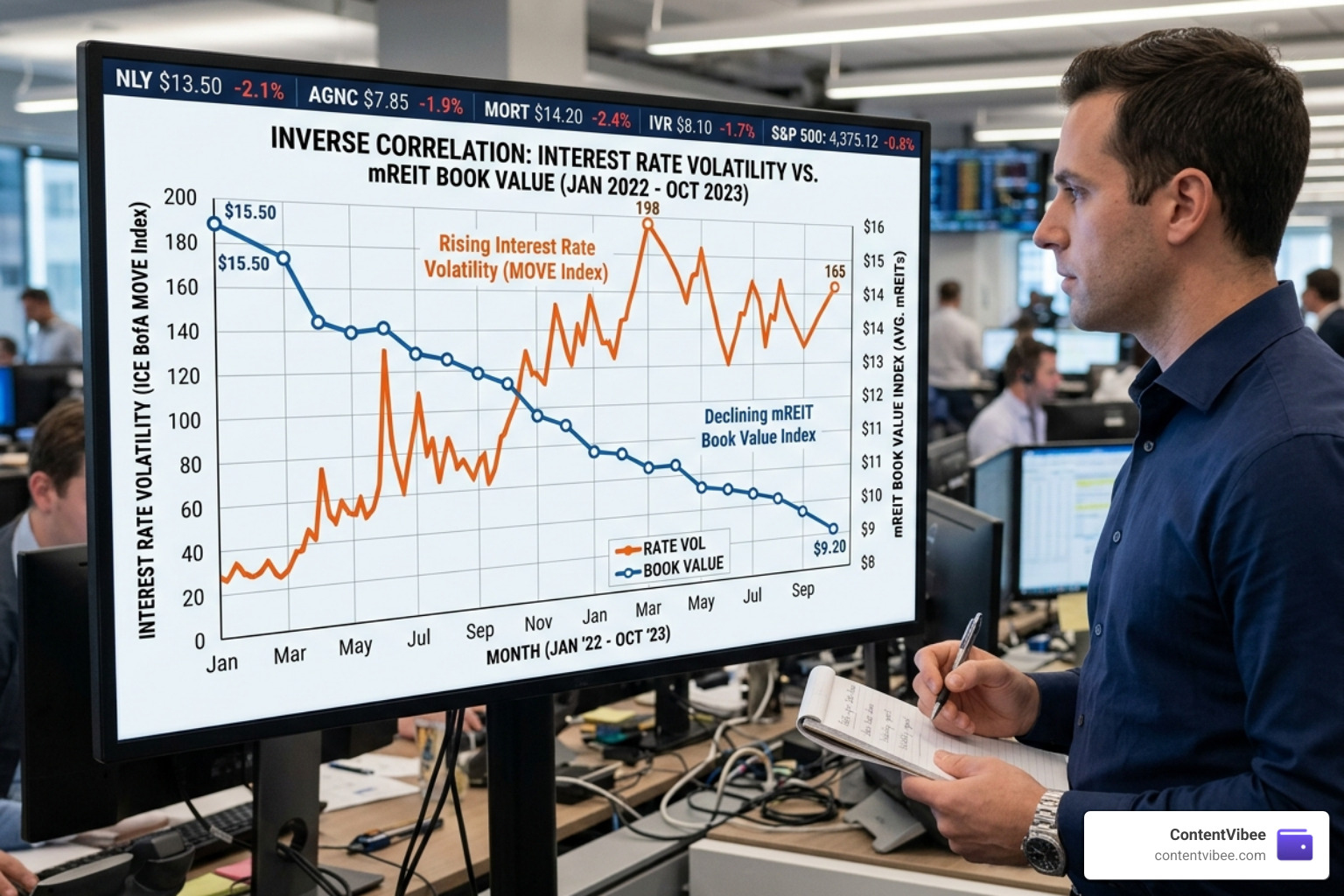
This erosion is the price investors pay for that high yield. In Q1 2026, the total economic return was -1.6%. If you received $0.36 in dividends but your share of the company’s “stuff” (the book value) dropped by $0.50, you technically lost value during that window. This is a common theme in Googl Lly Long Term Investment Risk—understanding that headline yields don’t always equal total wealth gain.
AGNC’s Low-Cost Moat and Rate Swings are what keep the company afloat during these times. AGNC is the second-largest mREIT, and its massive scale allows it to operate with lower costs than smaller competitors. This “moat” helps them absorb some of the shocks from March 2026’s volatility, but it doesn’t make them immune to the laws of physics—or finance.
Prepayment Risk and CPR Metrics
Here’s a risk most people forget: what happens if interest rates fall? You’d think that’s good for a bond-heavy portfolio, right? Well, yes and no. When rates drop, homeowners refinance their mortgages. This is measured by the Constant Prepayment Rate (CPR).
In Q1 2026, AGNC’s actual CPR was 13.2%. When people pay off their mortgages early, AGNC gets their money back at par ($100), but if they bought that mortgage at a premium (say, $105), they lose that $5 premium immediately. This is known as premium amortization. As AGNC Faces Yield Squeeze as Prepayment Risk Rises, the company has to pivot toward “higher-coupon” MBS that are less likely to be refinanced or use “TBA” (To-Be-Announced) securities to manage duration.
Leverage and Liquidity Management
To turn a 2% interest spread into a 13% dividend, you have to use leverage. AGNC’s at-risk leverage currently sits at 7.4x. This means for every $1 of equity, they are holding $7.40 of assets. It’s like buying a house with a very small down payment—great when prices go up, scary when they go down.
However, AGNC maintains a “fortress” balance sheet compared to many others. They hold $7.0 billion in unencumbered cash and Agency MBS, representing 60% of their tangible equity. This liquidity buffer is crucial. If the market panics, AGNC has the cash to meet “margin calls” without being forced to sell assets at fire-sale prices. This is a much more robust setup than what we see in Why Mobile Home Investment Roi And Financing Risk, where financing can be much more fragile. Furthermore, a $12 billion common equity cushion provides significant protection for the company’s preferred shareholders.
Preferred Shares: AGNCZ vs. AGNCP Risk-Reward Profiles
For investors who find the common stock a bit too “spicy,” AGNC offers several series of preferred shares. These act more like bonds—they pay a fixed (or floating) rate and sit higher in the capital stack, meaning they get paid before common stockholders.
| Feature | AGNCZ (Series G) | AGNCP (Series C) |
|---|---|---|
| Yield Range | 8.5% – 8.75% | 8.8% – 9.0% |
| Coupon Type | Fixed | Fixed-to-Floating |
| Call Protection | Until Oct 2030 | Currently callable |
| Best Scenario | Falling or Flat Rates | Rising Rates |
According to the Analysis of AGNC Investment Trust’s Yield and Risks, AGNCZ is currently favored by many analysts because of its 8.75% fixed coupon and long call protection. If the Fed starts cutting rates in late 2026, a fixed 8.75% yield will look like a gold mine. Conversely, AGNCP might be better if you fear inflation will keep rates “higher for longer.”
Just like we analyze in Why Energyx Investment Risk Analysis Long Term, choosing the right “layer” of the company to invest in is half the battle.
Strategic Hedging and Downside Protection
AGNC doesn’t just sit there and take the punches from the market. They are active hedgers. As of the latest data, they have a 91% hedge ratio. They use interest rate swaps, Treasury futures, and “swaptions” to lock in their borrowing costs.
One clever tool they use is the “receiver swap.” This is a bet that pays off if interest rates fall, helping to offset the losses from prepayments (CPR) we mentioned earlier. By managing the duration gap—the difference in sensitivity between their assets and their liabilities—management tries to keep the book value as stable as possible. You can track their real-time price movements and historical volatility on AGNC Investment Corp. (AGNC) Stock Price and History.
The Agency MBS Advantage
The secret sauce of AGNC is that they only play in the “Agency” sandbox. Because their RMBS (Residential Mortgage-Backed Securities) are backed by Fannie Mae and Freddie Mac, they don’t have to stay up at night worrying about homeowners defaulting on their loans. The U.S. government effectively stands behind the credit.
This makes AGNC a “pure play” on interest rates rather than a play on the economy or housing prices. While Is Whole Life Insurance A Good Investment focuses on individual safety, AGNC relies on the institutional safety of the GSE guarantees. This credit mitigation is the reason they can carry 7.4x leverage without the whole house of cards falling down.
Frequently Asked Questions about AGNC Dividends
Is AGNC’s 14% dividend yield sustainable in 2026?
Sustainability is a “maybe.” In Q1 2026, their net spread income of $0.42 covered the $0.36 dividend. However, the payout ratio is tight (95.9%). If mortgage spreads widen significantly or if the Fed makes an unexpected hawkish turn, the “coverage” could evaporate. For now, the dividend is supported by current earnings and a massive liquidity buffer.
How does rising interest rate volatility affect AGNC’s book value?
Volatility is the enemy. When rates jump around, the “spread” between Treasuries and MBS typically widens. This makes the existing mortgages AGNC holds less valuable on the open market, leading to a drop in Tangible Book Value (TNBV). We saw this in Q1 2026 with the 5.6% decline in book value.
Which AGNC preferred shares offer the best protection against falling rates?
AGNCZ (Series G) is the standout for a falling-rate environment. Because it has a fixed 8.75% coupon and cannot be called (bought back by the company) until late 2030, you “lock in” that high rate even if market rates drop to 3% or 4%.
Conclusion
Investing in AGNC is not for the faint of heart. It is a sophisticated, leveraged bet on the U.S. housing finance market. With a 12.75% trailing yield and a management team that has navigated through the 2008 crisis and the 2020 pandemic, the company has a proven track record. However, as our AGNC Investment Corp Dividend Yield and Mortgage REIT Risk Analysis shows, that yield is a compensation for the volatility of the bond market.
At ContentVibee, we want to make sure you have the tools to evaluate these risks. If the complexity of mREIT hedging and repo financing feels like too much, consider using an automated solution. The Autopilot investment app is a fantastic fintech tool for self-directed investors. It offers automated portfolio management and, more importantly, comprehensive reviews of fees, risks, and management quality to ensure your investments are truly cost-worthy.
Whether you’re chasing the high monthly income of AGNC common shares or the relative stability of the preferreds, always keep an eye on the Fed, the yield curve, and the book value. For more deep dives into different asset classes, check out our investment categories. Happy investing!


