


What Are After Tax Contributions — and Why They Matter for Your Retirement
After-tax contributions are money you put into a retirement plan — like a 401(k) — using income you’ve already paid taxes on. Unlike traditional pre-tax contributions, they don’t reduce your taxable income today. But they open powerful doors for tax-advantaged growth later.
Quick answer — what you need to know:
- What they are: Contributions made with already-taxed dollars, beyond the standard pre-tax or Roth elective deferral limit
- Who can use them: Anyone whose employer plan allows them — most useful for high earners who’ve already maxed standard limits
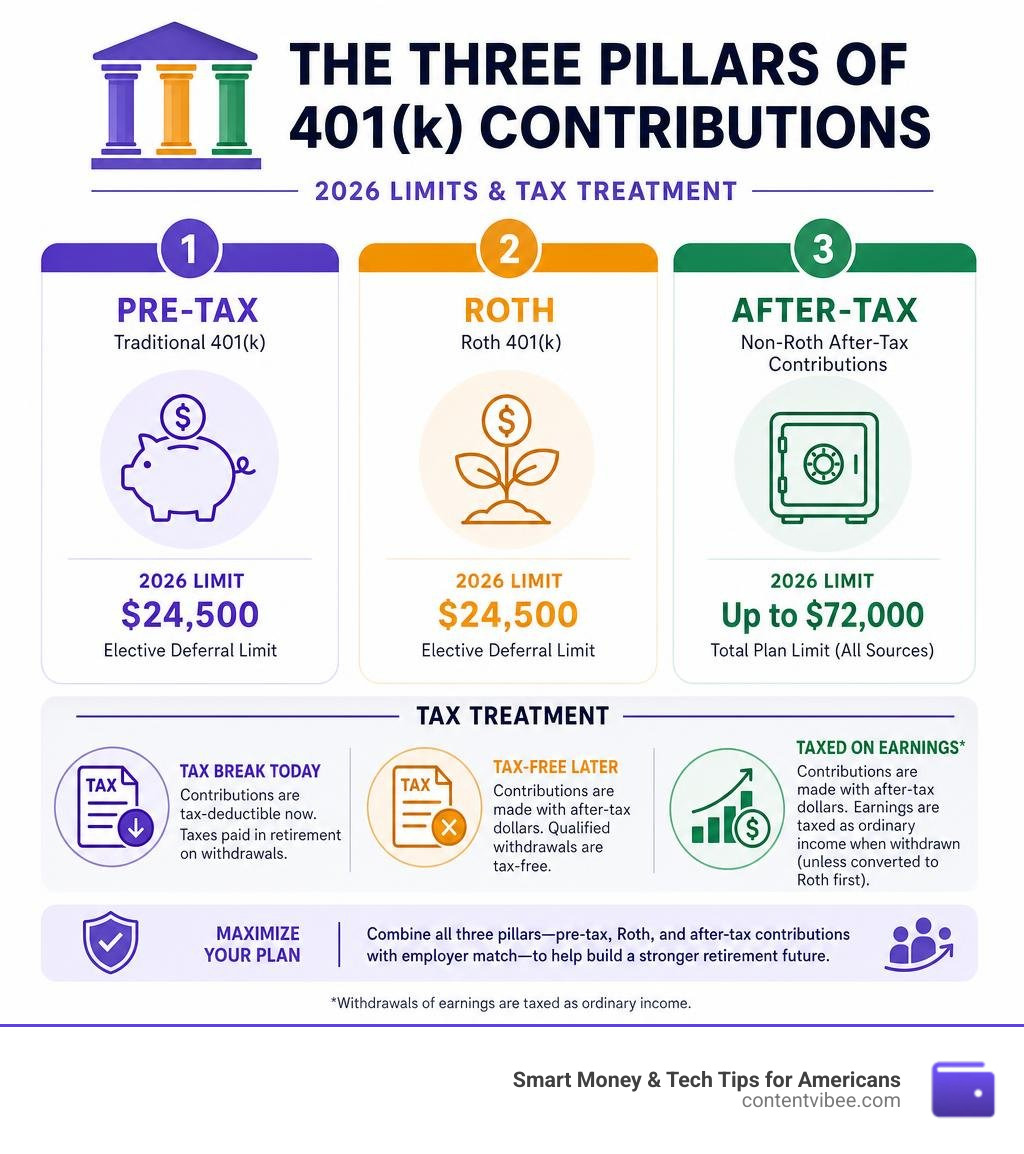
- 2026 limits: The elective deferral limit is $24,500, but the total plan limit is $72,000 — after-tax contributions can fill the gap
- Key benefit: They can be converted to a Roth account for tax-free growth, using a strategy called the “mega backdoor Roth”
- The catch: Earnings on after-tax contributions are taxed as ordinary income when withdrawn (unless converted to Roth first)
Most people approaching retirement know about pre-tax 401(k)s and Roth accounts. But the third option — after-tax, non-Roth contributions — is one of the most overlooked tools for building a bigger, more tax-efficient nest egg.
Think of it this way: once you’ve maxed out your standard contributions, after-tax contributions let you keep saving inside the same tax-sheltered plan. And if your plan allows conversions, those dollars can eventually come out in retirement completely tax-free.
In 2026, a saver who maximizes all three contribution types — pre-tax deferrals, employer match, and after-tax contributions — could potentially shelter up to $72,000 in a single year inside one retirement plan.
That’s a significant edge, especially if you’re in your peak earning years and want to catch up fast.
Understanding After Tax Contributions and How They Work
To understand how after-tax contributions work, it helps to look at the three distinct pathways your money can take when entering a workplace retirement plan like a 401(k).

When you make an after-tax contribution, you are depositing dollars that have already been subjected to federal and state income taxes. This creates what the IRS calls your cost basis—the principal amount you contributed that will never be taxed again.
However, the unique benefit of keeping these funds inside a retirement plan rather than a standard brokerage account is tax-deferred growth. Any dividends, interest, or capital gains generated by your after-tax contributions grow completely shielded from annual taxes. You won’t owe a dime to the IRS while the money sits in the account, allowing your investments to compound much faster.
The catch is that when you eventually withdraw this money in retirement, the growth (or earnings) is taxed as ordinary income. Fortunately, as we will explore, there are highly effective ways to bypass this future tax bill.
If you are looking for alternative ways to keep more of your hard-earned cash, you might also want to read about how to stop paying platform fees with top tax-free investment accounts to optimize your outer-plan investments.
It is easy to see why financial experts argue that after-tax 401(k) contributions shouldn’t be an afterthought. They act as a vital third pillar of wealth accumulation, particularly for dedicated savers who have already exhausted their standard retirement accounts.
Key Differences Between After Tax Contributions and Roth 401(k)s
At first glance, Roth contributions and after-tax contributions seem identical. After all, both are funded using post-tax dollars. But the IRS treats them very differently when it comes to contribution limits, growth, and withdrawals.
To put it simply: all Roth contributions are after-tax, but not all after-tax contributions are Roth.
Here is how they differ:
- Withdrawal Taxation: With a Roth 401(k), qualified withdrawals of both your original contributions and all accumulated earnings are 100% tax-free. With non-Roth after-tax contributions, only the contribution portion (your basis) is tax-free upon withdrawal; the earnings are taxed as ordinary income.
- Contribution Limits: Roth contributions are grouped together with your pre-tax contributions under the annual elective deferral limit ($24,500 in 2026). Non-Roth after-tax contributions do not count toward this deferral limit. Instead, they are restricted only by the much higher overall annual additions limit ($72,000 in 2026).
| Feature | Roth 401(k) Contributions | After-Tax (Non-Roth) Contributions |
|---|---|---|
| Source of Funds | Post-tax salary | Post-tax salary |
| 2026 Limit Category | Elective Deferral Limit ($24,500 combined with pre-tax) | Overall Plan Limit ($72,000 combined with all sources) |
| Tax on Contributions | Paid upfront | Paid upfront |
| Tax on Earnings at Withdrawal | Tax-free (if qualified) | Taxed as ordinary income |
| RMD Requirements | Exempt from RMDs | Exempt only if converted to Roth |
Traditional Pre-Tax vs. After-Tax Options
The choice between traditional pre-tax contributions and after-tax contributions usually comes down to your current income and tax bracket.
Traditional pre-tax contributions offer an immediate tax deduction. If you contribute $10,000 pre-tax, your taxable income for the year drops by $10,000. This is highly beneficial for high earners who want to lower their current tax bill. However, when you withdraw this money in retirement, both the contributions and the earnings are taxed as ordinary income.
After-tax contributions offer no upfront tax break. You pay taxes on the money today, but the principal can be withdrawn tax-free at any time. Because of this, after-tax contributions are generally used as a “supplemental” savings bucket once you have already maxed out your traditional pre-tax or Roth elective deferrals.
For those interested in other specialized tax-deferred options, demystifying the 457 deferred compensation plan can show you how governmental and certain non-profit employees access additional pre-tax savings pathways.
2026 Contribution Limits and Plan Rules
Navigating the rules and limits set by the IRS is essential to avoid costly penalties. For the year 2026, the IRS has established clear boundaries on how much you can save across different retirement accounts.
According to the official IRS Retirement Topics – Contributions guidelines, there are two primary limits you need to watch when managing a workplace 401(k) or similar plan:
- The Elective Deferral Limit: In 2026, this limit is $24,500. This is the maximum amount an employee can contribute as either traditional pre-tax or Roth contributions.
- The Overall Annual Additions Limit: In 2026, this limit is $72,000. This is the absolute ceiling for all contributions made to your account from all sources combined. This includes your elective deferrals, any employer matching, profit-sharing contributions, and your non-Roth after-tax contributions.
For savers aged 50 and older, the IRS allows an elective deferral catch-up contribution of $8,000, raising their personal deferral limit to $32,500. Under the SECURE 2.0 Act, there is also a “super catch-up” contribution of $11,250 available for employees aged 60 to 63, raising their elective deferral limit to $35,750.
How to Calculate Your After-Tax Contribution Room
Because after-tax contributions sit in the gap between your elective deferrals and the overall plan limit, calculating your available “room” requires some simple math.
To find your maximum after-tax contribution space, use this formula:
Overall Limit ($72,000 in 2026) - Your Elective Deferrals - Employer Contributions = Your After-Tax Capacity
Let’s look at a real-world example:
Sarah is a 45-year-old software engineer in California earning $160,000. She wants to maximize her retirement savings.
- Sarah contributes the full elective deferral amount of $24,500 to her pre-tax 401(k).
- Her employer provides a 5% match, which totals $8,000.
- Her total contributions so far are $32,500 ($24,500 + $8,000).
To find her remaining after-tax contribution room:
$72,000 (Overall Limit) - $24,500 (Sarah's Deferral) - $8,000 (Employer Match) = $39,500
Sarah can contribute an additional $39,500 in after-tax contributions to her plan.
To manage these large sums efficiently, many savers choose to set and forget your way to wealth with automated investing, ensuring their monthly payroll deductions align perfectly with these annual limits.
SECURE 2.0 High-Earner Catch-Up Rules
The SECURE 2.0 Act introduced a major rule change that affects high earners making catch-up contributions.
If your wages (defined as FICA wages) from your employer in the preceding calendar year exceeded $150,000, any catch-up contributions you make must be designated as Roth contributions. This means you can no longer make these catch-up contributions on a pre-tax basis; they must be made with after-tax dollars.
This rule is designed to shift tax revenue forward, but it also highlights the growing importance of understanding after-tax and Roth mechanics. If your employer’s plan does not offer a Roth option, high earners may be barred from making catch-up contributions entirely until the plan updates its compliance features.
The Mega Backdoor Roth Strategy Explained
The true superpower of making non-Roth after-tax contributions is that they serve as the foundation for the Mega Backdoor Roth strategy.

While standard Roth IRA contributions are restricted by strict income limits, the Mega Backdoor Roth has no income caps. It allows high-income earners to transfer tens of thousands of dollars of after-tax 401(k) contributions directly into a Roth account where both the principal and all future earnings grow completely tax-free.
To execute this strategy, your employer’s retirement plan must support two specific features:
- After-Tax Contributions: The plan must explicitly allow you to make non-Roth after-tax contributions.
- In-Service Distributions or In-Plan Roth Conversions: The plan must allow you to either roll your after-tax balance out of the plan into a Roth IRA while you are still employed (an in-service distribution) or convert the after-tax balance directly into the Roth portion of your workplace 401(k) (an in-plan Roth conversion).
The goal is to perform this conversion as quickly as possible after making the after-tax contribution. If you convert the funds immediately, there will be no accumulated earnings to tax, resulting in a completely tax-free transition.
If you are looking to maximize your overall returns while executing complex strategies like this, it is also wise to learn how to buy and sell stocks without losing your shirt to fees to keep your transaction costs as low as possible.
IRS Notice 2014-54 and the Pro-Rata Rule
Before 2014, executing this strategy was incredibly messy due to the IRS’s “pro-rata rule.” This rule required that any distribution from a retirement account containing both pre-tax and after-tax dollars must consist of a proportional mix of both.
For example, if your account was 80% pre-tax and 20% after-tax, any withdrawal or rollover would be taxed as 80% ordinary income and only 20% tax-free.
This changed with the release of IRS Notice 2014-54. Under this guidance, the IRS allows savers to split a single distribution sent to multiple destinations.
Today, if you request a distribution of your after-tax account, you can instruct your plan administrator to send the after-tax contributions (the basis) directly to a Roth IRA (tax-free) and any associated earnings to a traditional pre-tax IRA (tax-deferred). This eliminates the tax friction of the pro-rata rule and makes the Mega Backdoor Roth incredibly clean to execute.
Tax Implications and Withdrawal Rules
When it comes time to enjoy your hard-earned retirement nest egg, understanding the tax rules surrounding withdrawals is critical.
Generally, you can withdraw your original after-tax contributions at any time without paying income taxes or the 10% early withdrawal penalty, because you already paid taxes on that money. However, the earnings generated by those contributions are a different story.
If you withdraw the earnings before reaching age 59½, those earnings will be taxed as ordinary income and will typically be subject to a 10% IRS early withdrawal penalty.
To keep your retirement transitions smooth, check out our guide on selling your shares without losing your shirt to fees to avoid unnecessary brokerage charges during liquidation.
Taxation of Earnings on After Tax Contributions
If you choose not to convert your after-tax contributions to a Roth account, any growth on those contributions will eventually be taxed. The IRS treats these earnings as ordinary income rather than lower capital gains tax rates.
To prevent double taxation on these funds, you must keep meticulous records of your cost basis. For workplace plans, your plan administrator is responsible for tracking your pre-tax, Roth, and after-tax sub-accounts separately.
However, if you make after-tax contributions to a Traditional IRA, you must file IRS Form 8606 with your tax return every year to report your non-deductible contributions. Failing to file this form could result in paying taxes twice on the same money when you withdraw it.
If you are looking for other advanced ways to manage tax liabilities on your investments, you might read about tax loss harvesting: the secret weapon of robo advisors to offset capital gains in your taxable accounts.
State Tax Considerations and RMD Rules
Because Smart Money & Tech Tips for Americans is based in California, we must pay close attention to state-specific tax rules.
California has some of the highest state income tax brackets in the country, and the California Franchise Tax Board closely mirrors federal tax treatment for retirement accounts. This means after-tax contributions do not reduce your California state income tax today, and any earnings withdrawn in retirement will be taxed at your ordinary California income tax rate.
For payroll withholding and compliance details, you can consult the California Employment Development Department’s guide on Contribution Rates, Withholding Schedules, and Meals and Lodging. To plan your overall tax burden, we also recommend reviewing California State Taxes: What You’ll Owe in 2026 – AARP.
On the federal level, Required Minimum Distributions (RMDs) are another critical piece of the puzzle. Under the SECURE 2.0 Act, Roth 401(k) accounts are exempt from RMDs starting in 2024.
However, if you leave your after-tax contributions unconverted, the pre-tax earnings associated with those contributions will still be subject to RMD rules when you reach age 73 (or age 75 if you reach age 74 after December 31, 2032). Converting your after-tax balances to a Roth IRA is the most effective way to eliminate future RMD requirements on those funds.
Frequently Asked Questions About After-Tax Savings
Can I withdraw only my after-tax contributions without earnings?
No. Under IRS rules, if you take an in-service distribution from an active workplace plan, the distribution must include a pro-rata share of both your after-tax contributions and the earnings they have generated. You cannot “cherry-pick” only the tax-free contributions while leaving the taxable earnings in the plan.
However, you can use IRS Notice 2014-54 to split the distribution during a rollover, sending the contributions to a Roth IRA and the earnings to a Traditional IRA.
How do after-tax contributions affect my required minimum distributions (RMDs)?
The after-tax contributions themselves do not trigger RMD taxes because they represent already-taxed basis. However, any earnings left unconverted within the traditional plan are subject to RMDs.
To completely protect your savings from RMDs, you should convert your after-tax contributions and their earnings into a Roth IRA or Roth 401(k) before you reach RMD age.
Are after-tax contributions subject to nondiscrimination testing?
Yes. To prevent workplace retirement plans from heavily favoring highly compensated employees (HCEs), the IRS subjects after-tax contributions to strict nondiscrimination testing known as the Actual Contribution Percentage (ACP) test.
If the average after-tax contribution rate of HCEs exceeds the rate of non-highly compensated employees by too much, the plan may be forced to refund a portion of the after-tax contributions to the high earners, which can disrupt your savings strategy.
Conclusion
Maximizing your retirement nest egg requires using every tool at your disposal. While pre-tax and Roth accounts are the standard building blocks of retirement planning, after-tax contributions provide a powerful mechanism to supercharge your savings once those standard limits are reached. By pairing after-tax savings with the Mega Backdoor Roth strategy, you can shelter up to $72,000 in 2026, paving the way for a tax-free retirement.
At Smart Money & Tech Tips for Americans, we are committed to helping you navigate these complex tax laws and investment rules so you can build a secure, prosperous future.
As you plan your long-term income strategy, don’t forget to coordinate your personal retirement accounts with your federal benefits. Take a look at our A Comprehensive Guide to Social Security Benefits to ensure you are maximizing every dollar of your hard-earned retirement income.


