


Why the IRA Rollover Deadline Can Make or Break Your Retirement Savings
The IRA rollover deadline is one of the most important — and most misunderstood — rules in retirement planning. Miss it by even one day, and a tax-free transfer can become a costly taxable event.
Here’s the quick answer:
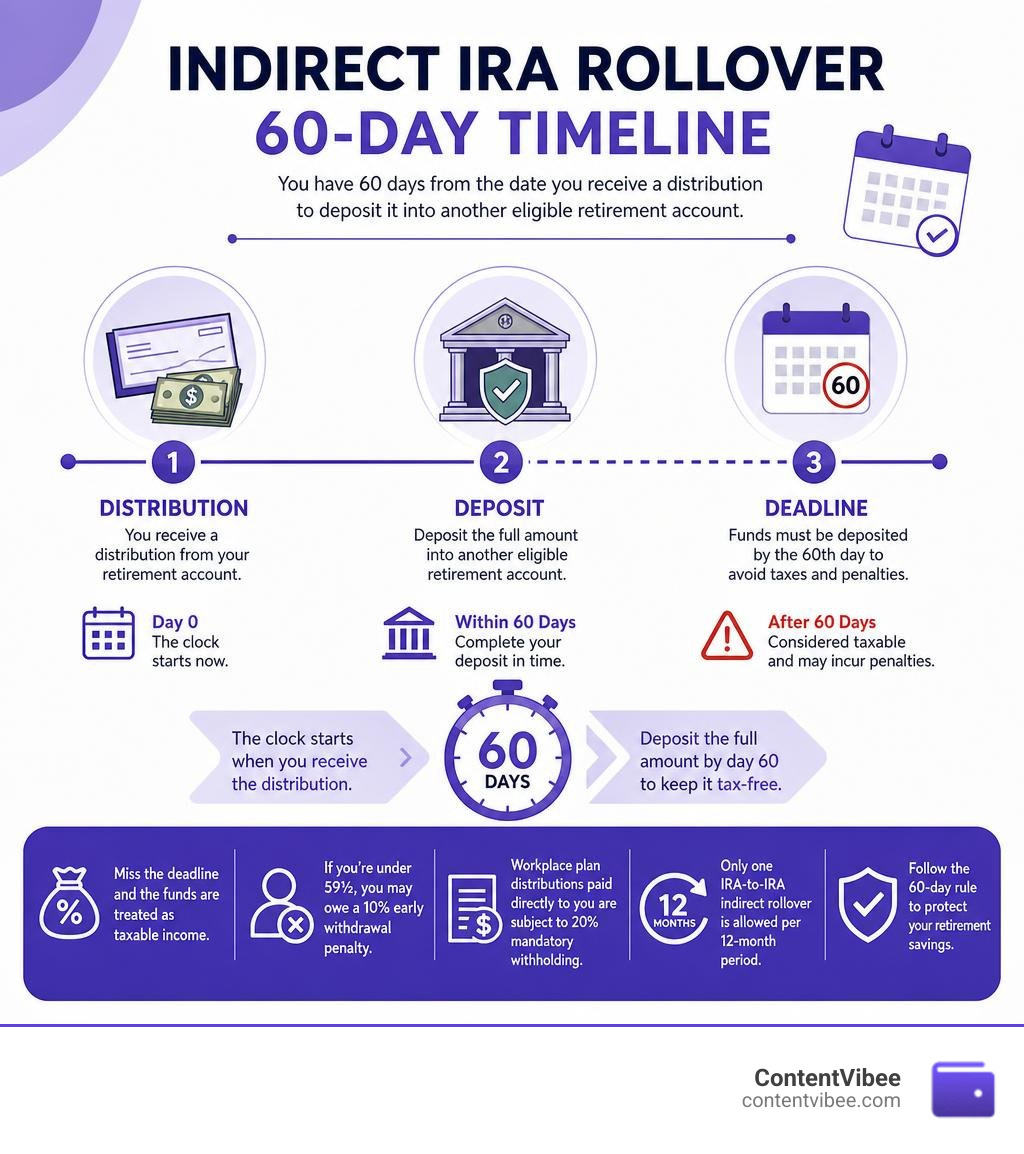
- You have 60 days from the date you receive a distribution to deposit it into another eligible retirement account
- Miss that deadline and the funds are treated as taxable income
- If you’re under age 59½, you may also owe a 10% early withdrawal penalty
- Workplace plan distributions paid directly to you are subject to 20% mandatory withholding
- Only one IRA-to-IRA indirect rollover is allowed per 12-month period
More than half of Americans already rely — or plan to rely — on personal savings like IRAs for retirement income, according to Empower research. With the average American believing they need $1.06 million to retire, getting a rollover wrong isn’t just a paperwork headache. It can set back years of careful saving.
This guide walks you through exactly how to complete an indirect rollover without triggering IRS penalties — including what to do if you’ve already missed the deadline.
Understanding the 60-Day IRA Rollover Deadline
When you decide to move money from an old retirement account to a new one, the clock starts ticking the moment those funds touch your hands. This is known as the 60-day rule, and it is the absolute cornerstone of the indirect rollover process.

An indirect rollover occurs when your retirement plan custodian cuts a check directly to you, rather than transferring the money directly to another financial institution. Once you receive that check, the IRS gives you exactly 60 days to deposit those funds into another eligible retirement account, such as a Traditional IRA, Roth IRA, or a new employer’s 401(k) plan.
According to official guidelines on Rollovers of retirement plan and IRA distributions | Internal Revenue Service, this 60-day countdown begins the day after you receive the distribution. It does not begin when the check is mailed, nor does it begin when you decide to leave your employer. If you receive the check on October 1, your 60-day window starts on October 2.
If you are navigating this transition after leaving a job, you might wonder about your overall timeline. For a deeper look at your options during this career transition, check out our guide on How Long Do You Have To Rollover A 401K After Quitting.
What Happens If You Miss the IRA Rollover Deadline?
Missing the ira rollover deadline is a financial mistake that can cost you thousands of dollars. The IRS is notoriously unyielding when it comes to deadlines, and the consequences of a late deposit are threefold:
- Immediate Income Taxation: The entire distributed amount is treated as ordinary taxable income for that calendar year. If you withdrew $50,000, you must add that $50,000 to your taxable income, potentially pushing you into a much higher tax bracket.
- The 10% Early Withdrawal Penalty: If you are under the age of 59½, the IRS will slap you with a 10% early distribution penalty on the taxable portion of the money. On a $50,000 distribution, that is an automatic $5,000 penalty.
- The 6% Excess Contribution Tax: If you miss the deadline but try to deposit the money into an IRA anyway, the IRS will view this as an ordinary, annual contribution. Because annual IRA contribution limits are much lower than rollover amounts, any amount over the annual limit will be flagged as an excess contribution, subject to a 6% annual penalty tax until it is corrected.
To see how these numbers can quickly add up and impact your bottom line, we highly recommend trying our interactive tool: Before You Cash Out Use This 401K Withdrawal Calculator First.
How to Request a Waiver for a Missed IRA Rollover Deadline
If you have already missed the 60-day window, do not panic just yet. The IRS recognizes that life happens. There are three primary pathways to secure a waiver for a missed ira rollover deadline:
1. Automatic Waivers
You may qualify for an automatic waiver if the delay was entirely due to an error by a financial institution. To qualify, the institution must have received the funds before the 60-day period expired, you must have followed all their procedures, and the funds must be deposited into your account within one year from the date of the distribution.
2. Self-Certification
Introduced in August 2016, the self-certification procedure is a lifesaver for taxpayers who miss the deadline due to circumstances beyond their control. Under Revenue Procedure 2016-47, you can submit a written self-certification letter to your new plan administrator or IRA custodian. You must meet two primary conditions:
- You must have missed the deadline due to one of 11 approved IRS reasons (e.g., severe illness, hospitalization, death of a family member, natural disaster, postal error, or financial institution error).
- You must make the rollover contribution as soon as practicable after the obstacle is resolved (the IRS generally considers 30 days to be a reasonable timeframe).
You can use the model letter provided by the IRS to complete this process. For more detailed rules on self-certification, review the Retirement plans FAQs relating to waivers of the 60-day rollover requirement | Internal Revenue Service.
3. Private Letter Ruling (PLR)
If you do not meet the criteria for self-certification or an automatic waiver, your last resort is to apply for a Private Letter Ruling from the IRS. This is a formal request where the IRS reviews your specific situation. However, this path is highly formal, time-consuming, and expensive — the IRS currently charges a $10,000 user fee just to file the request.
For an example of how the IRS evaluates these unique cases, you can read 200634064, a real-world private letter ruling where a taxpayer was granted a waiver after a spouse mistakenly established a non-IRA account due to confusing online instructions while the taxpayer was living abroad.
Direct vs. Indirect Rollovers and Key IRS Rules
To protect your retirement savings, it helps to understand the structural differences between direct and indirect transfers.
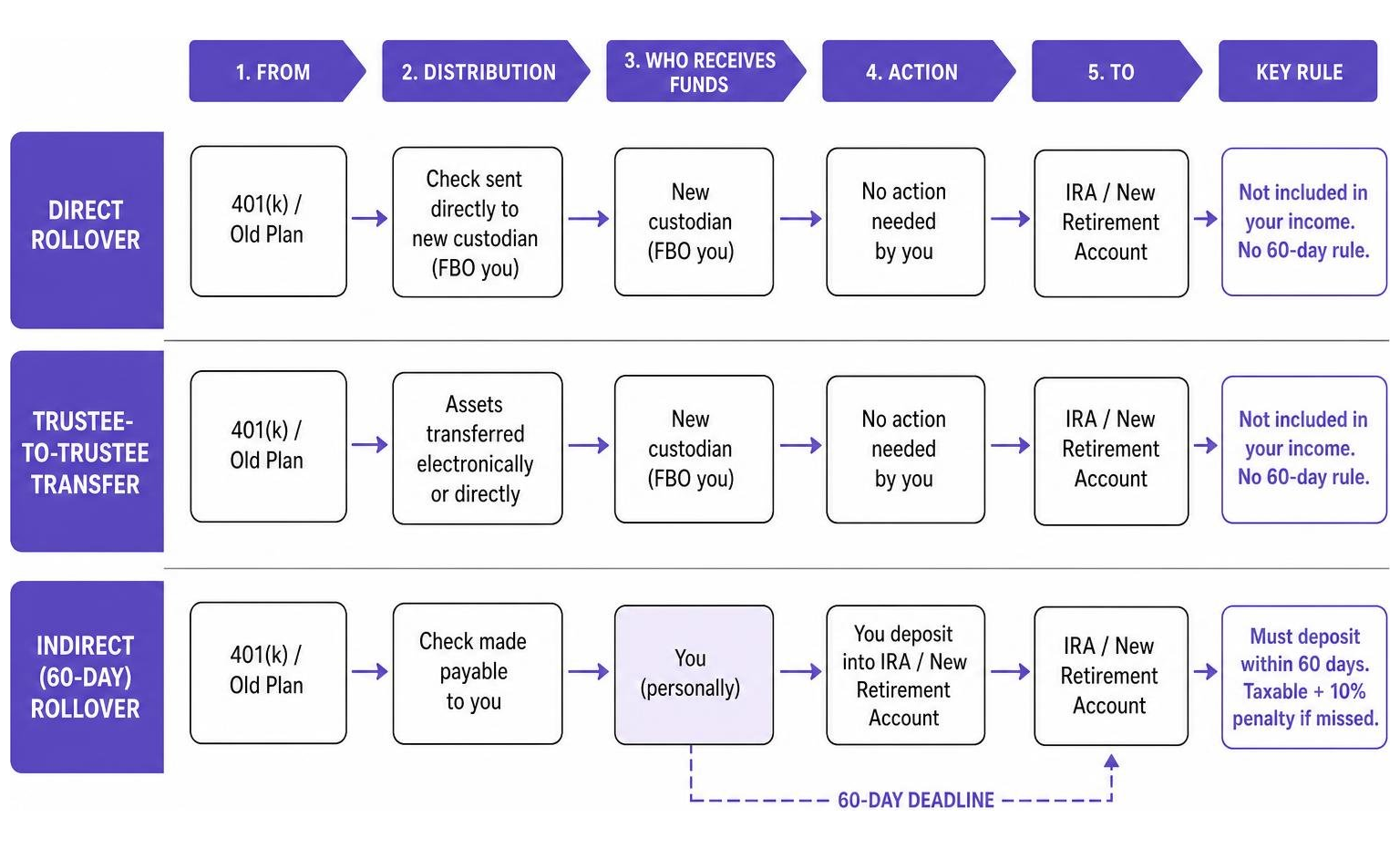
Here is a quick look at how these methods compare:
| Feature | Direct Rollover | Trustee-to-Trustee Transfer | Indirect (60-Day) Rollover |
|---|---|---|---|
| Who receives the check? | The new custodian (FBO you) | Transferred electronically/directly | You (personally) |
| Mandatory Tax Withholding | 0% | 0% | 20% (for workplace plans) |
| Subject to 60-day limit? | No | No | Yes |
| Frequency Limits | None | None | Once per 12-month period |
As explained in Topic no. 413, Rollovers from retirement plans | Internal Revenue Service, a direct rollover occurs when your employer plan pays the funds directly to your new IRA or retirement plan. Alternatively, a trustee-to-trustee transfer moves funds directly between two IRAs of the same type. Both of these methods completely bypass the 60-day rule and avoid tax withholding.
If you are currently managing a transition involving a 403(b) account, you can find a comprehensive breakdown of your options in our 403b Rollover Guide Master Your Retirement Account Move.
Tax Withholding Rules and the 20% Trap
One of the most dangerous traps of an indirect rollover is the mandatory tax withholding rule.
If you request an indirect rollover from a workplace plan (like a 401(k) or 403(b)), the plan administrator is legally required to withhold 20% of the distribution for federal income taxes.
Here is why this is a trap: to complete a tax-free rollover, you must deposit 100% of the original distribution amount into your new account within 60 days.
Let’s look at a real-world scenario. Imagine you have $10,000 in your 401(k) and request an indirect rollover:
- The custodian sends you a check for $8,000 (having withheld 20%, or $2,000).
- To complete the rollover successfully, you must deposit $10,000 into your new IRA within 60 days.
- This means you must find $2,000 from your personal savings to make up the difference.
- If you only deposit the $8,000 you received, the IRS will treat the remaining $2,000 as a taxable distribution, and you may owe a 10% early withdrawal penalty on that $2,000.
- Once you file your taxes for the year, the $2,000 withheld will be credited back to you as taxes paid, but you must have the liquidity to cover it in the meantime.
If you are considering moving your workplace funds specifically into a Roth account, you can learn more about managing these tax implications in our guide: Can You Move Your 403B To A Roth Ira.
The One-Rollover-Per-Year Rule and RMD Restrictions
The IRS enforces a strict limit on the frequency of indirect rollovers. You are only allowed one IRA-to-IRA indirect rollover in any 12-month period.

This rule is calculated as a rolling 365-day period, not a calendar year. If you complete an indirect rollover on October 15, 2025, you cannot perform another indirect rollover until October 16, 2026. This limit applies across all of your IRAs combined (including Traditional, Roth, SEP, and SIMPLE IRAs), treating them as a single account for this rule.
Note: This frequency limit does not apply to direct rollovers, trustee-to-trustee transfers, or rollovers from an employer plan to an IRA.
Additionally, if you have reached the age where you must take Required Minimum Distributions (RMDs), be aware that RMDs cannot be rolled over. As outlined in Publication 590-B (2025), Distributions from Individual Retirement Arrangements (IRAs) | Internal Revenue Service, any RMD amount paid to you must be treated as taxable income and cannot be deposited into another tax-advantaged account.
If you accidentally make an invalid rollover or over-contribute to your account, you must act quickly. Learn how to fix this issue before the IRS steps in with our guide on How To Correct Over Contributing To Your Ira Before The Irs Finds Out.
Step-by-Step Guide to Executing a Penalty-Free Indirect Rollover
If you must perform an indirect rollover, following a strict checklist is the best way to avoid expensive mistakes.
Here is our step-by-step process for completing an indirect rollover safely:
Step 1: Confirm Account Compatibility
Before you request any funds, contact your receiving financial institution. Ensure they are prepared to accept the rollover and verify that your new account is fully open and active.
Step 2: Request the Distribution
Contact your current plan custodian and request an indirect rollover distribution. If this is coming from an employer plan, 20% will be withheld. If it is coming from an IRA, you can generally choose to opt out of withholding.
Step 3: Track the Arrival Date
Mark your calendar the exact day you receive the check in the mail or the funds hit your bank account. Your 60-day countdown starts the very next day.
Step 4: Secure Replacement Funds
If taxes were withheld from your distribution, calculate the 20% difference. Secure these funds from your personal savings or other non-retirement assets so you can roll over the full 100% of your original balance.
Step 5: Deposit the Funds
Deposit the full distribution amount (including your personal replacement funds) into your new retirement account. Clearly instruct the receiving institution that this deposit is a “Rollover Contribution.”
According to IRS guidelines on Accepting late rollover contributions | Internal Revenue Service, financial institutions can accept these contributions smoothly if you provide proper documentation showing that you have met all requirements.
Frequently Asked Questions about IRA Rollovers
Which types of retirement plan distributions are eligible for rollover?
Most pre-retirement distributions from traditional IRAs, Roth IRAs, 401(k) plans, and 403(b) plans are fully eligible for rollover. You can move pre-tax funds into a Traditional IRA to keep them tax-deferred, or you can perform a Roth conversion to move them into a Roth IRA.
If you are specifically moving 403(b) funds into a Roth IRA, you can read our step-by-step walkthrough: The Ultimate Guide To Converting Your 403B To A Roth Ira.
Can I roll over a 401(k) loan or a hardship withdrawal?
No. The IRS strictly prohibits the rollover of hardship distributions, corrective distributions of excess contributions, and defaulted plan loans that are treated as distributions. These amounts must be reported as taxable income and cannot be deposited into an IRA.
How do cross-year rollovers affect my tax reporting?
If you receive a distribution in December but do not complete the rollover until January of the following year, the transaction crosses tax years.
Your old custodian will report the distribution on Form 1099-R for the year the money left the account. Your new custodian will report the deposit on Form 5498 for the year the rollover was completed. You must report both forms on your tax return to show the IRS that the distribution was offset by a timely rollover, keeping the transaction tax-free.
Conclusion
Consolidating your retirement accounts is a great step toward securing your financial future, but keeping an eye on the ira rollover deadline is essential. Whenever possible, we highly recommend using direct rollovers or trustee-to-trustee transfers to avoid the 60-day rush and the 20% tax withholding trap entirely.
At ContentVibee, we are dedicated to providing you with clear, actionable advice to help you manage your personal finances with confidence.
If you want to understand more about how legal timelines, statutes of limitations, and financial safety nets interact to protect your assets, check out our guide to Learn more about legal timelines and financial protections.