


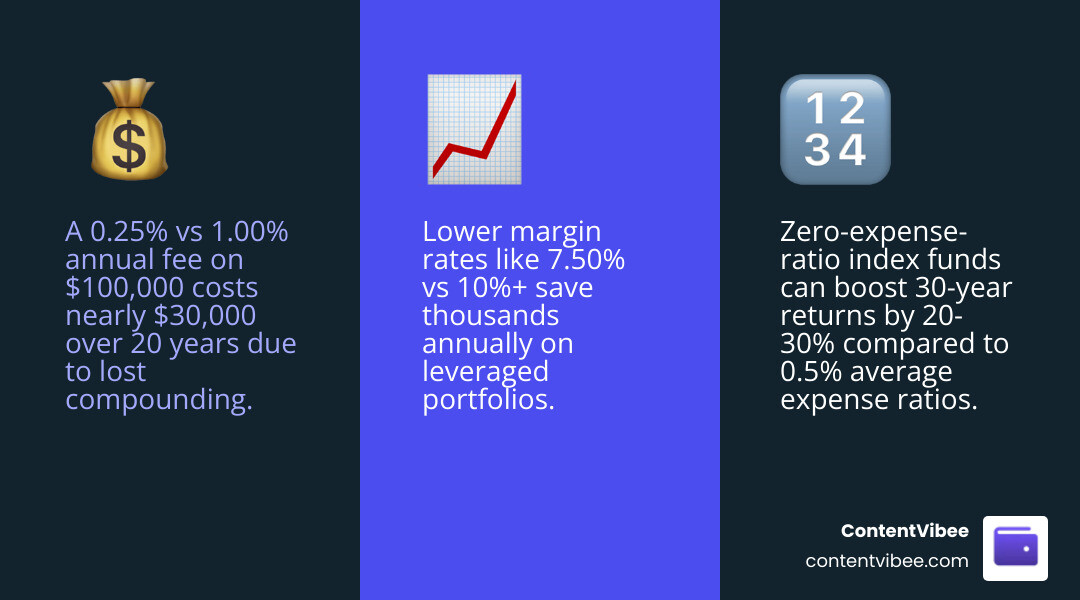
A fidelity investments fees comparison reveals something that surprises most investors: the difference between a 0.25% and a 1.00% annual fee on a $100,000 portfolio can cost you nearly $30,000 over 20 years — money that could be compounding in your favor instead.
Here’s a quick snapshot of where Fidelity stands in 2026:
| Fee Category | Fidelity | Schwab | Vanguard | E*TRADE |
|---|---|---|---|---|
| Stock/ETF trades | $0 | $0 | $0 | $0 |
| Options per contract | $0.65 | $0.65 | $1.00 | $0.65 |
| Index fund expense ratio | 0.00%–0.015% | 0.02%–0.06% | 0.04%–0.11% | Varies |
| Margin rate (lowest) | 7.50% | 10.075% | 10.00% | 10.45% |
| Account minimum | $0 | $0 | $0 | $0 |
| IRA closeout fee | $0 | $0 | $0 | Varies |
| Domestic wire fee | $0 | $15+ | $0 | Varies |
| Default cash yield | ~4%+ | ~0.45% | ~4%+ | ~0.01% |
The bottom line: Fidelity leads on margin rates, bond mark-ups, and is the only broker offering true zero-expense-ratio index funds. But the biggest hidden cost at most brokers isn’t the headline fee — it’s what your uninvested cash earns by default.
For real estate investors managing capital gains exposure and looking to maximize every dollar of portfolio return, these fee differences aren’t small print. They’re real money — and they compound year after year.
This guide breaks down every major fee category so you can see exactly what you’re paying (or saving) at Fidelity versus the competition.
Core Trading Commissions and Fidelity Investments Fees Comparison
When we look at the bread-and-butter of trading, Fidelity has positioned itself as a low-cost leader. Since the industry-wide shift to commission-free trading, the “sticker price” for most US-based transactions has hit zero. However, the devil is in the details, especially when you move beyond simple stock picks into derivatives or fixed income.
Fidelity offers $0 commissions for online US stock, ETF, and option trades. While the base trade for options is $0, there is a standard $0.65 per contract fee. This is highly competitive, especially compared to firms like Vanguard that may charge up to $1.00 per contract. For those of us managing high-volume portfolios, that $0.35 difference per contract adds up to thousands of dollars in saved overhead annually.
For a deeper look at the granular costs, you can review the official [PDF] Fidelity Brokerage and Commission Fee Schedule. Understanding these nuances is vital because why brokerage firm investment fees and account structures matter often dictates the long-term “drag” on your capital gains.
Comparing International Trading and Fidelity Investments Fees Comparison
If you are looking to diversify your real estate profits into global markets, the fidelity investments fees comparison becomes more complex. Fidelity offers three distinct ways to trade international stocks: International Trading (local currency), Dollarized International Trading, and Foreign Ordinary Share Trading.
- Foreign Settlement Fees: These vary by country. For example, trading on the London Stock Exchange might incur a different flat fee than trading in Tokyo.
- Currency Conversion: Fidelity applies a markup/markdown on currency exchanges. For amounts under $100,000, this is typically 1.0%, scaling down to as low as 0.20% for transactions over $1M.
- Stamp Taxes and Levies: Certain countries impose their own costs, such as the French Financial Transaction Tax (0.40%) or the UK Stamp Duty (0.50%).
Compared to competitors like Schwab, Fidelity’s international platform is robust, but it requires a keen eye on “non-DTC” fees, which can add $50 to a trade if the security isn’t settled in the US.
Fund Management and Zero Expense Ratio Analysis
One of Fidelity’s most aggressive moves in the fee war is the introduction of the “ZERO” funds. These are the industry’s first index mutual funds with a 0.00% expense ratio.
We often discuss why robo advisor fees comparison matters, but for the self-directed investor, these ZERO funds are the ultimate profit maximizer. The core lineup includes:
- FZROX: Fidelity ZERO Total Market Index Fund
- FNILX: Fidelity ZERO Large Cap Index Fund
- FZIPX: Fidelity ZERO Extended Market Index Fund
- FZILX: Fidelity ZERO International Index Fund
While these funds have no management fees, there is a catch: portability. Fidelity ZERO funds are proprietary. If you decide to move your account to another broker, you cannot transfer these funds “in-kind.” You must sell them, which could trigger a capital gains tax event. For our real estate clients focused on tax-efficient exits, this is a critical consideration. If you want portability, you might opt for the standard FSKAX (Total Market), which carries a tiny 0.015% fee but can be moved anywhere.
According to the Vanguard vs Schwab vs Fidelity: Expense Ratio Breakdown, Fidelity’s asset-weighted average expense ratios are now among the lowest in the world, often beating Vanguard’s investor-owned model on pure price.
Margin Rates and Fixed-Income Trading Costs
For investors looking to leverage their portfolio—perhaps to bridge a gap between real estate acquisitions—margin rates are a primary concern. Fidelity’s margin rates are tiered, meaning the more you borrow, the lower the rate.
As of late 2025/early 2026, Fidelity offers margin rates as low as 7.50% for balances over $1M. Compare this to Schwab or E*TRADE, where rates often hover between 10% and 11% for similar balances. You can see a direct side-by-side on their Compare Online Brokers – Compare Fidelity to Your Broker page.
In the fixed-income world, Fidelity is exceptionally transparent.
- US Treasuries: $0 fee for online trades.
- Secondary Market Bonds/CDs: $1 per bond mark-up. This $1 mark-up is significantly lower than the industry average, where investors often lose $15 per bond in “hidden” mark-ups. For a fixed-income ladder, this transparency ensures you keep more of the yield.
Account Maintenance, Security, and Hidden Fees
One of the reasons we frequently recommend a fidelity investments fees comparison is the absence of “nuisance” fees. Fidelity charges $0 for:
- Account maintenance
- Inactivity
- Domestic wire transfers (Schwab often charges $15-$25)
- IRA closeouts (Vanguard and others may charge $50-$100)
However, there is a “hidden” fee to watch for: the Short-Term Redemption Fee. If you buy a No Transaction Fee (NTF) non-Fidelity mutual fund and sell it within 60 days, Fidelity charges a $49.95 fee. This is designed to discourage market timing in funds meant for long-term holding.
Digital Security and Fraud Recovery
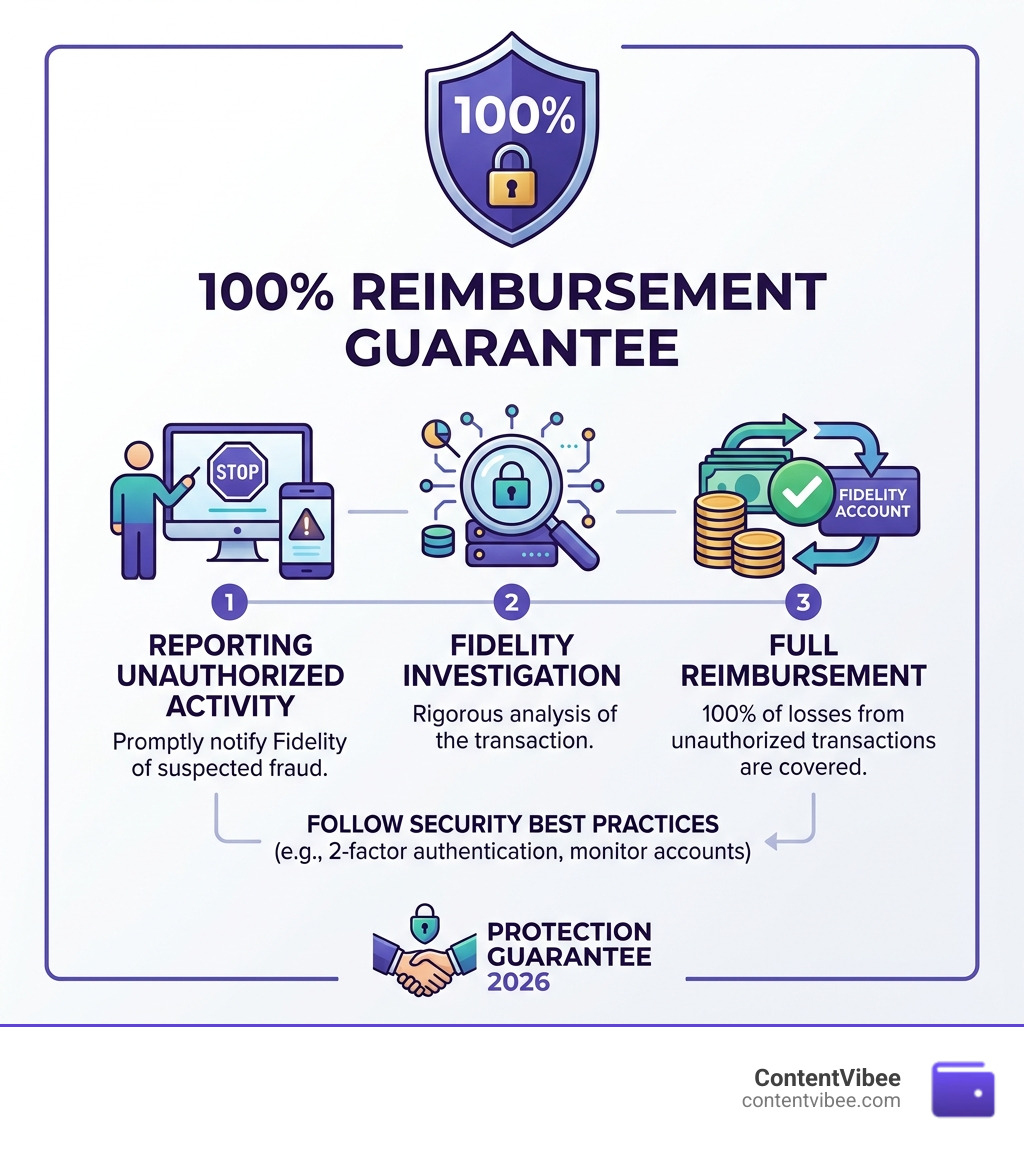
In 2026, the cost of a fee isn’t just what’s on the statement—it’s the cost of a security breach. We’ve looked into why the Fidelity investment login security breach concerns investors, and Fidelity has responded with a robust “Customer Protection Guarantee.”
If you encounter an unauthorized bank transaction how to dispute and recover money USA 2026, Fidelity provides 100% reimbursement for unauthorized activity if you follow their security best practices. Furthermore, if you are dealing with identity theft credit report fraud how to fix and protect your score USA, Fidelity offers integration with identity monitoring services to help safeguard your brokerage assets and your broader financial identity.
Advisory Services and Wealth Management Structures
Not everyone wants to fly solo. Fidelity offers several tiers of professional management, and understanding why Fidelity investments advisory fees vary is key to choosing the right service.
- Fidelity Go (Robo-Advisor): $0 for balances under $25,000. Above that, it’s a flat 0.35% annual fee. This covers the management and the underlying fund expenses.
- Fidelity Wealth Management: Typically 0.50%–1.50% of assets, requiring a $500,000 minimum.
- Private Wealth Management: For those with $2M+, fees are often negotiated and can drop as low as 0.20% depending on the complexity of the estate.
When asking what are wealth management fees, you have to weigh the cost against the value of tax-loss harvesting and estate planning—services that are particularly valuable for those with high-value real estate portfolios.
Frequently Asked Questions
Frequently Asked Questions about Fidelity Investments Fees Comparison

Does Fidelity have an account minimum? No. You can open a retail brokerage account or an IRA with $0. This makes it an excellent choice for those just starting to reinvest small amounts of rental income.
What are fractional shares? Fidelity allows you to buy “slices” of stocks and ETFs for as little as $1. This is a massive advantage over Schwab (which only allows fractional shares for S&P 500 stocks) or Vanguard (which has limited fractional options).
Are there fees for closing an IRA? No. Unlike many older brokerage firms that charge a “termination fee” of $50 to $125, Fidelity allows you to move your money freely.
How do margin rates impact long-term portfolio leverage?
Margin rates act as a “hurdle rate.” If your margin rate is 8% and your investments return 10%, you are profiting. However, if the market dips, those interest costs continue to accrue, potentially leading to a margin call. Fidelity’s lower-than-average rates make this leverage more sustainable, but it remains a high-risk strategy.
What are the specific costs for trading physical precious metals?
Trading gold or silver at Fidelity isn’t free. Buy commissions range from 2.90% for small amounts to 0.99% for $100,000+. There is also a quarterly storage fee of 0.125% of the total value (minimum $3.75). For most investors, a gold ETF like IAU or GLD is a much cheaper way to get exposure.
Conclusion
Conducting a fidelity investments fees comparison in 2026 makes one thing clear: Fidelity is built for the “all-in-one” investor. By eliminating wire fees, IRA closeout fees, and offering zero-expense-ratio funds, they have removed the friction that typically slows down wealth accumulation.
For our community at ContentVibee, the goal is always profit maximization. Whether you are liquidating a property and looking for a place to park cash at 4%+ yields, or you’re looking for low-cost index funds to hold your long-term wealth, Fidelity provides a transparent, high-value framework.
By minimizing these “silent” costs, you ensure that more of your hard-earned capital stays where it belongs: in your account, compounding for the future. For more on how to protect your gains, explore our actionable real estate investment and tax strategies.


