


Fidelity Investment Login Security Breach and Account Protection is a critical issue for anyone who holds a brokerage, retirement, or crypto account with one of America’s largest financial institutions.
Here’s what you need to know right now:
- The 2024 breach exposed personal data of up to 155,000 account holders between August 17–19, 2024
- A $2.5 million settlement was reached, with affected customers eligible for up to $100 cash, $50 CCPA payments (California residents), and two years of credit monitoring
- Fidelity’s Customer Protection Guarantee reimburses losses from unauthorized activity — but only if you report within 30 days and follow specific security steps
- Your accounts are at risk from phishing, smishing, SIM swapping, and AI-generated scams — not just data breaches
The breach itself didn’t expose account funds directly. But the stolen personal data — names, addresses, and other identifying information — can be used for identity theft, unauthorized account access, and financial fraud long after the initial incident.
And that’s the real danger.
Cybercriminals don’t need to break into Fidelity’s systems directly. They can use your leaked data to impersonate you, reset your login credentials, or trick you into handing over access yourself.
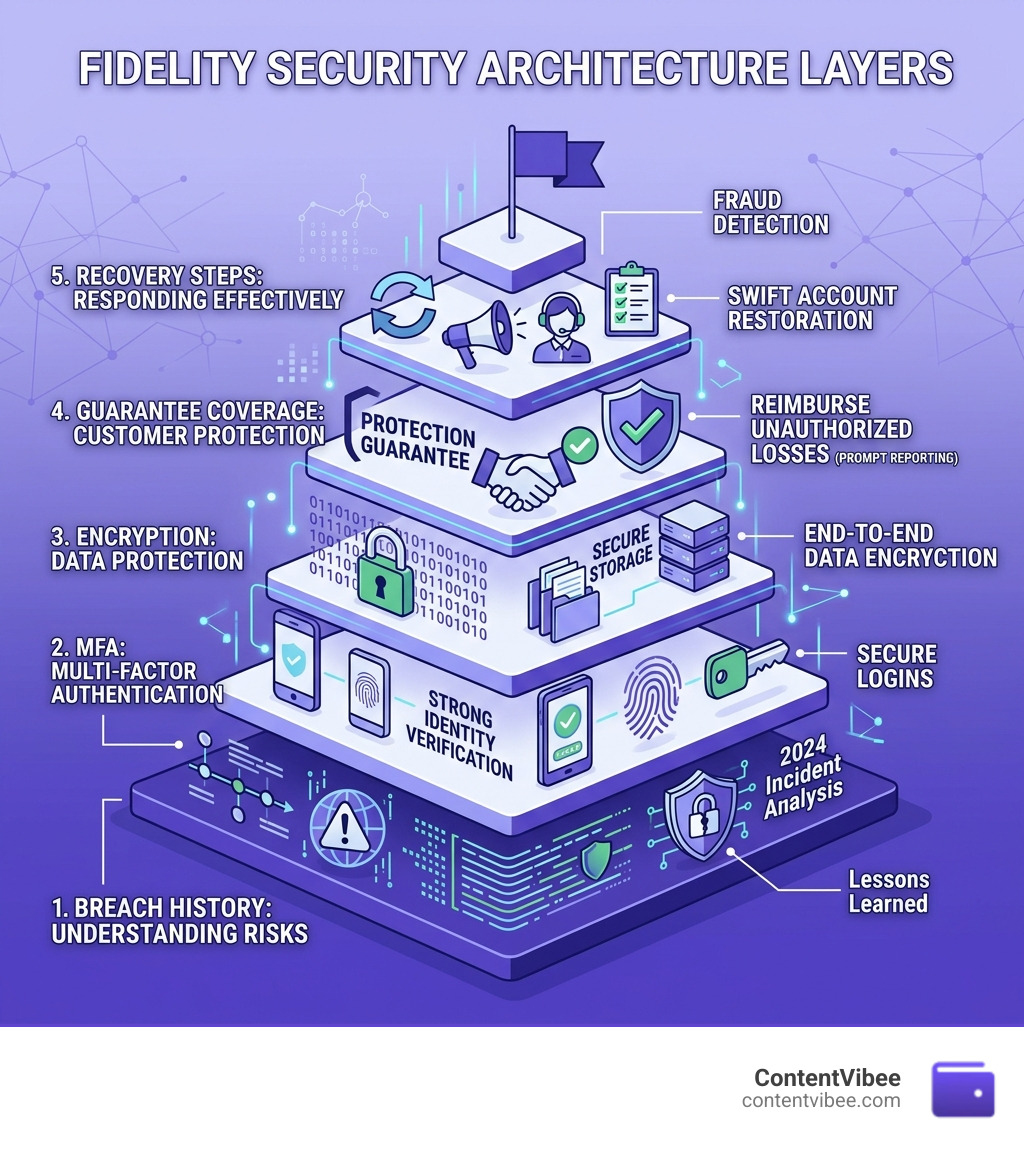
The 2024 Data Breach and $2.5 Million Settlement Outcomes

In high-finance security, the date August 2024 serves as a stark reminder that even giants can have vulnerabilities. While initial reports suggested that roughly 77,000 customers were impacted, the final tally revealed that 155,000 individuals or joint accountholders had their personal information accessed.
The incident occurred when a third party exploited two recently established customer accounts to scrape personal data over a three-day window. While Fidelity was quick to point out that the intruders did not gain access to actual Fidelity accounts or funds, the exposure of personal details led to a major class-action lawsuit.
By April 2026, the dust has settled on a $2.5 million settlement fund designed to compensate those affected. If you were part of this group, the settlement outcomes provided several layers of relief:
- Pro Rata Cash Payments: Claimants were estimated to receive approximately $100.
- CCPA Payments: California Sub-class Members were eligible for an additional $50 under state privacy laws.
- Loss Reimbursement: Victims could apply for up to $5,000 for documented out-of-pocket losses related to the breach.
- Credit Monitoring: Two years of professional identity theft protection and credit monitoring services.
Beyond the money, the settlement forced Fidelity to implement “Business Practice Enhancements.” This means they’ve had to beef up their internal data security to ensure the same loophole isn’t exploited again. For more details on the legal protections surrounding your assets, you can review the Fidelity Customer Protection Guarantee.
Fidelity Investment Login Security Breach and Account Protection: The Guarantee
When we talk about Fidelity Investment Login Security Breach and Account Protection, the “Guarantee” is the centerpiece. Fidelity promises to reimburse you for losses from unauthorized activity in covered accounts—provided the loss was “through no fault of your own.”
However, this isn’t a blank check. It is a partnership. To remain eligible, you must monitor your accounts and report any discrepancies within 30 days of them appearing on your statement.
| Account Type | Covered by Guarantee? | Key Conditions |
|---|---|---|
| Brokerage Accounts | Yes | Must report within 30 days |
| Fidelity Crypto℠ | Yes | Requires unique credentials |
| Retirement (401k/403b) | Yes | Employer plan must be eligible |
| Advisor-Managed Trades | No | Authorized transactions are excluded |
| External Transfers | No | Non-Fidelity assets not covered |
Fidelity Investment Login Security Breach and Account Protection Eligibility
To stay protected, you have to play by the rules. Fidelity may deny a claim if they find you were negligent. For instance, if you shared your password with a family member or used a “password123” that was easily guessed, you might find yourself footing the bill for the fraud.
Common exclusions include:
- Shared Access: If you give your login to a third-party app or a person, you are essentially “authorizing” their access.
- Delayed Reporting: If you wait 60 days to check your statement and find a missing $5,000, you’ve likely missed the reimbursement window.
- Credit/Debit Cards: These often fall under different protection sets provided by the card issuer rather than the brokerage guarantee.
Understanding the cost of managing these accounts is also vital for long-term planning. You can learn more about how fees impact your bottom line in our guide on Why Brokerage Firm Investment Fees and Account structures matter.
Advanced Security Features and Third-Party Data Protection

Fidelity doesn’t just wait for a breach to happen; they use a “defense-in-depth” strategy. This involves multiple layers of technology designed to stop hackers before they reach your “Buy” button.
One of the coolest features we’ve seen is Fidelity MyVoice. Instead of remembering a PIN that can be stolen, the system uses voice biometrics to verify your identity when you call. Your voice is as unique as a fingerprint, making it incredibly difficult for a scammer to impersonate you over the phone.
Other institutional-grade protections include:
- Money Transfer Lockdown: You can “lock” your account to block all electronic outbound transfers. Even if a hacker gets in, they can’t move the money out without you unlocking it first.
- 24/7 Surveillance: Proactive system monitoring that looks for “impossible travel” (e.g., logging in from New York and then 10 minutes later from Eastern Europe).
- Encryption and Firewalls: Standard but robust protocols that keep your data unreadable to prying eyes.
Secure Connections for Financial Apps
Many of us use budgeting apps or “aggregators” to see all our money in one place. Historically, these apps used “screen scraping,” which required you to give them your actual Fidelity username and password. This is a massive security risk.
Fidelity has been leading the charge to move these third parties toward a secure API connection. This allows you to “Connect, Protect, and Control” your data. You authorize the app to see your balance without ever handing over your login credentials. While this transition might cause temporary disruptions in some third-party apps, it is a necessary step for Fidelity Investment Login Security Breach and Account Protection. You can find more tips on how to Protect yourself and your accounts | Fidelity directly on their security portal.
Identifying Phishing Scams and Unauthorized Access Risks
The most advanced firewall in the world can’t stop you from accidentally giving your password to a scammer. Phishing (email) and smishing (text) are the primary ways accounts are compromised today.
Scammers are getting smarter, often using AI to craft messages that look identical to official Fidelity communications. They might send a text saying, “Do you recognize this transaction for $1,200?” followed by a link to “dispute” it. That link leads to a fake login page designed to steal your credentials.
Warning Signs of a Scam:
- Extreme Urgency: “Your account will be closed in 2 hours!”
- Emotional Language: Using fear or excitement to bypass your logic.
- Mismatched Links: The text says it’s from Fidelity, but the link is something like
fidelity-secure-update.net. - Requests for Codes: Fidelity will never call you and ask for the Multi-Factor Authentication (MFA) code they just sent to your phone.
Fidelity Investment Login Security Breach and Account Protection Best Practices
We recommend a “digital fortress” approach. First, enable Multi-Factor Authentication (MFA) on everything. This adds a second step to your login, such as a code sent via text or, even better, a push notification through the Fidelity app.
Second, call your cell phone provider and set up a Transfer PIN. This prevents “SIM swapping,” a technique where a hacker convinces your carrier to move your phone number to their device, allowing them to intercept your MFA codes. For a deeper dive into these habits, check out Fidelity’s guide on How to prevent identity theft | Fidelity.
Recovery Steps: What to Do After a Financial Security Incident
If you suspect your account has been compromised, every second counts. Don’t panic, but do act with a sense of urgency.
- Call Fidelity Immediately: Use their dedicated fraud line at 800-544-6666. If your account is blocked, this is the only way to regain access.
- Secure Your Email: Most financial breaches start with a compromised email account. Change your email password and enable MFA there immediately.
- Report the Issue: You can report suspicious activity via secure email once you’ve logged in safely. Fidelity typically responds to these reports within 24 to 48 hours. For security researchers, Fidelity even uses platforms like HackerOne for responsible disclosure.
- Freeze Your Credit: Contact the three major bureaus—Equifax, Experian, and TransUnion—to place a credit freeze. This prevents anyone from opening new accounts in your name using your stolen data.
You can find the official portal for Reporting a Security Issue – Fidelity Investments to start the process.
Post-Incident Digital Hygiene
Once the immediate fire is out, you need to “clean” your digital life. Run a full antivirus scan on your computer to ensure no malware or “keyloggers” are recording your keystrokes. Update your software patches and change your security questions—don’t use the same “mother’s maiden name” answer across every site.
It’s also a good time to review your financial health. If you’re wondering about the costs associated with professional management during your recovery, see our article on Why Fidelity Investments Advisory Fees? to understand what you’re paying for.
Long-Term Identity Protection and Credit Fraud Prevention
Identity theft isn’t just an adult problem. According to Javelin Strategy & Research, 1 in 50 children are victims of identity fraud. Scammers love using a child’s clean Social Security number because the fraud often goes undetected for decades—usually until the child applies for their first student loan or credit card.
We suggest taking these long-term steps:
- Go Paperless: Sign up for eDelivery. Physical mail is a goldmine for “dumpster divers” looking for account numbers and pre-approved credit offers.
- USPS Informed Delivery: This free service sends you a digital preview of your mail every morning, so you know if something important has been stolen from your box.
- Credit Monitoring for the Family: Consider a service that monitors the SSNs of everyone in your household.
For more household security tips, visit Protect yourself and your accounts – Fidelity Investments.
Frequently Asked Questions about Fidelity Security
How to report unauthorized bank transaction and recover money after fraud in USA 2026?
To recover money after an unauthorized transaction at Fidelity, you must notify them within 30 days of the activity. Call 800-544-6666 immediately. You will likely need to provide a statement of the unauthorized activity and may be asked to file a police report or provide proof that your computer was cleaned of malware. Under the Customer Protection Guarantee, Fidelity will reimburse 100% of lost funds if you followed their basic security protocols.
Fidelity phishing text or call: warning signs, how to identify, and report fraud to protect accounts?
A legitimate Fidelity text will never ask you to click a link to “verify your identity” or “unlock your account.” Look for “spoofed” numbers—scammers can make it look like “Fidelity” is calling, but if they ask for your password or an MFA code, it’s a scam. If you receive a suspicious message, do not reply. Instead, log in to the official website by typing the address directly into your browser and report the incident through their secure message center.
Fidelity Customer Protection Guarantee: does it cover crypto account unauthorized transactions and how to claim reimbursement?
Yes, the Fidelity Customer Protection Guarantee specifically includes Fidelity Crypto℠ accounts. To claim reimbursement, you must use unique login credentials for your crypto account and report the theft immediately. The guarantee does not cover losses due to market volatility or transactions you authorized, even if you were tricked into doing so (e.g., a “romance scam” or “investment scam” where you sent the money yourself).
Conclusion
At ContentVibee, we believe that your financial security is the foundation of your future. While the Fidelity Investment Login Security Breach and Account Protection landscape is constantly changing, being proactive is your best defense. By combining Fidelity’s institutional tools—like voice biometrics and transfer locks—with your own digital hygiene, you can significantly reduce your risk of becoming a statistic.
Stay vigilant, monitor your statements like a hawk, and never stop learning about the latest threats. Protect your financial future with expert credit and money insights by staying tuned to our latest updates. Your money worked hard for you; make sure you work hard to keep it.


