


What You Need to Know About Spousal Retirement Benefits (Before You Claim)
Spousal retirement benefits are Social Security payments you can receive based on your spouse’s work record — not your own. If you earned little or nothing over your career, this benefit can be a major source of retirement income.
Here’s a quick overview of how they work:
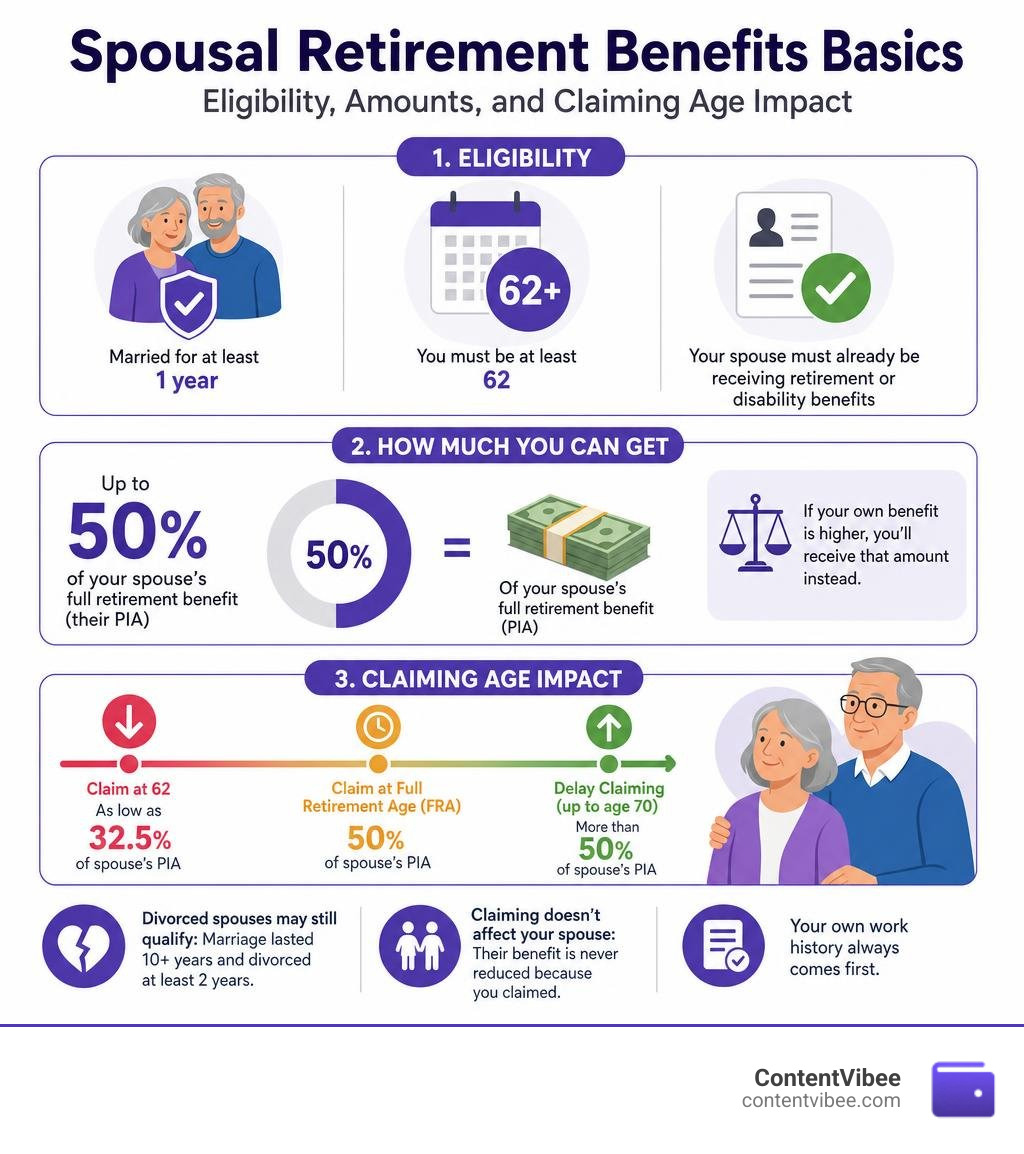
- Who qualifies: You must be at least 62, married for at least one year, and your spouse must already be receiving retirement or disability benefits.
- How much you get: Up to 50% of your spouse’s full retirement benefit (called their Primary Insurance Amount, or PIA).
- Claiming early reduces it: If you claim before your full retirement age (FRA), your benefit can drop as low as 32.5% of your spouse’s PIA.
- Own benefit takes priority: If your own retirement benefit is higher than the spousal benefit, Social Security pays the higher amount.
- Divorced spouses may still qualify: If your marriage lasted 10+ years and you’ve been divorced at least 2 years, you may still be eligible.
- Claiming doesn’t affect your spouse: Your spouse’s benefit is never reduced because you claimed on their record.
Many people — especially those who took time out of the workforce to raise children or support a partner’s career — don’t realize this benefit exists. As one common framing puts it: spousal benefits are an option many people don’t know about, and if you’re one of them, you may be missing out.
This guide walks you through everything: eligibility rules, how the math works, divorced spouse rules, railroad and government pension exceptions, and strategies to maximize what you and your partner collect together.
What Are Spousal Benefits and Who Qualifies?

When we think about retirement planning, we often focus on our personal work history. We count our quarters, estimate our average earnings, and try to figure out how much we will receive individually. But the Social Security Administration (SSA) recognizes that marriage is a financial partnership. If one partner spent years managing the home, raising children, or working in a lower-paying field, they shouldn’t be left out in the cold during their golden years.
This is where spousal retirement benefits come in. This program allows a husband or wife to receive a monthly retirement benefit based entirely on the lifetime earnings of their spouse.
But who exactly qualifies for these benefits? The basic rules require that you are currently married to a worker who is already entitled to and receiving either Retirement Insurance Benefits (RIB) or Disability Insurance Benefits (DIB). You cannot claim a spousal benefit on a living partner’s record until they have actively filed for their own benefits.
Eligibility Requirements for Spousal Retirement Benefits
To successfully claim these benefits, you must meet several strict statutory requirements. The SSA outlines these legal parameters in detail within the official policy manual, which you can review in the SSA – POMS: RS 00202.001 – Definitions and Requirements for Spouse Benefits.
To qualify, you must meet the following criteria:
- The Age Milestone: You must be at least 62 years old to claim.
- The One-Year Marriage Rule: You must have been legally married to your spouse for at least one continuous year before filing your application. (There are exceptions to this duration rule if you are the natural parent of your spouse’s child, or if you were entitled to certain other federal benefits in the month before you married).
- The “Child in Care” Exception: The age 62 requirement is completely waived if you are caring for a qualifying child of the retired worker. To qualify under this exception, the child must be under age 16 or have a disability that began before age 22. If you meet this requirement, you can receive unreduced spousal benefits at any age.
- The Primary Insurance Amount (PIA) Check: Your own individual retirement benefit (based on your own work history) must not exceed half of your spouse’s PIA. If your own benefit is higher, the SSA will simply pay you your own benefit instead.
It is also worth noting that the SSA recognizes both legal marriages and “deemed” marriages (such as good-faith ceremonies that may have had technical legal defects under state law), as well as same-sex marriages, ensuring that all modern couples have access to these vital protections.
How Spousal Benefits Are Calculated

Understanding the math behind your future monthly checks is the best way to prevent surprises. The absolute maximum amount you can receive as a spouse is 50% of your partner’s primary insurance amount (PIA).
Your spouse’s PIA is the monthly amount they are eligible to receive if they wait until their exact Full Retirement Age (FRA) to claim. It is calculated using up to 35 of their highest-earning years.
Here is how the calculation works in practice: If your spouse’s PIA at their Full Retirement Age is $2,000 per month, your maximum potential spousal benefit is $1,000 per month.
However, this 50% maximum is only available if you wait to claim spousal benefits until you reach your own Full Retirement Age. If you choose to claim earlier, your benefit will be permanently reduced.
To help you visualize how your claiming age affects your monthly payout, here is a breakdown of the spousal benefit percentages based on how early you claim relative to your Full Retirement Age:
| Months Before Full Retirement Age | Percentage of Spouse’s PIA You Receive | Example Monthly Benefit (Based on $2,000 PIA) |
|---|---|---|
| 0 (At Full Retirement Age) | 50.0% | $1,000 |
| 12 Months Early | 45.8% | $916 |
| 24 Months Early | 41.7% | $834 |
| 36 Months Early | 37.5% | $750 |
| 48 Months Early | 35.0% | $700 |
| 60 Months Early (Age 62) | 32.5% | $650 |
For personalized calculations and interactive tools to model your specific situation, you can use the official resource for Benefits for Spouses.
How Early Claiming Affects Spousal Retirement Benefits
If you decide to retire early, the penalty is permanent. The SSA reduces your spousal benefit using a specific monthly fraction for every month you claim prior to your FRA:
- For the first 36 months of early claiming: Your benefit is reduced by 25/36 of 1% for each month.
- For any additional months beyond 36 months (up to 60 months early): Your benefit is reduced by an additional 5/12 of 1% per month.
If your Full Retirement Age is 67 (which is the case for anyone born in 1960 or later) and you claim as early as possible at age 62, you are claiming exactly 60 months early.
Applying the formula:
- First 36 months: $36 \times (25/36 \times 1\%) = 25\%$ reduction.
- Remaining 24 months: $24 \times (5/12 \times 1\%) = 10\%$ reduction.
- Total reduction: $35\%$.
This means you will receive only 32.5% of your spouse’s PIA instead of the full 50%. If your spouse’s PIA is $1,600, your maximum spousal benefit at FRA would be $800. Claiming 36 months early reduces that amount to $600 (37.5%), and claiming at age 62 reduces it to $520 (32.5%).
Special Rules: Divorced Spouses, Government Pensions, and Railroad Workers
The standard rules apply to traditional married couples, but life isn’t always standard. The government has created specific rules to handle divorces, public sector pensions, and specialized industries like the railroad system.
Divorced Spouse Benefits
If you are divorced, you may still be able to claim spousal retirement benefits on your ex-spouse’s record. This is a crucial lifeline for individuals who spent years in a marriage but are now single.
To qualify for divorced spouse benefits, you must meet the following criteria:
- Your marriage must have lasted for 10 consecutive years or longer.
- You must be currently unmarried. (If you remarry, you generally lose eligibility to claim on your ex’s record, unless your subsequent marriage also ended by death or divorce).
- You must be at least 62 years old.
- Your ex-spouse must be eligible for retirement or disability benefits (even if they haven’t applied yet).
- If your ex-spouse has not yet applied for benefits, you can still claim on their record as long as you have been legally divorced for a continuous period of at least 2 years.
One of the biggest concerns people have when claiming on an ex-spouse’s record is conflict. Fortunately, the system is designed with complete privacy protections. Your ex-spouse will not be notified by the SSA when you file, and your claim will have absolutely no impact on their benefit amount or the benefits of their current spouse.
Government Pension Offset and Windfall Elimination Provision
If you worked in a federal, state, or local government job where you did not pay Social Security taxes, your spousal benefits may be heavily reduced or eliminated. This is due to the Government Pension Offset (GPO).
The GPO applies to spouses who receive a pension from a non-covered government job (such as those under the Civil Service Retirement System, or CSRS). Under GPO rules, your spousal Social Security benefit is reduced by two-thirds of the amount of your government pension.
For example, if you receive a monthly civil service pension of $1,200, two-thirds of that is $800. If you were eligible for a $900 spousal Social Security benefit, the GPO reduces your spousal benefit by $800, leaving you with just $100 per month from Social Security. If two-thirds of your pension is larger than your potential spousal benefit, your Social Security spousal payment will be reduced to zero.
For more details on how federal retirement systems handle these benefits and survivor elections, you can reference the CSRS and FERS Handbook Chapter 52.
Railroad Retirement Spouse Annuities
The railroad industry operates under its own federal retirement system rather than standard Social Security. If your spouse was a railroad employee, you may qualify for a spouse annuity through the Railroad Retirement Board (RRB).
These annuities are calculated using a unique two-tier system:
- Tier I: This is the Social Security equivalent. It is calculated using standard Social Security formulas as if railroad work were covered employment. It is equal to 50% of the employee’s Tier I benefit before reductions.
- Tier II: This is a private pension-style benefit. The spouse component is equal to 45% of the employee’s Tier II amount.
Railroad spouse benefits are highly advantageous. In fiscal year 2023, the average monthly railroad spouse annuity was $1,235, compared to the average monthly Social Security spouse benefit of $865. For divorced railroad spouses, the average annuity paid in the final quarter of 2023 was $831.58 (note that divorced railroad spouses only receive the Tier I portion).
To learn more about these specific rules, read the official guide on Railroad Retirement Spouse Annuities and view the statutory calculations under 45 U.S. Code § 231c – Computation of spouse and survivor annuities.
Coordinated Claiming Strategies to Maximize Spousal Retirement Benefits
Maximizing your household’s total lifetime retirement income requires a coordinated strategy. You shouldn’t look at your benefits in isolation; instead, look at them as a combined puzzle.
One of the most effective strategies for married couples is the higher-earner delay. While delaying your claim past Full Retirement Age does not increase your spousal benefit (spousal benefits do not earn delayed retirement credits), delaying does increase the primary worker’s retirement benefit by 8% per year up to age 70.
More importantly, delaying the higher earner’s claim maximizes the future survivor benefit for the surviving spouse.
We can visualize the optimal planning process for couples with this simple framework:
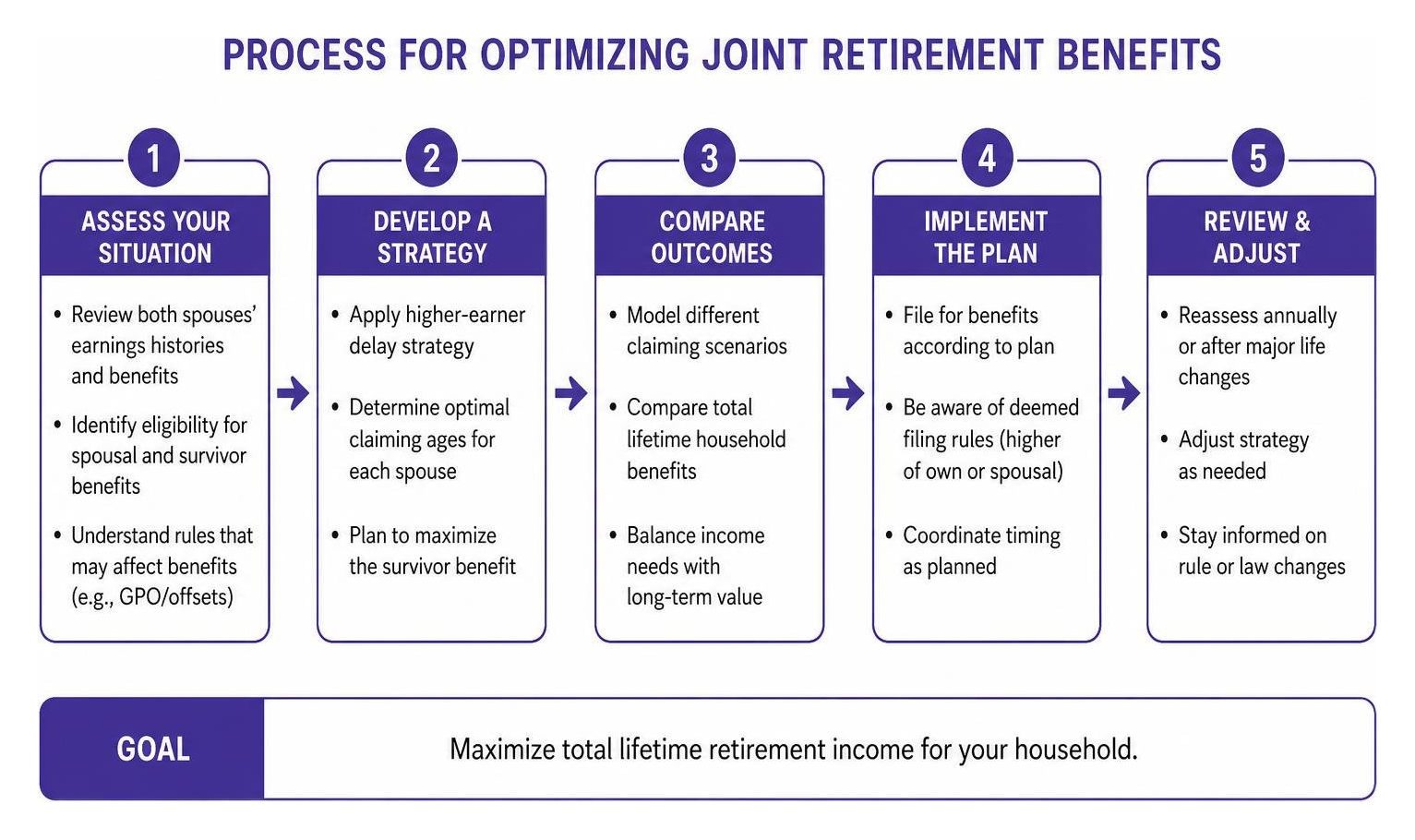
It is also important to understand the deemed filing rules. Under the Bipartisan Budget Act of 2015, which eliminated older loopholes like “file-and-suspend” and “restricted applications” for anyone turning 66 after May 1, 2016, you no longer have the luxury of choosing which benefit to claim first.
When you apply for either your own retirement benefit or a spousal benefit, you are “deemed” to have applied for both. The SSA will automatically calculate both and pay you the higher of the two amounts.
Frequently Asked Questions about Spousal Benefits
What is the difference between spousal benefits and survivor benefits?
Spousal benefits are paid while your spouse is still alive and max out at 50% of their primary insurance amount. Survivor benefits are paid after your spouse passes away and can be worth up to 100% of the deceased worker’s actual benefit amount. Furthermore, while spousal benefits require you to be at least 62, surviving spouses can claim survivor benefits as early as age 60 (or age 50 if disabled).
Can both spouses receive benefits on each other’s records?
No. The SSA does not allow “double dipping” where both partners collect a spousal benefit on each other’s records simultaneously. Each person will receive their own individual retirement benefit, or a spousal benefit based on their partner’s record, whichever amount is higher.
Will my ex-spouse know if I claim benefits on their record?
No. Because of federal privacy laws, the SSA will never notify your ex-spouse that you have filed a claim on their work record. Your claim is treated as an entirely independent entitlement and has no effect on their personal monthly payments.
Conclusion
Navigating the rules of spousal retirement benefits can feel overwhelming, but taking the time to understand your options is one of the smartest financial moves you can make as a couple. At ContentVibee, we believe in delivering clear, actionable, step-by-step financial advice to help you secure the retirement you deserve.
By coordinating your claiming ages, understanding how early retirement reductions work, and accounting for special rules like divorced spouse benefits or government pension offsets, you can easily avoid leaving money on the table.
Ready to see how the numbers play out for your household? Start planning your stress-free retirement today!


