


Will Inflation Push You Into a Higher Tax Bracket in 2026?
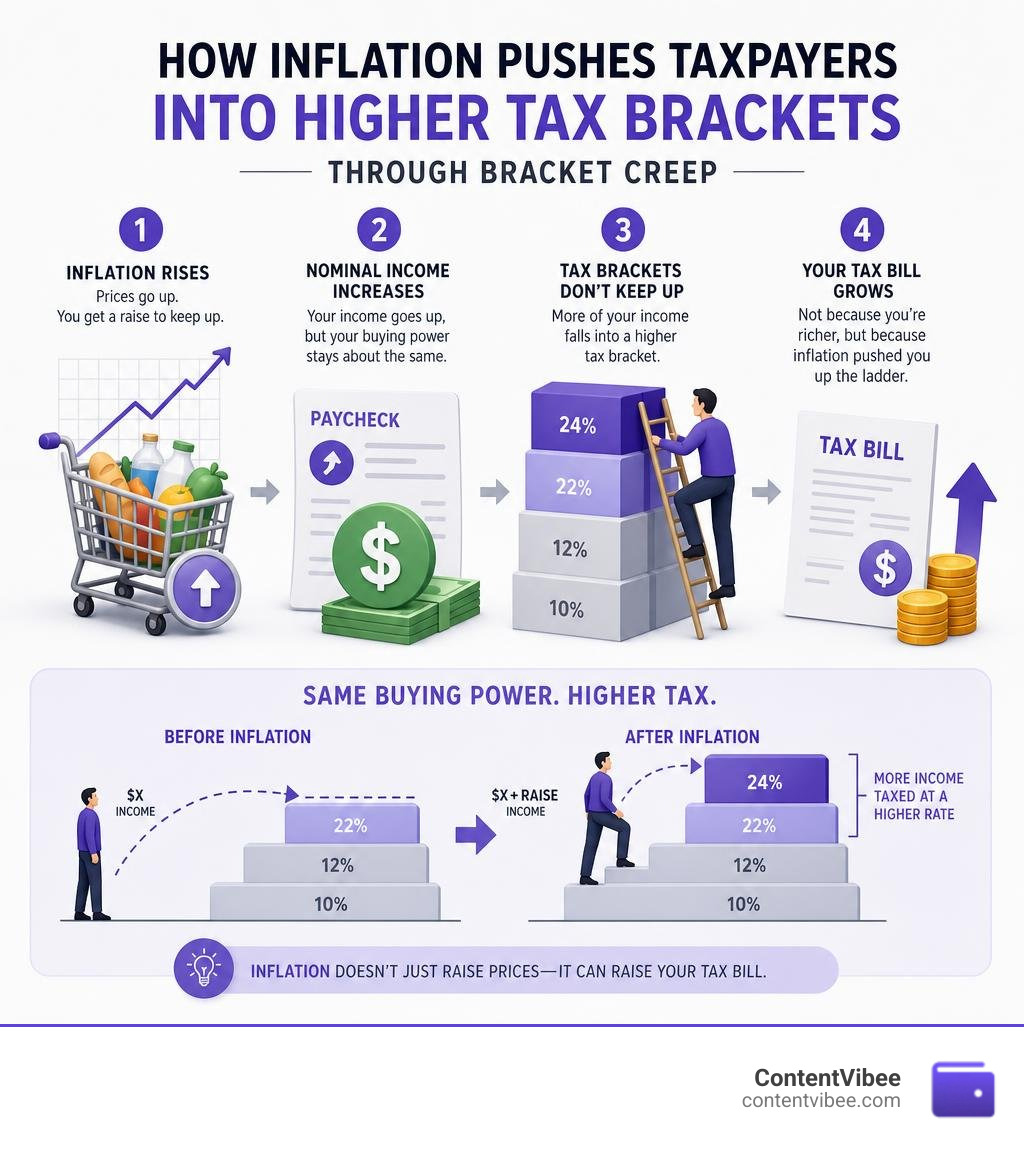
Tax bracket inflation is the quiet tax squeeze that happens when your paycheck rises with inflation, but your real buying power does not. On paper, you earn more. In real life, groceries, housing, insurance, and retirement costs may have already swallowed the raise.
That is the Discover-worthy question for 2026: could an inflation raise leave you with less after-tax cash? Even with annual IRS inflation adjustments, some taxpayers can still see more income taxed at higher rates — especially when raises, Social Security COLAs, investment income, or retirement withdrawals collide with provisions that are not fully indexed.
Here is the quick version:
- Inflation raises prices — your cost of living goes up.
- Your nominal income rises — your paycheck, COLA, or withdrawals may increase.
- Some tax thresholds lag behind — brackets adjust, but not every deduction, credit, or income limit keeps pace.
- Your after-tax cash flow can shrink — even if you are not truly richer.
This is called bracket creep, and it is one of the most misunderstood ways inflation can raise your tax bill.
The IRS adjusts more than 60 tax provisions for inflation every year, including income thresholds for each bracket and the standard deduction. For 2026, those adjustments averaged about 2.7%. But not every tax provision gets updated, and the chained CPI formula used for federal tax inflation adjustments tends to rise more slowly than traditional CPI measures. That gap is where bracket creep can still slip in.
For Google Discover, the article works best when it answers one urgent personal-finance concern quickly, then gives readers practical next steps. This guide keeps the focus on the 2026 tax-year numbers, why inflation still matters, and what workers and retirees can do before a raise, COLA, Roth conversion, or required withdrawal creates an avoidable tax surprise.
Understanding Tax Bracket Inflation and Bracket Creep

To understand how tax bracket inflation affects your wallet, we have to look at the mechanics of progressive taxation. In the United States, we don’t pay a single flat rate on our income. Instead, our tax system is structured like a staircase, where higher portions of your income are taxed at progressively higher marginal rates.
Your marginal tax rate is the rate you pay on the very next dollar of income you earn. Your average tax rate, on the other hand, is your total tax bill divided by your total taxable income.
For example, if you are a single filer with a taxable income of $20,000, you don’t pay the same rate on the whole amount. The first portion of your income falls into the 10% bracket, and the rest is taxed at 12%. This means your marginal rate is 12%, but your average rate is lower (around 10.5%).
Here is how bracket creep disrupts this balance:

When inflation is high, your nominal income (the number on your paycheck) might go up by 3% or 4% to help you keep pace with the rising cost of groceries and housing. However, if the tax brackets do not adjust upward by that same amount, that raise will push a larger portion of your earnings into a higher tax bracket.
Even though your real purchasing power hasn’t changed at all, your average tax rate increases, leaving you with less money after taxes. According to the Congressional Research Service, automatic tax indexing was introduced in 1981 to prevent this exact issue, but the way we measure inflation has changed over time. For a deeper look at the historical context, you can read the CRS Releases Federal Tax Bracket Overview.
How Chained CPI Drives Tax Bracket Inflation
Historically, the IRS used the Consumer Price Index for All Urban Consumers (CPI-U) to adjust tax brackets. However, starting in 2018, the federal government permanently switched to the Chained Consumer Price Index (C-CPI-U).
What is the difference, and why should you care? The answer lies in the substitution effect.
The standard CPI-U assumes that consumers buy the same basket of goods regardless of price. Chained CPI, however, accounts for consumer behavior. If the price of beef skyrockets, chained CPI assumes you will substitute it with chicken. Because it accounts for this shifting behavior, C-CPI-U consistently produces a lower estimate of inflation than CPI-U.
Between late 2015 and late 2025, C-CPI-U rose by 33%, while the traditional CPI-U rose by 37%. Because the IRS uses Chained CPI:
- Tax brackets and standard deductions rise more slowly each year.
- Slower adjustments mean taxpayers experience slightly more bracket creep over time.
- This policy change functions as a stealth revenue generator for the government. In fact, the Joint Committee on Taxation estimated that switching to Chained CPI would bring in an additional $134 billion in federal revenue over a ten-year period.
The Legislative Impact of TCJA and the One Big Beautiful Bill Act
The tax landscape saw massive shifts with the Tax Cuts and Jobs Act (TCJA) of 2017, which lowered individual rates and nearly doubled the standard deduction while suspending the personal exemption. Many of these individual provisions were originally set to expire at the end of 2025. You can read more about how those timelines affect your planning in our guide on the TCJA Expiration Date and What It Means for Your Wallet.
However, the passage of the One Big Beautiful Bill Act (OBBBA) permanently reshaped these rules for 2026 and beyond.
The OBBBA made the suspension of the personal exemption permanent (keeping it at $0) and locked in the higher standard deductions. Additionally, it permanently eliminated the limitation on itemized deductions for most taxpayers, though it retained a limitation for those in the highest 37% tax bracket.
Notably, for the 2026 tax year, the OBBBA implemented a dual-track inflation adjustment: it applied a generous 4% inflation adjustment to the bottom two brackets (10% and 12%) and a 2.3% adjustment to the top five brackets, resulting in an average adjustment of roughly 2.7% across all tax parameters.
The 2026 Federal Income Tax Brackets and Deductions
For the 2026 tax year, the IRS has officially released the inflation-adjusted brackets and standard deductions. Thanks to the OBBBA, these numbers reflect both cost-of-living adjustments and statutory changes.
| Tax Rate | Single Filers | Married Filing Jointly | Head of Household |
|---|---|---|---|
| 10% | Up to $12,400 | Up to $24,800 | Up to $17,700 |
| 12% | $12,400 to $50,400 | $24,800 to $100,800 | $17,700 to $72,100 |
| 22% | $50,400 to $105,700 | $100,800 to $211,400 | $72,100 to $108,700 |
| 24% | $105,700 to $201,775 | $211,400 to $403,550 | $108,700 to $201,750 |
| 32% | $201,775 to $256,225 | $403,550 to $512,450 | $201,750 to $256,200 |
| 35% | $256,225 to $640,600 | $512,450 to $768,700 | $256,200 to $640,600 |
| 37% | Over $640,600 | Over $768,700 | Over $640,600 |
For 2026, the standard deduction has increased to:
- Single: $16,100 (up from $15,350 in 2025)
- Married Filing Jointly: $32,200 (up from $30,700 in 2025)
- Head of Household: $24,150 (up from $23,050 in 2025)
These updates mean that a married couple can earn $32,200 completely tax-free before federal income tax kicks in. To view the official announcement and the full list of adjusted rules, you can review the IRS releases tax inflation adjustments for tax year 2026.
Key 2026 Inflation-Adjusted Tax Parameters
Beyond the standard brackets, several other critical provisions have been adjusted for the 2026 tax year to keep pace with inflation:
- Estate Tax Exclusion: The lifetime basic exclusion amount for estates has risen to $15,000,000 per individual in 2026, up from $13,990,000 in 2025.
- Annual Gift Tax Exclusion: The annual limit for tax-free gifts remains at $19,000 for 2026, while the exclusion for gifts to a non-citizen spouse has increased to $194,000.
- Earned Income Tax Credit (EITC): The maximum EITC amount for qualifying taxpayers with three or more children is now $8,231 (up from $8,046 in 2025).
- Child Tax Credit (CTC): The maximum CTC is $2,200 per qualifying child, with the refundable portion capped at $1,700.
- Foreign Earned Income Exclusion: American citizens working abroad can now exclude up to $132,900 of foreign-earned income, up from $130,000 in 2025.
The New Temporary Senior Deduction and Social Security Impacts
One of the most talked-about additions in the OBBBA is a temporary senior deduction designed to help older Americans combat the rising cost of living. Seniors aged 65 and older can claim an additional $6,000 deduction. However, this benefit is targeted at low- and middle-income retirees and phases out at a rate of 6% for incomes above $75,000 for single filers and $150,000 for married couples filing jointly.
At the same time, Social Security benefits are receiving a 2.8% cost-of-living adjustment (COLA) for 2026. While this boost helps cover daily expenses, it can create a major tax trap.
The income thresholds that determine whether your Social Security benefits are taxable (such as the provisional income limit of $25,000 for single filers and $32,000 for married couples) are not indexed for inflation. They have remained completely unchanged since they were established decades ago.
As a result, when retirees receive their 2.8% COLA increase, that extra money can easily push them over these static thresholds, causing their benefits to be taxed for the first time. To protect your retirement income from this trap, take a look at our detailed resources:
- Taxing Your Golden Years: A Guide to Social Security Tax on Benefits
- Uncle Sam’s Cut: Understanding Taxes on Social Security
- Social Security Taxable Income Guide 2026
Additionally, working professionals should note that the Social Security wage base has increased to $184,500 for 2026 (up from $176,100). This means an additional $8,400 of your salary will be subject to the 6.2% payroll tax.
How to Calculate and Minimize Your Inflation-Adjusted Tax Bill

Now that you know how tax bracket inflation works, let’s talk about how to fight back. You don’t have to sit by and let bracket creep chip away at your hard-earned savings. Here are some of the most effective strategies to lower your taxable income:
- Maximize Retirement Contributions: Contributions to traditional 401(k)s, 403(b)s, and IRAs are made with pre-tax dollars, which directly lowers your taxable income. For 2026, the employee contribution limit for 401(k)s has risen to $24,000, and the standard IRA contribution limit is $7,500.
- Leverage Health Savings Accounts (HSAs): HSAs offer a rare “triple tax advantage.” Contributions are tax-deductible, growth is tax-free, and withdrawals for qualified medical expenses are completely tax-free. If you have a high-deductible health plan, maximizing this account is an excellent way to reduce your current-year tax bill.
- Execute Strategic Roth Conversions: If you expect to be in a higher tax bracket in the future, converting a traditional retirement account to a Roth account during a year when tax brackets have adjusted significantly upward can allow you to pay taxes now at a lower relative rate, paving the way for tax-free growth.
- Practice Tax-Loss Harvesting: If you have investments in taxable brokerage accounts, you can sell underperforming assets at a loss to offset capital gains. If your losses exceed your gains, you can use up to $3,000 of those losses to offset your ordinary taxable income.
To see exactly how these changes impact your bottom line, you can play around with the interactive Calcix — Run the numbers. Or be run by them. tool to model different scenarios.
State-Level Variations in Tax Bracket Inflation
While we often focus on federal rules, state taxes can have a massive impact on your overall tax liability. State income tax systems vary widely in how they handle inflation:
- Indexed States: Roughly two-thirds of states with graduated income taxes automatically adjust their tax brackets and standard deductions for inflation every year, mirroring the federal system.
- Non-Indexed States: About 15 states and Washington, D.C., do not index their tax brackets. In these states, bracket creep is a silent, ongoing tax hike, as even small cost-of-living raises can permanently push you into higher state tax brackets.
- No-Income-Tax States: States like Texas, Florida, and Nevada have no individual state income tax, making them highly popular for retirees looking to minimize their tax burdens.
If you are trying to figure out where to settle down, check out our rankings of the Best States for Taxes in Retirement Ranked and our comprehensive directory of The Ultimate Guide to State Pension Tax Breaks and Exemptions.
For those living on the West Coast, navigating state-specific rules is especially important. You can learn more about how local adjustments work in The Golden State Guide: Deciphering CalPERS COLA and California Tax Adjustments.
Frequently Asked Questions about Inflation and Taxes
What is bracket creep and how does it affect my paycheck?
Bracket creep occurs when inflation increases your nominal income (the dollar amount on your paycheck) and pushes you into a higher tax bracket, even though your real purchasing power (what those dollars can actually buy) has stayed the same or even decreased. The result is a higher overall tax bill without any real financial gain.
Why did the IRS switch to Chained CPI for inflation adjustments?
Congress permanently switched from the traditional CPI-U to the Chained CPI (C-CPI-U) starting in 2018. Because Chained CPI accounts for the fact that consumers substitute cheaper items when prices rise, it reports a lower rate of inflation. This slower growth rate means tax brackets adjust upward more slowly, which prevents brackets from keeping full pace with headline inflation and generates extra revenue for the federal government.
Are all tax credits and deductions indexed for inflation?
No. While major items like the standard deduction and tax brackets are adjusted annually, several key provisions are entirely unindexed. For example, the $2,500 limit on the student loan interest deduction, the income thresholds for the 0.9% Additional Medicare Tax and the 3.8% Net Investment Income Tax (which have remained at $200,000 for single filers and $250,000 for married couples since 2013), and the taxability thresholds for Social Security benefits do not adjust for inflation.
Conclusion
Inflation can raise your tax bill in ways that are easy to miss. Even when the IRS adjusts brackets and standard deductions, unindexed thresholds, slower chained CPI adjustments, Social Security taxation rules, and retirement income decisions can still create bracket creep.
The practical move is to plan before the tax year gets away from you. Review your projected 2026 taxable income, retirement contributions, HSA eligibility, Roth conversion opportunities, Social Security taxation risk, and state tax exposure. Small adjustments now can help prevent an inflation raise from turning into a surprise tax bill later.
Ready to take control of your retirement taxes? Learn how to protect your benefits and keep Uncle Sam’s hands out of your nest egg by reading our Secure Your Retirement with ContentVibee’s Social Security Tax Guide.


