


Why a Health Insurance Plans Comparison Can Save You Thousands in 2026
A smart health insurance plans comparison could be one of the most valuable financial decisions you make this year. With average marketplace premiums hitting $619 per month before subsidies — and dropping to just $113 with tax credits — the difference between picking the right plan and the wrong one is enormous.
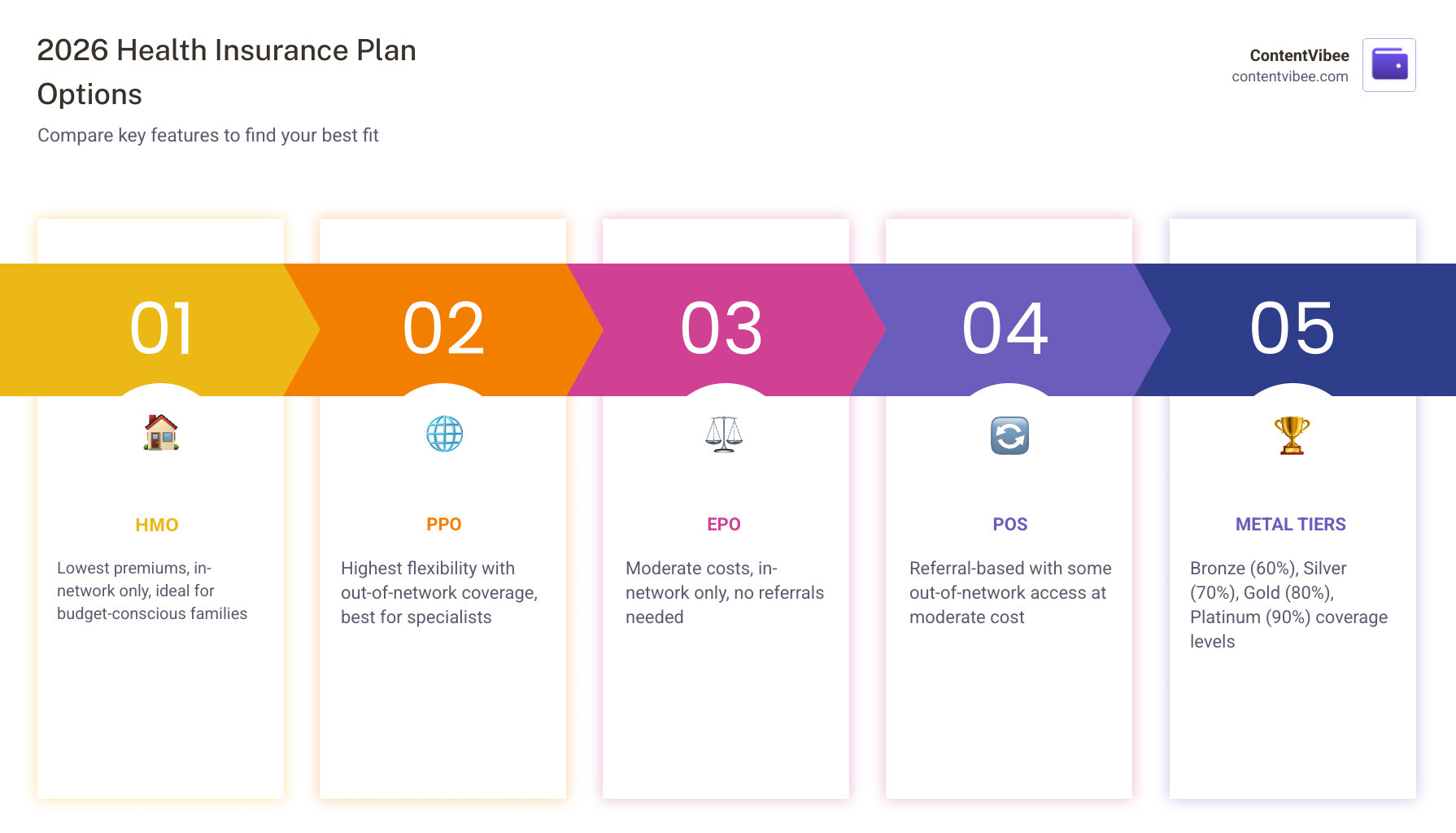
Here is a quick breakdown of your main options:
| Plan Type | Best For | Network Flexibility | Avg. Cost |
|---|---|---|---|
| HMO | Budget-conscious, consistent care | Low (in-network only) | Lowest |
| PPO | Flexibility, specialist access | High (in + out-of-network) | Highest |
| EPO | Mid-range flexibility | Medium (in-network only) | Moderate |
| POS | Referral-based flexibility | Medium | Moderate |
And by metal tier:
| Tier | Plan Pays | Best For |
|---|---|---|
| Bronze | 60% | Healthy, low usage |
| Silver | 70% | Most buyers (subsidy sweet spot) |
| Gold | 80% | Frequent care needs |
| Platinum | 90% | High ongoing medical costs |
Shopping for health coverage is genuinely hard. You are juggling premiums, deductibles, networks, and drug formularies — all at once. And the stakes are high. Choose wrong and you could face thousands of dollars in unexpected bills.
The good news? Once you understand a few key concepts, the comparison process becomes much more manageable.
This guide breaks everything down — plan types, metal tiers, subsidies, and common mistakes — so you can choose the right 2026 coverage with confidence.
Navigating the Health Insurance Plans Comparison Process
When we sit down to look at health insurance, it often feels like trying to solve a puzzle where the pieces keep changing shape. In 2026, the marketplace remains the primary hub for individuals, families, and the self-employed to secure coverage. However, simply looking at the monthly premium is a trap many of us fall into.
A true health insurance plans comparison requires looking at the “total cost of ownership.” This includes your monthly premiums, what you pay when you actually visit a doctor (deductibles and copays), and the maximum amount you could possibly lose in a worst-case scenario (out-of-pocket maximum).
For those of us here in Virginia, we have access to specific resources like Virginia’s Marketplace Plan Comparison Tool which helps narrow down local options. Whether you are a freelancer in Richmond or a family in Alexandria, understanding your local network flexibility is the first step to avoiding “sticker shock” at the doctor’s office. You can also explore more about How to Choose the Best Health Insurance Plan through our curated insurance guides.

Understanding HMO, PPO, EPO, and POS Networks
The “alphabet soup” of insurance types—HMO, PPO, EPO, and POS—actually describes how much freedom you have to choose your doctors and how much you’ll pay for that privilege.
- HMO (Health Maintenance Organization): These are usually the most affordable. You must choose a Primary Care Physician (PCP) who acts as a “gatekeeper.” If you need to see a specialist, you need a referral. There is typically zero coverage for out-of-network care.
- PPO (Preferred Provider Organization): This is the “gold standard” for flexibility. You don’t need referrals, and you can see out-of-network doctors (though you’ll pay more for them). Blue Cross Blue Shield is often cited for having the largest physician networks, covering nearly 49% of doctors on average.
- EPO (Exclusive Provider Organization): Think of this as a hybrid. You don’t need a referral to see a specialist, but like an HMO, there is no coverage for out-of-network care except in emergencies.
- POS (Point of Service): These require a PCP referral for specialists but do offer some limited out-of-network coverage at a higher cost.
Choosing between these often depends on your family’s specific needs. For instance, if you have a child away at college in another state, a PPO with a national network might be a necessity. You can find More info about family coverage to see which structure fits your household best.
Decoding Metal Tiers for Health Insurance Plans Comparison
The “Metal Tiers” (Bronze, Silver, Gold, and Platinum) do not reflect the quality of medical care you receive—doctors don’t treat you differently because you have a Bronze plan. Instead, they represent the “actuarial value,” or the split of costs between you and the insurance company.
| Tier | Insurer Pays | You Pay (Avg) | Monthly Premium | Deductible |
|---|---|---|---|---|
| Bronze | 60% | 40% | Lowest | Highest |
| Silver | 70% | 30% | Moderate | Moderate |
| Gold | 80% | 20% | High | Low |
| Platinum | 90% | 10% | Highest | Lowest |
In Virginia, for 2026, a 30-year-old might see Bronze plans starting around $362 per month. However, if you have a chronic condition like diabetes or asthma, a Gold plan might actually be cheaper in the long run because the lower deductibles and copays offset the higher monthly premium.
Evaluating Costs Beyond Monthly Premiums
We often focus on the premium because it’s the bill we see every month. But the “hidden” costs are what usually break the budget.
- Deductibles: This is the amount you pay out-of-pocket before your insurance starts to chip in. In 2026, some Bronze plan deductibles can exceed $7,000 for an individual.
- Out-of-Pocket Maximum: This is your safety net. Once you hit this limit (often around $9,100 for Silver plans), the insurance company pays 100% of covered services.
- Prescription Coverage: Not all plans cover the same drugs. Always check the “formulary” to see if your specific medications are on a low-cost tier.
- HSA Eligibility: High-Deductible Health Plans (HDHPs) often allow you to open a Health Savings Account. This is a triple-tax-advantaged way to save for medical costs. Check out our More info about HSA tools to see if the tax savings outweigh the higher deductible.
Maximizing Savings and Finalizing Your 2026 Coverage
The secret to a successful health insurance plans comparison is knowing how to make the government pay for a portion of your bill. Thanks to the Inflation Reduction Act, enhanced subsidies have been extended through 2026. This means that for many Americans, the cost of a benchmark Silver plan is capped at 8.5% of their household income, regardless of how much they earn.

Leveraging Subsidies and Tax Credits
There are two main types of financial help available on the marketplace:
- Premium Tax Credits: These lower your monthly bill. If your income is between 100% and 400% of the Federal Poverty Level (FPL)—which for an individual in 2026 is roughly up to $62,600—you likely qualify.
- Cost-Sharing Reductions (CSR): This is the “Silver Plan Trick.” If your income is below 250% of the FPL ($39,125 for an individual), you should almost always buy a Silver plan. Why? Because the government automatically lowers your deductible and out-of-pocket maximum. You essentially get Gold or Platinum-level coverage for a Silver-level price.
For those of us who are self-employed, we can even use Traditional IRA contributions to lower our Modified Adjusted Gross Income (MAGI), which in turn can increase the size of our insurance subsidies. It’s a double win for your wallet. For more on navigating these choices, see our guide on Understanding Individual and Family Health Insurance.
Avoiding Common Pitfalls in Health Insurance Plans Comparison
Even with the best tools, it’s easy to step into a “value trap.” Here are the most common mistakes we see:
- Ignoring Pre-Deductible Benefits: Some plans allow you to see a primary care doctor or buy generic drugs for a small copay before you meet your huge deductible. These are incredibly valuable for day-to-day health.
- The “Out-of-Network” Surprise: If you choose an HMO or EPO and see a specialist who isn’t in your network, you might be responsible for 100% of the bill. Always verify your current doctors are in-network before hitting “enroll.”
- Dental and Vision: For adults, dental and vision are generally not “essential health benefits” under the ACA. You may need to add a separate “standalone” dental plan. Companies like Ambetter are often noted for offering robust adult dental add-ons.
- Ignoring Complaint Scores: A low premium isn’t worth it if the company denies every claim. Look for the NAIC complaint score. A score of 1.0 is average; companies like Molina often score lower (around 0.7), meaning they have 30% fewer complaints than the industry average. You can find More info about insurance categories to compare provider reputations.
Enrollment Periods and Next Steps
For 2026 plans, the Open Enrollment Period typically runs from November 1, 2025, to January 15, 2026. If you want your coverage to start on New Year’s Day, you generally need to sign up by December 15.
If you miss this window, you can only enroll if you have a Qualifying Life Event for a Special Enrollment Period. These include:
- Losing existing health coverage (like leaving a job).
- Getting married or divorced.
- Having a baby or adopting.
- Moving to a new permanent residence in a different ZIP code.
At ContentVibee, our mission is to provide quick, practical money tips for Americans. Whether you are calculating Average Refi Closing Costs or comparing the latest health tiers, we are here to help you navigate the complexities of 2026 finance.
Don’t wait until the last minute. Gather your 2025 tax returns, make a list of your current prescriptions, and start your health insurance plans comparison today. Your future self—and your bank account—will thank you.


