


Mobile Home Investment ROI and Financing Risk Analysis is one of the most misunderstood topics in real estate — yet the numbers can be surprisingly compelling for investors who know what to look for.
Here’s a quick snapshot of what the data shows:
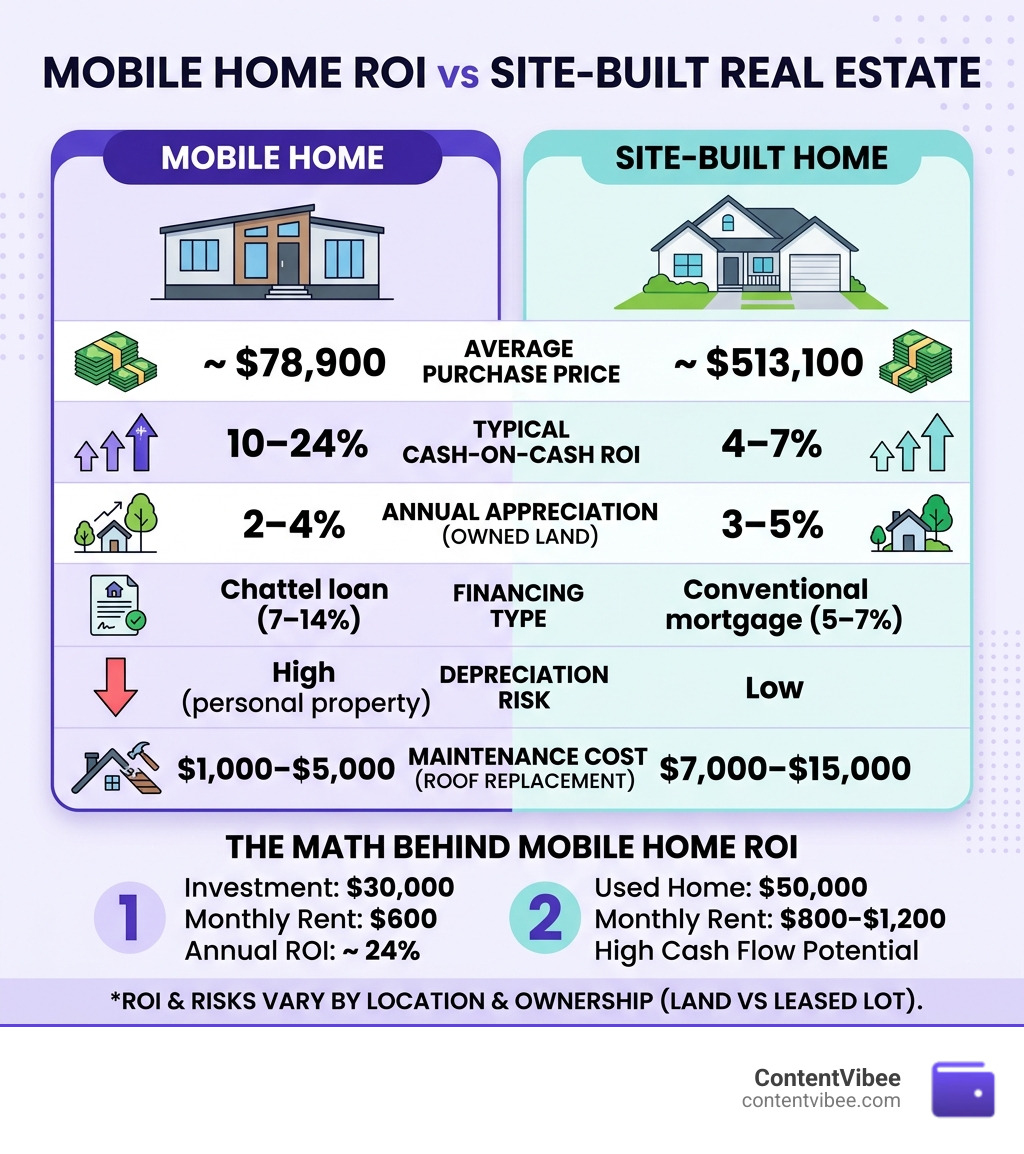
| Factor | Mobile Home | Site-Built Home |
|---|---|---|
| Average purchase price | ~$78,900 | ~$513,100 |
| Typical cash-on-cash ROI | 10–24% | 4–7% |
| Annual appreciation (owned land) | 2–4% | 3–5% |
| Financing type | Chattel loan (7–14%) | Conventional mortgage (5–7%) |
| Depreciation risk | High (personal property) | Low |
| Maintenance cost (roof replacement) | $1,000–$5,000 | $7,000–$15,000 |
The appeal is real. A $30,000 mobile home renting for $600 a month generates a 24% annual ROI — numbers most traditional real estate investors can only dream about.
But the risks are equally real.
Mobile homes classified as personal property face higher loan rates, faster depreciation, and limited financing options. And the difference between owning land versus leasing a lot can mean the difference between building wealth and losing it slowly over 10–25 years.
This guide breaks down both sides — the returns and the risks — so you can make a clear-eyed decision.
ROI Analysis: Cash-on-Cash Returns and Rent-to-Price Ratios
When we look at the pure math of cash flow, mobile homes often run laps around traditional condos and single-family houses. The secret lies in the rent-to-price ratio. In the traditional real estate world, a “good” deal might follow the 1% rule (where monthly rent equals 1% of the purchase price). In the mobile home sector, we frequently see 2% or even 3%.
For example, a used mobile home purchased for $50,000 in a decent community can often command rents between $800 and $1,200 per month. Compare that to a $250,000 condo that might only rent for $1,500 to $2,000. The mobile home investor is getting significantly more “bang for their buck” in terms of monthly cash flow.
However, we have to distinguish between different types of setups. Not all mobile home investments are created equal.
| Investment Type | Typical Annual ROI | Primary Benefit | Primary Risk |
|---|---|---|---|
| Individual Unit (Park) | 15–18% | Low entry cost | Lot rent hikes |
| Individual Unit (Owned Land) | 10–13% | Appreciation | Higher entry cost |
| Mobile Home Park (MHP) | 7–10% (Cap Rate) | Scalability | Infrastructure costs |
As we explore Understanding Traditional vs Alternative Investments, it becomes clear that mobile homes sit in a unique “hybrid” category. They offer the cash flow of a business with the physical asset backing of real estate.
One of the key drivers of these high returns is the sheer demand for affordable housing. In April 2026, with site-built home prices remaining out of reach for many, manufactured housing has become the go-to solution for millions of Americans. This keeps vacancy rates low — often around 6% nationally — ensuring that our ROI remains stable even during economic shifts.
Mobile Home Investment ROI and Financing Risk Analysis
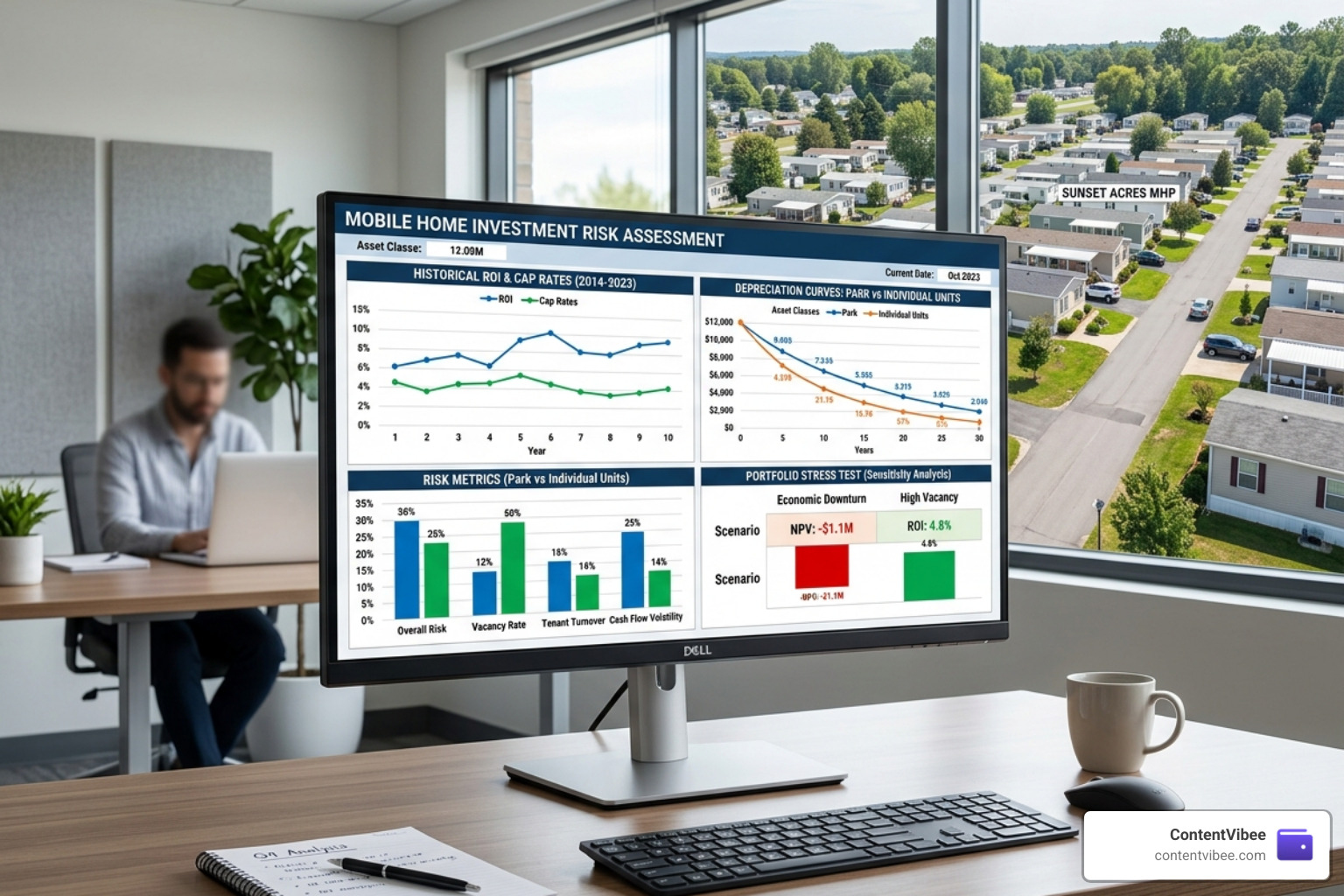
Now, let’s get into the “risk” part of our Mobile Home Investment ROI and Financing Risk Analysis. If you’ve ever bought a new car, you know the pain of “drive-off depreciation.” Mobile homes, unfortunately, share this trait when they are not attached to deeded land.
Research shows that a new mobile home can lose approximately 5% of its value almost immediately upon purchase. This depreciation can continue at a rate of 5% annually. A $150,000 double-wide might lose 55% of its resale value over a decade if it’s sitting on a leased lot. This is because, legally, the home is often classified as personal property (like a vehicle) rather than real property.
Calculating Mobile Home Investment ROI and Financing Risk Analysis for Parks
Investing in an entire mobile home park shifts the math entirely. Instead of worrying about a single unit’s depreciation, we focus on the lot rent. In a 50-lot park where each tenant pays $500 a month in lot rent, the gross income is $25,000 monthly, or $300,000 a year.
The beauty of this model? The tenants usually own the homes. We just own the dirt and the utility hookups. This drastically reduces our maintenance responsibility. While a traditional landlord has to fix a leaky faucet or a broken HVAC, a park owner only worries about the “main lines.” This low-overhead model leads to Cap Rates in the 7–10% range, which is significantly higher than the 4–6% seen in most apartment complexes today.
Long-Term Mobile Home Investment ROI and Financing Risk Analysis
If we look at a 25-year horizon, the location becomes the ultimate ROI driver. Let’s take the Phoenix, Arizona market as a case study. An investor who puts $280,000 into a manufactured home on owned land with a permanent foundation can see a very different outcome.
With a 3% annual appreciation rate, that $280,000 investment could yield over $300,000 in total appreciation over 25 years. That’s a 109% total ROI just on the equity side, not counting the monthly rental income. This highlights why Why EnergyX Investment Risk Analysis Long-Term strategies are so important; you have to look past the immediate cash flow to see how the asset will perform over decades.
Financing Hurdles: Chattel Loans, Interest Rates, and Credit Fraud
Financing is where many mobile home dreams meet a harsh reality. Because these homes are often titled as personal property, they don’t qualify for standard 30-year fixed mortgages. Instead, buyers must use “chattel loans.”
Chattel loans typically come with:
- Higher Interest Rates: Usually 2% to 3% higher than conventional mortgages, often ranging from 7% to 14%.
- Shorter Terms: 10 to 20 years instead of 30.
- Stricter Requirements: Larger down payments (often 20%+) for investors.
If you are looking to scale, you might wonder How Much Do You Need to Invest with Blackstone? or other big private equity firms. The truth is that while institutional money is pouring into mobile home parks, individual investors still have an edge in the “small park” (under 50 lots) niche where traditional bank financing is harder to get and seller financing is common.
Identity Theft and Credit Fraud in Mobile Home Financing
In the digital age of 2026, the financing process is rife with security risks. When applying for specialized loans, you are often sharing sensitive data with smaller, niche lenders who may not have the same cybersecurity budget as a global bank.
We’ve seen a rise in identity theft credit report fraud how to fix and protect your score USA searches because a single breach can tank an investor’s ability to secure funding. If you are a victim of unauthorized bank transaction how to dispute and recover money USA 2026, your first step must be to freeze your credit and contact the fraud department of your financial institution immediately.
Common risks include:
- Loan Application Scams: Fraudsters posing as “specialized lenders” to harvest your SSN.
- Wire Transfer Fraud: Intercepted closing costs during a park acquisition.
- SSN Misuse: Criminals using your identity to take out chattel loans on multiple units.
If you find yourself in a wire transfer fraud victim what to do and recovery options USA 2026 situation, time is of the essence. You must report the incident to the FBI’s IC3 and your bank within 24 hours to have any hope of a “clawback.”
Land Ownership vs. Lot Leasing: The 2026 Equity Divide
The biggest fork in the road for any mobile home investor is the “Dirt vs. Rent” debate.
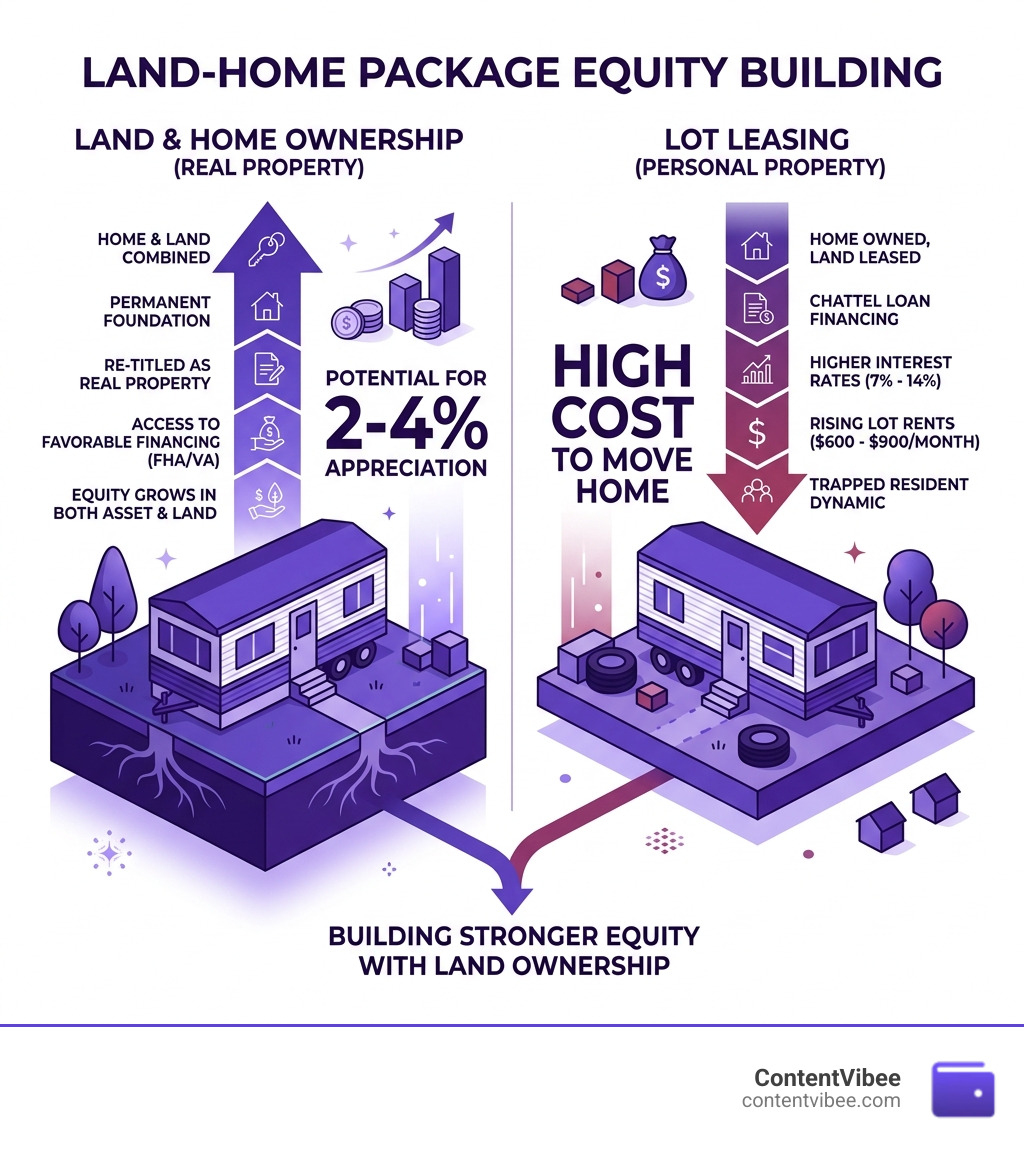
The Case for Owned Land: When you own the land and place the home on a permanent foundation, the home can be re-titled as “Real Property.” This is the “Golden Ticket.” It allows for FHA and VA financing, which brings interest rates down and appreciation rates up (to that 2–4% range). It also protects you from the “trapped resident” dynamic.
The Case for Lot Leasing: Leasing a lot in a park is much cheaper upfront. However, in 2026, lot rents in many corporate-owned parks have climbed to $600–$900 per month. Because moving a double-wide can cost $10,000 to $20,000, many owners find themselves “trapped.” If the park owner raises the rent by 10% every year, your ROI as a rental owner begins to evaporate.
Strategic Risk Mitigation and Tax Optimization
To truly master Mobile Home Investment ROI and Financing Risk Analysis, we have to look at the “boring” stuff: taxes and regulations.
- Section 8 Stability: One of our favorite ways to mitigate risk is through government programs. Mobile homes often qualify for Section 8 vouchers. This provides guaranteed rental income directly from the government, which is a massive stabilizer during recessions.
- Depreciation Schedules: While the market value of a mobile home might drop, the tax benefit is high. You can often depreciate the structure over a shorter period than a site-built home, providing a larger annual tax shield for your other income.
- Infrastructure Audits: If you are buying a park, your biggest risk isn’t the tenants — it’s the septic system. A failed septic field can cost $100,000 or more to replace, which can wipe out three years of profit in a single month. Always perform a camera inspection of the lines before closing.
For those doing deep-dive research, tools like the Zacks Rank system can help you analyze the parent companies of major manufactured home builders or REITs (Real Estate Investment Trusts) that own parks. While we focus on physical property, knowing the financial health of the industry leaders provides a macro-view of your investment’s safety.
Frequently Asked Questions about Mobile Home Investing
Why do mobile homes depreciate while land appreciates?
Mobile homes are built in factories and are technically “movable.” Because they are exposed to the elements and built with lighter materials than traditional homes, they have a limited lifespan (typically 30–55 years). Land, however, is a finite resource. As population grows, the demand for the “dirt” increases, even if the structure on top of it is aging.
Can I get a traditional mortgage for a mobile home in a park?
Generally, no. Traditional mortgages require the home to be permanently attached to land that you own. If you are in a park, you are leasing the land, so lenders will steer you toward chattel loans, which treat the home more like a high-end RV or a boat.
How does Section 8 impact mobile home rental stability?
Section 8 is a game-changer for mobile home investors. It ensures that a large portion of the rent is paid on time every month by the local housing authority. Since mobile homes are often the most affordable housing in a given zip code, they are in high demand for voucher holders, leading to near-zero vacancy rates.
Conclusion
At ContentVibee, we believe that the “hidden gem” of real estate is only a gem if you understand the facets of the risk involved. Mobile Home Investment ROI and Financing Risk Analysis shows us that while the 24% returns are achievable, they require a different set of skills than traditional “fix-and-flips.”
Success in 2026 requires a three-pronged approach:
- Rigorous Due Diligence: Checking titles, foundations, and septic systems.
- Financial Vigilance: Protecting yourself from identity theft credit report fraud how to fix and protect your score USA and ensuring your lenders are legitimate.
- Strategic Positioning: Aiming for land ownership whenever possible to capture long-term appreciation.
Whether you are looking at a single-wide in Nevada or a 100-pad park in Florida, the fundamentals remain the same. The housing crisis isn’t going away, and those who provide clean, safe, and affordable manufactured housing will likely continue to see some of the strongest returns in the market.
For More info about money and credit services, visit our dedicated resource center to stay ahead of the curve in this evolving asset class.


