


The types of risk in investment every investor should understand are:
- Market risk — the whole market drops and takes your portfolio with it
- Interest rate risk — rising rates push bond prices down
- Inflation risk — your returns don’t keep up with rising prices
- Credit/default risk — a bond issuer fails to pay you back
- Liquidity risk — you can’t sell an asset quickly without taking a loss
- Concentration risk — too much money in one stock, sector, or region
- Currency risk — foreign exchange moves eat into international returns
- Reinvestment risk — you’re forced to reinvest income at lower rates
- Horizon risk — an unexpected life event forces you to sell too early
- Longevity risk — you outlive your savings
- Political/regulatory risk — government decisions hurt your holdings
- Volatility risk — short-term price swings trigger bad decisions
All investments carry some degree of risk. There is no way around it.
But here’s what most investors get wrong: risk isn’t just about losing money. It’s about any outcome that differs from what you expected — including returns that fall short of inflation, or being forced to sell at the wrong time.
FINRA defines investment risk as “any uncertainty with respect to your investments that has the potential to negatively affect your financial welfare.” That’s a broad definition on purpose. Because the threats to your portfolio don’t come from just one direction.
Think about this: fifty years ago, something that cost $1 would cost $6.63 today. That means even “safe” cash savings quietly lose purchasing power year after year. Risk hides in plain sight.
As of April 2026, investors are navigating a market shaped by persistent inflation concerns, shifting interest rate expectations, and ongoing geopolitical instability. Understanding the specific risks at play — and how they interact — is no longer optional. It’s the foundation of every good investment decision.
This guide breaks down every major type of investment risk, explains how each one works, and shows you what you can actually do about it.
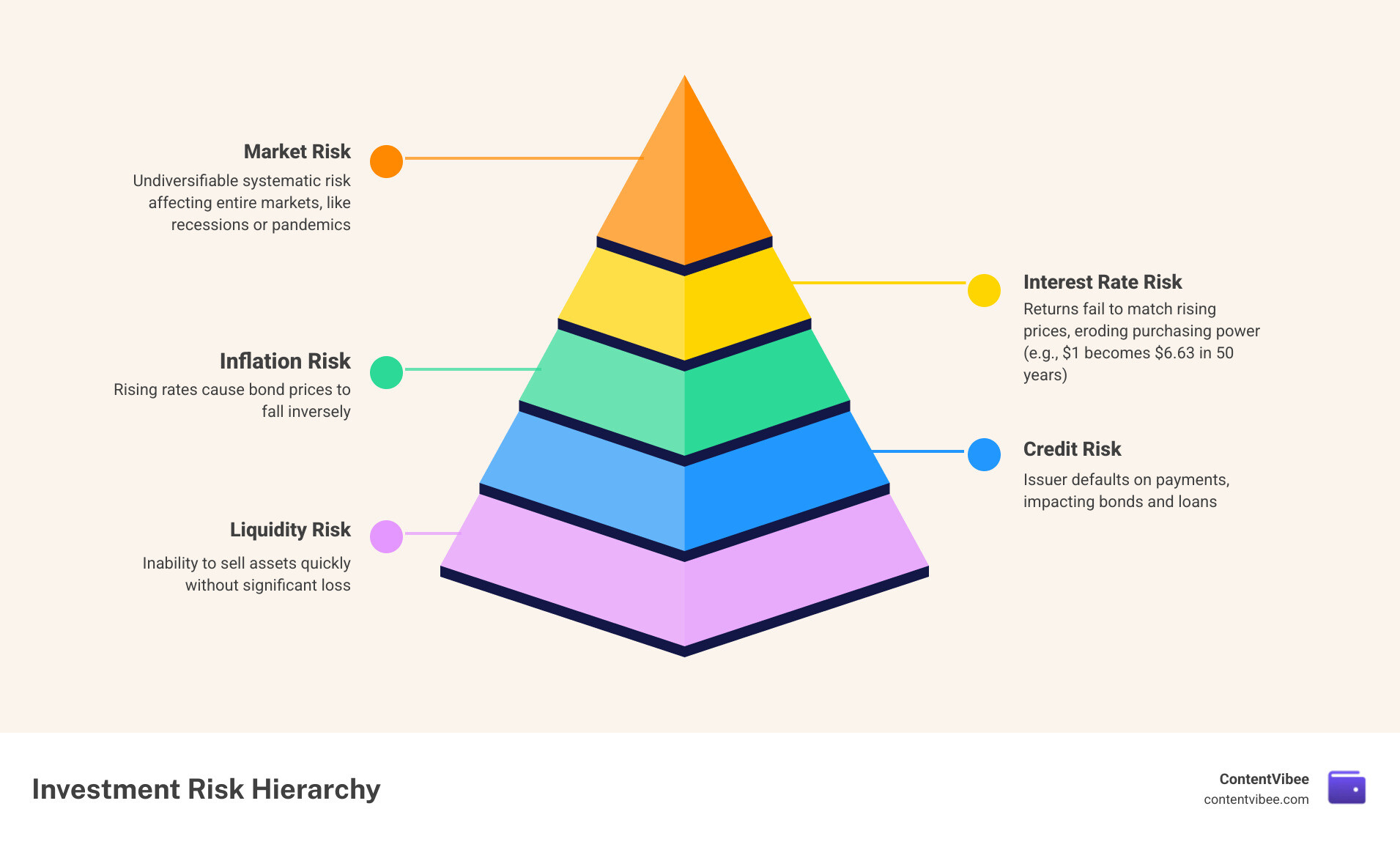
Systematic vs. Unsystematic: The Two Main Types of Risk in Investment
When we look at the big picture of types of risk in investment, we can generally split them into two buckets: systematic and unsystematic. Understanding the difference is the first step toward building a resilient portfolio.
Systematic risk, often called “market risk,” is the “undiversifiable” kind. It’s the risk inherent to the entire market or an entire market segment. Think of it as the tide that moves all boats. Economic recessions, major political shifts, or global pandemics are systematic risks. You can’t escape these by simply buying more stocks; if the S&P 500 drops 20%, almost every stock in it will feel the heat.
Unsystematic risk, on the other hand, is “specific risk.” This is unique to a specific company or industry. If a CEO gets caught in a scandal or a tech company’s new product flops, that’s unsystematic risk. The good news? This type of risk is diversifiable. By spreading your money across different companies and sectors, you can significantly reduce the impact of one company’s failure on your total wealth.
| Feature | Systematic Risk | Unsystematic Risk |
|---|---|---|
| Source | External, macro-level factors | Internal, company-specific factors |
| Impact | Affects the entire market | Affects a specific firm or industry |
| Diversification | Cannot be eliminated by diversification | Can be reduced through diversification |
| Examples | Interest rates, inflation, war | Management changes, strikes, fraud |
To dig deeper into how these forces interact, check out this Types of Investment Risk: A Guide for Savvy Investors. We also have an extensive breakdown of how these play into your overall Investment Asset Allocation Strategy Risk Management.
Managing Currency and Political Types of Risk in Investment
In our modern, interconnected world, many of us look beyond U.S. borders for growth. However, international investing introduces two specific types of risk in investment: currency risk and political risk.
Currency risk (or exchange rate risk) happens when the value of the foreign currency your investment is held in changes relative to the U.S. dollar. For example, if you buy a stock in London and the British Pound weakens against the Dollar, your investment value drops in USD terms—even if the stock price itself stayed the same!
Political or regulatory risk involves changes in a country’s government or laws that could hurt your investment. This could range from a sudden change in tax laws to more extreme events like the nationalization of private industries. As of April 2026, global trade tensions make this a particularly relevant topic for anyone holding international ETFs or emerging market funds.

Assessing Personal Tolerance for Different Types of Risk in Investment
Before you pick a single stock or bond, you need to look in the mirror. Your “risk profile” is made up of two distinct parts: risk tolerance and risk capacity.
- Risk Tolerance: This is your emotional comfort level. Can you sleep at night if your portfolio drops 10% in a week? If the answer is no, you might have a low risk tolerance.
- Risk Capacity: This is your financial ability to endure a loss. A 25-year-old with a steady job and $50,000 in the bank has a higher risk capacity than a 70-year-old retiree living off their savings.
Your time horizon—how long you plan to keep the money invested—is the biggest factor here. The longer you have, the more “market noise” you can afford to ignore. For a real-world look at how risk assessment works in practice, see our analysis of Tazopha Investment Group Legitimacy And Risk.
Market, Interest Rate, and Inflation Risks
These are the “Big Three” that every investor encounters. Market risk is the volatility we see on the news every day—the fluctuating prices of stocks and commodities. Large company stocks, as a group, have historically lost money about one out of every three years. If you can’t handle a 30% drop, you shouldn’t be 100% in equities.
Interest rate risk is the primary threat to bond investors. There is an inverse relationship between interest rates and bond prices: when rates go up, the value of existing bonds goes down. Why? Because new bonds are being issued with higher payouts, making your older, lower-paying bond less attractive.
Inflation risk (or purchasing power risk) is the “silent killer.” It’s the risk that the return on your investment won’t keep up with the rising cost of living. If your savings account pays 1% but inflation is 3%, you are technically losing 2% of your wealth every year. We’ve seen this play out over decades; remember, $1 today buys what 15 cents bought fifty years ago.
For those looking at specific equity risks, you might find our deep dive into Googl Lly Long Term Investment Risk helpful. You can also explore the A Guide to Types of Investment Risk for a broader perspective.
Reinvestment Risk and Income Streams
For income-focused investors, reinvestment risk is a major concern. This is the risk that when your investment pays out (like a bond maturing or a dividend being issued), you won’t be able to reinvest that money at the same rate of return.
Imagine you owned a bond paying 7% that just matured. If the current market rate is only 4%, your future income stream just took a massive hit. This is why comparing yields is so vital. For example, look at our Et Vs Enbridge Dividend Yield And Risk Comparison to see how different companies manage their payouts and the risks associated with those yields.
Credit, Liquidity, and Fraud Recovery Risks

When you lend money to a company or government (by buying a bond), you face credit risk (or default risk). This is the chance the issuer simply won’t be able to pay you back. This is why we pay attention to credit ratings from agencies like S&P or Moody’s. An “AAA” rating means very low risk, while “junk bonds” offer high interest to compensate for their high default risk.
Liquidity risk is the danger of being “stuck” in an investment. If you own a house, you can’t sell it in five minutes to pay for an emergency. That’s an illiquid asset. In contrast, a stock like Apple is highly liquid; you can sell it almost instantly during market hours.
Protecting Your Assets from Fraud and Failure
In April 2026, digital security is more important than ever. While market losses are part of the game, losses from fraud or brokerage failure shouldn’t be. Here are the protections you should know:
- FDIC Insurance: Insures deposits up to $250,000 per depositor, per insured bank.
- SIPC Protection: If your brokerage firm fails, the SIPC replaces missing stocks and other securities up to $500,000 (including $250,000 in cash). Note: This does not protect against market value loss!
- Fraud Recovery: If you are a victim of unauthorized bank transaction how to dispute and recover money USA 2026, your first step is to contact your financial institution immediately. Under federal law, your liability for unauthorized electronic transfers is often limited if you report it quickly.
For those exploring newer asset classes, legitimacy is key. Read our take on Why Rep Sheri Biggs Bitcoin Investment Legitimacy to understand the risks of the crypto space.
Business and Financial Risk Factors
Beyond the market, individual companies face business risk (the risk that the company’s product or strategy fails) and financial risk (the risk that the company’s debt load becomes unmanageable). A company with a high debt-to-equity ratio is much more likely to go bankrupt during a downturn than one with a “clean” balance sheet. Before jumping into a new opportunity, ask yourself: Is Phoenix Energy A Good Investment? Analyzing their fundamentals can save you from a permanent loss of capital.
Personal Planning: Horizon and Longevity Risks
Two of the most overlooked types of risk in investment are horizon risk and longevity risk.
Horizon risk occurs when your investment timing is forced by outside events. If you plan to retire in 2030 but lose your job in 2026 and are forced to sell your stocks during a market crash to pay bills, you’ve suffered from horizon risk. This is why an emergency fund is the best “risk management” tool in existence.
Longevity risk is the risk of outliving your money. With medical advancements in 2026, many people are living well into their 90s. If your portfolio is too conservative, inflation might eat your savings before you’re done using them.
Managing these requires a long-term view. See our guides on Why Mobile Home Investment Roi And Financing Risk and Why Energyx Investment Risk Analysis Long Term to see how different assets fit into a multi-decade plan.
Concentration Risk and the Power of Diversification
“Don’t put all your eggs in one basket” is the oldest advice in the book for a reason. Concentration risk happens when a single investment or sector makes up too much of your portfolio. If 50% of your wealth is in one tech stock and that company gets sued, your entire financial future is at risk.
The antidote is diversification. Research shows you can effectively diversify away most unsystematic risk with about 20 different stocks across various industries. Or, you can achieve full diversification with just one S&P 500 index fund.
Frequently Asked Questions about Investment Risk
Are there any truly risk-free investments?
Technically, no. While U.S. Treasury bills are often called “risk-free” because the government is unlikely to default, they still carry inflation risk and opportunity cost. If your Treasuries pay 3% and the stock market gains 15%, you’ve “lost” out on significant growth.
How does time horizon affect my ability to take on risk?
Time is an investor’s greatest ally. If you have 30 years until retirement, a 40% market crash is just a “sale” on stocks. You have time for the market to recover. If you need the money in six months for a house down payment, you cannot afford any market risk. As of April 2026, short-term volatility remains high, making cash-matching more important for near-term goals.
What is the difference between volatility and permanent capital loss?
Volatility is the “bouncing” of prices up and down. It only becomes a loss if you sell. Permanent capital loss is when an investment goes to zero (like a bankruptcy) or you are forced to sell at the bottom. Volatility is the price you pay for long-term returns; permanent loss is the thing we want to avoid at all costs.
Conclusion
Understanding the various types of risk in investment isn’t about avoiding risk altogether—it’s about choosing which risks are worth taking. By balancing market risk with diversification, protecting yourself against inflation, and staying aware of credit and liquidity issues, you can build a portfolio that stands the test of time.
At ContentVibee, we believe in empowering investors with the right tools. Our Autopilot app offers automated portfolio management that takes the guesswork out of diversification. We provide comprehensive fee and risk reviews to ensure your investments are actually worth the cost.
Ready to take control of your financial future? Explore More info about investment categories to find the right path for your goals. The greatest risk of all is doing nothing. Stay informed, stay diversified, and keep your eyes on the long term.


