


Robo advisor for beginners is one of the smartest entry points into investing — and if you’ve ever felt lost staring at stock charts or paralyzed by too many choices, you’re not alone.
Here’s the short answer to get you started fast:
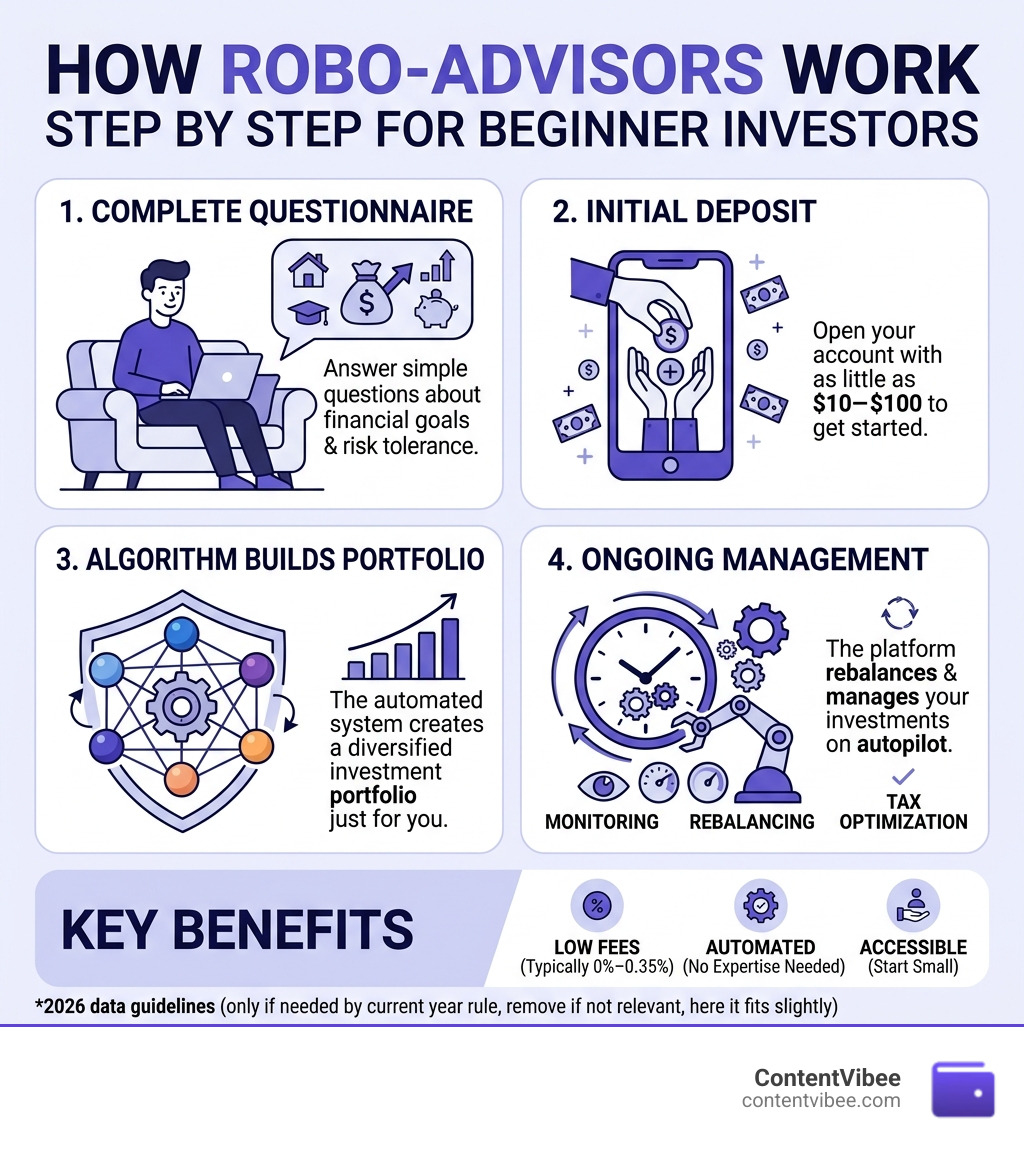
What is a robo-advisor and how do you start?
- Answer a few questions about your goals and how much risk you’re comfortable with
- Deposit as little as $10–$100 to open your account
- The algorithm builds a diversified portfolio for you automatically
- It rebalances and manages your money on autopilot — no expertise needed
Key facts at a glance:
| Feature | Typical Range |
|---|---|
| Minimum to start | $0–$5,000 (most under $100) |
| Annual advisory fee | 0%–0.35% of your balance |
| Human advisor access | Available on hybrid platforms |
| Automatic rebalancing | Included on most platforms |
| Tax-loss harvesting | Available on select platforms |
Millions of people keep their money sitting in savings accounts earning almost nothing — not because they don’t want to invest, but because traditional investing feels too complicated, too risky, or too expensive.
Robo-advisors were built to fix exactly that problem.
They use algorithms to do the heavy lifting: building your portfolio, monitoring the markets, and adjusting your investments over time. You don’t need a finance degree. You don’t need a lot of money. And you don’t need to watch the markets every day.
In this guide, you’ll learn exactly how robo-advisors work, what they cost, which ones are worth your time, and how to get started — even if you’re starting from zero.
What is a robo advisor for beginners and how does it work?
At its core, a robo advisor for beginners is a digital service that provides automated, algorithm-driven financial planning services with little to no human supervision. Think of it as a “GPS for your money.” You tell the platform where you want to go (your financial goals), and the software maps out the best route to get there.
When you sign up, you’ll complete a questionnaire that helps the platform understand your financial situation. It asks about your age, income, and, most importantly, your risk tolerance. Based on your answers, the algorithm performs a risk assessment and builds a diversified portfolio.
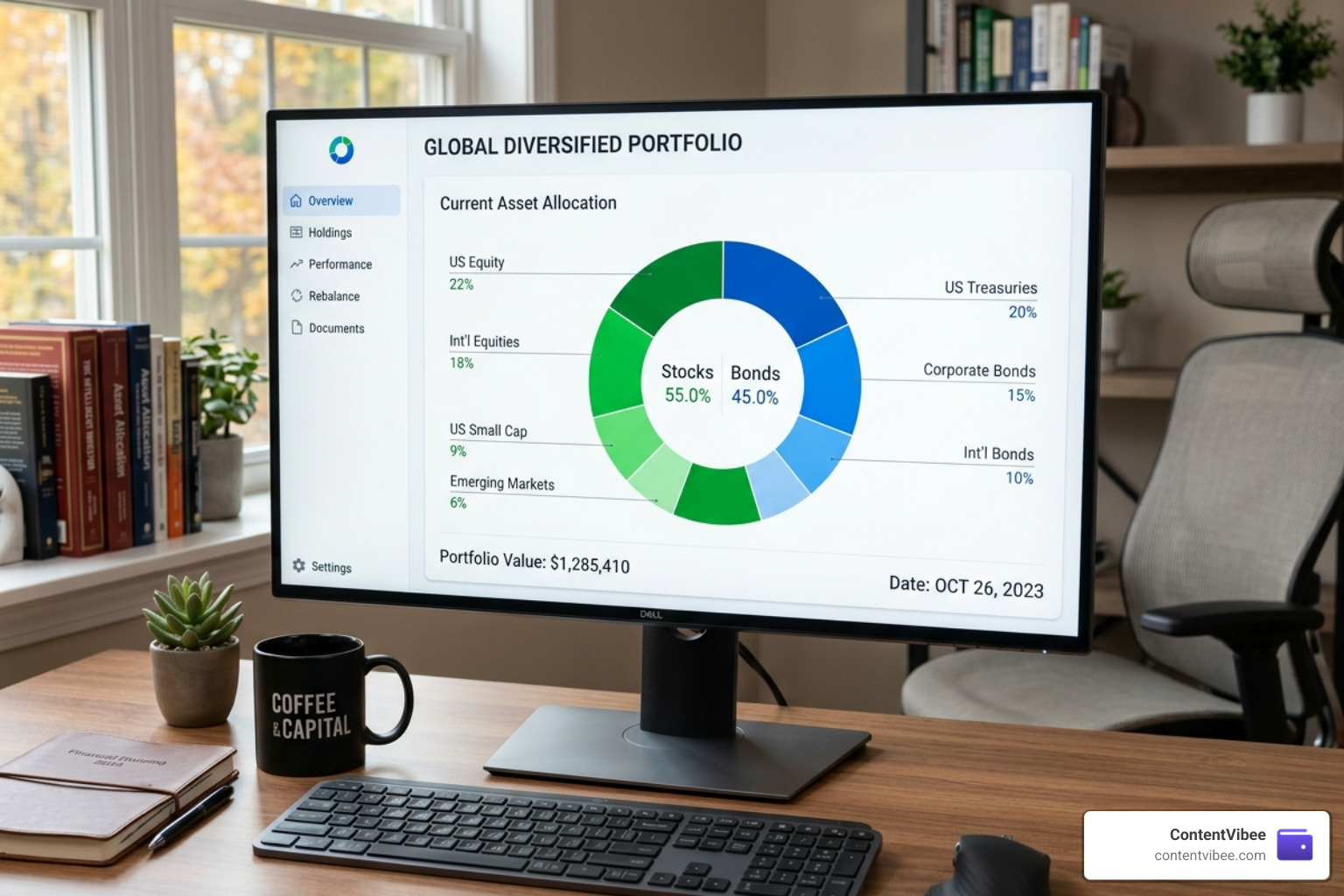
This portfolio usually consists of low-cost Exchange-Traded Funds (ETFs) that cover various asset classes like stocks, bonds, and sometimes real estate or commodities. This process, known as asset allocation, ensures your eggs aren’t all in one basket. If you’re wondering if this “set it and forget it” approach is right for you, check out our guide on Is Automated Portfolio Management Right For You/.
Why a robo advisor for beginners is ideal for small budgets
One of the biggest hurdles for new investors has historically been the “barrier to entry.” Traditional wealth managers often require $100,000 or more just to walk through the door. In contrast, a robo advisor for beginners democratizes wealth building.
In April 2026, many top-tier platforms have incredibly low minimums. For example:
- Entry-level digital accounts often have no minimum to open and require just $10 to start investing.
- Standard automated advisors may require only $100 to enroll.
- Institutional-style platforms might have a $5,000 minimum but charge no management fee for their basic tier.
Many of these services also offer fractional shares, meaning if a single share of an expensive stock costs $500, you can still buy $5 worth of it. This makes your portfolio scalable; as you earn more, you can simply increase your monthly deposit. For more tips on starting small, read How to Start Investing with Little Money/.
Hybrid robo-advisors vs. fully automated services
As you grow your wealth, you might find yourself wanting a human to talk to. This is where hybrid robo-advisors come in. While a fully automated service is 100% digital, a hybrid model combines the efficiency of algorithms with access to human coaching.
Many hybrid platforms offer unlimited 1-on-1 calls with financial coaches once your balance reaches a certain threshold (typically $25,000). These live advisors can help with complex life events, like planning for a child’s education or navigating a career change. It’s about finding the right balance for your risk profile—using technology for the daily grind of rebalancing while keeping a human in the loop for the big-picture strategy.
Key Benefits: Automation, Rebalancing, and Tax Efficiency
The real “magic” of a robo advisor for beginners happens behind the scenes through three primary features: automation, rebalancing, and tax efficiency.
- Hands-free Management: Once you set up your recurring deposit, the robo-advisor handles the buying and selling. You don’t have to log in to execute trades.
- Automatic Rebalancing: Over time, some investments grow faster than others. If your goal was to have 60% stocks and 40% bonds, a stock market rally might push you to 70% stocks. This makes your portfolio riskier than you intended. The robo-advisor automatically sells some stocks and buys bonds to bring you back to your 60/40 target.
- Tax-Loss Harvesting: This is a sophisticated strategy where the robo-advisor sells investments that have dipped in value to offset capital gains taxes. This can significantly increase your “after-tax” returns over decades.
Understanding how these tools work together is essential for Investment Asset Allocation Strategy Risk Management/.

How a robo advisor for beginners manages market volatility
Market volatility can be scary for beginners. When the news headlines turn red, the temptation to sell everything is high. Robo-advisors help manage this through “glide paths.” A glide path gradually shifts your portfolio from aggressive (more stocks) to conservative (more bonds) as you get closer to your goal date, such as retirement.
By monitoring the market 24/7, the algorithm stays objective. It doesn’t panic when the market dips; instead, it uses those dips as an opportunity to rebalance. This long-term strategy helps you stay the course, which is historically the most successful way to build wealth.
Understanding Fees, Minimums, and Investment Costs
While robo-advisors are much cheaper than traditional advisors, they aren’t always free. You need to understand the two main types of costs: advisory fees and expense ratios.
- Advisory Fees: This is what you pay the platform to manage your money. The industry average is around 0.25% of assets under management (AUM). That means for every $10,000 you invest, you pay about $25 a year. Compare this to the 1% or 2% ($100–$200) charged by traditional human advisors.
- Expense Ratios: These are fees charged by the funds (ETFs) themselves. Even if the robo-advisor is “free,” the underlying funds usually cost between 0.02% and 0.20%.
To get a clearer picture of what you might pay, see our breakdown on Understanding Investment Management Fees/.
Typical Fee Structures (As of April 2026)
| Provider Category | Advisory Fee | Account Minimum |
|---|---|---|
| Low-Cost Digital | ~0.15% AUM | $100 |
| Tiered Management | $0 (under $25k); 0.35% ($25k+) | $0 to open / $10 to invest |
| No-Fee Cash Model | $0 | $5,000 |
| Strategy-Based | Varies | $100 |
Hidden costs and free investment options
“Free” robo-advisors often have a catch. For instance, some automated platforms require a certain percentage of your portfolio to be held in cash. While they don’t charge a fee, they earn interest on that cash. This is known as “cash drag” because that money isn’t invested in the stock market. Others might use proprietary funds that have slightly higher expense ratios. Always read the fine print to understand What Are Wealth Management Fees/ in their entirety.
Security First: Protecting Your Assets from Fraud and Identity Theft
When you’re investing online, security is just as important as returns. Most reputable robo-advisors are members of the Securities Investor Protection Corporation (SIPC). This protects your funds up to $500,000 (including a $250,000 limit for cash) if the brokerage firm fails. However, SIPC does not protect you against market losses.
Beyond brokerage failure, you must protect yourself from digital threats. For more on safe paths, see What Is The Safest Investment/.
Identity theft credit report fraud how to fix and protect your score USA
As an investor in the USA in 2026, identity theft is a real financial risk. If a fraudster gains access to your Social Security Number, they could attempt to open fraudulent brokerage accounts in your name. We recommend:
- Freezing your credit reports at Equifax, Experian, and TransUnion.
- Setting up fraud alerts so you are notified of any new credit applications.
- Using Multi-Factor Authentication (MFA) on all financial apps.
If you suspect your data has been compromised, learn How to Protect Your Identity Online/ immediately.
Unauthorized bank transaction how to dispute and recover money USA 2026
If you notice an unauthorized bank transaction how to dispute and recover money USA 2026 is a process you need to start immediately. Under federal law (Regulation E), your liability for unauthorized electronic fund transfers is limited if you report them quickly.
- Notify your bank within two business days of noticing the fraud to limit your liability to $50.
- Follow up in writing with a formal dispute letter.
- Monitor your account for the temporary credit while the bank investigates.
This is a critical part of Understanding Traditional Vs Alternative Investments/ because liquid digital accounts require more active monitoring than physical assets.
Wire transfer fraud victim what to do and recovery options USA 2026
Wire transfer fraud is particularly dangerous because wires are often irreversible. If you are a wire transfer fraud victim what to do and recovery options USA 2026 includes:
- Contacting the sending bank immediately to request a “Wire Recall.”
- Filing a report with the FBI’s Internet Crime Complaint Center (IC3).
- Reporting the fraud to your local police.
While recovery is difficult, acting within the first 24 hours provides the only real chance of clawing back the funds. For a step-by-step path, consult our Financial Fraud Recovery Guide/.
Is a robo advisor for beginners safe for long-term retirement?
Yes, robo-advisors are highly suitable for long-term goals like retirement. Most allow you to open Individual Retirement Accounts (IRAs), including Traditional, Roth, and SEP IRAs.
Many advanced robo-advisors even allow you to integrate your 401(k) accounts for a holistic view of your progress. Because these platforms are regulated by the U.S. Securities and Exchange Commission (SEC) and FINRA, they must adhere to strict compliance standards. By automating your retirement contributions and using features like tax-loss harvesting, you are often better positioned than a DIY investor who might make emotional decisions during a market crash.
Frequently Asked Questions about Robo-Advisors
How much money do I need to start?
As we’ve seen, you don’t need much. You can start with as little as $10 or $100 at various leading platforms. This low barrier allows you to scale your deposits as you become more comfortable. If you’re looking for advanced automation, you might wonder Is The Autopilot Investment App Worth The Cost/—the answer usually depends on how much you value your time and the complexity of the strategies you want to use.
Can I change my investment strategy later?
Absolutely. Life changes, and your robo advisor for beginners should change with you. Most platforms allow you to retake the risk questionnaire at any time. If you get a raise, get married, or decide you want to be more aggressive, you can adjust your “risk score” (usually on a scale of 1 to 10) and the platform will rebalance your portfolio to match the new strategy.
What are the potential drawbacks of robo-advisors?
While they are great, they aren’t perfect.
- Limited Customization: You usually can’t pick individual stocks. You are buying the “basket” the algorithm chooses.
- Lack of Human Touch: Unless you choose a hybrid model, you won’t have a person to talk to during market scares.
- Cash Drag: As mentioned, some “free” advisors keep a portion of your money in cash, which can lower your overall returns over decades.
Understanding these trade-offs is part of the debate of Why Wealth Management Vs Investment Banking/—it’s about choosing the level of service that fits your specific needs.
Conclusion: Starting Your Journey with ContentVibee
Starting your investment journey doesn’t have to be a source of stress. A robo advisor for beginners provides the tools, the automation, and the professional-grade strategies that were once reserved for the ultra-wealthy.
At ContentVibee, we believe in empowering you through knowledge and the right tools. Apps like Autopilot offer a modern way for self-directed investors to manage their portfolios with comprehensive reviews of fees and risks. By combining automated wealth growth with a sharp eye on financial security, you can build a future that is both prosperous and protected.
Explore More info about wealth management categories to find the perfect strategy for your financial future.


