


What You Need to Know About the 55 Pension Tax Before You Retire Early
Understanding the 55 pension tax rules can save you thousands of dollars — or pounds — depending on which side of the Atlantic you’re on.
Whether you’re in the UK or the US, turning 55 opens a door to your retirement savings earlier than most people expect. But that door comes with tax strings attached, and pulling the wrong lever can trigger penalties, emergency tax codes, or a surprise bill you weren’t planning for.
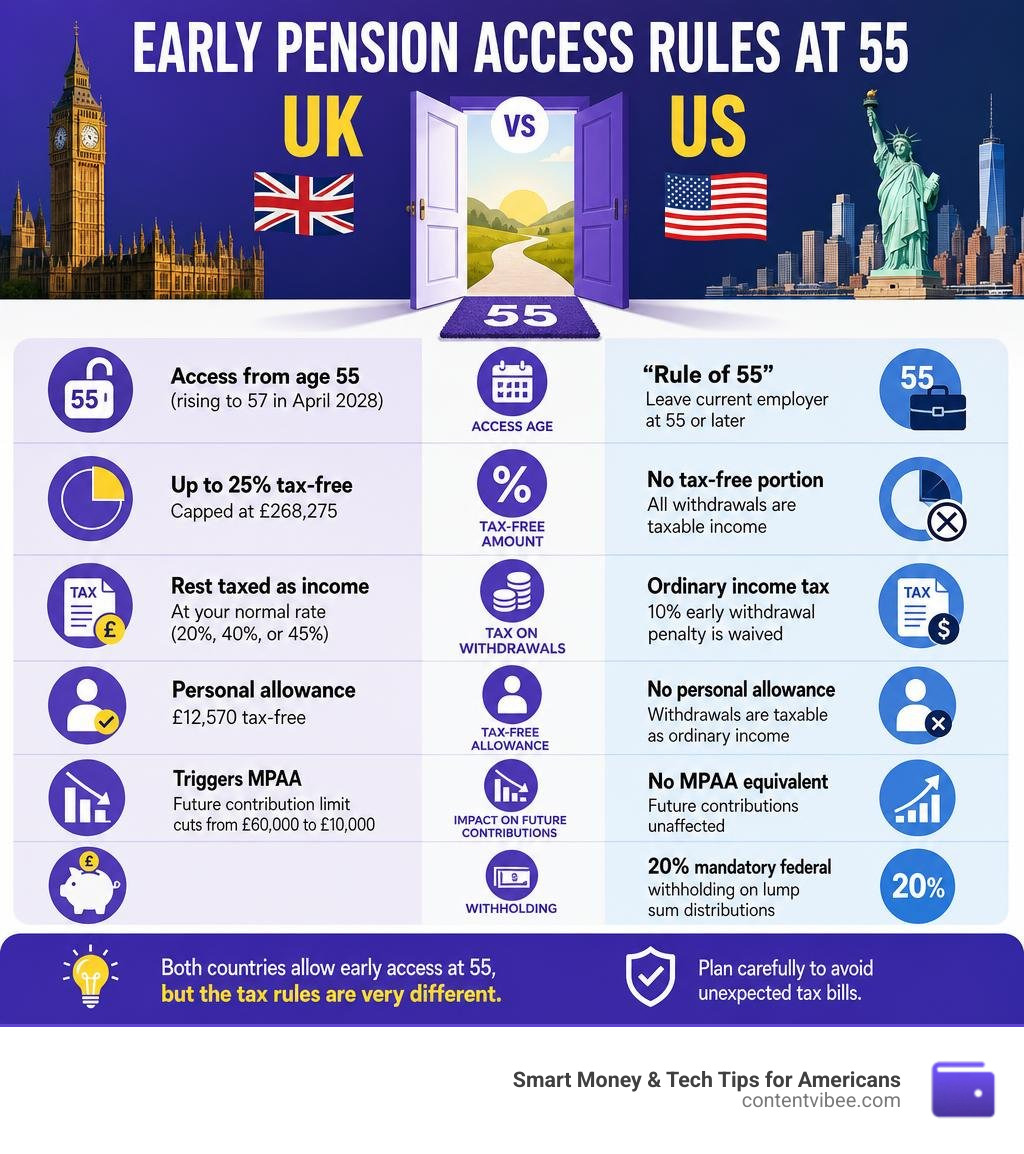
Here’s a quick summary of the key rules:
UK rules at a glance:
- You can access your pension from age 55 (rising to 57 in April 2028)
- Up to 25% of your pension can be taken tax-free, capped at £268,275
- The rest is taxed as income at your normal rate (20%, 40%, or 45%)
- Your personal allowance is £12,570 — income below this is tax-free
- Taking taxable income triggers the Money Purchase Annual Allowance (MPAA), cutting your future contribution limit from £60,000 to £10,000
US rules at a glance:
- The “Rule of 55” lets you withdraw from a current employer’s 401(k) penalty-free if you leave your job at 55 or later
- You still owe ordinary income tax on withdrawals — there’s no tax-free portion like in the UK
- The 10% early withdrawal penalty is waived, but IRAs don’t qualify
- A mandatory 20% federal withholding applies to lump sum distributions
The bottom line: early pension access at 55 is legal and possible in both countries, but the tax cost depends entirely on how, when, and how much you take.
55 pension tax vocab explained:
Navigating the 55 Pension Tax Rules in the UK
If you hold a UK pension, reaching age 55 is a major milestone. Under the UK’s flexible pension access rules, this is the earliest age at which you can begin drawing from a defined contribution pension pot. However, time is ticking on this lower age limit. From April 6, 2028, the normal minimum pension age (NMPA) will rise from 55 to 57. If you were born after April 5, 1973, you will face a two-year gap where you must wait until age 57 to access your funds, unless you have a “protected pension age” written into your specific policy.
The type of pension you hold also dictates how early access works. Defined contribution (DC) pensions—where you build up a pot of money over time—offer maximum flexibility. Defined benefit (DB) pensions, or “final salary” schemes, are far more rigid. While some DB schemes allow access at 55, they typically apply heavy early retirement penalties that permanently reduce your annual payout.
When you decide to access a DC pension, you have several choices. But before you make a move, you must understand how HM Revenue and Customs (HMRC) views these withdrawals. If you make a mistake, you could face an eye-watering tax bill. To help you navigate this process, HMRC provides specific guidelines on how to Claim back tax on a flexibly accessed pension overpayment (P55) – GOV.UK.
Tax-Free Lump Sums and the Lump Sum Allowance (LSA)
One of the most attractive features of UK pension rules is the ability to take up to 25% of your pension pot completely tax-free. However, this is not an unlimited privilege. The tax-free portion is capped by the Lump Sum Allowance (LSA), which is set at £268,275.
This £268,275 limit applies to all of your pensions combined, not to each individual pot. Because the LSA is exactly 25% of £1,073,100, you will only be restricted by this cap if your total retirement savings across all accounts exceed £1,073,100.
Alongside the LSA, you must also keep the Lump Sum and Death Benefit Allowance (LSDBA) in mind. Set at £1,073,100, the LSDBA limits the total amount of tax-free lump sums you can take during your lifetime combined with what your beneficiaries can receive tax-free upon your death (if you die before age 75).
If you took tax-free cash from your pension prior to April 6, 2024, those withdrawals were calculated under the old Lifetime Allowance (LTA) rules. To ensure your current LSA and LSDBA are calculated fairly, you may need to apply for a “transitional tax-free amount certificate” from your pension provider. This certificate proves exactly how much tax-free cash you previously received, which can prevent HMRC from assuming you took the full 25% and unnecessarily reducing your remaining allowance.
How the 55 Pension Tax Affects Your Personal Allowance and Tax Code
Once you withdraw more than your 25% tax-free lump sum, the remaining 75% of your pension is treated as taxable income. This income is subject to regular UK Income Tax bands (20%, 40%, or 45%) and is added directly to any other income you earn during the tax year, such as a salary or rental income.
Your standard Personal Allowance is £12,570. If your total annual income—including your taxable pension withdrawals—remains below this threshold, you will not owe any tax. However, if your total income exceeds £100,000, your Personal Allowance begins to taper away at a rate of £1 for every £2 of income over the limit, disappearing entirely once your income hits £125,140.
The biggest shock for early retirees is often the application of “emergency tax.” When you make your first flexible pension withdrawal, your pension provider does not have an active tax code for this income stream. Consequently, they are legally required to apply an emergency tax code on a “week 1 / month 1” basis.
This system treats your one-off withdrawal as if it were a regular monthly payment you would receive 12 times a year. For example, if you withdraw £20,000 in a single month, HMRC’s system assumes your annual income is £240,000 and taxes that single payment at the highest marginal rates. To understand how HMRC reconciles these accounts internally, you can review the official PAYE94055 – Reconcile individual: in-year reconciliation: Flexibly accessed pension rights – HMRC internal manual – GOV.UK.
Reclaiming Overpaid Tax: Forms P55, P50Z, and P53Z
If you have been hit with emergency tax on your pension withdrawal, you do not have to wait until the end of the tax year for HMRC to send a refund. You can claim an in-year tax repayment by submitting the correct form based on your specific situation:
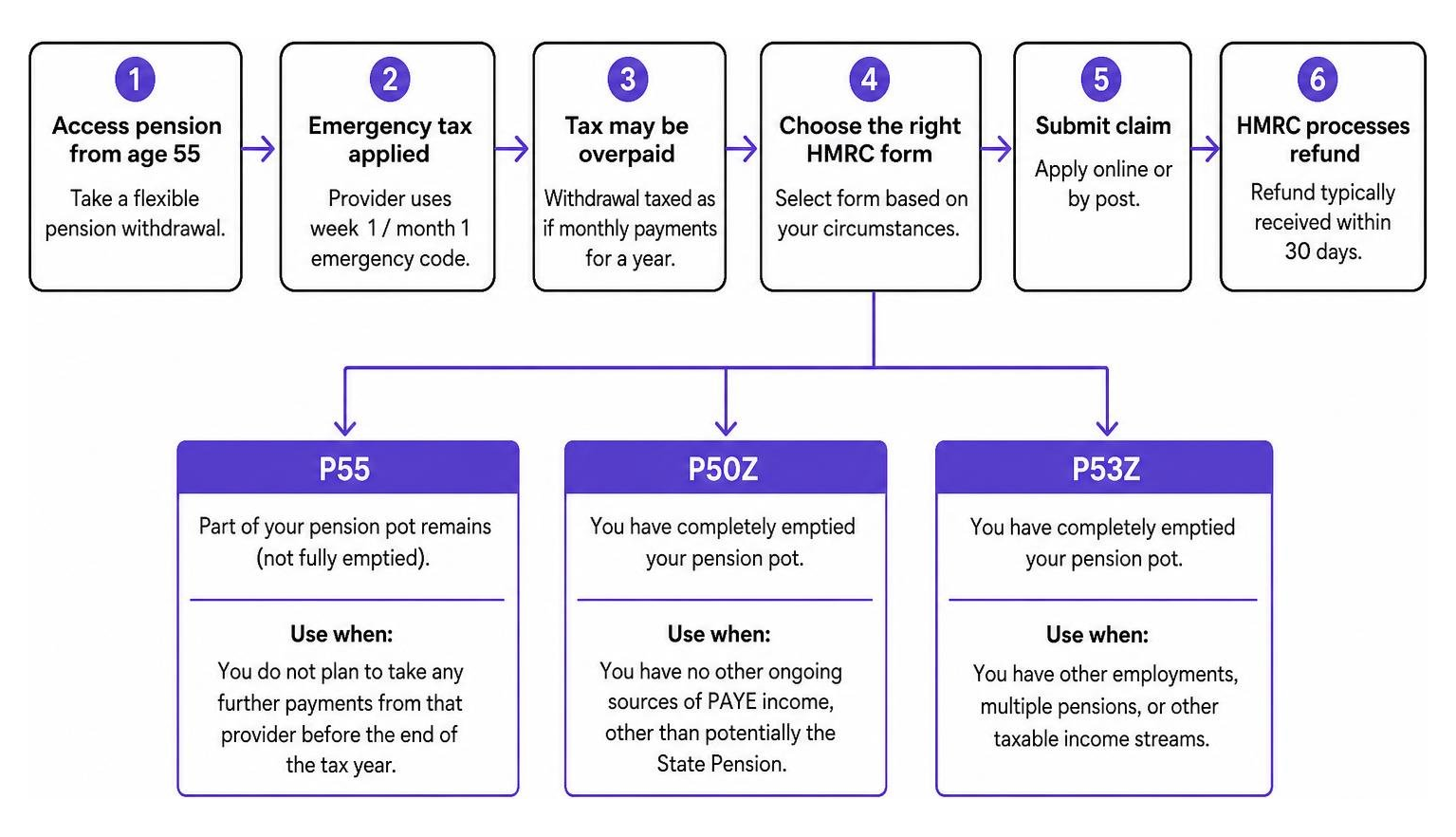
- Form P55: Use this form if you have flexibly accessed only a portion of your pension pot (meaning the pot is not fully emptied) and you do not plan to take any further payments from that provider before the end of the tax year.
- Form P50Z: Use this form if you have completely emptied your pension pot and you have no other ongoing sources of PAYE income (such as employment or other pensions), other than potentially the State Pension.
- Form P53Z: Use this form if you have fully emptied your pension pot but you still have other active employments, multiple pensions, or other taxable income streams.
By submitting the appropriate form online or via post, HMRC will typically process your claim and issue your tax refund within 30 days.
Accessing Your Pension at 55 While Working
Can you access your pension at 55 and continue working? Absolutely. There is no legal requirement to stop working or reduce your hours to access your pension savings. However, combining a regular salary with taxable pension withdrawals requires careful tax planning.
Because taxable pension income is added to your employment earnings, a poorly timed withdrawal can easily push you into a higher tax bracket. For example, if you earn £45,000 from your job and decide to withdraw £15,000 of taxable income from your pension, your total income rises to £60,000. This pushes you past the £50,270 basic-rate threshold, meaning the top portion of your pension withdrawal will be hit with a 40% tax rate.
To avoid these traps, we must look at how to balance our active employment income with our retirement accounts. For a deeper dive into coordinating these strategies, check out our guide on Pension vs 401k Tax Strategies for Working Retirees.
The Money Purchase Annual Allowance (MPAA) Trap
Perhaps the most dangerous trap for working retirees is triggering the Money Purchase Annual Allowance (MPAA). Under normal circumstances, you can contribute up to £60,000 per year into your pension and receive full tax relief on those contributions (subject to your total earnings).
However, the moment you access taxable income from a defined contribution pension, you trigger the MPAA. This immediately reduces your annual tax-relievable contribution limit from £60,000 to just £10,000.
The MPAA is triggered by actions such as:
- Taking a payment from a flexi-access drawdown account.
- Taking an Uncrystallised Funds Pension Lump Sum (UFPLS).
- Cashing in your entire pension pot.
Crucially, taking only your 25% tax-free lump sum does not trigger the MPAA. If you need cash but want to continue making large contributions to your pension (including receiving employer auto-enrolment contributions), you should only withdraw your tax-free cash and leave the taxable portion untouched.
Minimising Your 55 Pension Tax Bill: Smart Withdrawal Strategies
To keep your 55 pension tax bill as low as possible, you should avoid taking large, irregular lump sums. Instead, consider spreading your withdrawals across multiple tax years to maximize your personal allowances and stay within lower tax bands.
Here is how the primary withdrawal methods compare:
| Withdrawal Method | Tax-Free Treatment | Taxable Treatment | MPAA Triggered? | Best For |
|---|---|---|---|---|
| Full Cash Out | 25% is tax-free | 75% taxed as ordinary income in one go | Yes | Small pension pots under £10,000 |
| Flexi-Access Drawdown | Take up to 25% upfront tax-free | Keep the rest invested; draw taxable income as needed | Yes (on first taxable draw) | Flexible income and long-term inheritance planning |
| UFPLS (Phased Chunking) | Each chunk is 25% tax-free | 75% of each chunk is taxed as ordinary income | Yes (on first chunk) | Spreading tax liability without entering drawdown |
| Annuity | Take up to 25% upfront tax-free | Guaranteed regular income is taxed as ordinary income | No | Secure, guaranteed lifetime income |
By taking a blended approach—such as withdrawing your tax-free cash first and then using phased drawdown or mixing in tax-free ISA withdrawals—you can keep your effective tax rate remarkably low.
Long-Term Risks of Retiring and Drawing Pension at 55
While retiring at 55 sounds like a dream, the financial reality of a 12-year gap before you can claim your State Pension (at age 67) requires a massive nest egg.

Consider this: if you have a £150,000 pension pot and decide to retire at 55, drawing that pot down evenly over 12 years to bridge the gap until age 67 leaves you with just £5,250 per year (assuming 25% is tax-free and the rest is drawn slowly). That is a meager £437 a month to live on.
If you wait until 67 to retire, that same £150,000 pot has 12 more years to grow. Combined with your State Pension, your annual retirement income would be significantly higher. To achieve a “moderate” lifestyle standard at age 55 without a State Pension, you would realistically need a private pension pot of £650,000 to £750,000, assuming a safe withdrawal rate of 3.5% to 4%.
The US Rule of 55 vs. UK Pension Access Rules
While the UK uses age 55 as a flexible gateway to private pensions, the US retirement system operates on a different set of rules. Generally, the IRS imposes a 10% early withdrawal penalty on retirement account distributions taken before age 59½.
However, the US tax code features a vital exception known as the Rule of 55. Under this rule, if you are laid off, fired, or quit your job during or after the calendar year in which you turn 55, you can withdraw funds from your current employer’s qualified retirement plan completely penalty-free.
To explore the official IRS rules regarding these exceptions, you can read the guidelines on What is the Rule of 55? | Tax Questions, Answers, and Help or refer directly to Topic no. 410, Pensions and annuities | Internal Revenue Service.
How the US Rule of 55 Avoids the 10% Early Withdrawal Penalty
The Rule of 55 is an incredibly powerful tool for early retirement, but it comes with strict limitations that differ sharply from UK pension freedoms:
- Current Plan Only: The exception only applies to the retirement plan of the employer you just separated from at age 55 or older. You cannot use the Rule of 55 to access funds in a previous employer’s 401(k) plan penalty-free, nor can you use it for an IRA.
- No IRAs: Individual Retirement Accounts (IRAs) are strictly excluded from the Rule of 55. If you roll your 401(k) into an IRA before taking your distributions, you lose the Rule of 55 exception entirely and will face the 10% penalty on withdrawals before age 59½.
- Income Tax Applies: While the Rule of 55 waives the 10% early withdrawal penalty, it does not waive ordinary income tax. Every dollar you withdraw from a traditional 401(k) is taxed as ordinary income at your current federal and state tax rates.
- Mandatory Withholding: If you take a direct lump sum distribution under the Rule of 55, your employer is legally required to withhold 20% for federal income taxes. If your actual tax bracket is lower, you will have to wait until you file your annual tax return to get that overpayment back.
For a broader look at how retirement income is taxed in the US, see our overview of What taxes do I pay in retirement? – Empower.
US Tax Planning: Social Security and State Tax Impacts
When planning early retirement withdrawals in the US, you must look at your total financial picture, including state taxes and future Social Security benefits.
Most states tax retirement distributions as ordinary income. However, some states offer special exemptions. For example, Colorado allows taxpayers aged 55 to 64 to subtract up to $20,000 of taxable pension or annuity income from their state taxable income (rising to $24,000 for those 65 and older).
Furthermore, large early withdrawals can severely impact your future Social Security benefits. If you take a large 401(k) distribution, it can push your “combined income” (Adjusted Gross Income + non-taxable interest + 50% of your Social Security benefits) above the thresholds where Social Security itself becomes taxable:
- Single Filers: If your combined income is between $25,000 and $34,000, up to 50% of your Social Security benefits may be taxed. Above $34,000, up to 85% is taxable.
- Joint Filers: If combined income is between $32,000 and $44,000, up to 50% is taxable. Above $44,000, up to 85% is taxable.
To understand these tax mechanics, read our Social Security Taxable Income Guide 2026 and learn about the potential pitfalls of Double Dipping or Double Trouble with Social Security and Your Government Pension.
Frequently Asked Questions about Early Pension Access
Can I access my pension at 55 and still work?
Yes, in the UK, you can access your defined contribution pension from age 55 while remaining in active employment. However, any taxable withdrawals will be added to your employment earnings, which could push you into a higher tax band. Additionally, taking taxable pension income triggers the MPAA, reducing your annual contribution limit from £60,000 to £10,000. To avoid this, consider taking only your 25% tax-free lump sum or utilizing employer salary sacrifice schemes to keep your taxable income low.
What is the difference between the LSA and the LSDBA?
In the UK, the Lump Sum Allowance (LSA) caps the total amount of tax-free lump sums you can personally take during your lifetime at £268,275. The Lump Sum and Death Benefit Allowance (LSDBA) is a wider cap of £1,073,100 that limits the total tax-free lump sums taken by you and any tax-free lump sums paid to your beneficiaries after your death (if you die before age 75).
Does the US Rule of 55 apply to IRAs?
No, the US Rule of 55 applies strictly to qualified employer-sponsored plans like 401(k) and 403(b) accounts. Traditional IRAs, SEP IRAs, and SIMPLE IRAs do not qualify. If you roll your 401(k) funds into an IRA, you lose the ability to withdraw those funds penalty-free under the Rule of 55 before age 59½.
Conclusion
Whether you are navigating the UK’s flexible pension rules or the US Rule of 55, accessing retirement funds early requires a careful, proactive strategy. Making a mistake can trigger massive tax bills, strip away your future savings allowances, or leave you with a significant income gap before state pensions kick in.
At ContentVibee, we believe that early retirement shouldn’t mean paying unnecessary taxes. By planning your withdrawals, spreading your income, and utilizing your legal tax-free allowances, you can secure a bright financial future.
Ready to master the tax rules on your retirement benefits? Read our complete breakdown of Uncle Sam’s Cut: Understanding Taxes on Social Security.