


Why State Pension Tax Benefits Can Save You Thousands Every Year
State pension tax benefits vary dramatically depending on where you live — and the difference can add up to thousands of dollars every single year.
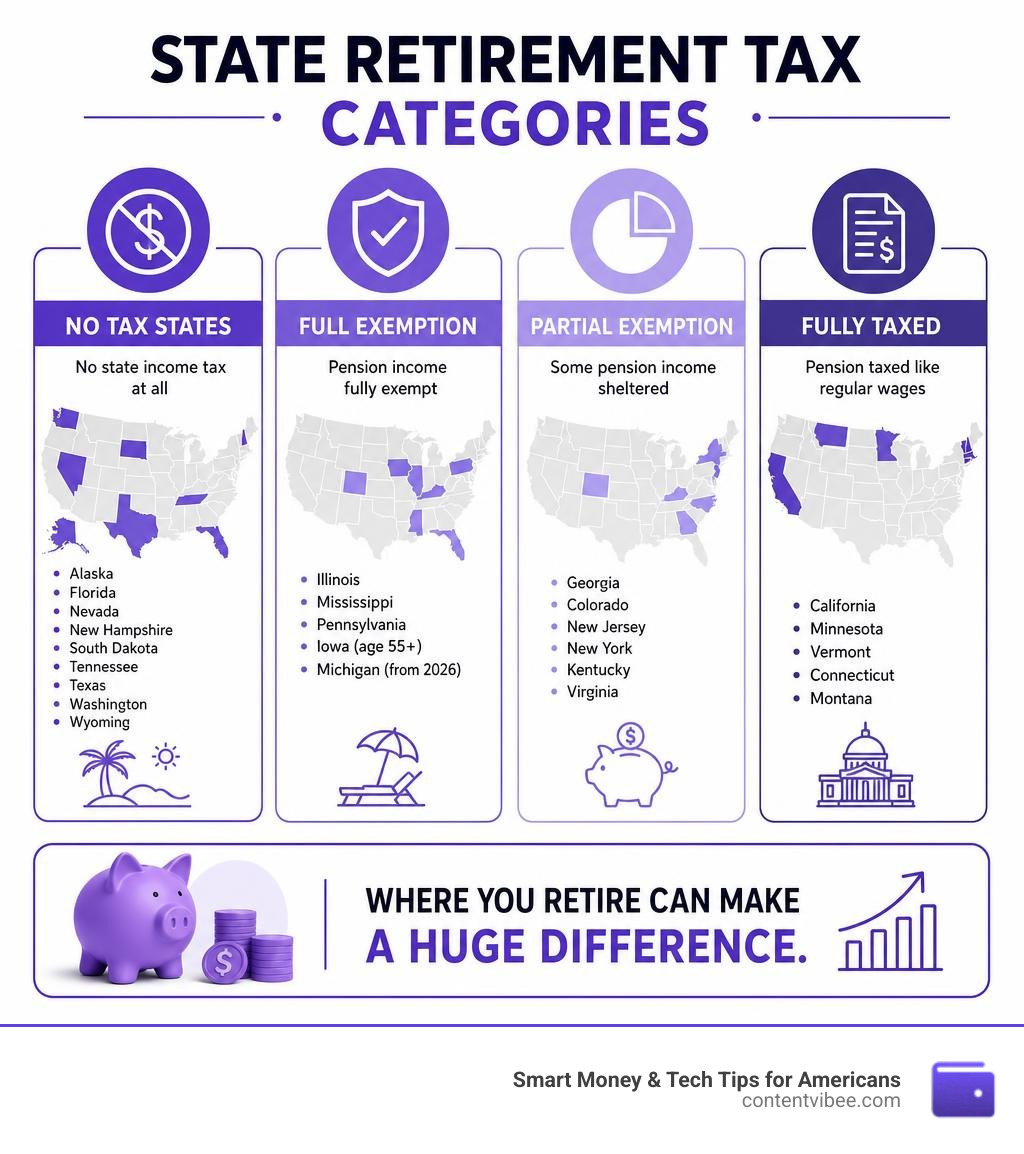
Here’s a quick snapshot of how states treat pension income:
| Category | States | What It Means for You |
|---|---|---|
| No income tax at all | Alaska, Florida, Nevada, New Hampshire, South Dakota, Tennessee, Texas, Washington, Wyoming | Zero state tax on pension income |
| Full pension exemption | Illinois, Mississippi, Pennsylvania, Iowa (age 55+), Michigan (from 2026) | Pension fully exempt even with state income tax |
| Partial exemption | Georgia, Colorado, New Jersey, New York, Kentucky, Virginia | Some pension income sheltered based on age or income |
| Fully taxed | California, Minnesota, Vermont, Connecticut, Montana | Pension taxed like regular wages |
A $60,000 annual pension in California can cost you over $5,500 per year in state income tax. That same pension in Florida or Illinois? $0.
Over a 25-year retirement, that gap can exceed $138,000 — real money that either stays in your pocket or goes to the state.
This guide breaks down exactly how each state treats pension income, Social Security, and deferred compensation plans. Whether you’re already retired or planning your exit from New York, understanding these rules before you choose where to live is one of the highest-leverage financial decisions you can make.
Key terms for State pension tax benefits:
Understanding State Pension Tax Benefits Across the US
When we think about retirement planning, we often focus on how much we can save during our working years. But what happens when it is time to withdraw those hard-earned funds? The state you choose to reside in during your golden years plays a massive role in how long your retirement nest egg will last.
State income taxes on pensions, traditional IRAs, and 401(k)s vary dramatically across the country. In some states, you will pay regular income tax rates on every single dollar you withdraw. In others, you might not pay a single cent. This discrepancy is why understanding the landscape of state pension tax benefits is absolutely vital.
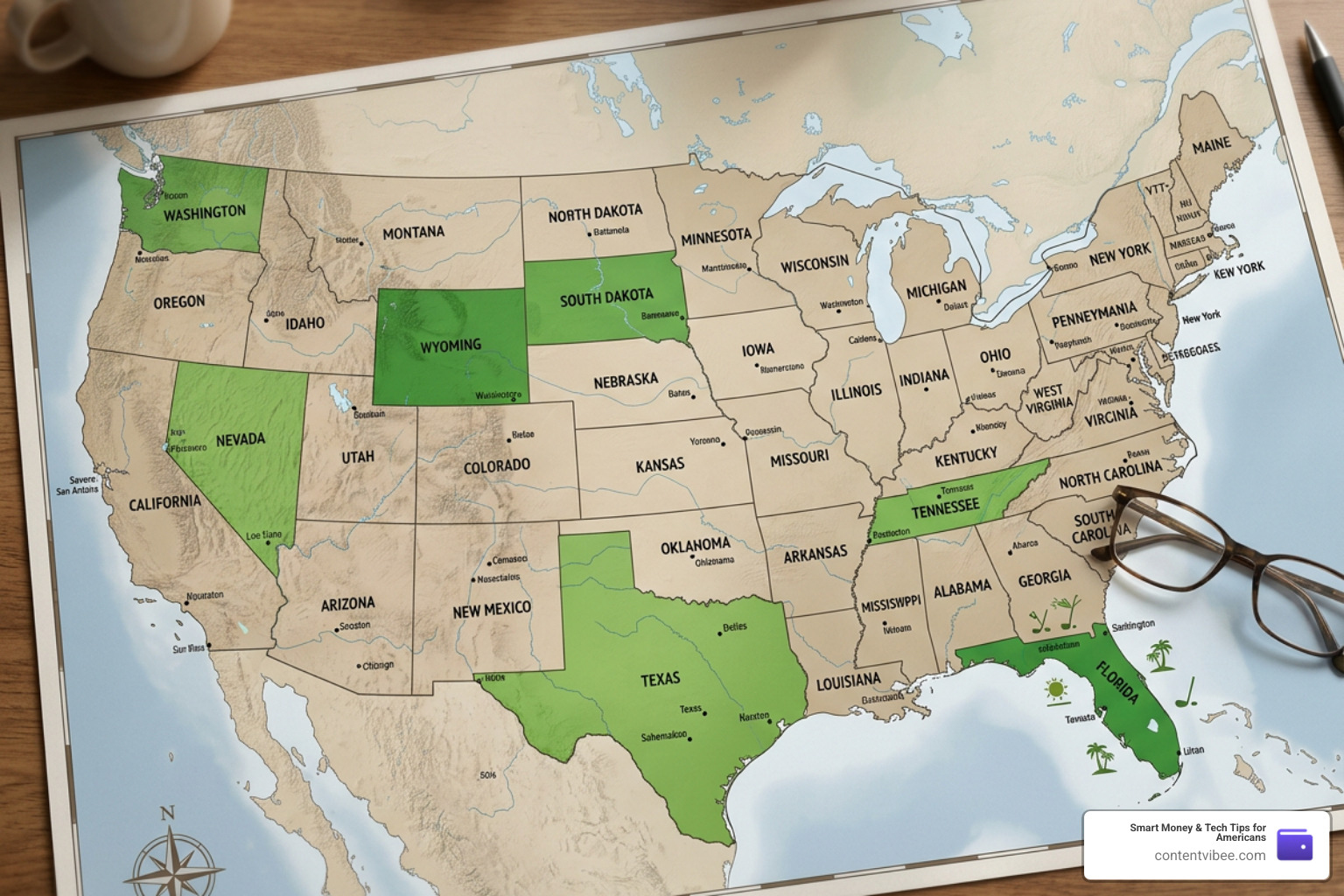
There are 9 states with no personal income tax at all: Alaska, Florida, Nevada, New Hampshire, South Dakota, Tennessee, Texas, Washington, and Wyoming. If you relocate to one of these states, all of your retirement income — including defined benefit pensions, 401(k) distributions, and traditional IRAs — is completely exempt from state taxation.
Beyond those 9 states, there are several states that do impose a state income tax but choose to fully exempt pension income or broader retirement distributions. For example, Illinois, Mississippi, and Pennsylvania have built highly retiree-friendly tax codes by exempting qualified pension payouts entirely.
However, if you live in a high-tax state like California, which has progressive tax brackets reaching up to 13.3%, your retirement income is taxed as ordinary income. A retiree with a $60,000 annual pension in California can expect to pay between $4,000 and $5,580 per year in state income taxes, whereas that same pension generates $0 in state income tax in Florida or Illinois. Over a 25-year retirement, this simple geographic difference can save you roughly $138,000.
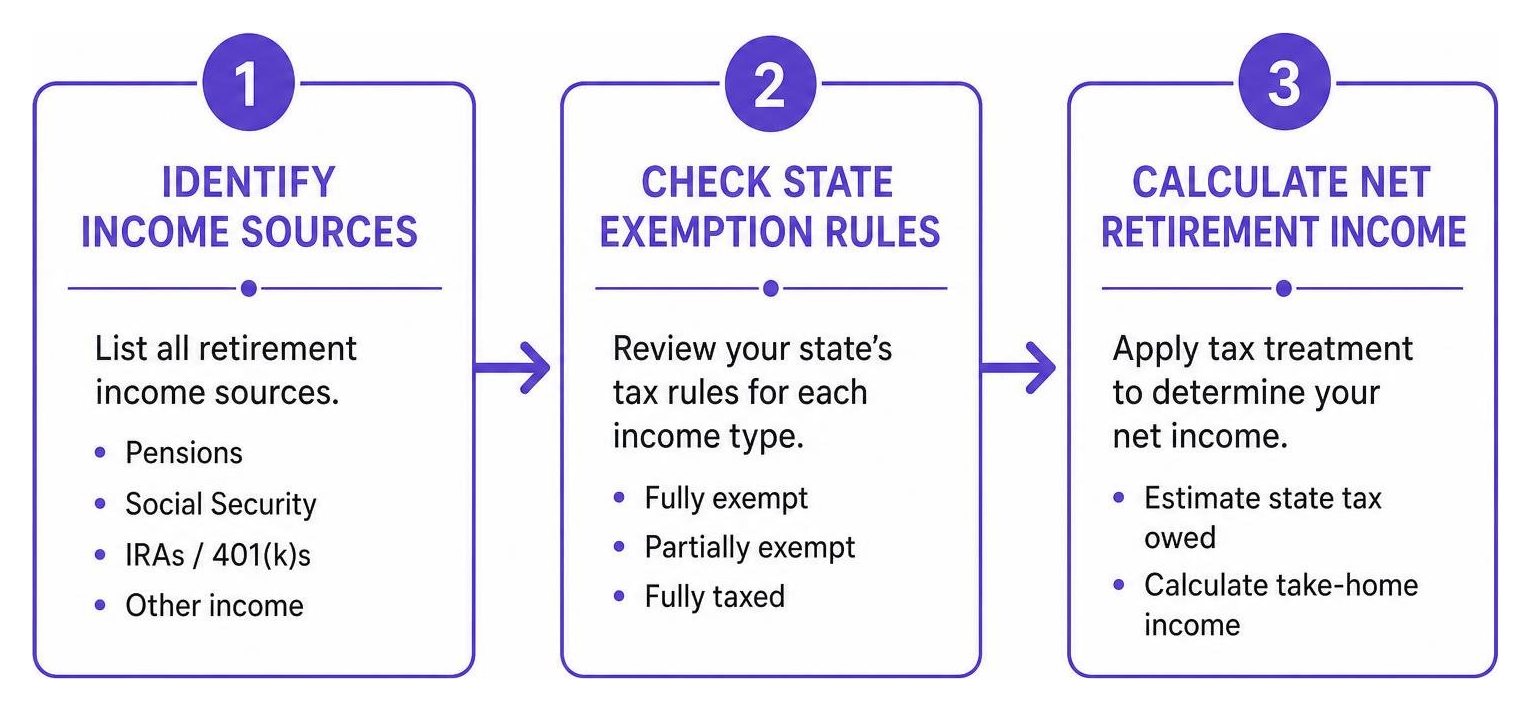
To optimize your distributions, it is essential to look at how your state taxes different retirement accounts. For instance, some states might exempt a government pension but fully tax a private workplace pension or traditional IRA distributions. We highly recommend reviewing Pension vs 401k Tax Strategies to learn how to structure your withdrawals to minimize both federal and state tax liabilities.
How States Tax Out-of-State Public Pensions and NYS Benefits
If you are a retired New York State public employee — perhaps you served as a teacher, police officer, firefighter, or civil servant — you already know that New York fully exempts all New York State and local government pensions from state and local income taxes. Additionally, for private pensions and out-of-state public pensions, New York allows a generous exclusion of up to $20,000 per year for retirees who are at least 59.5 years old.
But what happens if you decide to leave the Empire State?
Many New York retirees mistakenly believe that because their NYS pension is exempt from New York taxes, it will remain tax-free wherever they move. This is a dangerous assumption. Once you establish residency in another state, that new state’s tax laws govern how your pension is taxed.
Under federal law (specifically the State Taxation of Pension Income Act of 1995), New York cannot tax your pension once you are no longer a resident. However, your new home state is fully permitted to tax your New York State pension unless that state has an explicit exemption or does not levy an income tax.
When you receive your annual pension statement, it is reported on Form 1099-R. For a detailed breakdown of how to read this form and ensure your tax reporting is accurate, see our guide on Demystifying Form 1099-R.
Additionally, the IRS outlines the federal tax rules for these distributions under Topic no. 410, Pensions and annuities | Internal Revenue Service . While federal tax rules remain the same regardless of where you live, the state-level tax treatment of your NYS pension will depend entirely on your destination.
States with Full Out-of-State State Pension Tax Benefits
If you are looking to relocate but want to keep your state income tax bill at absolute zero on your NYS pension, you have several excellent options outside of the 9 no-income-tax states. A handful of states with state income taxes specifically choose to fully exempt public pension benefits, including those from other states:
- Illinois: Illinois is one of the most generous states for retirees. Despite having a flat 4.95% state income tax rate, Illinois fully exempts all qualified retirement income, including out-of-state public pensions, private pensions, and IRA/401(k) distributions, with no upper income limits.
- Pennsylvania: Boasting a flat 3.07% income tax rate, Pennsylvania does not tax qualified retirement benefits, including out-of-state public pensions, once you reach age 59.5.
- Mississippi: Mississippi fully exempts qualified retirement and pension income from state income tax. In 2026, Mississippi’s flat income tax rate is 4.3%, but your pension remains entirely untouched.
- Iowa: Effective January 1, 2023, Iowa implemented a massive tax shift, fully exempting all retirement income for residents age 55 and older. By 2026, Iowa has successfully reached its target flat income tax rate of 3.9% for non-retirement income, but your NYS pension will be 100% tax-free.
- Michigan: Under recent legislative changes, Michigan is fully phasing out state income tax on most retirement and pension benefits starting in the 2026 tax year. This phase-out allows significant relief for retirees who choose to make the Great Lakes State their home.
Choosing one of these states allows you to protect your entire pension from state income taxes while utilizing Smart Strategies to Defer Taxes to keep more of your other investments growing tax-deferred.
States with Partial Out-of-State State Pension Tax Benefits
If you don’t move to a fully exempt state, you may still qualify for partial state pension tax benefits through age-based exclusions or income-based deductions:
- Georgia: Georgia is highly attractive for retirees. It offers a substantial retirement income exclusion. Taxpayers aged 62 to 64 can exclude up to $35,000 of retirement income per person, while those aged 65 and older can exclude up to $65,000 per person. This applies to out-of-state pensions, IRAs, and business income.
- Colorado: Colorado allows a pension and annuity subtraction. For retirees aged 55 to 64, you can exclude up to $20,000 of retirement income. Once you turn 65, that exclusion limit increases to $24,000 per year.
- New Jersey: New Jersey offers significant retirement exclusions if your gross income is under $150,000. Joint filers can exclude up to $100,000 of retirement income, while single filers can exclude up to $75,000. However, these benefits phase out quickly if your total income exceeds the $150,000 threshold. For more on New Jersey’s specific pension guidelines, you can review Fact Sheet #12 .
When planning your retirement distributions in these partial-exemption states, it is critical to understand how pre-tax and after-tax funds interact. To learn how to maximize your tax-free cash flow, take a look at our After-Tax Contributions Guide.
Relocating to No-Income-Tax States: Florida, Texas, and Nevada
For decades, the standard retirement migration pattern for northeastern retirees has pointed directly toward sunnier climates like Florida, Texas, and Nevada. The primary financial driver behind this trend is “tax arbitrage” — the practice of earning money in a high-tax jurisdiction (like New York) and spending/withdrawing it in a jurisdiction with no state income tax.
When you move your primary residence to Florida, Texas, or Nevada:
- State Income Tax is Eliminated: You will pay 0% state income tax on your NYS pension, your Social Security, and any traditional 401(k) or IRA withdrawals.
- No State Filing Requirement: You won’t even need to file a state income tax return unless you have business income sourced in another state.
- Increased Purchasing Power: The money that would have gone to state tax departments remains in your local bank account, helping you combat inflation and cover rising healthcare costs.
However, retirees must look at the complete financial picture. While these states lack an income tax, they must generate revenue somehow. Texas, for instance, has some of the highest property tax rates in the nation. Florida has experienced sharp increases in property insurance premiums.
Furthermore, you must ensure you cleanly break your tax domicile with New York. New York State is notorious for auditing former residents who claim to have moved. To successfully establish residency in a no-income-tax state, you must spend at least 183 days per year outside of New York and demonstrate a permanent shift in your primary home, bank accounts, healthcare providers, and driver’s licenses.
While state taxes disappear, federal taxes on your retirement income do not. The Social Security Administration outlines overall retirement rules at Retirement benefits | SSA . Additionally, depending on your total provisional income, the federal government may tax up to 85% of your Social Security benefits. To see how these federal brackets work, read our Social Security Taxable Income Guide 2026.
Defined Benefit Pensions vs. Deferred Compensation Plans
When analyzing state pension tax benefits, it is crucial to distinguish between defined benefit pensions (traditional monthly annuities) and deferred compensation plans, such as IRC 457(b) plans, 403(b) plans, and 401(k)s.
Some states that offer generous tax exemptions for a “pension” define that term very narrowly. They may fully exempt a monthly government annuity but apply full state income taxes to withdrawals from a 457(b) or 401(k) plan.
This is known as the IRA Rollover Trap. If you live in a state that exempts pension income but taxes IRA distributions, and you decide to take your pension as a lump-sum rollover into a traditional IRA, you could inadvertently turn a tax-free pension into a fully taxable IRA distribution. Always verify how your target state defines “qualifying pension income” before making irreversible rollover decisions.
For public employees, particularly those in western states like California, understanding these adjustments is essential. If you have a CalPERS pension, you should review our guide on CalPERS Tax Adjustments to see how cost-of-living adjustments and state taxes interact over time.
Frequently Asked Questions about Retirement Taxes
Do no-income-tax states tax New York State pensions?
No. Under federal law (the State Taxation of Pension Income Act of 1995), no state can impose an income tax on the retirement income of a non-resident. Therefore, if you move to a state with no income tax — such as Florida, Texas, Nevada, or Wyoming — that state cannot tax your New York State pension. Because New York also cannot tax your pension once you are a non-resident, your NYS pension becomes entirely free from state-level income taxes.
For more details on states that do not tax pension payouts, you can check the guide from 15 States Don’t Tax Retirement Pension Payouts – AARP .
How do states treat Social Security benefits for relocating retirees?
Social Security tax rules vary widely by state. As of 2026, 36 states and the District of Columbia fully exempt Social Security benefits from state income tax. This includes the 9 no-income-tax states, plus states like Illinois, Pennsylvania, and New York.
However, 11 states still tax Social Security benefits to some degree, often depending on your age and overall adjusted gross income (AGI). If you are moving, it is critical to verify if your new state is one of the few that taxes these benefits. To understand the federal and state tax dynamics on your benefits, see our guide on Taxing Your Golden Years.
(Note: For our readers interested in international comparisons or UK rules, the UK State Pension is treated as taxable income and is taxed at your marginal rate. You can read more about UK rules at Is the State Pension taxable? Yes – here’s how and the technical mechanics of lump sums at EIM75750 – The taxation of pension income: social security lump sums – HMRC internal manual – GOV.UK .)
What is the IRA rollover trap in pension-exempt states?
The IRA rollover trap occurs when a retiree rolls over a lump-sum pension distribution into a traditional IRA in a state that exempts pension income but taxes IRA withdrawals. By rolling the money over, the income changes classification from “pension income” to “IRA distribution,” causing it to lose its state tax-exempt status. If you plan to retire in a state with selective exemptions, keeping your funds within the pension system as an annuity is often more tax-efficient than rolling them into an IRA.
Conclusion
At ContentVibee, our mission is to provide concise, actionable financial strategies that help you keep more of your hard-earned money. Maximizing your state pension tax benefits is one of the easiest ways to instantly boost your retirement income without taking on any investment risk.
By carefully aligning your retirement income profile with the tax laws of your chosen state, you can eliminate thousands of dollars in annual tax liabilities. Whether you choose a completely tax-free state like Florida, or a pension-friendly state like Illinois, proper planning before you move is key.
As you plan your next steps, don’t forget about federal obligations. Learn how to navigate federal tax brackets on your retirement benefits with our comprehensive guide: Uncle Sam’s Cut: Understanding Taxes on Social Security.


