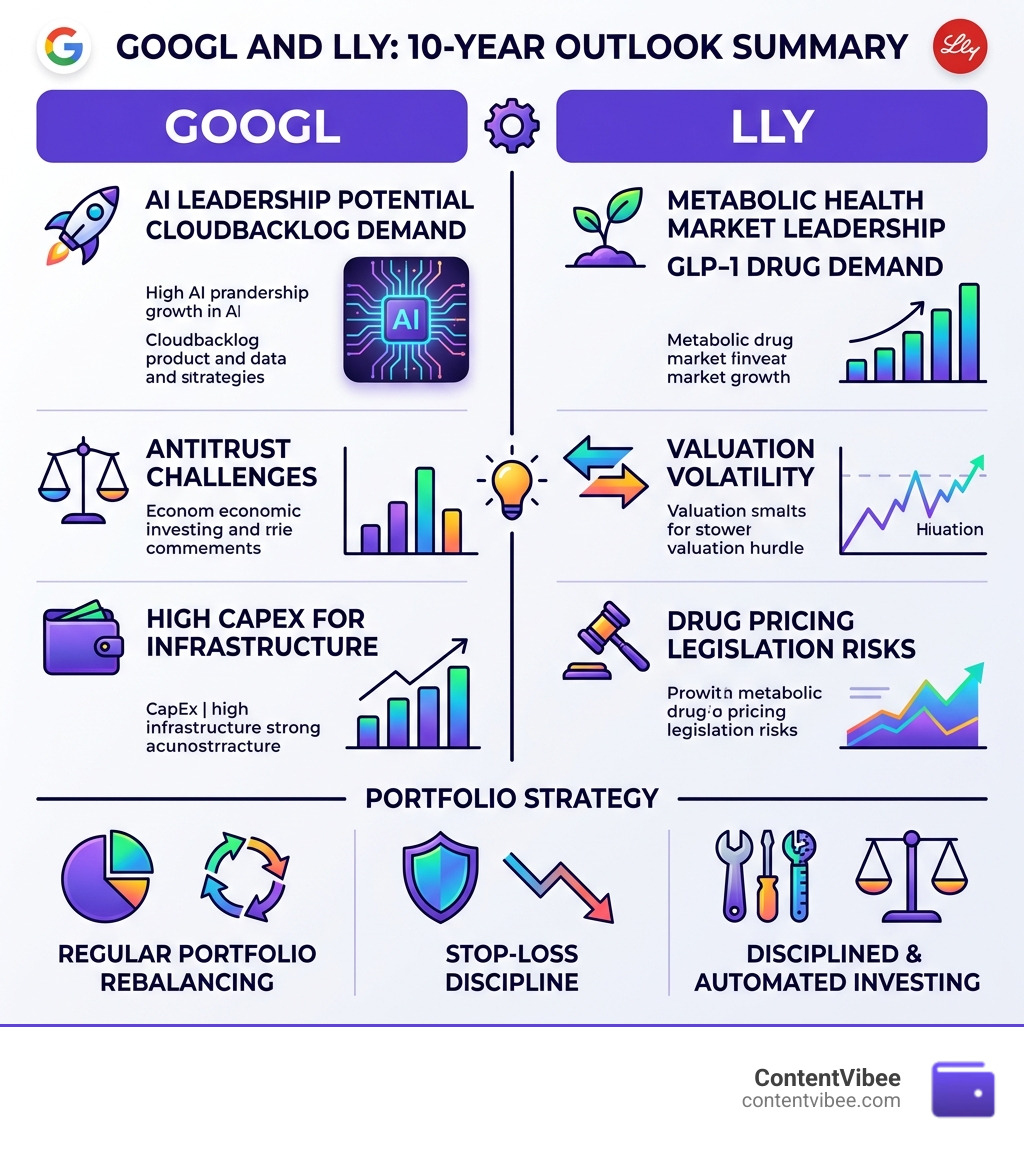

GOOGL LLY Long Term Investment Risk and Portfolio Allocation Strategy is one of the most searched topics among self-directed investors in 2026 — and for good reason.
Here is a quick snapshot of what you need to know before diving deeper:
| Factor | GOOGL (Alphabet) | LLY (Eli Lilly) |
|---|---|---|
| Market Cap | ~$3.6 trillion | ~$739 billion |
| Forward P/E | ~22–25x | ~35x |
| 2025 Revenue Growth | +15.1% YoY ($402.8B) | +38% YoY ($15.6B in Q2) |
| Analyst Consensus | Strong Buy (45 Buy, 5 Hold) | Strong Buy (20 Strong Buy, 2 Moderate Buy) |
| Primary Growth Driver | AI, Cloud, Search | GLP-1 drugs (Mounjaro, Zepbound) |
| Key Risk | Antitrust, AI CapEx returns | Drug pricing, patent cliffs, competition |
| Average Price Target | ~$352 (~19% upside) | $900–$1,500 (23–40%+ upside) |
These are not small bets. Alphabet has committed $175–$185 billion in capital expenditure for 2026 alone — a figure never seen before from a single tech company. Meanwhile, Eli Lilly became the first healthcare company to reach a $1 trillion market cap, driven by explosive demand for its weight-loss and diabetes drugs.
But big opportunity always comes with big risk.
Investors who jump in without understanding the full picture — regulatory threats, valuation premiums, sector volatility, and how much of each to hold — can face painful drawdowns. LLY, for example, has already corrected roughly 30% from its all-time highs, even while analysts maintained bullish price targets up to $1,500.
This guide breaks down the risks, valuations, and portfolio allocation strategies for both stocks clearly and honestly — so you can make informed decisions without relying on a black-box app or paying for advice you don’t fully understand.
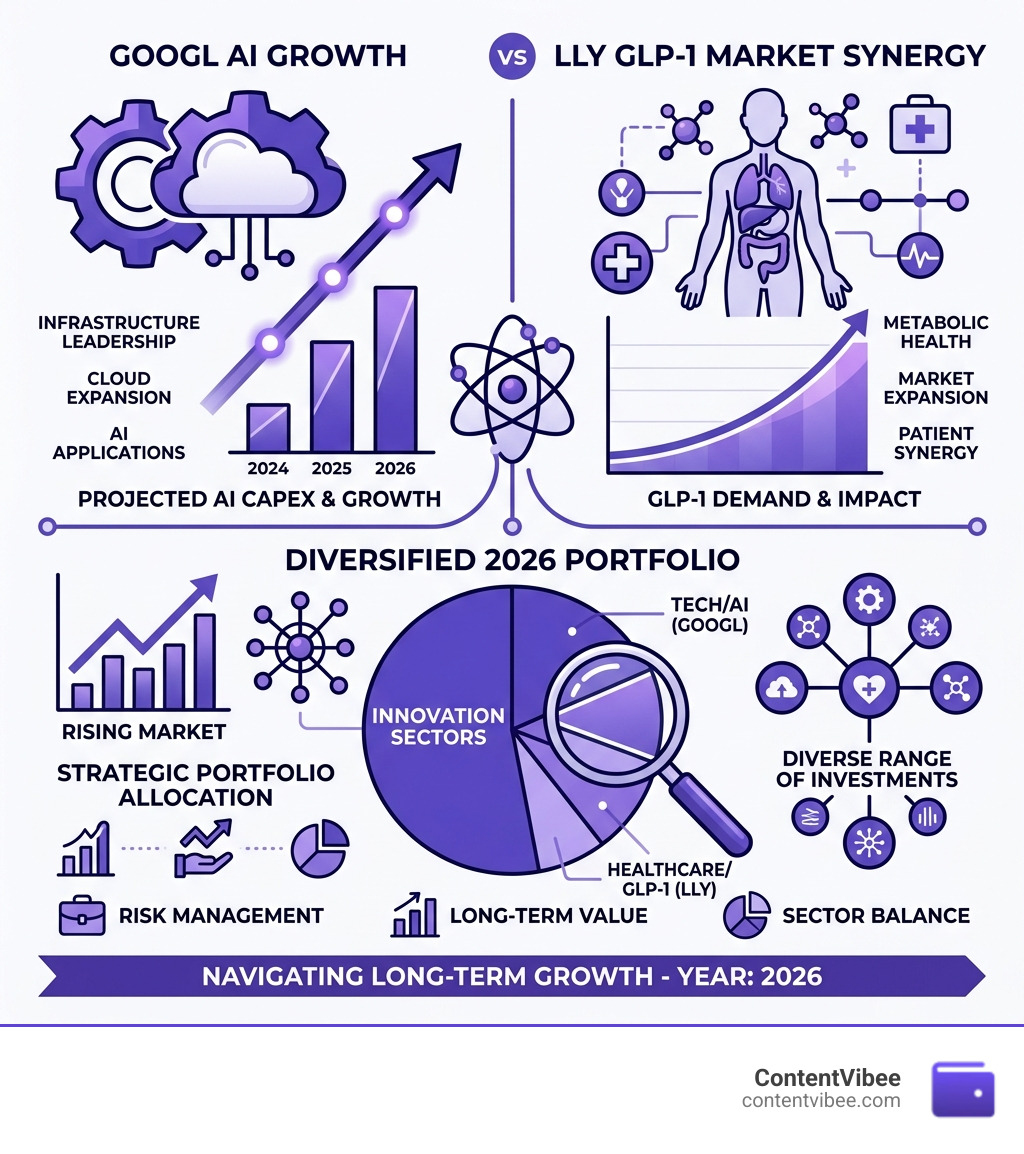
Core Growth Drivers: AI Infrastructure vs. GLP-1 Market Dominance
When we look at Alphabet (GOOGL) and Eli Lilly (LLY), we aren’t just looking at a search engine and a pill maker. We are looking at the two massive engines of the 2026 economy: Artificial Intelligence and Metabolic Health.
Alphabet: The AI Flywheel and Cloud Backlog
Alphabet’s long-term thesis is built on its transition from a search-first company to an AI-first company. The flagship Gemini models are now integrated across the entire Google Services ecosystem. While some feared that AI chatbots would cannibalize search, recent data shows the opposite. Between August 2025 and March 2026, Google’s share of the “information retrieval market” actually grew from 70% to 75%.
The real star of the show, however, is Google Cloud. With a massive $240 billion backlog (up 55% year-over-year), Cloud is no longer just a side project; it is a defining piece of Alphabet’s future. Furthermore, Alphabet’s strategic investments, such as the Why Alphabet Spacex Investment Value/ initiative, showcase their commitment to frontier technologies that provide long-term optionality.
For a deeper dive into their infrastructure, check out the Alphabet Stock (GOOGL): Complete Investment Analysis & Forecast 2026.
Eli Lilly: The GLP-1 Revolution and Alzheimer’s Pipeline
Eli Lilly has transformed into a growth powerhouse. Their “Holy Grail” drugs, Mounjaro (for diabetes) and Zepbound (for obesity), are leading a market that UBS forecasts will reach $126 billion by 2029. But LLY isn’t a one-trick pony. Their Alzheimer’s treatment, Kisunla (donanemab), has received marketing authorization in major markets like Australia and positive recommendations in Europe, where the patient population is expected to double by 2050.
According to Eli Lilly: The Right Long-Term Strategy – Seeking Alpha, the company’s ability to scale manufacturing is their current competitive moat. They aren’t just inventing the drugs; they are building the massive infrastructure required to deliver them to millions.

GOOGL LLY Long Term Investment Risk and Portfolio Allocation Strategy
Building a portfolio around these two titans requires a balance of aggression and caution. We often see investors over-allocate to “the winners” only to get caught in a sector rotation that wipes out years of gains.
Asset Allocation and Risk Management
In a diversified portfolio, we recommend treating GOOGL and LLY as core growth holdings. However, because they are in vastly different sectors (Tech vs. Healthcare), they provide a natural hedge. When tech valuations feel stretched, healthcare often acts as a defensive buffer, and vice versa.
To understand how these fit into a broader strategy, it’s helpful to review Understanding Traditional Vs Alternative Investments/. A common approach in 2026 is the “3-basket approach,” which aims for lower drawdowns while maintaining a 6% yield and market-beating growth.
Comparative Financial Metrics (April 2026)
| Metric | GOOGL | LLY |
|---|---|---|
| Gross Margin | ~57% | ~84.3% |
| Return on Equity (ROE) | ~31% | ~75.5% |
| Dividend Yield | ~0.25% | ~0.57% |
| Forward P/E | 22x | 35x |
| Institutional Sentiment | Strong Bullish | Strong Bullish |
Alphabet antitrust litigation financial loss recovery and GOOGL LLY Long Term Investment Risk and Portfolio Allocation Strategy
One of the most significant risks for Alphabet is the ongoing Department of Justice (DOJ) antitrust litigation. If a court rules that Google’s search dominance constitutes an illegal monopoly, the company could be forced to spin off key assets like Chrome or Android.
Furthermore, Alphabet faces new legal liabilities. A 2026 California jury verdict found YouTube liable for social media addiction harms. This sets a dangerous precedent that could bypass Section 230 immunity for thousands of pending lawsuits. For investors, this means that while the “flywheel” is spinning, the legal “friction” is increasing.
Eli Lilly drug pricing fraud prevention and GOOGL LLY Long Term Investment Risk and Portfolio Allocation Strategy
For Eli Lilly, the primary long-term risk is political. As GLP-1 drugs become a staple of the American healthcare system, they become a target for Medicare price negotiations. Any significant drug pricing reform could compress LLY’s 84% gross margins.
Additionally, competition from Novo Nordisk (NVO) and emerging Chinese biosimilars remains fierce. LLY must continue to innovate to stay ahead of the “patent cliff” — the moment when their exclusive rights to Mounjaro expire and cheaper generics enter the market.

Comparative Valuation and Technical Indicators for 2026
Are these stocks “expensive”? In 2026, the answer is “yes, but for a reason.”
Alphabet (GOOGL) Technicals
Alphabet currently trades around $311 per share. With a forward P/E of roughly 22x, it actually trades at a discount compared to many of its mega-cap peers like Microsoft or Apple, especially when you factor in its 18% revenue growth.
- Support Level: $300
- Analyst Target: $352 (19% upside)
- Institutional Note: Warren Buffett’s Berkshire Hathaway recently took a position, signaling that even value investors see the merit in Alphabet’s current price.
Eli Lilly (LLY) Technicals
LLY has seen extreme volatility. After hitting an all-time high of $1,061.17, it experienced a 30% correction.
- RSI (Relative Strength Index): Currently neutral after being heavily overbought (82.23) earlier in the year.
- 50-Day Moving Average: $855.85
- Analyst Target: High-end targets sit at $1,500, representing over 40% upside from recent lows.
Diversification and Income Strategies for Long-Term Portfolios
If you are holding these stocks in a Roth IRA, 401k, or a standard brokerage account, you might be looking for ways to generate income while waiting for that 10-year growth thesis to play out.
The LLYH ETF and Covered Calls
For investors who want exposure to Eli Lilly but are wary of its high price tag or volatility, the Harvest LLYH ETF is a popular 2026 strategy. This ETF holds LLY shares but writes covered calls on up to 50% of the position.
- Current Yield: ~20%
- Distribution: Monthly ($0.15 per unit)
- Benefit: It provides a high level of income, which can be reinvested to dollar-cost average into the stock during downturns.
Portfolio Rebalancing and Stop-Loss Levels
We recommend an annual rebalancing strategy. If LLY grows to represent 20% of your portfolio due to a massive run, it’s often wise to trim it back to 10% and redistribute those gains into more stable assets or GOOGL.
- Stop-Loss Levels: For long-term holders, we suggest “mental” stop-losses of 20-25% from all-time highs to protect capital against existential shifts in a company’s business model.
Frequently Asked Questions about GOOGL and LLY Risks
Is Alphabet’s $185 billion AI CapEx a risk to free cash flow?
Yes, it is a significant risk. Alphabet is betting the farm on AI infrastructure. If the returns on this investment — through Cloud revenue and ad efficiency — take longer than expected to materialize, free cash flow will be under pressure. However, the $240 billion cloud backlog suggests the demand is real and immediate.
How does the $1,500 price target for LLY impact its risk-reward profile?
A $1,500 price target implies that Wall Street expects LLY to essentially double its earnings again over the next few years. This creates a “high hurdle” for the company. If they miss an earnings report by even a small margin, the stock could see a sharp “valuation reset.”
What are the best recovery options for investors facing sector rotation losses?
If you’ve suffered losses due to a sudden shift out of tech or healthcare, the best “recovery” is often patience and diversification. Ensure you aren’t “revenge trading.” Using automated tools like the Autopilot app can help keep your emotions out of the process by maintaining a pre-set allocation.
Conclusion
Navigating the GOOGL LLY Long Term Investment Risk and Portfolio Allocation Strategy requires more than just picking “good companies.” It requires a deep understanding of the regulatory landscape, valuation metrics, and the discipline to rebalance when things get heated.
Alphabet remains the king of the digital world, but its crown is being challenged by antitrust regulators and the sheer cost of the AI race. Eli Lilly is the undisputed leader of the metabolic health revolution, but it faces the constant threat of drug pricing legislation and intense competition.
At ContentVibee, we believe that self-directed investors should have access to the same high-level analysis as institutional pros. If you’re looking for a way to manage these risks without spending 40 hours a week staring at charts, consider using the Autopilot app. Autopilot offers automated portfolio management with a transparent fee structure and comprehensive risk reviews, making it easier to hold high-conviction stocks like GOOGL and LLY for the long haul.
Ready to take control of your financial future? More info about ContentVibee services is just a click away.