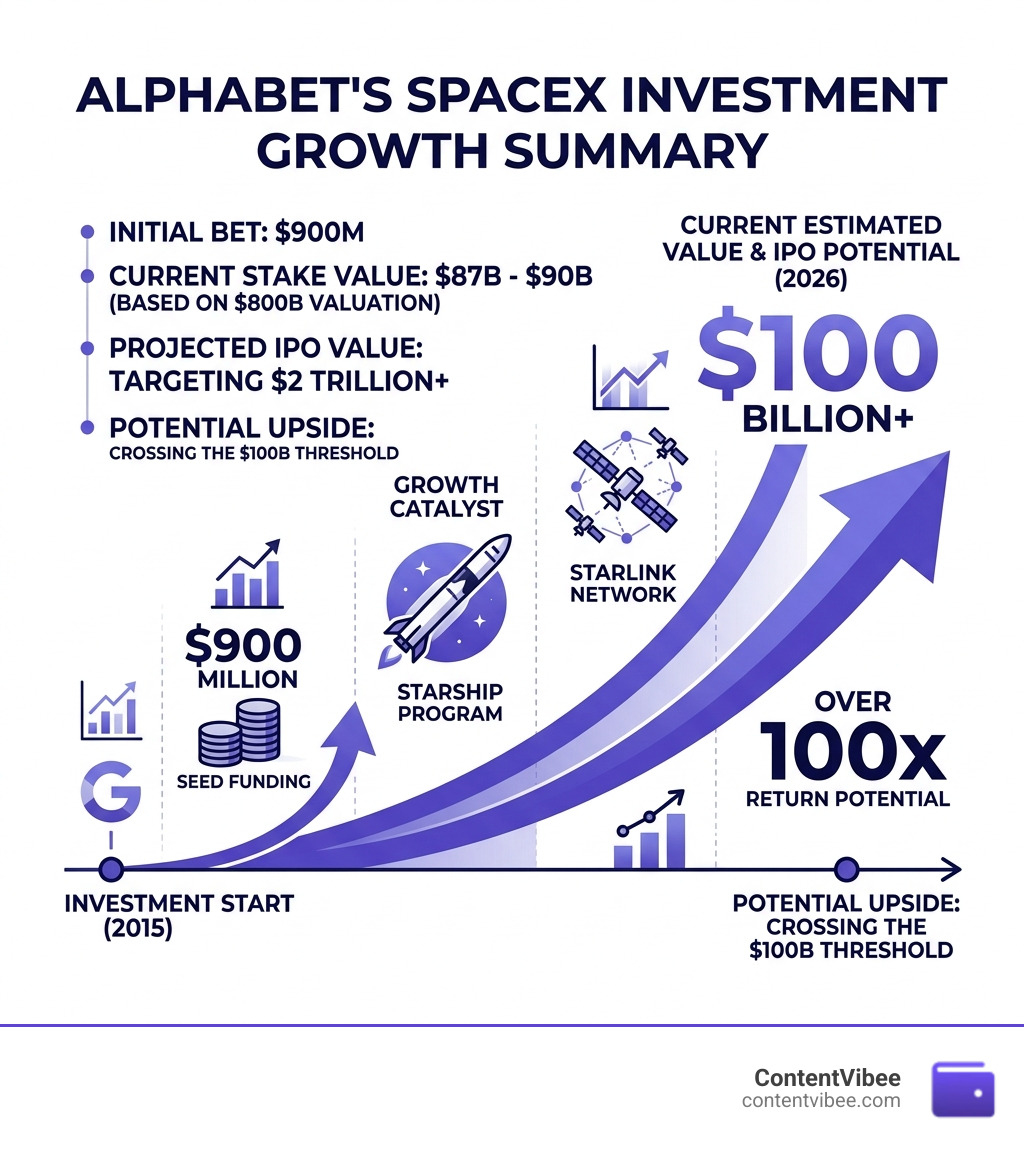
Alphabet SpaceX Investment Value and Private Equity Valuation Analysis is one of the most compelling case studies in modern portfolio management — and the numbers are hard to ignore.
Here’s a quick snapshot for self-directed investors who want the core facts fast:
| Key Data Point | Details (April 2026) |
|---|---|
| Original investment | $900 million in 2015 at $12B SpaceX valuation |
| Original stake | ~7.4% ownership |
| Current stake | ~5% (down from 6.11% at end of 2025) |
| Current SpaceX valuation | ~$800 billion (tender offer at $421/share) |
| Estimated stake value today | $87–$100 billion |
| Unrealized gain booked (Q1 2025) | $8 billion, boosting net income ~25–46% |
| Potential IPO stake value | $100–$122 billion at $2 trillion SpaceX valuation |
| ARK Invest 2030 projection | $2.5 trillion SpaceX enterprise value |
In short: a $900 million bet made over a decade ago could pay out more than 100 times the original investment.
But this story is about more than jaw-dropping returns. It raises real questions that every serious investor needs to understand:
- How do you value a private stake you can’t easily sell?
- How do unrealized gains flow through a public company’s earnings?
- What risks — dilution, illiquidity, regulatory hurdles — could shrink that windfall?
These are the questions this guide answers.
Alphabet’s SpaceX position sits at the intersection of venture capital strategy, private equity valuation, and public company financial reporting. Understanding it gives you a sharper lens for evaluating any company that holds significant private assets on its balance sheet.
The History of Alphabet’s Strategic Stake in SpaceX
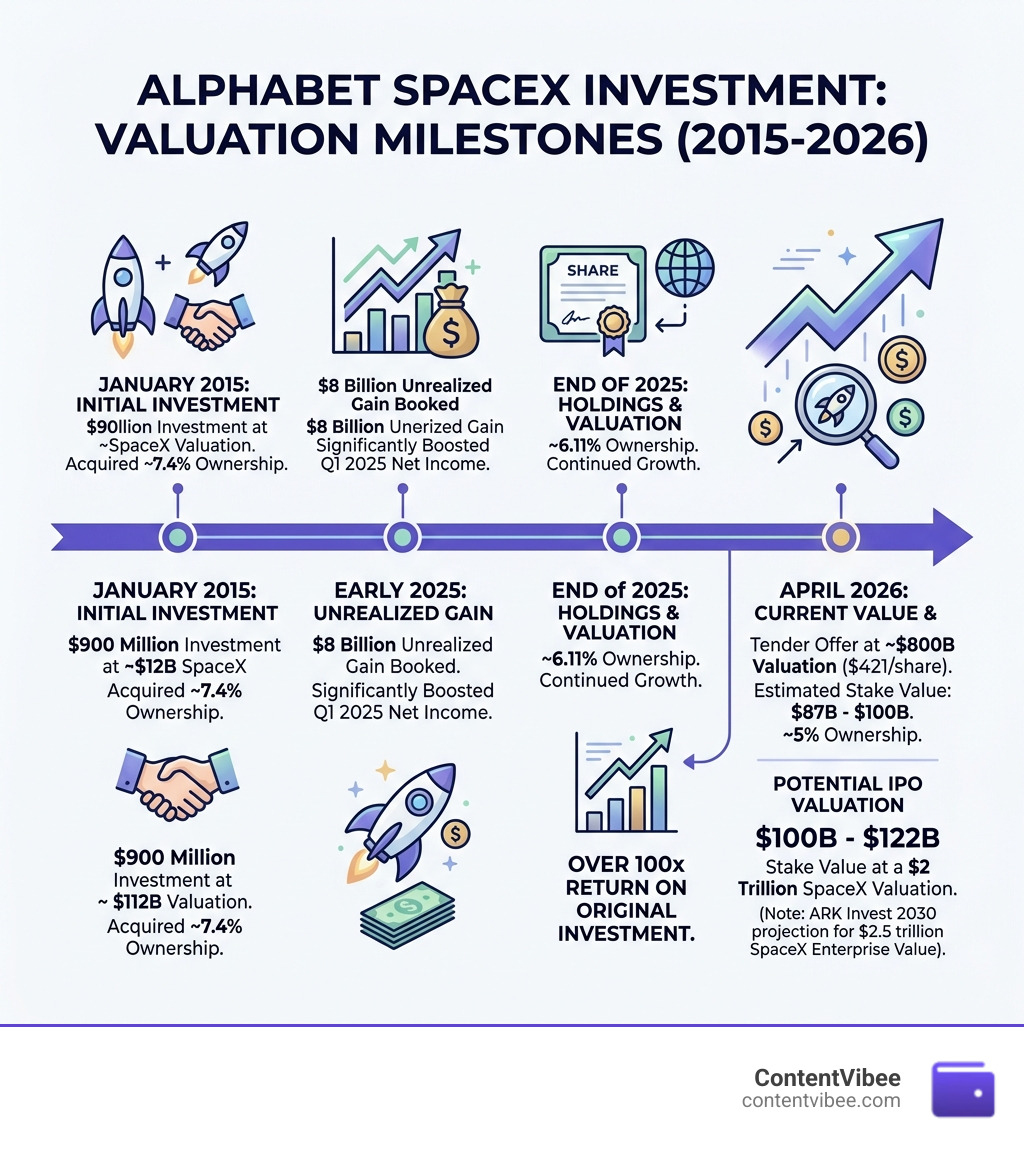
To understand where we are in April 2026, we have to look back to January 2015. At the time, SpaceX was far from the global titan it is today. It was a high-risk, high-reward aerospace company trying to prove that reusable rockets weren’t just science fiction.
Alphabet (then operating primarily as Google) joined forces with Fidelity to inject $1 billion into Elon Musk’s venture. Alphabet’s specific contribution was $900 million, which secured them a roughly 7.4% ownership stake. At that moment, the entire company was valued at a relatively modest $12 billion.
For Alphabet, this wasn’t just a random “moonshot.” It was a strategic move. While many saw it as a venture capital play, it was actually a masterful example of Understanding Traditional vs Alternative Investments. By stepping outside public stocks and bonds, Alphabet gained access to a sector—commercial space—that had almost no representation in the public markets at the time.
Evolution of Ownership and Dilution Trends
As we move through 2026, you might notice that Alphabet’s ownership percentage has shifted. While they started with 7.4%, recent filings indicate their stake has diluted to approximately 5%.
Why does this happen? In private equity, “dilution” is a natural part of the growth cycle. Every time SpaceX raises more capital or issues stock options to its thousands of employees, the total number of shares increases. If Alphabet doesn’t buy more shares in every single round, its “slice of the pie” gets smaller—even if the total value of that slice grows exponentially.
At the end of 2025, Alphabet held a 6.11% stake. However, following recent insider tender offers and secondary market activity in early 2026, that stake has settled closer to the 5% mark. Despite this smaller percentage, the Alphabet SpaceX Investment Value and Private Equity Valuation Analysis remains incredibly bullish because the underlying valuation of SpaceX has skyrocketed from $12 billion to $800 billion.
Strategic Synergies: Google Cloud and Starlink Integration
We often hear investors ask: “Is this just a passive investment for Alphabet?” The answer is a resounding no. There is a deep operational bridge between these two giants.
The most significant synergy lies in the relationship between Google Cloud and Starlink. As Starlink grew to over 8 million subscribers by late 2025, the data requirements for its global satellite broadband network became massive. SpaceX relies on Google’s high-capacity private network to deliver Starlink services, effectively making Google Cloud the backbone of the world’s most advanced satellite internet system.
This partnership creates a “flywheel” effect:
- SpaceX uses Google Cloud, generating recurring revenue for Alphabet.
- Alphabet’s investment in SpaceX grows in value as Starlink expands.
- The integration provides Alphabet with a front-row seat to the “Space Economy,” which Alphabet’s Strategic Bet on SpaceX and the Future of Space Commerce highlights as a critical frontier for the next decade of tech growth.
Alphabet SpaceX Investment Value and Private Equity Valuation Analysis

How do we actually put a price tag on a company that isn’t traded on the New York Stock Exchange? This is the heart of private equity valuation.
In April 2026, the primary benchmark for SpaceX’s value is the “tender offer.” A tender offer is a private transaction where existing shareholders (like employees or early investors) sell their shares to new or existing investors at a set price. The most recent tender offer was priced at $421 per share, which implies a total company valuation of approximately $800 billion.
This jump is staggering. Just a year and a half ago, SpaceX was valued at $350 billion. The doubling of value in such a short window is driven by the explosive revenue growth of Starlink, which is projected to bring in $11 billion in 2025 alone. As noted in SpaceX Valuation Hits $800B, Boosting Alphabet’s Paper Gains – News and Statistics – IndexBox, these private market milestones directly impact Alphabet’s balance sheet.
Private Equity Valuation Analysis of the $100 Billion Windfall
When we look toward a potential SpaceX IPO—rumored for mid-to-late 2026—the numbers become even more “astronomical.” Analysts suggest that in a public offering, SpaceX could command a valuation of $2 trillion.
If Alphabet maintains its ~5% stake, that stake would be worth $100 billion. If the dilution was less than expected and they still held closer to 6%, that value could hit $122 billion. To put that in perspective, Alphabet’s original $900 million check would have generated a 100x return.
This is what we call a “hidden asset.” Because SpaceX is private, its full value isn’t always reflected in Alphabet’s daily stock price. However, as Alphabet Poised for $100 Billion Windfall on SpaceX Investment explains, an IPO would “crystallize” this value, forcing the market to recognize over $100 billion in liquid cash or stock on Alphabet’s books.
GAAP Accounting and Unrealized Gain Reporting
You might wonder how this shows up in Alphabet’s quarterly earnings reports. Under GAAP (Generally Accepted Accounting Principles), Alphabet must account for its SpaceX stake as a “non-marketable equity security.”
In Q1 2025, Alphabet shocked Wall Street by booking an $8 billion unrealized gain from its SpaceX stake. This wasn’t cash in the bank—it was a “paper gain” based on the rising valuation of SpaceX in private markets. This single accounting adjustment boosted Alphabet’s net income by roughly 25% for that quarter.
While these gains are “unrealized” (meaning Alphabet hasn’t sold the shares yet), they are vital for investors to track. They provide a “secret” boost to earnings that can make Alphabet’s P/E ratio look much more attractive than it appears on the surface. For a deeper dive into how these assets are managed, see Alphabet’s Hidden $100B Asset: Assessing the Portfolio Impact of a Private Stake.
Managing Risks in Alphabet SpaceX Investment Value and Private Equity Valuation Analysis
No investment is without risk, especially one involving rockets and satellites. While the $100 billion headline is exciting, we must consider the “illiquidity premium.” Unlike Google stock, which you can sell in seconds, Alphabet cannot simply “dump” $100 billion worth of SpaceX shares without a major liquidity event like an IPO or a massive secondary sale.
There are also significant execution risks. SpaceX’s valuation is heavily tied to the success of the Starship program and the continued dominance of Starlink. Any regulatory hurdle—such as the FAA delaying launches or international governments blocking Starlink—could cause the private valuation to tumble. This is a common theme in Why Bridge Investment Group Private Equity, where the management of private assets requires a long-term horizon and a high tolerance for regulatory volatility.
Protecting Against Private Equity Valuation Fraud and Volatility
In the private secondary markets, pricing can sometimes be opaque. Unlike the Nasdaq, where the price is transparent, private valuations rely on the “last round” or “tender offer price.” This can lead to volatility if a company fails to meet its growth targets between rounds.
Investors should also be aware of concentration risk. While Alphabet is a diversified giant, a $100 billion stake in a single private company means a significant portion of its “Other Bets” value is tied to Elon Musk’s execution. As Alphabet’s $900M SpaceX Bet Now Worth $100B | Benzinga points out, this “lottery ticket” has already paid off, but the final payout depends on a successful exit.
Unauthorized Transaction Risks in Private Secondary Markets
As the value of private shares increases, so does the interest from bad actors. For individual investors looking to get “pre-IPO” exposure to companies like SpaceX through secondary platforms, the risks are real. We have seen a rise in identity theft credit report fraud how to fix and protect your score USA issues where scammers pose as brokers to steal sensitive financial information.
If you are navigating private equity markets, you must be vigilant against unauthorized bank transaction how to dispute and recover money USA 2026. Always ensure you are using reputable, SEC-registered secondary platforms. Furthermore, wire transfer fraud victim what to do and recovery options USA 2026 is a growing concern in the high-stakes world of private equity, where large sums of money move between accounts. We recommend robust credit monitoring and identity theft protection services to safeguard your personal data while chasing these high-growth opportunities.
Frequently Asked Questions about Alphabet’s SpaceX Stake
What is the current value of Alphabet’s SpaceX investment?
As of April 2026, based on the most recent tender offer of $421 per share, SpaceX is valued at approximately $800 billion. Alphabet’s roughly 5% stake is currently estimated to be worth between $87 billion and $90 billion. If we account for the potential “IPO pop,” that value could easily cross the $100 billion threshold.
When is the SpaceX IPO expected to occur?
While Elon Musk has historically been hesitant to take SpaceX public, the massive capital requirements for Mars exploration and the maturity of the Starlink business have shifted the timeline. Most analysts are now pointing toward a mid-2026 IPO. This would likely be the largest public offering in history, with a target valuation of $2 trillion.
How does the SpaceX stake impact Alphabet’s stock price?
For a long time, the market viewed Alphabet’s “Other Bets” as a “black hole” of spending. However, the realization that Alphabet holds nearly $150 billion in “hidden assets” (SpaceX at ~$100B and Anthropic at ~$7B-$10B) has changed the narrative. These assets provide a massive safety net and a catalyst for the stock price (GOOGL) that many traditional analysts are only just beginning to bake into their models.
Conclusion
The Alphabet SpaceX Investment Value and Private Equity Valuation Analysis serves as a masterclass in strategic patience. By identifying a generational talent and a transformative technology in 2015, Alphabet has turned a $900 million “side bet” into a $100 billion powerhouse that could soon rival the valuation of its own Cloud or YouTube divisions.
For us at ContentVibee, this story emphasizes the importance of looking beyond the headline earnings and digging into the balance sheet. Whether you are a retail investor or a seasoned pro, understanding the value of private stakes in public portfolios is key to finding the “hidden gems” of the market.
Stay informed on the latest shifts in big tech and private equity by joining our community. Subscribe to Newsletters Sign Up to get curated market intelligence delivered straight to your inbox.