


Dave Ramsey Investment Calculator Accuracy and Retirement Planning Strategy is one of the most searched topics among self-directed investors who want to plan their retirement without blindly trusting an app or advisor.
Here’s the quick answer:
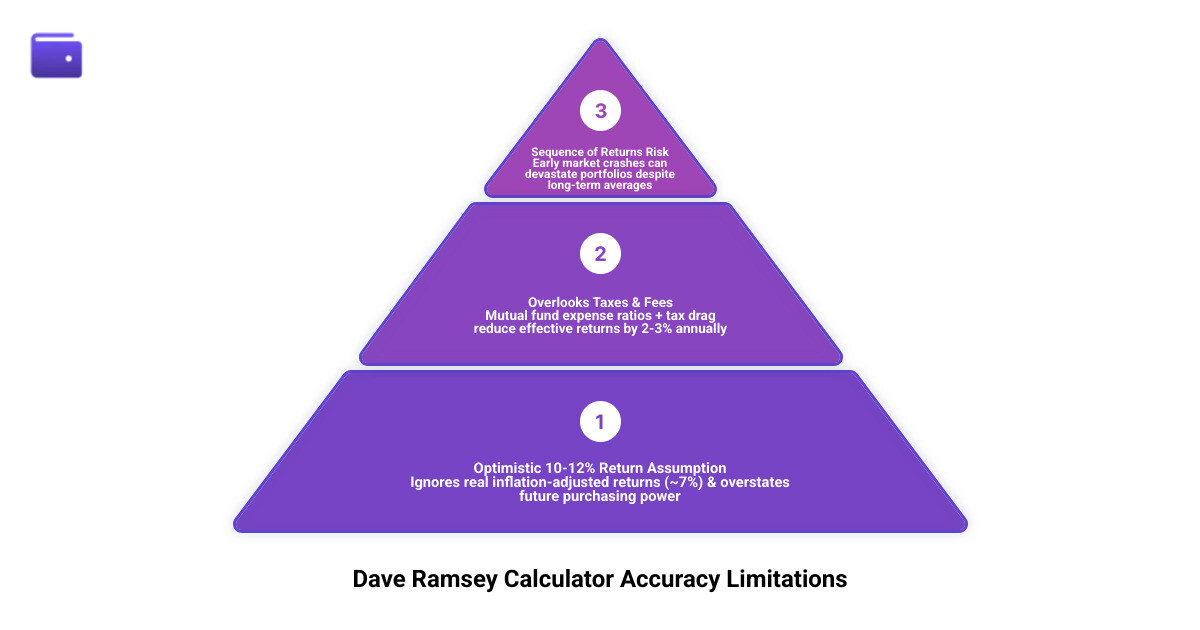
The Dave Ramsey Investment Calculator is a useful starting point, but it has real accuracy limitations you need to know before making financial decisions:
- Return assumption is optimistic: The calculator uses 10-12% annual returns based on historical S&P 500 averages — but the real inflation-adjusted return is closer to 7%
- Inflation is not fully baked in: Projections show nominal (not real) growth, which overstates your future purchasing power
- Taxes and fees are ignored: Mutual fund expense ratios and tax drag can reduce effective returns by 2-3% or more annually
- Sequence of returns risk is missing: A market crash early in retirement can devastate your portfolio even if long-term averages look fine
- Best use: Motivation and ballpark planning — not a precise retirement blueprint
The gap matters more than you might think. Investing $10,000 upfront plus $500/month for 30 years looks very different depending on which return rate you use:
| Return Rate | Projected Balance |
|---|---|
| 12% (Ramsey default) | ~$1,778,000 |
| 8% (conservative estimate) | ~$745,000 |
| 7% (inflation-adjusted real return) | ~$612,000 |
That’s a more than 2x difference — which could mean the difference between a comfortable retirement and a serious shortfall.
The calculator is genuinely motivating for beginners. But if you’re a self-directed investor who cares about fees, real returns, and actual control over your financial future, you need to understand exactly where it falls short — and how to adjust your inputs for a more honest picture.
Understanding the Dave Ramsey Investment Calculator Accuracy and Retirement Planning Strategy
To truly grasp the Dave Ramsey Investment Calculator Accuracy and Retirement Planning Strategy, we first have to look at how the tool functions. At its core, the Investment Calculator is a compound interest engine. You input your current age, your desired retirement age, your current savings, and your monthly contribution. The calculator then applies an annual return rate to project your “nest egg.”
The primary strategy advocated by Ramsey is to invest 15% of your gross household income into retirement accounts once you are debt-free (except for the mortgage). While this is a solid behavioral foundation, the accuracy of the resulting projection depends entirely on the “Expected Return” field. Ramsey famously suggests using 10–12%.
However, there is a massive difference between nominal returns (the raw number) and real returns (what that money can actually buy after inflation). If you don’t account for the “inflation-adjusted” reality, you might find yourself with a million dollars in 2056 that only has the purchasing power of $400,000 today. This is Why Investment Calculator Accuracy And Financial planning must go hand-in-hand with realistic expectations.
The 12% Return Myth vs. Market Reality in Your Retirement Planning Strategy
The most controversial aspect of the Ramsey strategy is the 12% annual return assumption. Ramsey bases this on the historical 30-year arithmetic average of the S&P 500. While it is true that the S&P 500 has had an arithmetic average of roughly 11.5% to 12% from 1926 through 2023, this number is mathematically misleading for a long-term investor.
In investing, we care about the Geometric Mean (or CAGR), not the arithmetic average. If you have $100 and lose 50% one year (+50) and gain 50% the next (+50), your arithmetic average is 0%. But in reality, you have $75, not $100. You actually lost 25%. Market volatility “eats” your returns.
When we look at historical data from 1926 to 2023, the geometric return of the S&P 500 is closer to 10–10.5%. Once you subtract the historical average inflation of 3%, you are left with a “real” return of roughly 7%. Planning your life around a 12% return is an aggressive gamble that overlooks the erosion of purchasing power.

How Starting Age Impacts Dave Ramsey Investment Calculator Accuracy
The power of the Dave Ramsey Investment Calculator Accuracy and Retirement Planning Strategy is most evident when you start young. Compound interest is a “math miracle” that rewards time above all else.
Consider these scenarios using a realistic 7% return:
- The Early Bird: Start at age 25, investing $500/month. By age 65, you have ~$1.2 million.
- The Late Starter: Start at age 45, investing $2,000/month. Even though you are contributing four times as much per month, you end up with only ~$1.08 million by age 65.
For those starting late (age 40+), the Ramsey calculator can be a bit of a “wake-up call.” If you are behind, you cannot simply rely on a 12% “myth” to save you. You must leverage catch-up contributions. In 2025/2026, the IRS allows those over 50 to contribute an extra $7,500 to their 401(k) and $1,000 to their IRA.
We recommend using age-based benchmarks to validate your progress:
- Age 30: Have 1x your annual salary saved.
- Age 40: Have 3x your annual salary saved.
- Age 50: Have 6x your annual salary saved.
- Age 67: Have 10x your annual salary saved.
Critical Limitations: What the Ramsey Calculator Overlooks
While the Ramsey tool is great for a quick “what-if” session, it is a simplified model that ignores several “wealth killers.” If you are a self-directed investor, these omissions are where the real risk lies.
- Mutual Fund Fees: Ramsey recommends actively managed growth stock mutual funds. These often come with expense ratios of 1% to 2%. In contrast, low-cost index funds might cost 0.03%. Over 30 years, that 1.5% difference in fees can cost you hundreds of thousands of dollars in lost growth.
- Tax Brackets: The calculator doesn’t distinguish between a Roth IRA (tax-free withdrawals) and a Traditional 401(k) (taxed as ordinary income). If your calculator says you have $2 million, but $1.5 million is in a Traditional 401(k), the IRS owns about $400,000 of that “nest egg.”
- Inflation Erosion: As mentioned, $100 today will not buy $100 worth of goods in 2050. At a 3% inflation rate, prices double roughly every 24 years (the Rule of 72).
This is Why A Compound Interest Calculator For Retirement/ is only the first step. You must look at the fine print of your specific portfolio.
Managing Sequence of Returns Risk in Your Retirement Planning Strategy
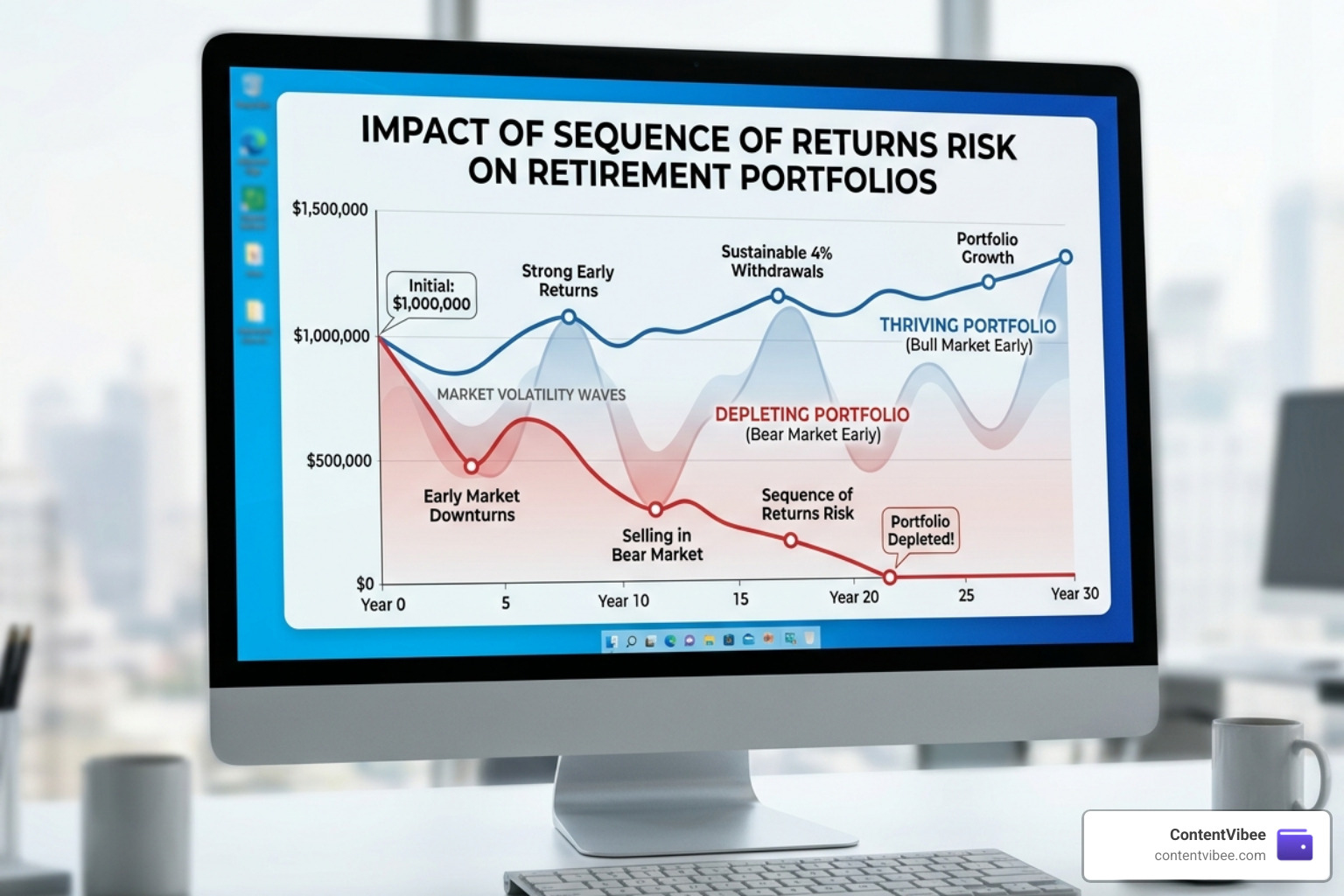
One of the most dangerous omissions in the Ramsey calculator is Sequence of Returns Risk. The calculator assumes a smooth, constant line of growth (e.g., exactly 12% every year). The stock market does not work that way.
Imagine two retirees, both with $1 million:
- Retiree A enters retirement during a 3-year bull market. Their portfolio grows, and their 4% withdrawals are easily covered by gains.
- Retiree B enters retirement during a “bear market” where the S&P 500 drops 30% in year one. Because they are forced to withdraw money for living expenses while the market is down, they are “selling low.” This can cause the portfolio to deplete decades faster than projected, even if the long-term average return eventually recovers to 10%.
To mitigate this, many experts suggest the 4% Rule: withdrawing only 4% of your initial portfolio value in year one, then adjusting for inflation. Ramsey has historically suggested an 8% withdrawal rate, which many fiduciaries consider “dangerously high” and likely to lead to portfolio exhaustion.
How the Ramsey Calculator Compares to More Comprehensive Planning Tools
The Ramsey calculator is a “Type 1” tool: simple, fast, and motivational. However, as you get closer to retirement, you need “Type 2” tools that offer high-level customization.
| Feature | Ramsey Calculator | Advanced Planning Tools |
|---|---|---|
| Return Inputs | Single fixed percentage | Variable by account type |
| Social Security | Not included | Full integration and optimization |
| Tax Impact | Ignored | Estimates federal and state taxes |
| Healthcare | Not included | Projects Medicare and LTC costs |
| Success Logic | 100% (Straight line) | Monte Carlo (Probability of success) |
Advanced tools use Monte Carlo simulations to run your plan through 1,000 different market scenarios (including depressions and booms). This gives you a “probability of success” score. If your score is 85% or higher, you’re in great shape. The Ramsey calculator, by contrast, gives you a single “perfect world” number that rarely happens in reality.
How to Adjust Your Strategy for Realistic Financial Security
If you want to use the Ramsey framework but ensure your Dave Ramsey Investment Calculator Accuracy and Retirement Planning Strategy is resilient, we suggest making these adjustments:
- Lower the Return Input: Run your numbers at 7% or 8%. This accounts for inflation and creates a “margin of safety.” If the market does better, great! You’ll just have a bigger party. If it does 8%, you’re still on track.
- Prioritize the Match: Ramsey says: 1) Employer Match, 2) Roth, 3) Traditional. This is excellent advice. Never leave free money on the table.
- Eliminate High-Interest Debt: You cannot out-invest a 24% credit card APR. Use the “Debt Snowball” to clear the deck so your 15% investment rate is sustainable.
- Review Fees Regularly: Use tools like Autopilot to perform a comprehensive fee and risk review. If your “growth stock mutual funds” are charging 1.5% and underperforming the S&P 500, they are not cost-worthy.
- Build a Cash Buffer: To fight sequence of returns risk, keep 1–2 years of living expenses in a high-yield savings account or money market fund as you approach retirement. This prevents you from being forced to sell stocks during a market crash.
Frequently Asked Questions about Dave Ramsey Investment Calculator Accuracy
Is a 12% annual return realistic for long-term planning?
No. While the S&P 500 has hit 12% in certain periods, it is “dangerously optimistic” for planning. After accounting for the difference between arithmetic and geometric returns, inflation (3%), and investment fees (1–2%), a “real” return of 6–8% is a much more professional benchmark.
How does inflation affect my projected retirement nest egg?
Inflation reduces the purchasing power of your future dollars. If you project a $1 million nest egg 30 years from now, and inflation averages 3%, that $1 million will only buy what ~$411,000 buys today. Always look at “inflation-adjusted” or “real” numbers to see if you can actually afford your future lifestyle.
Is saving 15% of my income enough if I start at age 40?
It might be tight. If you start at 40 with zero savings, a 15% savings rate might only replace about 40–50% of your income by age 65. Late starters should aim for a 20–25% savings rate and maximize catch-up contributions to bridge the gap.
Conclusion
The Dave Ramsey Investment Calculator Accuracy and Retirement Planning Strategy is a fantastic tool for lighting a fire under your savings goals. It simplifies the complex world of compound interest and gives you a target to shoot for. However, for the self-directed investor, simplicity can be a double-edged sword.
Relying on a 12% return and ignoring fees or taxes can lead to a “false sense of security.” At ContentVibee, we believe in looking at the full picture. This is why we appreciate the approach of apps like Autopilot, which focuses on automated portfolio management and rigorous reviews of fees and risks. Knowing if your investments are truly “cost-worthy” is the difference between following a guru’s advice and actually achieving financial independence.
Don’t just plug in numbers and hope for the best. Adjust your expectations, lower your fees, and stay consistent. Your future self will thank you for the realism today.
Start Your Journey to Financial Security


