


Investment Time Horizon Impact on Portfolio Risk and Returns is one of the most foundational — and most overlooked — concepts in building wealth. Put simply: how long you plan to invest changes everything about how much risk you should take, what assets belong in your portfolio, and how you’ll react when markets get rough.
Here’s a quick answer before we dive deeper:
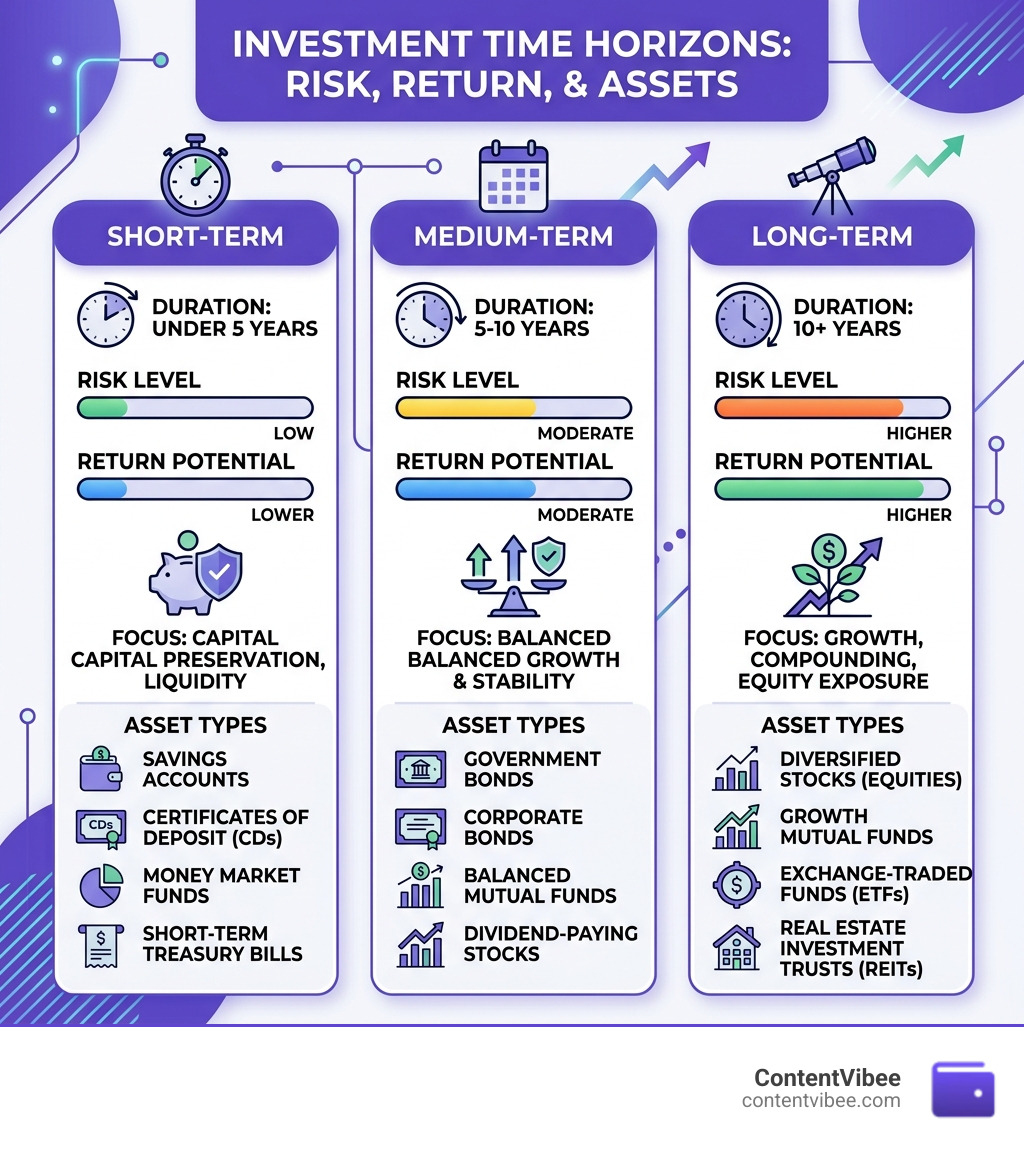
| Time Horizon | Typical Duration | Risk Level | Focus |
|---|---|---|---|
| Short-term | Under 5 years | Low | Capital preservation, liquidity |
| Medium-term | 5-10 years | Moderate | Balanced growth and stability |
| Long-term | 10+ years | Higher | Growth, compounding, equity exposure |
A few key points to understand right away:
- Longer horizons reduce the impact of short-term volatility — but they don’t eliminate risk entirely
- Time in the market matters more than timing the market — compounding rewards patience
- You can have multiple time horizons at once — your retirement savings and your house down payment fund are completely different problems
- Your strategy should shift as your deadline gets closer — what works at 30 years out is wrong at 3 years out
Research across more than 100 years of market data from 20 countries confirms that higher equity allocations are optimal for longer time horizons, regardless of an investor’s risk aversion level. At the same time, academic analysis shows that a 30-year-old investor planning for retirement needs a fundamentally different portfolio than a 70-year-old — even if both hold the same assets today.
The stakes are real. Getting this wrong doesn’t just mean lower returns. It means running out of money at the wrong time, panic-selling during a downturn, or locking up cash you needed in six months inside assets that won’t recover in time.
What is an Investment Time Horizon?
In our experience at ContentVibee, we’ve found that many people mistake “investing” for “picking winners.” In reality, your investment time horizon is the actual engine behind your strategy. It is the total length of time you expect to hold an investment before you need to access the money. Understanding Investment Time Horizons is essential because this distance varies for every goal, and your portfolio shouldn’t be a single monolith. Instead, it should be a collection of strategies tailored to different dates. This is known as goal-based planning. For instance, saving for a vacation next year requires a completely different approach than building a nest egg for a child’s college education a decade away.
Standard Classifications and Durations
While every investor is unique, the industry generally breaks timelines into three buckets:
- Short-term (less than 5 years): These are goals like buying a car, a wedding, or a home renovation. Here, the primary goal is capital preservation. You don’t have time to wait out a 20% market drop, so you prioritize liquidity—the ability to get your cash quickly without losing value.
- Medium-term (5 to 10 years): This might include a down payment for a house or starting a business. You can afford some risk to beat inflation, but you still need a “buffer” of stability.
- Long-term (10+ years): Retirement is the classic example. With decades ahead of you, you can harness the power of compounding and ride out the inevitable “roller coaster” of the stock market.
To understand how these timelines affect your math, ensure Investment Calculator Accuracy And Financial projections are based on the correct duration. A small error in your time assumption can lead to a massive gap in your final balance.
Factors Influencing Your Personal Timeline
Your horizon isn’t just a date on a calendar; it’s shaped by your life’s “big picture.”
- Human Capital: This is your ability to earn money in the future. A 25-year-old has high human capital (decades of paychecks ahead), which allows them to take more investment risk.
- Life Expectancy: We are living longer than ever. Worldwide life expectancy has risen from under 50 in 1950 to over 70 today, with many in the USA reaching 80+. This means your “retirement” horizon might actually be 30 years long, requiring more growth-oriented assets to avoid outliving your money.
- Inflation Risk: This is the “silent killer” of short-term thinking. If you keep long-term money in a 1% savings account while inflation is 3%, you are effectively losing money. Using A Compound Interest Calculator For Retirement can help you see how much growth you actually need to maintain your purchasing power over 20 or 30 years.
Investment Time Horizon Impact on Portfolio Risk and Returns
The relationship between time and risk is powerful. As your horizon lengthens, the probability of stocks outperforming bonds increases dramatically. Over the last century, the likelihood of ending up with more wealth in stocks than bonds grows the longer you stay invested.
| Horizon | Probability of Positive Return (S&P 500) | Risk Focus |
|---|---|---|
| 1 Year | ~73% | High Volatility |
| 10 Years | ~94% | Market Cycles |
| 20 Years | ~100% | Inflation/Purchasing Power |
This concept is often called “time diversification.” While the market can be a wild beast on a Tuesday afternoon, its long-term trend has historically been upward. A longer horizon gives you the “cushion” to ignore the noise.
Understanding the Investment Time Horizon Impact on Portfolio Risk and Returns
One of the most dangerous myths in finance is that you can “time the market.” In reality, “time in the market” is the true winner. When you stay invested for the long haul, you benefit from the equity risk premium—the extra return you get for enduring the volatility of stocks.
Research into serial correlation (how past returns affect future ones), as detailed in studies by the CFA Institute, shows that while stocks are volatile year-to-year, they often exhibit “mean reversion” over long periods. This means that after a very bad year, the odds of a recovery improve, but only if your time horizon is long enough to wait for it. In fact, some studies show that for a 20-year horizon, an optimal equity allocation might be as high as 70-80%, whereas for a 1-year horizon, it might drop significantly to protect your principal.
Strategic Adjustments for Investment Time Horizon Impact on Portfolio Risk and Returns
As you move through life, your portfolio shouldn’t stay static. We recommend using “glide paths”—a strategy where your asset allocation automatically shifts from aggressive to conservative as you approach your goal.
For a long-term goal, you might start with a heavy tilt toward Traditional Vs Alternative Investments like equities and real estate. As you get within five years of needing the money, you should begin “de-risking” by moving funds into bonds and cash. This prevents a market crash in year 19 of a 20-year plan from ruining your retirement.
Advanced Portfolio Rules and Distribution Shifts
For those who want to get technical, the Investment Time Horizon Impact on Portfolio Risk and Returns actually changes the “shape” of market math. Most basic models use the Mean-Variance (M-V) rule, which assumes market returns follow a neat, symmetrical “bell curve.”
However, research shows this doesn’t hold up over long periods. As your horizon grows, return distributions become “positively skewed” (meaning there’s a higher chance of extreme positive gains than extreme losses).
Why Mean-Variance Fails for Long Horizons
The M-V rule often suggests that as you invest for longer, you should actually hold more bonds to reduce variance. This is mathematically “efficient” but practically foolish. Academic studies show that for a 30-year horizon, M-V might recommend only 4% in stocks, while expected utility maximization (which looks at actual wealth goals) suggests nearly 100% stocks.
Relying solely on old-school M-V models for long horizons can lead to a significant economic loss. You end up “playing it too safe” and failing to build the wealth you need. For long-term planning, “stochastic dominance”—a method that compares the entire range of possible outcomes—is often a much better guide than simple averages.
The Role of Real Yields and TIPS in 2026
In the current 2026 economic landscape, we have to deal with the reality of low or even negative real interest rates. In 2021, for example, the real yield on 10-year TIPS (Treasury Inflation-Protected Securities) was -1.049%. This means if you invested $100, you’d only have about $90 in “real” purchasing power a decade later.
This highlights why understanding Asset Management Vs Investment Management is key. Asset management focuses on the long-term strategy of staying ahead of these negative rates, ensuring your “safe” money doesn’t slowly evaporate due to inflation.
Protecting Your Wealth: Horizon Risk and Financial Recovery Strategies

Even the best-laid plans face “Horizon Risk”—the danger that your investment timeline is suddenly cut short. This could happen due to a job loss, a medical emergency, or even falling victim to financial fraud.
In 2026, digital security is a major part of portfolio management. An unauthorized bank transaction or identity theft can force you to liquidate long-term investments early to cover immediate losses, destroying your compounding progress.
Common Mistakes in Horizon Misalignment
The most frequent error we see is putting “short-term money” into “long-term assets.”
- The House Down Payment Trap: Investing your house fund (needed in 18 months) into a volatile tech ETF. If the market dips 15%, you can’t buy the house.
- Ignoring Inflation: Keeping retirement funds in a “safe” checking account for 30 years.
- Emotional Selling: Treating a 20-year retirement account like a 20-minute trading account.
Misalignment often happens because investors don’t account for Brokerage Firm Investment Fees And Account costs, which can eat into returns more aggressively on shorter timelines. Likewise, Investment Manager Software Fees should be weighed against the value they provide in keeping your horizon on track.
Recovery from Market Downturns and Fraud
If you are a victim of wire transfer fraud or an unauthorized transaction in the USA in 2026, your first step is to dispute the charge immediately with your financial institution to recover funds. You can also report these incidents to the Federal Trade Commission to aid in your recovery. Protecting your account access is a prerequisite for any investment strategy.
When it comes to market “crashes,” recovery is a matter of time. Historically, every major US market downturn has been followed by an eventual recovery and new highs. The only way to “lose” is to sell at the bottom because your timeline was too short to wait for the rebound. This is why Automated Portfolio Management can be so helpful—it removes the emotional urge to panic-sell, keeping your assets aligned with your original goals.
Frequently Asked Questions about Investment Horizons
Does a longer time horizon always reduce portfolio risk?
It doesn’t remove the existence of risk (the market can still go down), but it reduces the impact of that risk on your final goal. With more time, you have more opportunities for the market to recover and for compounding to work its magic. However, long horizons introduce “inflation risk,” where your money might not buy as much in the future as it does today.
How do I determine my time horizon for multiple financial goals?
We recommend the “bucket” approach. List each goal (e.g., “New Car 2028,” “Kids College 2035,” “Retirement 2050”). Each bucket gets its own asset allocation. Your “New Car” bucket should be in low-risk CDs or money market funds, while the “Retirement” bucket stays aggressive in stocks.
Should I change my asset allocation as my target date approaches?
Yes! This is the “Protect” stage of investing. As you get closer to the date you need the money, your ability to recover from a market crash diminishes. Shifting from 90% stocks to 40% stocks as you approach retirement helps lock in your gains and ensures the money is there when you need it.
Conclusion
Mastering the Investment Time Horizon Impact on Portfolio Risk and Returns is the difference between hoping for the best and planning for success. By aligning your assets with your specific timelines, you can stop worrying about daily market headlines and start focusing on your long-term milestones.
At ContentVibee, we believe in using the best tools to simplify this process. If you’re looking for a way to manage these complexities without the headache, Autopilot offers automated portfolio management tailored for self-directed investors. With a comprehensive review of fees, risks, and management, Autopilot helps ensure your portfolio is truly “cost-worthy” and aligned with your future.
Ready to put time on your side? Access Stocks & ETFs Now and start building a portfolio that respects your horizon.