


Understanding Auto Insurance Quotes and How They Work
Getting auto insurance quotes is the single most important step you can take to stop overpaying for car coverage. Here’s what you need to know right away:
How to get an auto insurance quote — quick steps:
- Gather your driver’s license, vehicle VIN, and current coverage details
- Enter your ZIP code on a comparison site or carrier website
- Fill in your driving history and vehicle usage
- Compare quotes from at least three different insurers
- Pick the coverage that fits your needs and budget
Rates can vary dramatically from one insurer to the next — even for the exact same driver and car. One real-world example: a 40-year-old male with a clean record saw monthly quotes ranging from $48 all the way up to $139 depending on the carrier. That’s nearly a $1,100 difference per year for identical coverage.
The reason? Every insurance company weighs risk factors differently. Your age, location, driving record, and vehicle type all feed into a carrier’s pricing algorithm — and no two algorithms are the same.
For retirees on a fixed income, this matters a lot. Overpaying for car insurance year after year is a slow drain on the savings you worked decades to build. A few minutes comparing quotes could free up real money for retirement priorities.
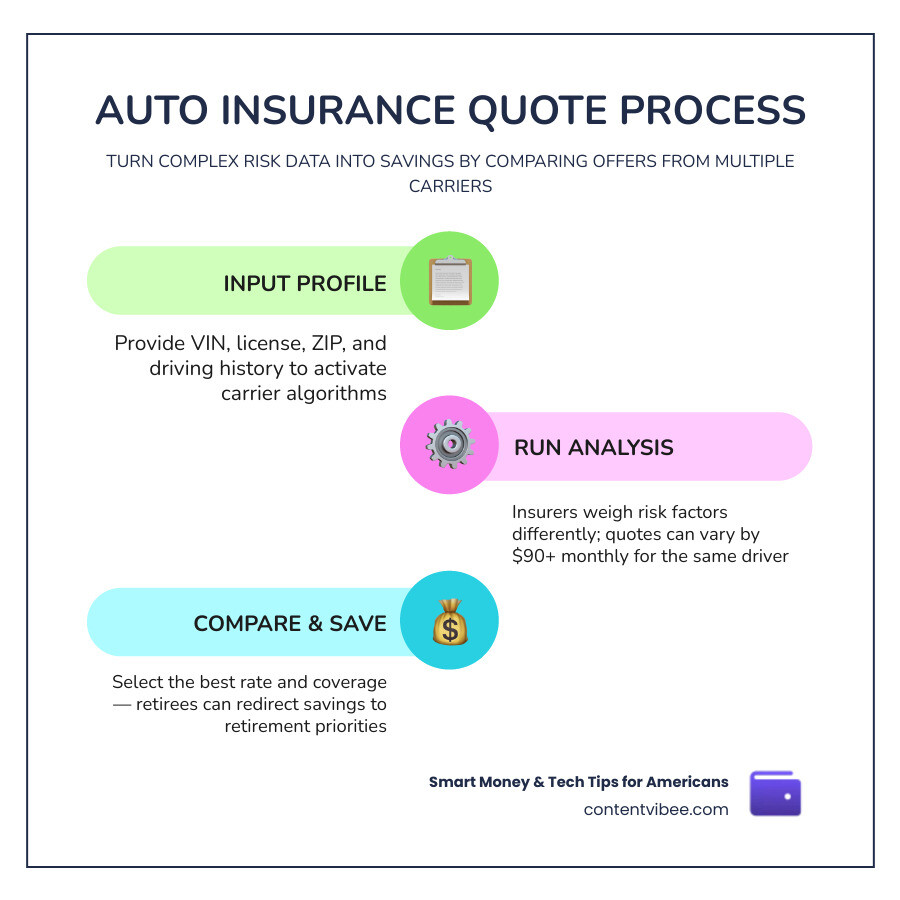
An auto insurance quote is essentially a carrier’s “best offer” based on the risk they think you represent. In May 2026, these offers are more transparent than ever thanks to advanced underwriting criteria. Carriers use complex algorithms to analyze your likelihood of filing a claim. They look at historical data—like the fact that car theft in the U.S. recently saw a 10% year-over-year increase—to set their baseline prices.
When you request a quick auto insurance quote, you are essentially asking the company to run your profile through their “black box” of data. Because these algorithms change frequently, a company that was the cheapest for you three years ago might be the most expensive today. This is why price transparency is your best friend; by looking at several quotes at once, you force the market to work in your favor.
Key Factors Influencing Your Premium Rates
Why does your neighbor pay $100 less than you for the same car? It isn’t just luck. Several core factors dictate the numbers you see on your auto insurance quotes.
- Driving History: This is the big one. Accidents, speeding tickets, and DUIs stay on your record for years. However, even if your record isn’t perfect, some carriers specifically cater to high-risk drivers, offering a “second chance” at affordable rates.
- Credit Score: In most states, your credit history is a major pricing factor. Insurers have found a statistical link between credit health and claim frequency. If you are working on your credit, you might also want to look at How to Create a Monthly Budget That Works to free up funds for debt reduction, which can eventually lower your insurance costs.
- Location-Based Risk: Where you park your car matters. If you live in a ZIP code with high rates of vandalism, theft, or heavy traffic congestion, your premium will reflect that risk.
- Vehicle Safety Features: Modern cars with automatic emergency braking, lane-departure warnings, and high crash-test ratings often qualify for lower premiums.
- Age and Demographics: Younger drivers (under 25) and very senior drivers often face higher rates due to statistical risk profiles.
- Annual Mileage: If you only drive 5,000 miles a year, you are statistically less likely to be in an accident than someone driving 20,000 miles.

How to Compare Coverage Options Effectively
When looking at auto insurance quotes, it is easy to get blinded by the lowest number. But the cheapest quote isn’t always the best value if it leaves your assets unprotected. You need to understand the difference between “bare minimum” and “full coverage.”
| Coverage Type | What it Covers | Is it Required? |
|---|---|---|
| Liability | Damage/injuries you cause to others. | Yes, in nearly every state. |
| Collision | Damage to your car from an accident. | If you have a loan or lease. |
| Comprehensive | Theft, fire, hail, or animal strikes. | If you have a loan or lease. |
| Uninsured Motorist | Protects you if a driver without insurance hits you. | Required in some states. |
A common mistake is choosing a deductible that is too low or too high. A higher deductible (the amount you pay out of pocket before insurance kicks in) will lower your monthly premium. If you have a solid emergency fund in a High Yield Savings Account, you might choose a $1,000 deductible to save on your monthly bill.
Essential Information for Accurate Auto Insurance Quotes
To get the most accurate price—and avoid “sticker shock” when the final policy is issued—you need to have your data ready. Insurers typically require:
- Vehicle Identification Number (VIN): This tells the insurer exactly what safety features and engine type your car has.
- Driver’s License Details: For every driver in the household.
- Garaging Address: Where the car is parked overnight.
- Current Coverage Limits: Found on your current “Declarations Page.”
- Social Security Number: Used to pull your insurance credit score.
- Vehicle Usage: Whether you use the car for commuting, pleasure, or ride-sharing (like Uber or Lyft).
How to Compare Auto Insurance Quotes Side-by-Side
To truly compare apples to apples, you must ensure the “limits” are identical across all quotes. If one quote uses a $500 deductible and another uses $1,000, the comparison is useless.
Check the financial strength of the carrier through ratings like AM Best. An “A” rating or higher ensures the company has the cash to pay out if you have a major claim. Also, look for “Claim Forgiveness” programs. Some carriers promise not to raise your rates after your first at-fault accident—a feature that can be worth its weight in gold. You can find these details through major comparison tools like Insurify, The Zebra, and NerdWallet.
Proven Strategies to Lower Your Insurance Costs
You don’t have to just accept the first price you see. There are several ways to aggressively hack your auto insurance quotes for better deals.
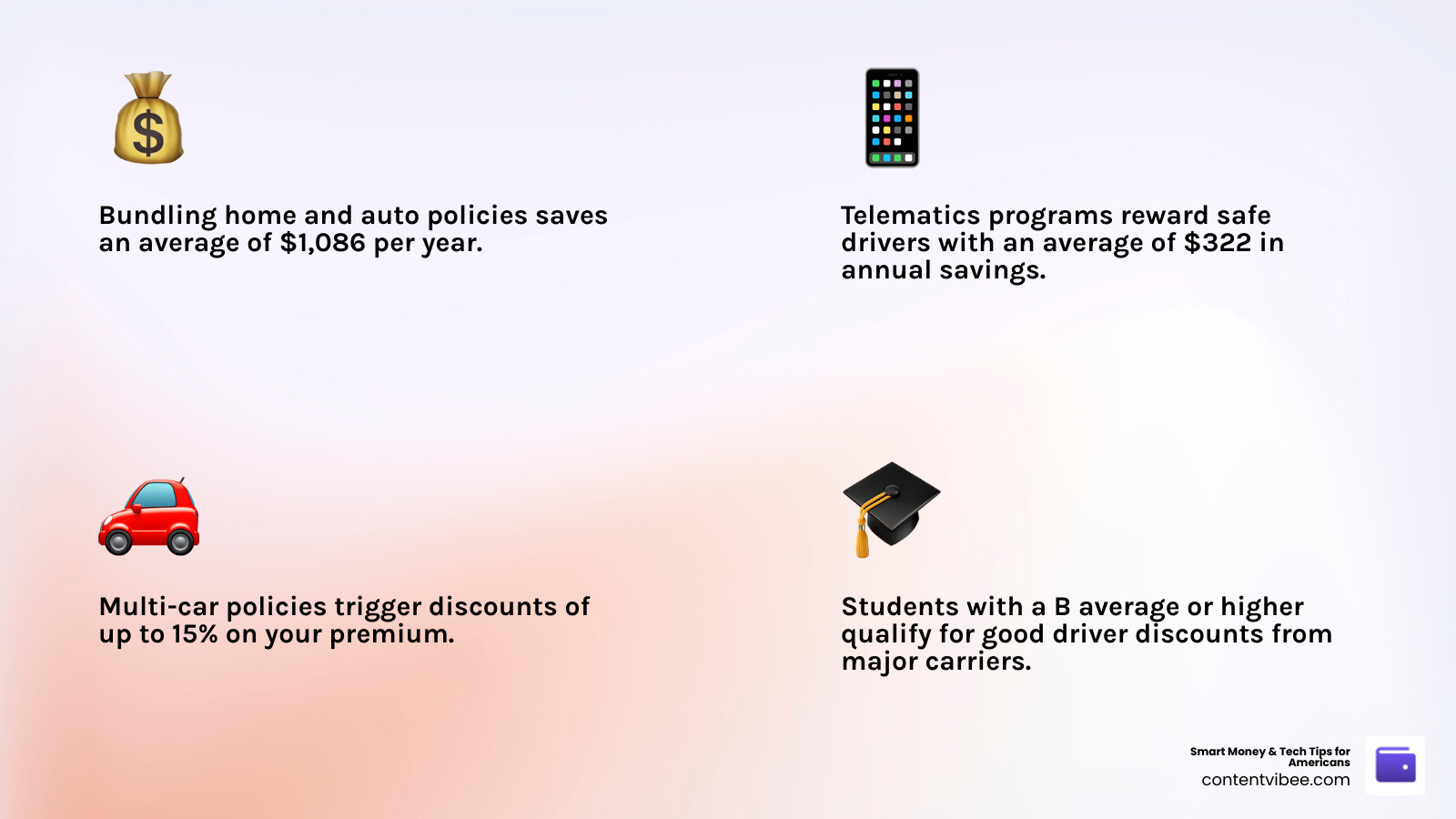
1. The Bundling Bonus: This is the “holy grail” of savings. New customers who bundle their home and auto policies save an average of $1,086 per year. Even bundling renters insurance with your auto can save you up to $900.
2. Telematics and Usage-Based Programs: Programs like Progressive’s Snapshot or State Farm’s Drive Safe & Save track your actual driving habits via a mobile app. Safe drivers save an average of $322 per year through these programs.
3. Multi-Policy and Multi-Car Discounts: Insuring more than one vehicle on the same policy can trigger discounts of up to 15%.
4. Strategic Financial Moves: If you are carrying high-interest debt that is hurting your credit (and thus your insurance rates), using the Best Balance Transfer Cards Save Money can help you pay down debt faster and eventually improve your insurance tier.
6. Professional and Student Rewards: Many carriers, like GEICO and Nationwide, offer discounts for government employees, military members, or students who maintain a “B” average or higher.
Frequently Asked Questions
How often should I update my quotes?
We recommend comparing auto insurance quotes every 6 to 12 months, or whenever your current policy is up for renewal. You should also shop around immediately if you experience a major life change, such as moving to a new ZIP code, getting married, or purchasing a new vehicle.
What is the difference between liability and full coverage?
“Liability” only covers the other person’s medical bills and car repairs if you are at fault. It does nothing for your own car. “Full coverage” is a colloquial term that usually refers to a policy including Liability plus Collision and Comprehensive coverage. If you are financing or leasing your car, your lender will almost certainly require full coverage.
How can I get free personalized quotes online?
The fastest way is to use independent comparison platforms or go directly to major carrier sites. Many top-tier insurers like GEICO, Progressive, and State Farm offer no-obligation estimates in under 10 minutes.
Conclusion
At Smart Money & Tech Tips for Americans, we believe that financial freedom starts with mastering the “boring” stuff—like your monthly bills. Taking 15 minutes to compare auto insurance quotes isn’t just about saving a few bucks; it’s about optimizing your entire financial picture.
Whether you are looking for ways to cut costs today or planning for the long term by using a Social Security Spousal Benefit Calculator, every dollar saved on insurance is a dollar that can go toward your future. Stop leaving money on the table and start shopping for a better rate today.