


What Does Legal Separation Actually Cost in 2026?
Legal separation cost can range from as little as $1,000 to well over $100,000 — depending on how complicated your situation is.
Here’s a quick snapshot to help you estimate your expenses:
| Scenario | Estimated Total Cost |
|---|---|
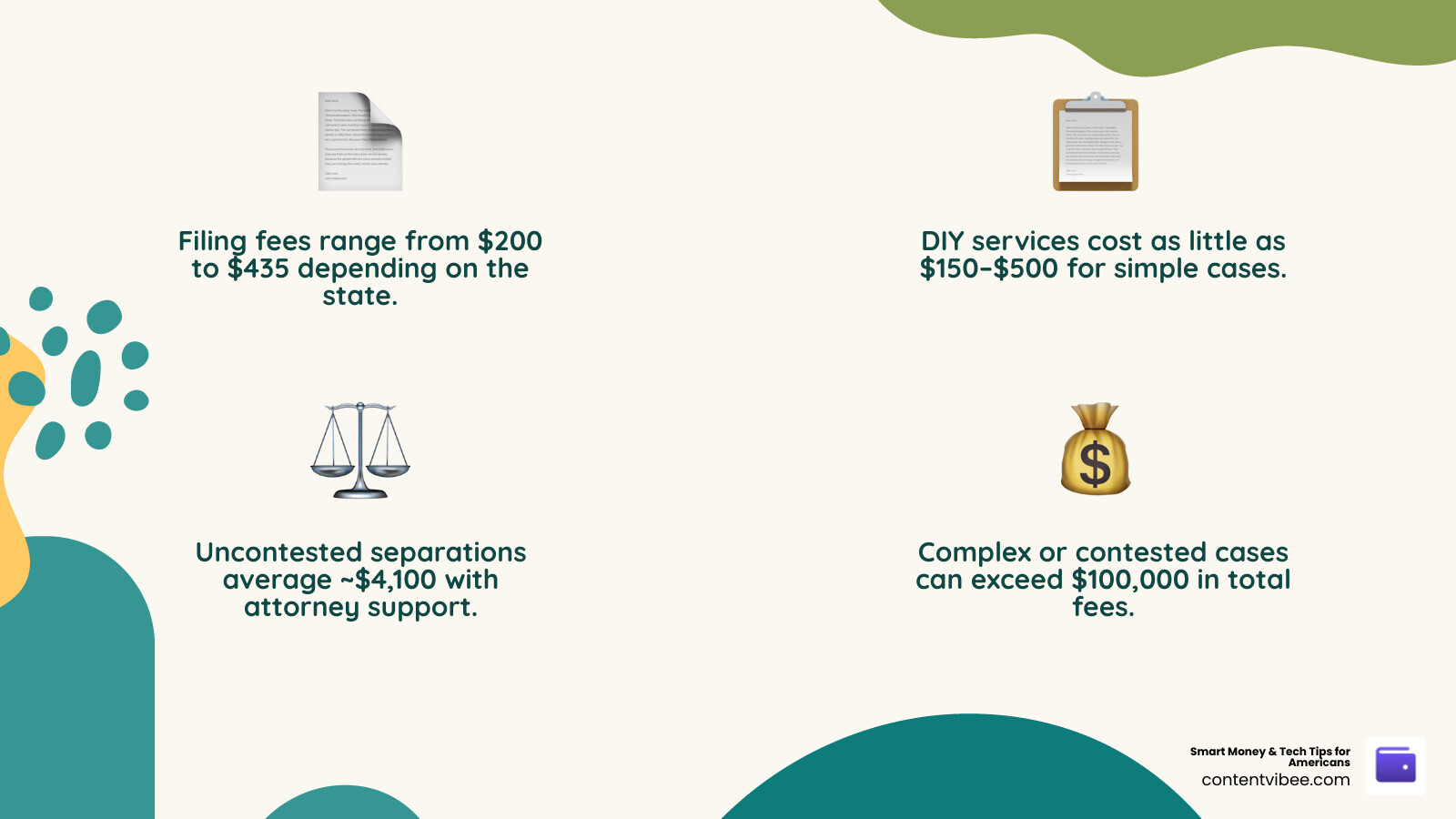
| DIY / online service (simple, uncontested) | $150 – $500 |
| Uncontested with attorney help | ~$4,100 |
| Mediated separation | $5,000 – $9,000 |
| Contested (one disputed issue, trial) | ~$20,400 |
| Contested (two or more issues, trial) | $23,300+ |
| Complex/high-conflict cases | $100,000+ |
Court filing fees alone typically run between $200 and $435, depending on your state. For example, California charges $435 to file a separation petition, while Cuyahoga County, Ohio charges $200.
If you’re facing a potential split, you already know the emotional weight is heavy enough. The last thing you need is a surprise $15,000 legal bill on top of it.
The good news? How much you pay depends largely on choices you make early in the process. Couples who agree on key issues — property, custody, support — before hiring lawyers spend a fraction of what contested cases cost.
The tricky part is knowing which costs to expect, where you have room to save, and what financial trade-offs come with choosing legal separation over divorce. That’s exactly what this guide breaks down.
Breaking Down the Average Legal Separation Cost

When we look at the total legal separation cost, it is helpful to view it as a puzzle made of several expensive pieces. In May 2026, the landscape of family law has shifted toward more tech-driven and mediated solutions, but the core expenses remain relatively consistent.
Court Filing Fees
Before you even speak to a judge, you have to pay the “admission fee” to the court system. These are the mandatory costs to process your paperwork. In California, the standard fee for filing a legal separation petition is $435. This fee generally covers the initial petition and the response. It is important to note that if you are in a tight spot financially, you can often apply for a fee waiver (like Form FW-001 in California) if your income falls below 125% of the federal poverty guidelines.
Attorney Retainers and Hourly Rates
Most people find that navigating the financial maze of family law costs requires professional help. Attorneys usually require an upfront payment known as a retainer. In 2026, retainers for legal separation typically range from $3,000 to $5,000.
Once that retainer is exhausted, you’ll be billed hourly. Rates vary wildly by geography:
- Rural areas: $150 – $250 per hour.
- Major California metros (SF, LA): $500 – $900 per hour.
Mediation Expenses
If you and your spouse aren’t seeing eye-to-eye but want to avoid a “War of the Roses” courtroom battle, mediation is a popular middle ground. A mediated separation typically costs between $5,000 and $9,000. Mediators charge hourly rates ranging from $250 to $500, but because you are splitting the cost and avoiding lengthy court hearings, it often ends up being much cheaper than traditional litigation.
| Cost Component | Low End (DIY/Uncontested) | High End (Contested/Trial) |
|---|---|---|
| Filing Fees | $435 | $435+ (plus motion fees) |
| Attorney Fees | $0 – $1,500 | $15,000 – $50,000+ |
| Mediation | $0 | $5,000 – $9,000 |
| Professional Valuations | $0 | $5,000 – $30,000 |
| Total | ~$500 – $2,000 | $25,000 – $100,000+ |
Factors That Spike Your Legal Separation Cost
Not every separation is created equal. We’ve seen cases wrap up in a few months for a few thousand dollars, and others drag on for years. What makes the difference?
- Contested Issues: The single biggest “cost-inflator” is disagreement. If you agree on everything, you have an uncontested separation. If you fight over who gets the dog or the 401(k), your costs will skyrocket. A trial on just one contested issue can push your total to $20,400, while two or more issues can easily exceed $23,300.
- Asset Complexity: If you own a business, multiple rental properties, or complex stock options, you’ll need more than just a lawyer. You might need a forensic accountant or a business valuator, which can add $5,000 to $30,000 to your bill.
- Children: When kids are involved, the stakes—and the costs—go up. You’ll need to figure out what a custody lawyer actually cost in your specific county. Between drafting parenting plans and calculating support, child support attorneys become a necessary part of the budget.
How to Reduce Your Legal Separation Cost
We are big fans of using tech and smart strategy to keep your money in your pocket. Here are the best ways to slash that legal separation cost:
- Online Platforms: For simple, uncontested cases, online services can handle your paperwork for as little as $150 to $500. This is a “middle ground” between doing it all yourself and hiring a full-service firm.
- Virtual Mediation: In 2026, virtual mediation has become the budget-friendly standard. It eliminates travel time and allows for more flexible, shorter sessions that can save you thousands.
- Limited Scope Representation: Instead of hiring a lawyer for the whole case, you can hire them for “unbundled” services, such as just reviewing your final agreement. This can cost between $500 and $2,000, significantly less than a full retainer.
- Billable Hour Hygiene: Don’t use your lawyer as a therapist. Attorneys often bill for “venting” time. If you need emotional support, hire a therapist; it’s cheaper and more effective. Also, batch your questions into one email rather than sending ten separate ones to avoid multiple minimum-billing increments. Curious about more tips? Check out how much do divorce lawyer fees really cost for a deeper dive into billing practices.
Financial Benefits: Why Separation Might Save You Money

You might be wondering: “If it costs almost as much as a divorce, why bother with a legal separation?” The answer often lies in the long-term financial benefits that a divorce would eliminate.
Health Insurance Retention
This is the “big one.” In many cases, a legal separation allows one spouse to remain on the other’s employer-sponsored health insurance plan. Since a legal separation doesn’t end the marriage, many insurance companies (though not all, so check your policy!) continue coverage. In a divorce, this benefit almost always ends immediately, forcing the non-covered spouse onto COBRA or private insurance, which can cost $600–$1,200 more per month.
Tax Filing Status
Because you are still legally married, you may still be eligible to file joint tax returns. This often results in a higher standard deduction and lower tax brackets compared to filing as “single” or “head of household.” This strategic financial planning can save a couple thousands of dollars every year.
Social Security and Military Benefits
If you are approaching the 10-year mark of marriage, staying legally separated rather than divorcing can be a million-dollar decision. Reaching 10 years of marriage unlocks the ability to claim Social Security spousal benefits based on your partner’s earnings. For military families, certain pension and commissary benefits are also tied to the duration of the marriage.
The “Residency Loophole” in California
In California, a divorce requires you to have lived in the state for six months and the county for three months. However, there is no residency requirement for a legal separation. Many people who have just moved to the state file for legal separation immediately to get court orders for support and custody in place, then “convert” it to a divorce once they hit the six-month mark.
Hidden Expenses and Long-Term Budgeting
When budgeting for your legal separation cost, don’t just look at the lawyer’s bill. There are “soft costs” and administrative fees that catch many people off guard.
- Service of Process: You have to legally notify your spouse. A professional process server typically costs between $50 and $150.
- Property Valuations: If you’re splitting the house, you’ll need a fresh appraisal. Budget $400–$800 for a standard residential appraisal.
- QDRO Preparation: If you are dividing a 401(k) or pension, you need a Qualified Domestic Relations Order. This is a specialized legal document that usually costs between $500 and $2,500 to prepare. Without it, you could face massive tax penalties for moving retirement funds.
- Lifestyle Duplication: This is the most significant “hidden” cost. You are moving from one household budget to two. Rent, utilities, and even Netflix subscriptions now have to be paid twice. We recommend budgeting 120% to 150% of your current monthly expenses for the first six months of separation.
For more detailed guides on these specific financial hurdles, explore our Category: Legal Guides.
Frequently Asked Questions about Separation Expenses
Is legal separation cheaper than a traditional divorce?
Initially, the costs are very similar because the legal work—dividing property, setting up custody, and determining support—is nearly identical. However, legal separation can be cheaper in the long run if it allows you to keep health insurance or file taxes jointly. The risk is “paying twice”: if you get a legal separation now and decide to divorce in two years, you may have to pay a second set of filing fees and legal costs to finalize the dissolution.
Can I convert my legal separation into a divorce later?
Yes. In states like California, you can amend a petition for legal separation to a petition for divorce. This is common for people who file for separation because they don’t yet meet residency requirements. However, be aware that this usually involves additional filing fees and potentially more attorney time to update the paperwork.
What are the typical court filing fees by state in 2026?
While fees vary by county, here are the general 2026 ranges:
- California: $435 (Statewide Civil Fee Schedule)
- Ohio (Cuyahoga County): $200 (advance deposit)
- New York: $210 – $335
- Texas: $250 – $350
- Florida: ~$408
Conclusion
At Smart Money & Tech Tips for Americans, we believe that financial clarity is the first step toward emotional healing. A legal separation cost doesn’t have to be a mystery that drains your savings. By choosing mediation, leveraging online filing tools, and being strategic about your timing, you can protect your wallet while finding the space you need.
Legal separation offers a unique blend of “finality” regarding finances and “flexibility” regarding your marital status. Whether you are choosing it for religious reasons, insurance benefits, or as a trial period before a full divorce, going in with a clear budget is your best defense.
If you’ve decided that a formal split is the right path, your next step is finding the right professional to guide you through the paperwork. Check out our detailed reviews of the top 10 family law attorneys to find an expert in your area who fits your budget and your needs. The choices you make today will shape your financial standard of living for years to come—make them count!