


What You’ll Actually Pay to Refinance Your Home in 2026
How much does it cost to refinance a house? Here’s the short answer:
| Loan Amount | Estimated Refinance Cost (2%–6%) |
|---|---|
| $100,000 | $2,000 – $6,000 |
| $150,000 | $3,000 – $9,000 |
| $200,000 | $4,000 – $12,000 |
| $300,000 | $6,000 – $18,000 |
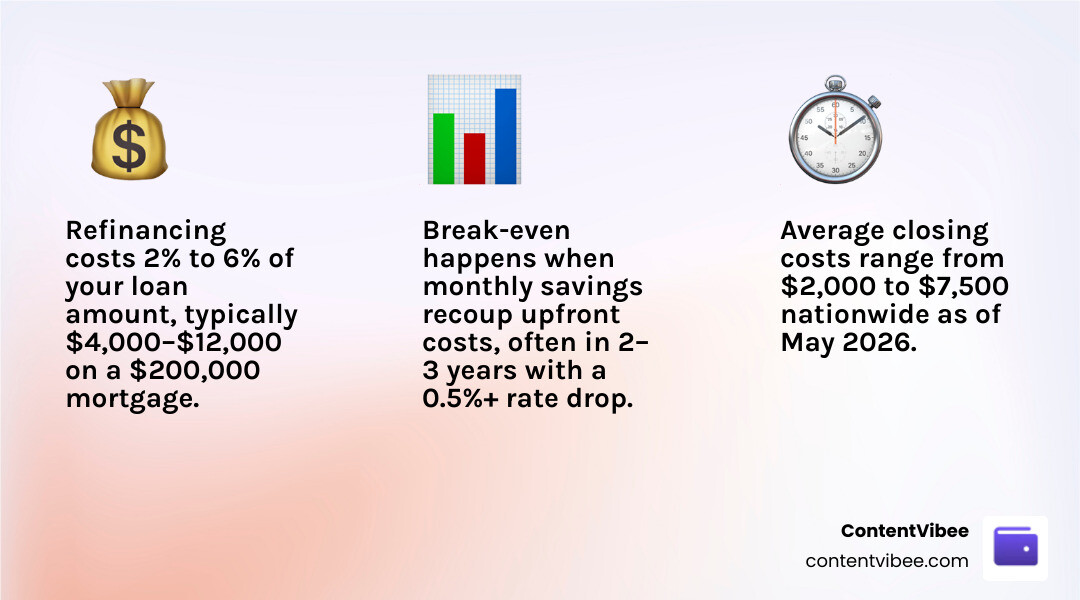
Refinancing typically costs 2% to 6% of your loan amount. That covers things like appraisal fees, origination charges, title insurance, and other closing costs.
Those numbers can feel like a gut punch — especially if you were hoping refinancing would just be a quick paperwork swap. It isn’t. It’s essentially a new mortgage, with most of the same upfront costs.
The good news? If you lower your rate enough, those costs pay for themselves. The key is knowing exactly what you’re walking into before you sign anything.
This guide breaks down every cost you’ll face, shows you how to calculate whether refinancing actually saves you money, and explains how to reduce what you pay at closing.
How Much Does It Cost to Refinance a House?

When we talk about the total bill, we’re looking at a wide spectrum. As of May 2026, the national average remains firmly in that 2% to 6% range. For most homeowners, this means preparing for an expense that sits between $2,000 and $7,500, though larger loans in high-value areas can certainly climb higher.
Understanding the total how much does it cost to refinance a house requires looking at the “hidden” side of the transaction. You aren’t just paying for the new interest rate; you are paying for the labor of the lender, the legal verification of your home’s title, and the government’s cut for recording the new deed.
If you are curious about how these numbers fluctuate locally, especially in the Mid-Atlantic region, you can check out our detailed guide on Average Refi Closing Costs.
Breaking Down Common Refinance Fees and Closing Costs
Think of refinance fees as a menu where some items are mandatory and others are “side dishes” you might be able to skip. Here is what usually makes up that 2% to 6% total:
- Application Fee ($75 – $500): This covers the initial processing of your request. Some lenders waive this if you are a loyal customer, but it’s a common starter cost.
- Origination and Underwriting Fees (0.5% to 1.5%): This is the heavy hitter. It’s what the lender charges to evaluate your risk and “originate” the loan. On a $300,000 house, a 1% fee is a cool $3,000.
- Appraisal Fees ($300 – $2,000): The lender needs to know your house is actually worth what you say it is. While standard appraisals are often $300–$600, complex properties or high-demand periods in May 2026 can drive these prices up.
- Title Search and Insurance (0.5% to 1% of purchase price): This ensures there are no liens or legal “ghosts” attached to your property. Pro tip: Ask your current title company for a “reissue rate” to save money.
- Home Inspection: While not always required for a refinance, many homeowners use this opportunity to ensure their investment is sound. You can use our Home Inspection Checklist to see if you need one.
- Recording Fees (~$125): Your local county or city (like those in Virginia) charges this to update public records.
Factors That Influence How Much It Costs to Refinance a House
Not every homeowner gets the same price tag. Your financial “health” dictates the risk the lender takes, which directly impacts your costs.
- Credit Score: Generally, you need a 620 minimum for a conventional refinance. However, if your score is closer to 740 or higher, you’ll unlock the lowest interest rates and potentially lower certain risk-based fees.
- Home Equity: The 20% threshold is the “magic number.” If you have less than 20% equity, you’ll likely have to pay for Private Mortgage Insurance (PMI), which adds to your monthly cost.
- Debt-to-Income (DTI) Ratio: Lenders prefer a DTI in the 36-45% range. If your debt is high relative to your income, you might be charged higher “points” to offset the risk.
Before you get too deep into the numbers, it helps to understand the Pre Approval Home Loan Process so you know how lenders view your application.
Government-Backed Loans: FHA, VA, and USDA Costs
If you have a government-backed loan, the rules for how much does it cost to refinance a house change slightly. These loans often offer “Streamline” options that require less paperwork and sometimes skip the appraisal entirely.
- VA Loans: These are fantastic for veterans. While there is no monthly mortgage insurance, there is a VA Funding Fee (usually 0.5% for a refinance). However, if you have a service-connected disability, this fee is often waived.
- FHA Loans: You’ll pay an Upfront Mortgage Insurance Premium (UFMIP) of 1.75% of the loan amount, plus an annual premium (MIP) that is paid monthly.
- USDA Loans: Similar to the FHA, these involve an upfront guarantee fee and an annual fee.
Navigating these can be tricky, so it’s worth revisiting Understanding The Real Estate Buying Process to see how these government fees differ from standard conventional loans.
Strategies to Lower Your Refinance Expenses

We hate seeing people overpay. You wouldn’t buy a car without negotiating, so don’t accept the first refinance quote you see.
- Shop Lenders: Get at least three Loan Estimates. Lenders are required by law to give you these standardized Loan Estimates, making it easy to compare “apples to apples.”
- Negotiate Fees: Some fees, like the origination or application fee, are negotiable. If Lender A offers a lower fee than Lender B, tell Lender B! They may match it to win your business.
- Use a Calculator: Before talking to a human, use a mortgage refinance cost calculator to set your expectations.
- Boost Your Credit First: Spending three months cleaning up your credit report can save you tens of thousands of dollars over the life of the loan.
Calculating Your Break-Even Point for Refinancing
The “Break-Even Point” is the most important number in this entire article. It tells you exactly when the monthly savings from your lower interest rate finally “pay back” the upfront closing costs.
The formula is simple: Total Closing Costs ÷ Monthly Savings = Months to Break Even
| Total Refi Costs | Monthly Savings | Months to Break Even |
|---|---|---|
| $4,000 | $100 | 40 Months (3.3 years) |
| $6,000 | $250 | 24 Months (2 years) |
| $9,000 | $150 | 60 Months (5 years) |
If you plan to sell your house in two years but your break-even point is five years, you are actually losing money by refinancing. Always look at how long you plan to stay in the home.
Understanding the Real Impact of a No-Closing-Cost Refinance
You’ve probably seen ads for a “no-closing-cost refinance.” We’ll let you in on a secret: there is no such thing as a free lunch. In a no-closing-cost refi, the lender either:
- Rolls the costs into the principal balance: You don’t pay $6,000 today, but your loan balance goes from $200,000 to $206,000. You will pay interest on that $6,000 for the next 30 years.
- Charges a higher interest rate: The lender pays your closing costs for you, but in exchange, they give you a 6.5% rate instead of the 6.0% you actually qualify for.
This can be a great move if you are short on upfront cash but have plenty of equity. However, it usually costs more in the long run. For those in the Commonwealth, check out What Are The Average Closing Costs In Virginia to see how these options play out with local taxes.
When Is It Worth the Cost to Refinance a House?
At ContentVibee, we believe refinancing is a tool, not a magic wand. It is generally worth the cost if:
- The Rate Drop is Significant: The old “rule of thumb” was a 1% drop, but in May 2026, even a 0.5% to 0.75% drop can be worth it if your loan balance is high.
- You’re Switching Loan Types: Moving from an Adjustable-Rate Mortgage (ARM) to a Fixed-Rate Mortgage provides peace of mind if you think rates will rise later in the 2020s.
- You’re Eliminating PMI: If your home value has skyrocketed and you now have 20% equity, refinancing to a conventional loan to drop that monthly insurance payment is a huge win.
- You Need Cash-Out: If you are tapping into equity for home improvements or debt consolidation, the “cost” is often justified by the value added to the home or the interest saved on high-interest credit cards.
Refinancing is a big decision, but it doesn’t have to be a confusing one. By focusing on your break-even point and shopping around, you can ensure that your new mortgage helps you reach your financial goals rather than setting you back. For more deep dives into the math behind your mortgage, visit our guide on Average Refi Closing Costs.


