


Why So Many Retirees Are Overpaying on Property Taxes Right Now
State senior tax benefits could be saving you thousands of dollars every year — but most eligible seniors never collect them.
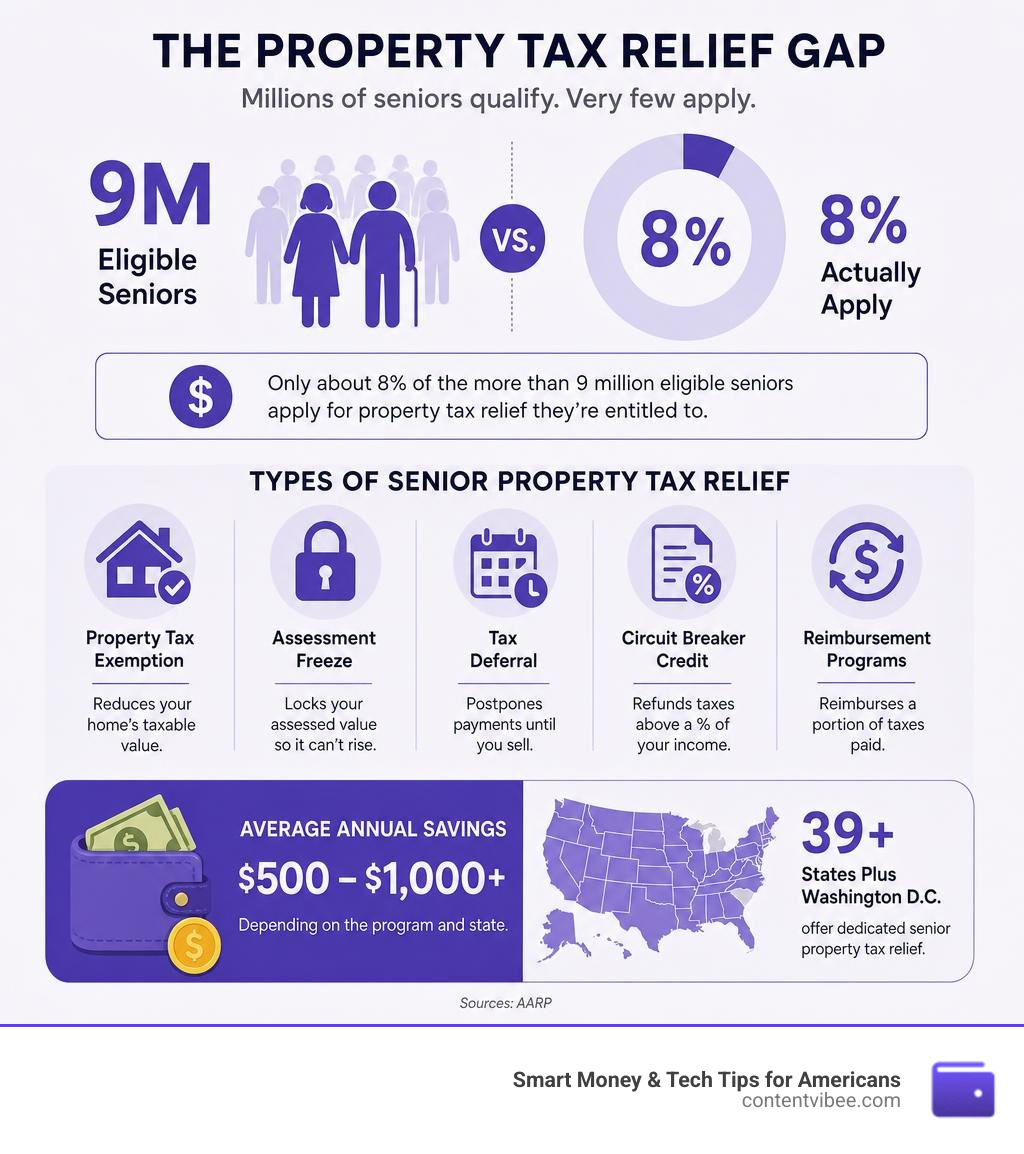
Here’s a quick look at the main types of relief available:
| Type of Relief | What It Does | Best For |
|---|---|---|
| Property Tax Exemption | Reduces your home’s taxable value | Homeowners in most states |
| Assessment Freeze | Locks your assessed value so it can’t rise | Fixed-income seniors |
| Tax Deferral | Postpones payments until you sell | Cash-strapped homeowners |
| Circuit Breaker Credit | Refunds taxes above a % of your income | Low-to-moderate income seniors |
| Reimbursement Programs | Reimburses a portion of taxes paid | States like New Jersey |
The numbers tell a stark story. According to AARP, only about 8% of the more than 9 million eligible seniors actually apply for property tax relief they’re legally entitled to. That’s a staggering amount of money left on the table.
Meanwhile, the median U.S. home price has climbed past $400,000, dragging assessments — and tax bills — up with it. And the 2026 Social Security COLA adjustment was just 2.5%, which barely keeps pace with rising costs.
The result? More retirees are being taxed out of homes they’ve owned for decades.
The good news: at least 39 states plus Washington D.C. offer dedicated senior property tax relief. The programs exist. You just have to claim them.
State senior tax benefits terms made easy:
How State Senior Tax Benefits Can Slash Your Property Tax Bill
When we look at the landscape of property tax relief, we see three primary mechanisms designed to protect seniors from rising home values: exemptions, assessment freezes, and tax deferrals. Each operates differently, but they all share a singular goal: keeping more cash in your pocket during retirement.
By strategically utilizing these programs, you can shield your hard-earned retirement nest egg from being drained by local tax assessors. In fact, aligning these property tax savings with broader smart strategies to defer taxes and boost your retirement savings is one of the most effective ways to secure your financial future.

Property Tax Exemptions: Reducing Your Assessed Value
A property tax exemption directly reduces your home’s “assessed value”—the dollar amount local governments use to calculate your tax bill.
For example, if your home’s market value is $300,000 and your local government applies a $50,000 senior exemption, you are only billed for taxes based on a $250,000 valuation.
One of the most robust examples of this is the Property Tax Exemption for Senior Citizens in Colorado | Colorado Department of Local Affairs Division of Property Taxation. In Colorado, the state exempts 50 percent of the first $200,000 of actual value of a qualified applicant’s primary residence. This means if your home is valued at $200,000 or more, you instantly wipe $100,000 off your taxable assessment!
Assessment Freezes: Locking Your Home Value in Place
While an exemption subtracts a specific dollar amount from your home’s value, an assessment freeze locks your home’s taxable value in place. Once you qualify, your assessed value cannot increase, even if the real estate market in your neighborhood goes completely wild.
Programs like New Jersey’s Senior Freeze (Property Tax Reimbursement) and the Illinois Senior Freeze program are designed to prevent seniors from being priced out of their neighborhoods by gentrification and soaring home prices. If your home is frozen at an assessed value of $250,000, you will continue to pay taxes based on that amount, even if its market value climbs to $450,000 over the next decade.
Tax Deferrals: Postponing Payments Until Sale
If you are cash-strapped but have substantial equity in your home, a tax deferral program might be your best option. Deferrals allow you to postpone paying all or a portion of your property taxes until you sell the home, move, or pass away.
In California, the State Controller’s Office offers a property tax postponement program with a reasonable interest rate (typically around 7%) for seniors with a household income of $55,181 or less. While this keeps immediate cash in your pocket, the deferred taxes plus interest eventually become a lien on the property, which must be paid off when the home changes hands.
If you are considering this route, it is crucial to weigh it against your long-term retirement timeline. To help map out your timeline, check out our guide on when can you stop working and retire in California.
Comparing the Most Generous State Senior Property Tax Programs
Not all states treat senior homeowners equally. Some offer modest drops in the bucket, while others provide massive, multi-thousand-dollar relief packages. Let’s look at how some of the country’s most prominent senior tax relief programs stack up against one another in 2026.
| State Program | Core Benefit Type | Maximum Benefit Amount | Income Limit (2026) |
|---|---|---|---|
| New Jersey Stay NJ | Direct Property Tax Reimbursement | Up to $13,000 (2025 benefit capped at $6,500) | $500,000 |
| New York Enhanced STAR | School Tax Assessment Cut | Varies by school district (averages ~$1,000+) | $107,300 (adjusted annually) |
| Illinois Senior Freeze | Assessed Value Lock | Prevents taxable assessment increases | $65,000 |
| Massachusetts Circuit Breaker | Refundable Income Tax Credit | Up to $2,820 (for tax year 2025) | $75,000 (Single) / $112,000 (Joint) |
New Jersey’s Stay NJ and Senior Freeze Programs
New Jersey has historically had some of the highest property taxes in the nation, but they also offer some of the most generous relief programs. The crown jewel is the NJ Division of Taxation – Stay NJ – Property Tax Relief for Senior Citizens program.
Stay NJ is designed to reimburse eligible homeowners aged 65 and older for 50% of their property tax bills, up to a maximum of $13,000 (with a 2025 benefit cap of $6,500). The income threshold is incredibly generous: you qualify as long as your income is below $500,000.
Crucially, Stay NJ benefits are calculated after your ANCHOR and Senior Freeze benefits are determined. The state combines these programs into a single, unified application process, making it much easier to claim your cash. Just keep in mind that the deadline to apply for the 2025 application year is November 2, 2026, and mobile homeowners are unfortunately not eligible for Stay NJ.
New York’s Enhanced STAR and Senior Citizens Exemption
New York seniors can double-dip on property tax relief by combining the Enhanced School Tax Relief (STAR) program with the local Senior citizens exemption – Department of Taxation and Finance.
The Senior Citizens Exemption provides a sliding-scale reduction of up to 50% on the taxable assessment of your home. Local municipalities and school districts can set their own base income limits (typically between $3,000 and $50,000) for the full 50% exemption, with partial exemptions available for seniors whose incomes fall slightly above the limit.
Additionally, if you receive the Senior Citizens Exemption, you are often automatically eligible for the Enhanced STAR program, which further slashes your school tax bill.
Massachusetts Senior Circuit Breaker Tax Credit
For seniors living in the Bay State, the Massachusetts Senior Circuit Breaker Tax Credit | Mass.gov serves as a vital financial safety net.
Unlike standard exemptions that reduce your property’s assessed value, this is a refundable income tax credit. If your property taxes (or 25% of your rent, if you are a tenant) exceed 10% of your total income, the state will refund you the difference up to a maximum of $2,820 for the 2025 tax year.
Because it is refundable, you receive the cash even if you owe zero state income tax! To learn how this credit interacts with other state-specific retirement tax breaks, check out the Massachusetts Tax Information for Seniors and Retirees | Mass.gov portal.
Eligibility Rules and How They Interact with Homestead Exemptions
Before you run to your county assessor’s office with your tax bill in hand, we need to talk about the rules of the road. Qualifying for state senior tax benefits isn’t just about blowing out 65 candles on your birthday cake; it requires navigating a web of age, income, residency, and ownership rules.

Navigating State Senior Tax Benefits: Eligibility and Homestead Rules
To successfully claim senior property tax relief, you must meet four key criteria:
- Age Requirements: Most programs kick in at age 65, though some states (like Washington) open up eligibility at age 61.
- Income Thresholds: Many programs look at your “combined disposable income” or Modified Adjusted Gross Income (MAGI). This calculation often includes non-taxable income, meaning you must factor in all your retirement streams. To see how your federal benefits affect this, read our guide on Uncle Sam’s cut and understanding taxes on Social Security alongside our Social Security taxable income guide for 2026.
- Residency Rules: You must occupy the property as your primary residence. Vacation homes and secondary rental properties do not qualify.
- Ownership Requirements: You must hold the deed, a life estate, or be a qualifying cooperative housing shareholder. In Colorado, for example, you must have owned and occupied your home for at least 10 consecutive years as of January 1 of the application year to qualify for the senior exemption.
Stacking Senior Exemptions with General Homestead Exemptions
Many first-time applicants ask us: “If I already have a standard homestead exemption, can I still get the senior exemption?”
The answer is almost always a resounding yes! In most jurisdictions, senior exemptions are designed to “stack” on top of general homestead exemptions.
Take Cook County, Illinois as an example. The Cook County Assessor’s Office administers a standard Homeowner Exemption alongside a dedicated Senior Exemption (which reduces the Equalized Assessed Value of a home by $8,000).
Even better, once you apply and qualify for the Senior Exemption in Cook County, the system automatically applies the standard Homeowner Exemption for you, and both renew automatically each year. Stacking these benefits allows you to compound your savings and dramatically lower your final tax bill.
The Application Process: Deadlines, Documents, and Assessment Ratios
Now that you know what programs are out there and whether you qualify, let’s talk about how to actually get your hands on these savings.
Step-by-Step Guide to Claiming Your State Senior Tax Benefits
Claiming your benefits requires careful attention to detail. Follow this simple process to ensure you don’t miss out:
First, gather your essential application documents:
- Proof of age (driver’s license, birth certificate, or passport)
- Proof of ownership (copy of your deed or property tax bill)
- Proof of residency (utility bills or voter registration card)
- Proof of income (federal tax returns, Social Security benefit statements, or Form 1099-R)
If you are managing multiple retirement income streams, understanding your tax documentation is vital. Take a moment to review our guide on demystifying Form 1099-R and retirement distributions as well as our deep dive on pension vs 401k tax strategies for working retirees to ensure you are reporting your income accurately to the assessor.
Be highly mindful of state-specific deadlines. In New York, the application deadline is typically March 1 in most communities. In Colorado, you must file by July 15 to preserve your full rights to appeal a denial. In Minnesota, proposed legislation like sf0443(hf0403) Senior Homestead Creditpt1 highlights a system where an estimated 105,000 homesteads would receive a credit for taxes payable in 2027, provided they submit their one-time application by December 15 of the year they turn 65.
To make sure you are maximizing your federal tax savings as well, don’t forget to check your eligibility for the new enhanced deduction for seniors through the IRS, which provides an additional standard deduction of up to $6,000 for individuals 65 and older.
How Assessment Ratios Affect Your Exemption Value
One detail that most property tax guides completely miss is the assessment ratio.
Your property tax is calculated by multiplying your home’s taxable value by the local tax rate. However, your taxable value isn’t always the same as your market value. States use an assessment ratio to determine what percentage of your home’s market value is actually subject to taxation.
To see how this affects your senior exemption, let’s look at a quick comparison:
- Texas (100% Assessment Ratio): If you own a $400,000 home, your assessed value is $400,000. If you receive a $50,000 senior exemption, your taxable value drops to $350,000. You get the full, face-value benefit of that $50,000 reduction.
- Tennessee (25% Assessment Ratio): In Tennessee, residential property is assessed at just 25% of its value. That same $400,000 home has an assessed value of only $100,000. If Tennessee applied a standard $50,000 exemption to your market value, the math would look very different.
Always ask your local assessor how your state’s assessment ratio impacts the real-world dollar value of your exemptions.
Common Pitfalls and When to Appeal Your Property Assessment
Even with the best intentions, many seniors hit administrative roadblocks that cost them thousands of dollars.
Common Mistakes Seniors Make When Applying
We see the same three mistakes derail senior tax applications year after year:
- Missing the Deadline: Property tax deadlines are absolute. If you file even one day late, you will likely have to wait an entire year to receive your benefits.
- Assuming the Process is Automatic: Many seniors assume that because the state knows their age via their driver’s license or tax returns, their property tax relief will automatically kick in. It won’t. You must apply.
- Income Calculation Errors: Many seniors accidentally over-report their income by including non-taxable Social Security benefits in programs where those benefits are legally excluded. For a clear breakdown of how these rules work, check out our guide on taxing your golden years and Social Security tax on benefits.
When and How to Appeal Your Property Assessment
Sometimes, claiming an exemption isn’t enough. If your local assessor has overvalued your home, you are still paying too much in taxes—even with a senior discount.
You should consider appealing your property assessment if:
- Your home’s assessed value is higher than the actual selling prices of similar homes in your immediate neighborhood.
- The assessor’s records contain factual errors (e.g., listing your home as having four bedrooms when it only has three).
- The local real estate market has experienced a sudden drop, but your tax assessment remained the same or went up.
Most counties have a formal Board of Equalization or Board of Assessment Appeals. The appeal window is typically very short (often just 30 to 60 days after you receive your annual assessment notice), so you must act quickly to present your evidence and demand a fair valuation.
Frequently Asked Questions about Senior Property Tax Relief
At what age do you stop paying property taxes?
No U.S. state completely eliminates property taxes based on age alone. However, many states offer robust relief programs that can reduce your tax liability to near-zero if you meet specific age and low-income criteria.
Can I get a senior property tax exemption if I still have a mortgage?
Yes, absolutely! Having an active mortgage does not affect your eligibility for senior property tax relief in any state. As long as you own the home, meet the age and income requirements, and occupy the property as your primary residence, you qualify.
What is the difference between a homestead exemption and a senior exemption?
A general homestead exemption is available to all homeowners regardless of age, simply for using the property as their primary residence. A senior exemption is an additional layer of tax relief reserved exclusively for homeowners who meet specific age (usually 65+) and income thresholds. In most states, these two benefits can be stacked together for maximum savings.
Conclusion
Securing your state senior tax benefits is one of the easiest and most effective ways to lower your cost of living in retirement. With rising home prices and a modest 2.5% Social Security COLA in 2026, protecting your home from aggressive tax assessments is a financial necessity.
Don’t let your hard-earned money go to waste. Take these three actionable steps today:
- Contact your local county assessor’s office to ask for a complete list of senior exemptions, freezes, and deferrals.
- Gather your income and residency documents to verify your eligibility.
- Submit your applications well ahead of your state’s deadlines.
For more expert advice on optimizing your retirement income and keeping more of your wealth safe from the taxman, check out our comprehensive guide on Uncle Sam’s cut and understanding taxes on Social Security. Let us help you keep your golden years truly golden!


