


Why a No Closing Cost Refinance Calculator Changes the Math on Your Mortgage
A no closing cost refinance calculator is one of the most useful tools a homeowner can use before signing anything with a lender.
Here’s what you need to know right now:
- A no closing cost refinance means you pay zero upfront fees — but your lender folds those costs into a slightly higher interest rate (typically 0.25% to 0.5% above market rate)
- The calculator shows you exactly how much that trade-off costs over time vs. paying fees upfront
- Refinancing typically costs 2%–5% of your loan amount — that’s $4,000–$10,000+ on a $200k–$300k loan
- Use the calculator by entering: current balance, current rate, new rate, new loan term, and estimated closing costs
- Break-even formula: Total closing costs ÷ Monthly savings = Months to recoup costs
The 2026 mortgage market is still demanding. Rates have come down from recent highs, but closing costs haven’t shrunk with them. On a $350,000 loan, you could be looking at $6,000+ in upfront fees just to refinance.
That’s real money. And for many homeowners, the question isn’t just “should I refinance?” — it’s “can I afford to close this loan and still come out ahead?”
That’s exactly the problem a no closing cost refinance calculator solves. It cuts through the guesswork and shows you the true cost of each option — side by side, in plain numbers.
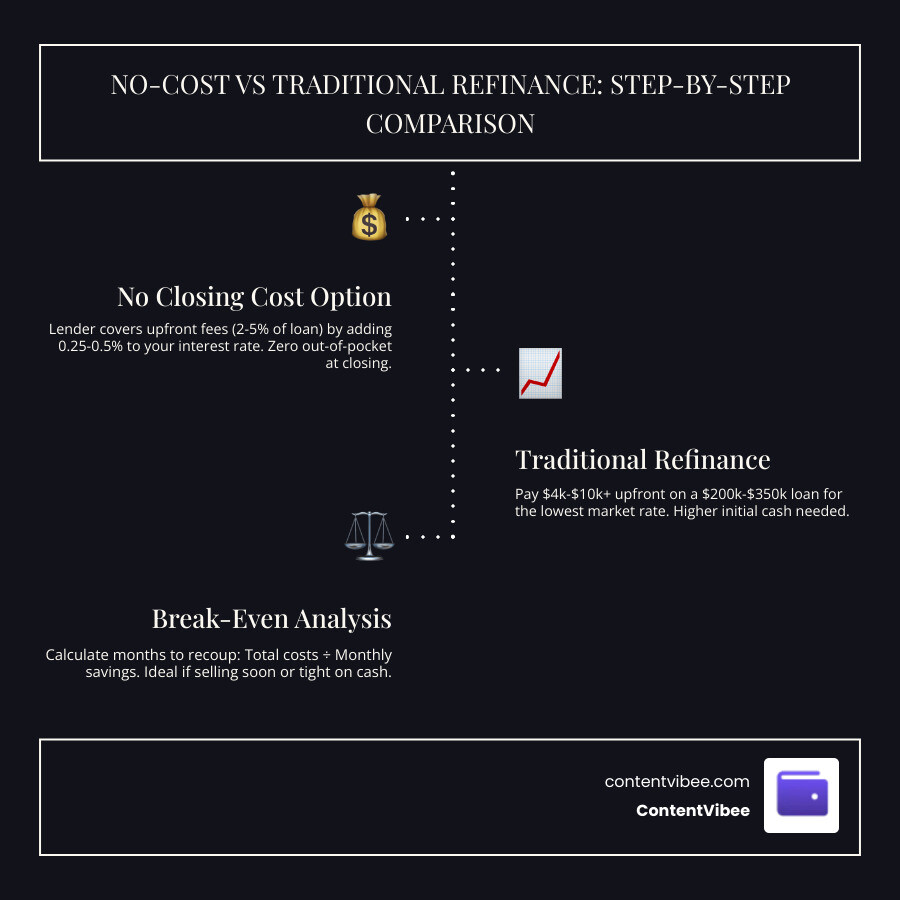
Mastering the No Closing Cost Refinance Calculator
When we talk about refinancing in May 2026, we are looking at a landscape where every basis point matters. Mastering a no closing cost refinance calculator isn’t just about plugging in numbers; it’s about understanding the mechanics of your home equity.
To get the most accurate results, you need to understand your current Loan-to-Value (LTV) ratio. This is calculated by dividing your current mortgage balance by your home’s appraised value. For many lenders in Virginia, an LTV of 80% or lower is the “sweet spot” that helps you avoid private mortgage insurance (PMI) and secures the best possible terms.
Your credit score also plays a starring role. Even in a “no-cost” scenario, a higher credit score reduces the interest rate premium the lender charges to cover those fees. If you are curious about what those fees look like before they are folded into your rate, checking out the Average Refi Closing Costs can give you a baseline. By using our Tools/Finance Calculator, you can visualize how lender credits — which are essentially payments from the lender to you to cover closing costs — affect your long-term amortization.

How a No Closing Cost Refinance Calculator Works
The “magic” behind a no-cost refinance is actually simple math: the lender covers your upfront fees in exchange for a higher interest rate. This is known as an interest rate premium.
For example, if the current market rate for a traditional refinance is 6.0%, a no-cost option might be 6.375% or 6.5%. The calculator takes the total estimated upfront fees (which usually range from 2% to 5% of the loan amount) and determines how much extra interest the lender needs to collect over time to recoup those costs.
By leveraging ContentVibee’s financial tools, you can run projections to see exactly when the “no-cost” option becomes more expensive than a traditional one. If you plan to sell the home in three years, the no-cost option is almost always the winner because you never reach the point where the higher monthly interest exceeds the $5,000 or $7,000 you saved at the closing table.
Key Inputs for Your No Closing Cost Refinance Calculator
To get an answer that actually helps your wallet, you need to be precise with your inputs. Most calculators, including our Tools/Finance Calculator, will require the following:
- Principal Balance: The actual amount you still owe on your current mortgage (check your latest statement!).
- Home Valuation: A realistic estimate of what your home is worth today.
- Current Interest Rate: Your existing “note rate.”
- New Loan Term: Are you sticking with a 30-year, or dropping to a 15-year to build equity faster?
- Property Taxes and Insurance: Even though these don’t change because of the refinance, including them gives you a true “all-in” monthly payment comparison.
Comparing No-Cost vs. Traditional Refinancing
In Virginia, closing costs can be a significant hurdle. Whether you are in Arlington or Richmond, government recording fees and title insurance add up quickly.
| Feature | Traditional Refinance | No Closing Cost Refinance |
|---|---|---|
| Upfront Cash Required | 2% – 5% of loan amount | $0 (or very close to it) |
| Interest Rate | Lower (Market Rate) | Higher (Premium Rate) |
| Monthly Payment | Lowest possible | Slightly higher |
| Lifetime Interest Cost | Lower | Higher |
| Best For… | Long-term homeowners (10+ years) | Short-term homeowners (under 5 years) |
For a deeper dive into local expectations, see What Are The Average Closing Costs In Virginia to see how our state’s specific taxes impact these totals.
When to Choose a No-Cost Option
We often tell our readers that “free” isn’t always best, but “no-cost” has a very specific place in a smart financial plan. The most common scenario is the “Short-term Residency” play. If you know you are moving for work or upgrading to a larger home in a few years, why would you pay $6,000 today to save $150 a month? You’d have to stay in the house for 40 months just to break even!
Another reason is cash flow management. If you have the equity but lack the liquid cash—perhaps you’d rather keep your savings for an emergency fund or high-yield investments—the no-cost option allows you to improve your rate without draining your bank account. This is a key part of Understanding The Real Estate Buying Process and subsequent management; it’s about keeping your capital where it works hardest for you.

Calculating the Break-Even Point
The break-even point is the “Golden Ratio” of refinancing. It tells you exactly how many months it will take for your monthly savings to “pay back” the cost of the refinance.
In a traditional refinance, the math is: Closing Costs / Monthly Savings = Break-even Months.
In a no closing cost refinance calculator scenario, the break-even is slightly different. You are comparing the No-Cost Monthly Saving (which is smaller because of the higher rate) against the Traditional Monthly Saving.
A general rule of thumb in May 2026 is that if you can drop your rate by at least 0.5% without paying a dime out of pocket, it is almost always worth a look. If the no-cost rate is still lower than your current rate, you start saving money from Day 1.
Hidden Costs and Interest Rate Markups
While we call it “no-cost,” the lender isn’t a charity. They are getting paid through that 0.25% to 0.5% rate premium. Over a 30-year amortization schedule, that tiny fraction can add up to tens of thousands of dollars.
For example, on a $300,000 loan, a 0.5% higher interest rate costs you about $100 more per month. Over 30 years, that is $36,000 in extra interest! This is why the calculator is so vital; it helps you see that if you stay in the home for the full 30 years, you’d be much better off paying the $6,000 upfront.
Understanding the Pre Approval Home Loan Process for a refinance is just as rigorous as a purchase. Lenders will still check your income, debts, and assets to ensure you can handle the new premium rate.
Final Verdict: Is It Right for You?
At ContentVibee, we believe the best financial decision is the one that aligns with your specific goals. If your goal is to maximize your monthly budget right now or if you plan to move soon, a no-cost refinance is a brilliant move. It preserves your equity and keeps cash in your pocket.
However, if this is your “forever home,” we usually suggest biting the bullet and paying the closing costs upfront to secure the lowest possible lifetime interest rate.
What to look for in a reputable no closing cost refinance calculator:
- Side-by-Side Comparisons: It should show you traditional vs. no-cost options simultaneously.
- Amortization Tables: You need to see how your loan balance decreases over time.
- Customizable Fees: It should allow you to input Virginia-specific costs for better accuracy.
- Net Savings Timeline: A clear chart showing when one option overtakes the other.
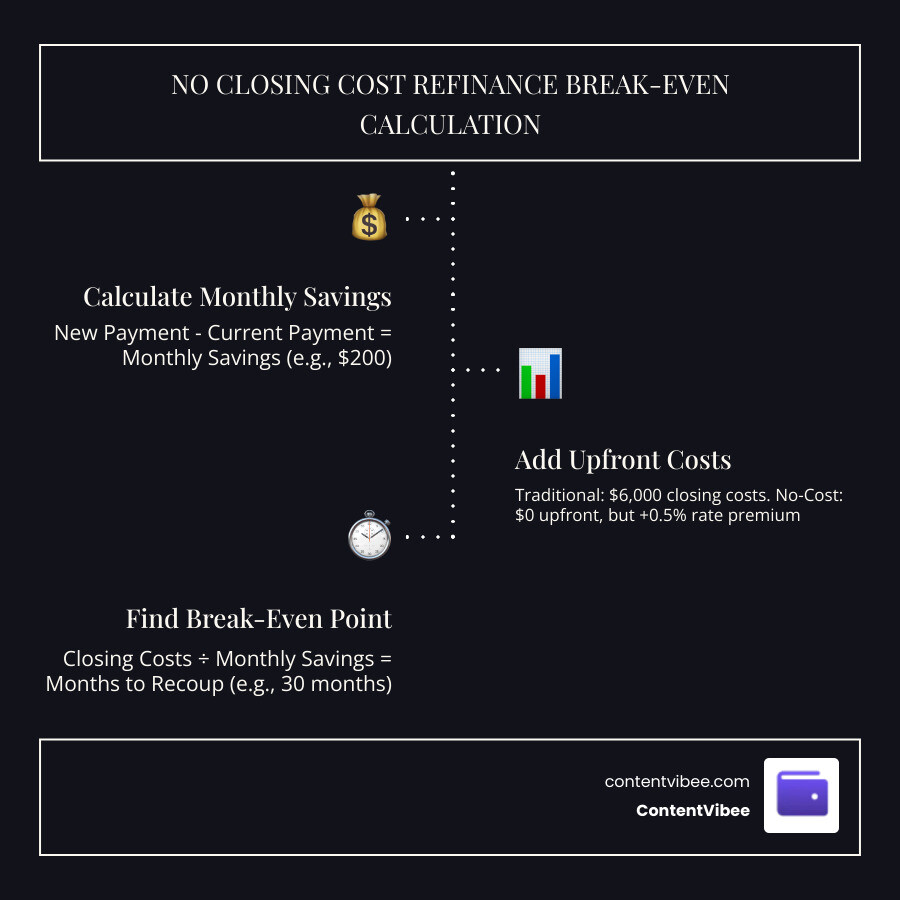
Before you commit, review the Average Refi Closing Costs one last time. Refinancing is a powerful tool to build wealth, but only if you do the math first. Stop guessing, start calculating, and make 2026 the year your mortgage finally starts working as hard as you do.


