


Why Monthly Byaj Calculations Matter More Than You Think
Using a byaj calculator in months is one of the fastest ways to see exactly how much interest you owe — or will owe — on any loan.
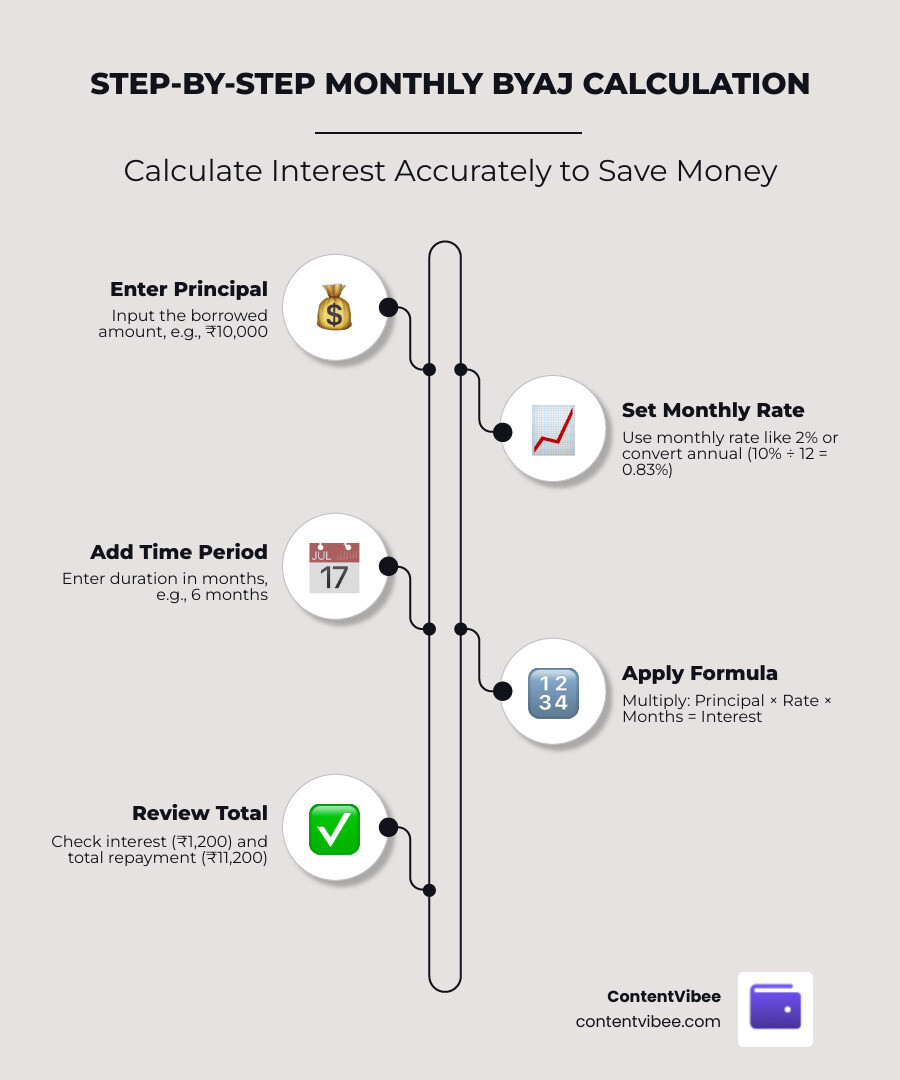
Here’s how to calculate monthly byaj in 3 simple steps:
- Enter your principal — the amount you borrowed or invested
- Enter the interest rate — either monthly (e.g., 2%) or annual (e.g., 10% ÷ 12 = 0.83% per month)
- Enter the time in months — then multiply:
Principal × Monthly Rate × Number of Months
Quick example:
₹10,000 at 2% per month for 6 months = ₹1,200 interest
In lending, the numbers can be deceiving. A moneylender might quote “just 2% a month” — which sounds small. But that’s 24% per year, nearly three times what a bank charges.
This is a real problem for millions of borrowers. Around 40% of loans in India’s unorganized sector are village-style monthly interest loans, and many borrowers never do the math until it’s too late.
Getting the calculation right isn’t just about accuracy — it’s about protecting your money.
This guide walks you through exactly how to use a monthly byaj calculator, understand the formulas behind it, and avoid the traps that cost borrowers thousands every year.
Byaj calculator in months further reading:
How to Use a Byaj Calculator in Months for Smarter Budgeting
A monthly byaj calculator is simply a tool that tells us how much interest builds up month by month. That matters because bills are monthly, budgets are monthly, and stress is usually monthly too.
With a good calculator, we usually enter just three things:
- Principal amount
- Interest rate
- Time in months
That is why these tools are so useful for financial planning. They help us compare loans, estimate investment returns, and see the real cost of borrowing before we commit.
If you want a broader set of tools for quick calculations, our Finance Calculator Tools page is a smart place to start.
Understanding the Formula for Byaj Calculator in Months
There are two common ways to calculate monthly interest.
1. When the rate is given annually
If the lender gives an annual rate, we first convert it into a monthly rate:
Monthly Rate = Annual Rate / 12
Then simple interest for a monthly period becomes:
Interest = Principal × (Annual Rate / 12 / 100) × Number of Months
Example:
- Principal: ₹50,000
- Annual rate: 12%
- Time: 4 months
Monthly rate = 12 / 12 = 1%
Interest = 50,000 × 1 / 100 × 4 = ₹2,000
2. When the rate is already monthly
If the lender says “2% per month,” no conversion is needed:
Interest = Principal × Monthly Rate / 100 × Number of Months
Example:
- Principal: ₹10,000
- Monthly rate: 2%
- Time: 6 months
Interest = 10,000 × 2 / 100 × 6 = ₹1,200
This is the formula most people mean when they search for byaj calculator in months.
Simple monthly interest vs. compound monthly interest
Simple interest is calculated only on the original principal.
Compound monthly interest adds interest to the balance, then charges interest on that larger amount in the next month.
Simple monthly formula:
SI = P × R × T
Compound monthly formula:
A = P × (1 + r/100)^n
Where:
- P = principal
- r = monthly interest rate
- n = number of months
- A = final amount
For short-term informal loans, simple interest is common. For formal loans and investments, compounding may apply. This difference is small at first but grows fast over time, which is exactly why precise math matters. Our guide on Why Investment Calculator Accuracy and Financial explains why small input errors can create expensive surprises.
Comparing Village Interest vs. Bank Rates
This is where monthly calculations become really important.
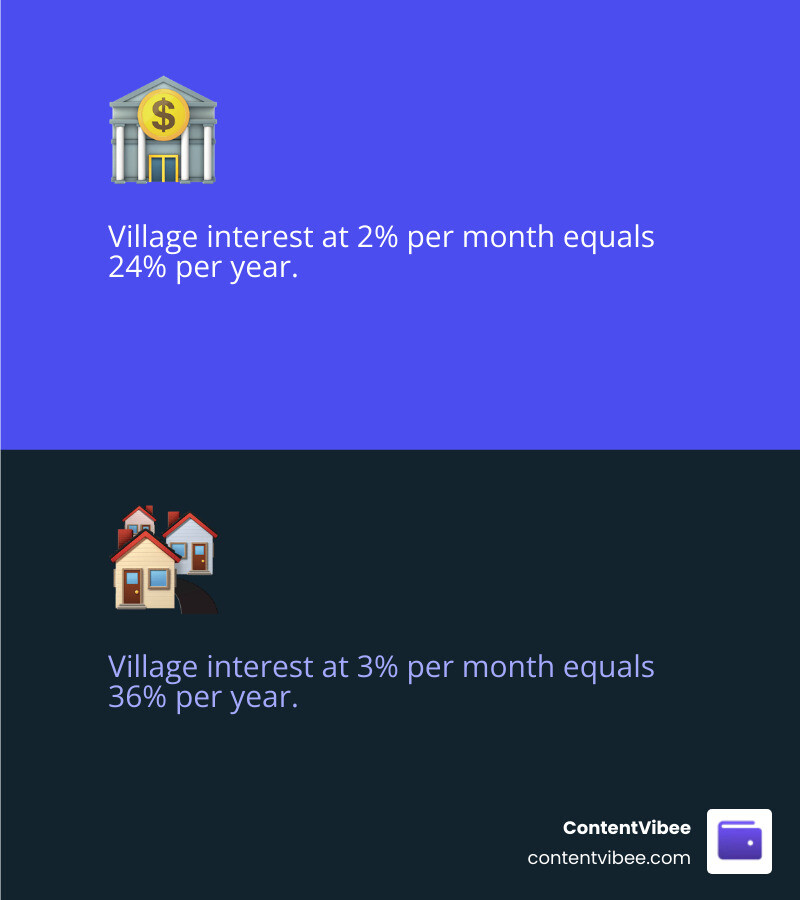
In informal lending, or “gaon ka byaj,” rates are often quoted as 2% to 3% per month. That may sound manageable, but over a year, that works out to roughly 24% to 36% before we even discuss extra charges or hidden fees.
By comparison, formal bank borrowing is often quoted around 8% to 10% per year.
| Type of lending | Typical quoted rate | Approx yearly cost |
|---|---|---|
| Village interest | 2% per month | 24% per year |
| Village interest | 3% per month | 36% per year |
| Bank loan | 8% per year | 8% per year |
| Bank loan | 10% per year | 10% per year |
This also helps explain the old “rupaye sekda” style of lending. If someone says “2 rupaye per hundred per month,” that means 2% monthly. On ₹1,00,000, that is ₹2,000 every month in interest alone. Over a year, that becomes ₹24,000 if the principal is unchanged.
Why does this matter so much? Because hidden interest is a common problem, and accurate calculation can potentially save borrowers 20% to 30% by helping them compare options clearly before taking the loan.
Step-by-Step Guide to Calculate Your Monthly Interest
Here is the easiest way to do it.
Step 1: Enter the principal amount
This is the amount borrowed or invested.
Examples:
- ₹20,000 personal borrowing
- ₹1,00,000 business borrowing
- ₹50,000 savings deposit
Step 2: Enter the interest rate
Use the rate exactly as quoted.
- If the rate is annual, divide by 12 for a monthly estimate
- If the rate is monthly, use it directly
- Double-check whether the rate is simple or compound
Step 3: Choose the duration in months
This is where a monthly calculator beats an annual one. If your loan is 5 months, 7 months, or 18 months, you do not need rough guesses.
Step 4: Review both interest and total repayment
Always look at:
- Interest amount only
- Total amount payable
- Monthly breakdown, if available
Example 1: Informal loan
- Principal: ₹10,000
- Monthly rate: 2%
- Time: 6 months
- Interest: ₹1,200
- Total repayment: ₹11,200
Example 2: Annual-rate loan converted monthly
- Principal: ₹10,000
- Annual rate: 8%
- Monthly equivalent: 0.67%
- Time: 12 months
- Interest: about ₹800
- Total repayment: about ₹10,800
For more finance explainers and practical tools, we recommend using ContentVibee resources alongside your calculations so the numbers make sense, not just the math.
Why Accurate Monthly Calculations Save You Money
The biggest benefit of monthly interest calculation is transparency. Annual rates can hide the real bite of a loan, while monthly figures show us what is actually happening to our cash flow.

A precise monthly view helps us:
- Spot expensive loan offers faster
- Identify hidden charges
- Avoid debt traps
- Plan repayments around real income cycles
- Compare borrowing versus investing options
That is a huge deal in unorganized lending, where monthly charges can look small but stack up fast. Better calculation can mean better decisions, and better decisions can mean meaningful savings.
For a deeper look at why precision matters in money decisions, read The Importance of Precision in Financial Planning.
Benefits of Using a Digital Byaj Calculator in Months
Online calculators beat manual math for most people, and yes, that includes those of us who once thought we could “just do it quickly on paper.”
Main advantages include:
- Faster results
- Fewer calculation errors
- Easy comparison between multiple loans
- Better monthly budgeting
- Mobile-friendly use anywhere
- Option to save, share, or print results
A strong monthly byaj calculator should also offer helpful features such as:
- Support for simple and compound interest
- Inputs in months and years
- Monthly and annual rate handling
- PDF report download
- Shareable results
- Reset and edit options
- Clear total interest and final payable amount
Some tools also include voice input. That can be especially helpful for rural or low-literacy users who may be more comfortable speaking numbers than typing them. Accessibility is not a bonus feature in finance. It is a money-saving feature.
If you are comparing long-term growth instead of loan costs, our article on Why a Compound Interest Calculator for Retirement can help connect the dots.
Avoiding Common Pitfalls in Monthly Lending
A calculator is powerful, but only if we use it correctly.
Here are the most common mistakes to avoid:
Confusing monthly and annual rates
A rate of 2% per month is not the same as 2% per year. This is the most dangerous mix-up.
Ignoring compounding
If interest is added every month, the total cost can be higher than simple multiplication suggests.
Forgetting extra fees
Processing fees, penalties, and add-on charges can change the real borrowing cost. This is why effective APR matters in formal lending.
Entering the wrong time period
6 months and 6 years are very different life experiences for both humans and loans.
Not checking the math twice
Before you agree to a loan, verify:
- Principal
- Rate unit
- Loan term
- Repayment schedule
- Total amount due
This matters even more when dealing with unorganized lending. Research shows that around 40% of loans in that sector follow village-style monthly interest patterns, where rates can reach 24% to 36% annually. That makes strategic repayment planning essential.
A few smart ways to reduce the burden:
- Choose shorter repayment periods when possible
- Pay early if there is no prepayment penalty
- Compare monthly cost, not just the quoted rate
- Ask for the full total payable in writing
- Use a digital calculator before signing anything
Conclusion: Take Control of Your Financial Future
A byaj calculator in months is more than a convenience. It is a reality check.
It helps us understand what we owe, compare loans fairly, budget with confidence, and avoid getting tricked by small-looking monthly rates that turn into large yearly costs. Whether we are evaluating a short-term loan, checking investment returns, or trying to decode a “rupaye sekda” quote, monthly calculations give us the clearest picture.
At ContentVibee, we believe financial clarity should be simple, practical, and useful in real life. That is why we focus on advice that helps us make smarter borrowing and saving decisions without the jargon headache.
If you want more practical money guidance, explore Explore Real Estate and Finance Insights.