


Why an AUM Fee Calculator Can Make or Break Your Retirement
Using an aum fee calculator is the fastest way to see exactly how much your financial advisor is costing you — in real dollars, not abstract percentages.
Quick Answer: How to Calculate an AUM Fee
- Find your portfolio value (e.g., $500,000)
- Get your advisor’s fee percentage (e.g., 1%)
- Multiply: $500,000 × 0.01 = $5,000 per year
- Add ETF expense ratios (typically 0.03%–0.10%) and any platform fees
- That total is your all-in annual cost
For tiered fee schedules, apply each rate only to that portion of the balance — similar to how tax brackets work.
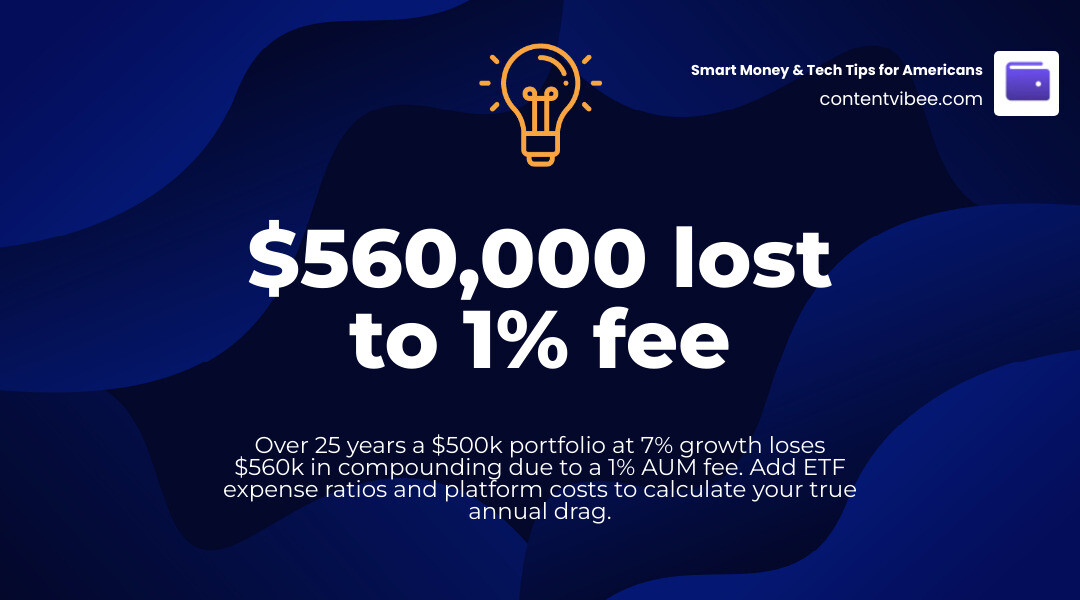
Here’s the thing most investors miss: a 1% annual fee sounds small. But on a $500,000 portfolio growing at 7% per year, that 1% can quietly erase more than $560,000 in wealth over 25 years. Not because the fee is large — but because every dollar paid in fees stops compounding.
Financial advisors often deduct these fees directly from your account, so you never write a check. That invisibility is exactly why so many people are shocked when they run the numbers.
This guide will help you understand what you’re actually paying, whether it’s worth it, and how to use a calculator to find out.
Understanding the Basics of Assets Under Management (AUM) Fees
Before we dive into the math, let’s get on the same page about what an AUM fee actually is. At its core, an Assets Under Management (AUM) fee is an advisory percentage charged annually by a firm to manage your investments.
Unlike a subscription to a streaming service or a gym membership, you rarely see an AUM fee leave your wallet. Instead, it’s an account deduction. This “invisible” nature is one reason why many Americans in 2026 still underestimate their total investment costs. If you’ve ever wondered What Are Wealth Management Fees, the AUM fee is usually the biggest slice of that pie.
The Fiduciary Standard and Transparency
In the financial world, we talk a lot about the “fiduciary standard.” This means your advisor is legally obligated to act in your best interest. Part of that duty involves transparent fee disclosure. You can find these details in a document called the Form ADV, which every registered investment advisor must file with the SEC.
As we move through May 2026, industry benchmarks show that the average AUM fee typically ranges from 0.59% to 1.18% per year. However, this isn’t a “one size fits all” number. Larger portfolios often qualify for lower percentages, while smaller accounts might pay slightly more for the same level of service.

How to Use an AUM Fee Calculator for Your Portfolio
Using an aum fee calculator isn’t just about plugging in one number and walking away. To get a true picture of your retirement future, you need to consider the full ecosystem of your portfolio.
When we help clients evaluate their costs, we look at several key variables:
- Current Portfolio Balance: The total value of all managed accounts.
- Expected Annual Returns: Historically, the S&P 500 has averaged about 10% per year, but many planners use a more conservative 6-8% for projections.
- Time Horizon: How many years until you need to start withdrawing the money?
- Annual Contributions: How much “new money” are you adding to the pile each year?
To get started, you can use a high-quality AUM Fee Calculator to see your baseline. But remember, a management fee is only one part of your risk profile. Understanding Why a Portfolio Risk Management Tool is necessary can help you see if you’re paying high fees for a portfolio that isn’t actually protected against market swings.
Step-by-Step Guide to Using an AUM Fee Calculator
Ready to crunch the numbers? Follow these steps to ensure your calculation is accurate:
- Gather Your Statements: Look at your most recent quarterly statements. Find the “Management Fee” or “Advisory Fee” line item.
- Input Your Gross Balance: This is your total balance before any fees are taken out.
- Define Your Net Balance: The aum fee calculator will subtract the projected fees from your growth to show you the “Net Balance”—the money that actually stays in your pocket.
- Project Future Value: Most tools, like this Financial Advisor Fee Calculator: Compare Costs, allow you to see what that 1% or 1.5% looks like over 20 or 30 years.
The goal here isn’t just to see what you’re paying today; it’s to see the “opportunity cost.” If you pay $10,000 in fees this year, that’s $10,000 that cannot grow by 7% next year. Over a few decades, that missing growth is what creates the massive wealth gap we mentioned earlier.
Calculating Tiered vs. Flat AUM Fee Calculator Results
Not all AUM fees are created equal. Some advisors charge a “flat” percentage (e.g., 1% on everything), while others use “tiered” or “by-slice” logic.
Tiered fees work like progressive tax brackets. For example:
- First $500,000: 1.25%
- Next $500,000: 1.00%
- Amounts over $1 Million: 0.75%
If you have a $1.2 million portfolio, you don’t pay 0.75% on the whole thing. You pay 1.25% on the first slice, 1.00% on the second, and 0.75% only on the final $200,000. This results in an effective fee percentage that is somewhere in the middle.
| Portfolio Value | Flat 1% Fee | Tiered Schedule (Effective %) | Annual Savings with Tiers |
|---|---|---|---|
| $500,000 | $5,000 | 1.25% ($6,250) | -$1,250 |
| $1,000,000 | $10,000 | 1.125% ($11,250) | -$1,250 |
| $2,000,000 | $20,000 | 0.93% ($18,750) | +$1,250 |
As your portfolio grows, these “breakpoints” become your best friend. Using an Impact of AUM Fees Calculator can help you visualize exactly when your effective rate starts to drop.
The Hidden Impact of Fees: Compounding and All-In Costs
We often hear the phrase “the tyranny of compounding.” Usually, this refers to the magic of interest making you rich. But in fees, it works in reverse. Fees are a “compounding drag” on your wealth.
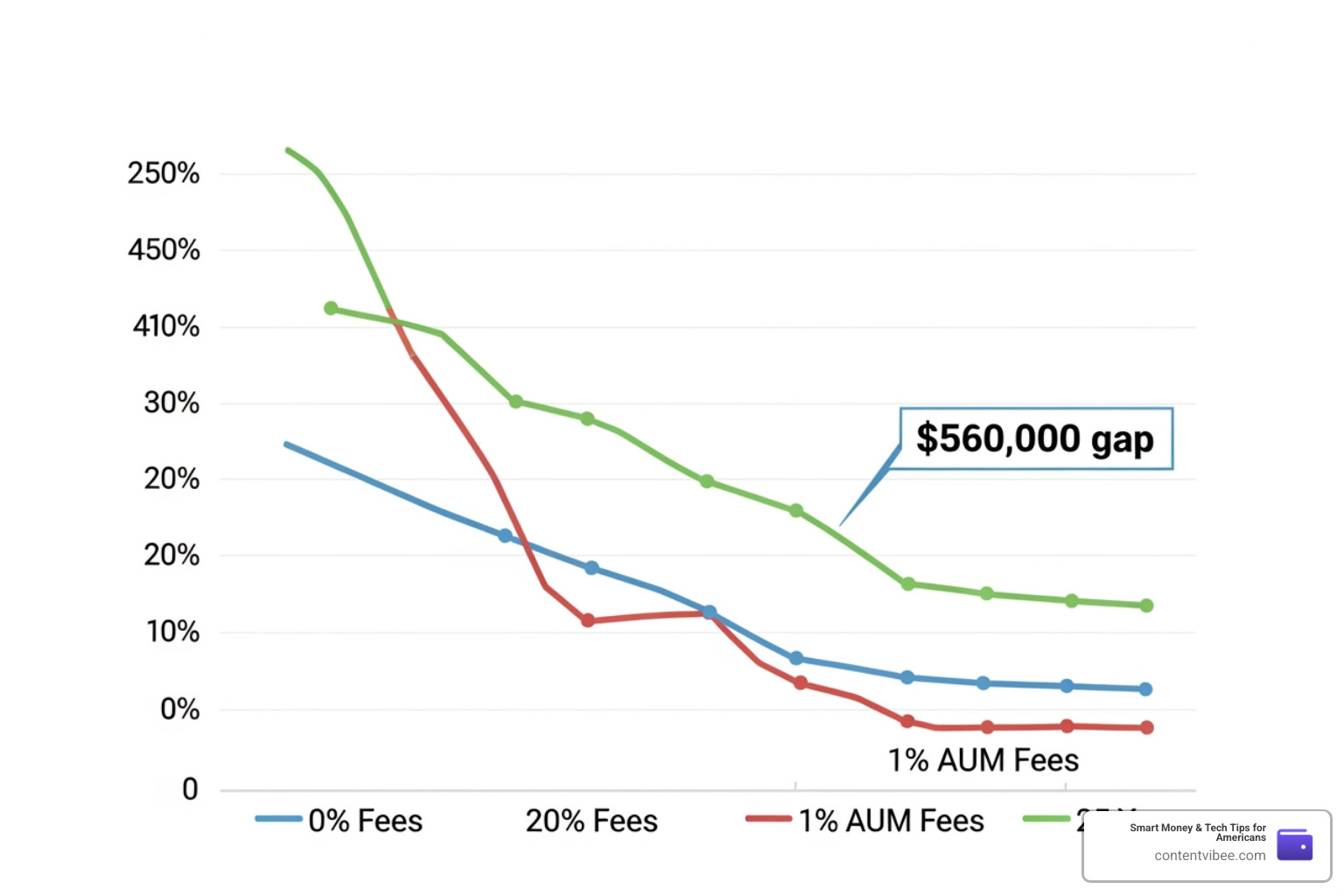
When an aum fee calculator shows a $560,000 difference over 25 years on a $500,000 portfolio, it’s highlighting that the total cost of the fees actually exceeds the original principal you invested. That is a staggering thought for any retiree.
Don’t Forget the “All-In” Costs
Your advisor’s AUM fee is rarely the only cost you pay. To get an accurate reading from an Asset Management Fee Analyzer , you must include:
- ETF Expense Ratios: Even if you use low-cost funds, they usually cost between 0.03% and 0.10% (3 to 10 basis points).
- Platform/Custodial Fees: Some firms charge a small fee (often 0.10% to 0.20%) just to hold the money on their digital platform.
- UMA Charges: If you have a Unified Managed Account, there might be additional “overlay” fees for professional sub-management.
When you add these up, a “1% fee” often turns into a 1.25% or 1.40% “all-in” cost.
Comparing AUM Fees to Alternative Pricing Models
Is the AUM model the best for you? In 2026, Americans have more choices than ever. While the AUM model aligns the advisor’s incentives with your growth (they make more when you make more), it can lead to conflicts of interest—such as an advisor discouraging you from paying off a mortgage because it would lower the assets they manage.
Here are the primary alternatives:
- Flat Annual Fees: Typically ranging from $2,000 to $8,000 per year, regardless of portfolio size. This is often better for high-net-worth individuals.
- Hourly Rates: Usually $200 to $500 per hour. Great for a one-time “financial checkup.”
- Project-Based Billing: A set fee for a specific task, like creating an estate plan or a divorce settlement strategy.
- Robo-Advisors: These automated platforms charge much less—usually 0.25% to 0.50%. Check out Why Robo-Advisor Fees Comparison Matters to see if a human touch is worth the extra cost for your specific situation.
Complexity-based pricing is gaining popularity because it charges you for the work performed, not just the size of your bank account.
Maximizing Value: Negotiating Fees and Calculating Net Benefit
Before you fire your advisor over a 1% fee, we have to look at the other side of the coin: Advisor Alpha.
Research from Vanguard and other major institutions suggests that a good advisor can add approximately 3% in net returns through value-added services. If your advisor is charging 1% but adding 3% in value, you are actually “net positive” by 2%.
Where does that 3% come from?
- Behavioral Coaching (1.5% to 3%): This is the “don’t sell during a market crash” factor. Preventing one emotional mistake can save a decade’s worth of fees.
- Tax-Efficient Strategies (0.5% to 1.5%): This includes tax-loss harvesting and choosing the right accounts for the right assets.
- Asset Allocation & Rebalancing (0.25% to 0.75%): Keeping your risk levels consistent over time.
How to Negotiate
AUM fees are often negotiable, especially if your portfolio has grown significantly. Here are a few scripts you can use:
- “I’ve noticed my portfolio has crossed the $1 million mark. Does your firm offer a fee breakpoint at this level?”
- “I am comparing your all-in costs to a flat-fee model. Can we move to a tiered schedule to make our interests more competitive?”
- “What ‘all-in’ dollar amount did I pay last year across advisory fees, fund expenses, and platform costs?”
Most advisors respect clients who use an AUM Fee Calculator | Estimate Your Investment Fees and … to come prepared to the meeting.
Frequently Asked Questions about AUM Fees
Are financial advisor AUM fees tax-deductible in 2026?
Under current federal tax laws (following the Tax Cuts and Jobs Act), miscellaneous itemized deductions for investment advisory fees are suspended through 2025. As of May 2026, unless new legislation has passed, these fees are generally not deductible on your federal return. However, if you are in California, check with a tax professional, as state-level rules for high-net-worth individuals can sometimes differ. We always recommend “tax-smart” investing—paying fees from taxable accounts rather than IRAs when possible to preserve tax-advantaged growth.
What is a UMA fee on my account statement?
A UMA (Unified Managed Account) fee is often a “bundled” fee. It covers the cost of the advisor, the technology platform, and sometimes the individual professional money managers who are picking the specific stocks or bonds within your account. It may appear as a prorated amount or include credits labeled as “final” depending on when your billing cycle ends.
What is a fair AUM fee range for a $1 million portfolio?
For a $1 million portfolio, a “fair” fee in 2026 typically falls between 0.70% and 1.00%. If you are paying more than 1.18% for a million-dollar account, you should expect a very high level of service, including comprehensive estate planning, tax preparation, and perhaps even concierge services. High-net-worth individuals with over $5 million often see fees drop to 0.50% or less.
Conclusion
At Smart Money & Tech Tips for Americans, we believe that technology should empower your financial decisions. An aum fee calculator is one of the most powerful tools in your arsenal to ensure your retirement stays on track.
By converting abstract percentages into real dollar amounts, you can finally have an honest conversation with your advisor—or yourself—about the value you’re receiving. The goal isn’t necessarily to find the cheapest advice, but the best value for your long-term wealth preservation.
Don’t let “invisible” fees erode your hard-earned savings. Take control of your costs and Start planning your investment strategy today.