


Avis Stock Investment Risk and Rental Market Revenue Analysis is one of the most urgent topics for self-directed investors right now — and for good reason.
Here is a quick summary of the key risks and revenue signals you need to know:
| Risk Factor | Current Status (April 2026) |
|---|---|
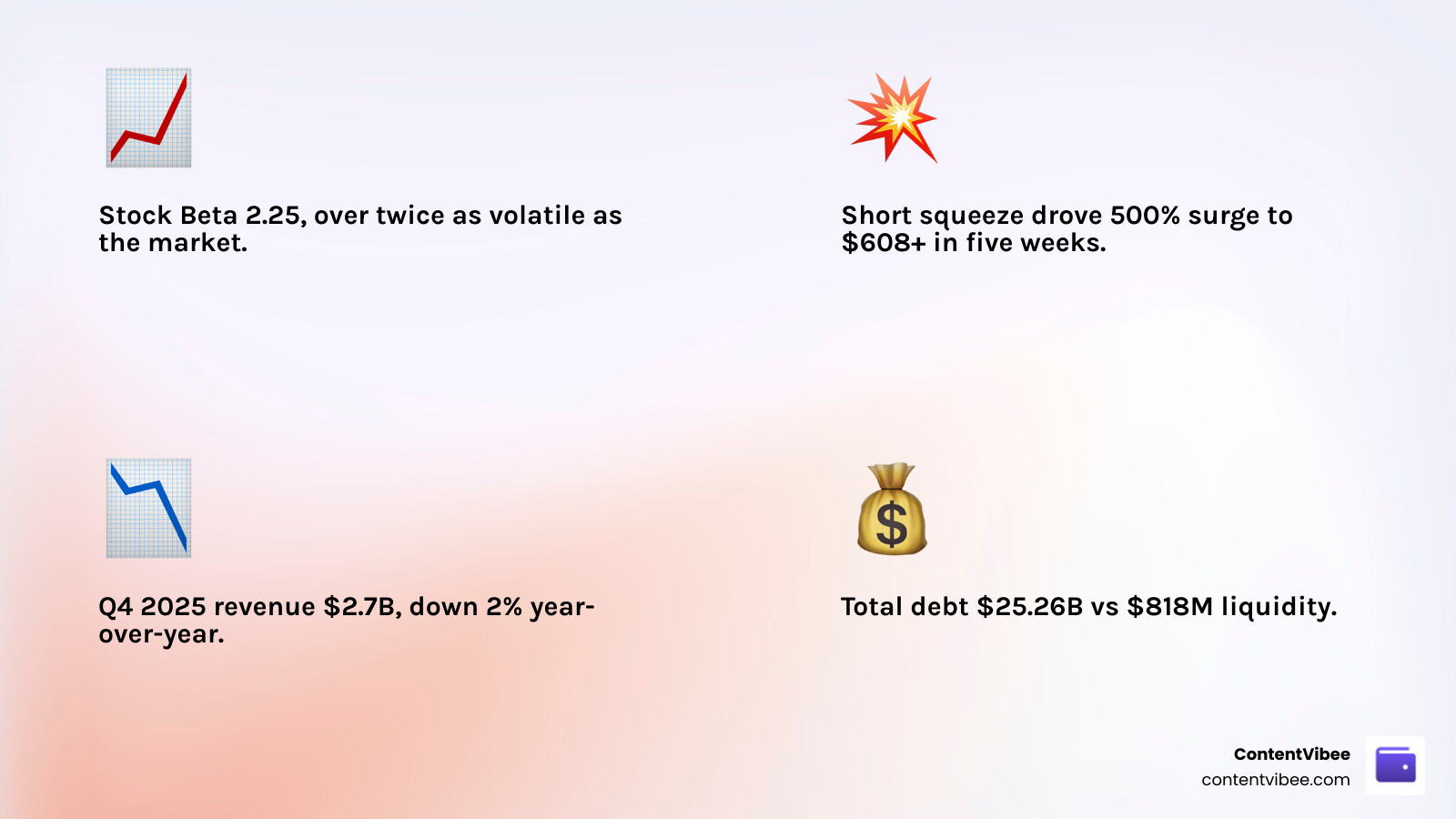
| Stock volatility (Beta) | 2.25 — more than twice the market |
| 52-week price range | $62.17 to $212.81 |
| Short squeeze surge | Up ~500% in five weeks to $608+ |
| Q4 2025 revenue | $2.7B (down ~2% year-over-year) |
| Q4 2025 net loss | $856 million |
| EV fleet impairment charge | $518 million (one-time, non-cash) |
| Total debt | $25.26 billion |
| Cash on hand | ~$618–$818 million |
| Analyst average price target | $137.57 (range: $120–$157) |
| Forward P/E at peak squeeze price | ~175x projected 2026 earnings |
Avis Budget Group (Nasdaq: CAR) has gone from a struggling rental giant to a short-squeeze phenomenon — all within a few months. Hedge funds SRS Investment Management and Pentwater Capital accumulated over 100% economic interest through shares and swaps, locking up roughly 82% of the available float. That triggered a gamma squeeze that sent the stock soaring over 200% in six weeks, hitting an all-time high near $714.
But here is the tension every investor faces: the stock price and the business fundamentals are telling very different stories.
The company posted a full-year net loss of $995 million in 2025, carries over $25 billion in debt, and saw both revenue per day and total rental days decline year-over-year. At the same time, operational metrics like vehicle utilization and per-unit fleet costs are quietly improving — and the CEO has framed the painful Q4 as a “catalyst for meaningful change.”
So is CAR a recovery play, a speculative trap, or something in between? This guide breaks it all down.
Market Structure and the 2026 Short Squeeze Dynamics

To understand the current state of Avis Budget Group (CAR), we have to look past the rental counters and into the plumbing of the stock market. In early 2026, CAR became the poster child for “market structure” trading, where the way a stock is owned matters more than how many cars it actually rents.
The primary driver of the recent 500% surge was an unprecedented short squeeze. This wasn’t just a group of retail traders on a message board; it was a high-stakes tug-of-war involving major institutional players. Two hedge funds, SRS Investment Management and Pentwater Capital, accumulated a massive “economic interest” in the company. By using a combination of direct share ownership and equity swaps, these firms effectively locked up 82% of the company’s float.
When short interest exceeds the available float, any upward price movement forces short sellers to buy shares to cover their positions. This creates a feedback loop: buying drives the price up, which forces more buying. This was further intensified by a “gamma squeeze,” where options dealers are forced to buy the underlying stock to hedge their positions as the price climbs toward “strike” prices.
According to Avis Budget Group (CAR) Is Up 74.5% After Short-Squeeze Frenzy … , the stock’s beta of 2.25 indicates that it is moving significantly more than the broader market. For investors, this means the stock isn’t just a bet on travel trends; it’s a bet on technical market mechanics that can reverse instantly.
Speculative Trading and Retail Investor Exposure
The danger for the average investor lies in the “low free float” environment. When a few large entities own the vast majority of tradable shares, the price becomes highly sensitive to even small trades. While the 390% monthly gain seen recently is exhilarating, it is detached from the reality of the company’s balance sheet.
We must remember that Every Investor Faces Risk, but the risks in a concentrated ownership scenario are unique. If the major hedge funds decide to unwind their swap positions or sell shares, the “floor” beneath the stock price could vanish. Retail investors often enter these trades at the peak of the hype, only to find themselves holding shares in a company trading at 175x its projected earnings while the actual business is facing revenue headwinds.
Avis Stock Investment Risk and Rental Market Revenue Analysis
When we pivot from the stock chart to the actual income statement, the picture becomes more grounded. Our Avis Stock Investment Risk and Rental Market Revenue Analysis shows that the company is navigating a difficult post-pandemic transition.
In the fourth quarter of 2025, Avis reported revenues of $2.7 billion. While that sounds like a lot of car rentals, it actually represents a 1.7% to 2% decline compared to the previous year. The company missed analyst estimates for both revenue and EBITDA (Earnings Before Interest, Taxes, Depreciation, and Amortization) by significant margins.
| Metric | Q4 2024 | Q4 2025 | YoY Change |
|---|---|---|---|
| Total Revenue | $2.75B | $2.70B | -1.8% |
| Net Income/Loss | ($63M) | ($856M) | -1,258% |
| Revenue Per Day | $67.35 | $66.01 | -2.0% |
| Total Rental Days | 31.2M | 30.9M | -1.0% |
| Vehicle Utilization | 67.7% | 68.0% | +0.3% |
As noted in the Avis Budget Group Reports Fourth Quarter and Full Year release, the massive net loss was primarily driven by a massive write-down of their electric vehicle (EV) fleet. However, even without that one-time charge, the core business is feeling the squeeze of lower pricing power.
Key Metrics in Avis Stock Investment Risk and Rental Market Revenue Analysis
The “Revenue Per Day” (RPD) metric is the pulse of the rental industry. A 2% drop in RPD suggests that Avis is having to lower prices to keep its cars on the road. When you combine that with a 1% drop in total rental days, it signals a cooling in general travel demand or increased competition from peers like Hertz and Enterprise.
Utilization remains a bright spot at 68%, showing that management is doing a decent job of matching fleet size to demand. However, the monetization efficiency—how much profit they squeeze out of every mile driven—is under pressure. We believe that Why The Investment Time Horizon Impact is crucial here; short-term traders are ignoring these operational dips, but long-term investors cannot afford to.
Future Outlook: Avis Stock Investment Risk and Rental Market Revenue Analysis
Looking ahead to the rest of 2026, analyst opinions are split. The average price target sits around $137.57, which is a far cry from the squeeze-driven highs of $600 or $700. This suggests that professional analysts expect the stock to eventually “mean-revert” or fall back toward its fundamental value.
The Avis Budget’s Q4 Earnings: The EV Charge and Restructuring as a Tactical Catalyst report suggests that the current restructuring could be a “tactical catalyst.” By taking the pain of the EV write-downs now, Avis is clearing the decks for a more profitable 2026. If they can continue to lower their per-unit fleet costs—which dropped 18% in Q4—they may be able to offset the sluggish revenue growth.
Balance Sheet Fragility and Debt Obligations

If the short squeeze is the “engine” of the stock price, the balance sheet is the “chassis”—and it’s looking a bit strained. Avis currently carries a staggering $25.26 billion in total debt. To put that in perspective, their cash on hand is only about $618 million to $818 million.
The debt-to-equity ratio is a shocking -830.4%. In normal financial terms, a negative equity ratio often suggests a company is technically insolvent on paper, though in the rental industry, this is often skewed by how vehicles are financed as assets. Still, the interest coverage—the ability to pay the interest on that debt from earnings—is a major concern.
Effective Investment Asset Allocation Strategy Risk Management requires looking at how a company manages its “liquidity.” Avis does have a safety net: $2.1 billion in fleet funding capacity and a recent issuance of $965 million in asset-backed securities (ABS). These ABS deals allow Avis to borrow against the value of their cars at lower interest rates than traditional corporate bonds.
Liquidity and Cash Flow Recovery Options
The company’s free cash flow (FCF) for Q4 2025 was -$181 million. While negative cash flow is usually a red flag, it was actually an improvement from the -$579 million they saw in the same quarter the previous year.
Avis is currently using its operating cash flow (which was a healthy $1.4 billion for the year) to pay down debt and refresh its fleet. The strategy is clear: sell off expensive-to-maintain EVs, use the cash to pay down high-interest debt, and focus on the high-margin Americas segment. If they can move toward a positive free cash flow in late 2026, the “fundamental” case for the stock improves significantly.
Fleet Strategy: The $518 Million EV Impairment
The biggest headline from the recent financial results was the $518 million impairment charge. This wasn’t a “cash” loss (they didn’t literally lose $518 million from their bank account that day), but it was a massive admission that their electric vehicles were worth much less than they previously thought.
As reported in Avis Budget Group (NASDAQ:CAR) Misses Q4 CY2025 Revenue Estimates , Avis had to shorten the “useful life” estimates for its U.S. EV fleet. This is a trend we are seeing across the industry: EVs are depreciating faster than gas-powered cars due to price wars in the new car market (led by Tesla) and higher-than-expected repair costs.
Avis is turning this lemon into lemonade by selling these EVs to a joint venture, which generated $183 million in cash from tax credits. This “fleet discipline” is essential. By getting rid of underperforming assets, they can focus on “utilization”—making sure every car they own is actually making money.
Operational Turnaround and Macro Headwinds
Despite the net loss, the Americas segment showed signs of life, moving from a $63 million loss in the prior year to a $1 million profit (on an Adjusted EBITDA basis). The International segment also grew, posting $21 million in EBITDA.
However, the “macro” environment remains a threat. We are seeing:
- Travel Demand Volatility: If inflation keeps leisure travelers at home, rental days will continue to slide.
- EV Adoption Challenges: The infrastructure for charging rentals is still lagging, making EVs a hard sell for many customers.
- Intense Competition: Peers are also slashing prices to gain market share, leading to a “race to the bottom” on revenue per day.
Frequently Asked Questions about Avis Stock Risk
What caused the $856 million net loss in Q4 2025?
The loss was almost entirely due to a $518 million non-cash impairment charge on the company’s electric vehicle fleet. Avis realized that these cars were losing value much faster than expected and had to adjust their books accordingly. Other factors included a slight dip in total rental days and lower revenue per day.
Is Avis Budget Group still considered a meme stock ?
Yes, in the sense that its price movements are often driven by “market structure” (short squeezes and concentrated ownership) rather than business performance. With short interest remaining high and a small group of hedge funds controlling the majority of the float, the stock remains highly susceptible to “meme-like” volatility.
How does the company’s debt level impact its stock valuation?
The $25 billion debt load is a massive weight on the company. It means a large portion of their earnings must go toward interest payments rather than being reinvested or returned to shareholders. This high leverage makes the stock very “high beta,” meaning it will swing much more wildly than the average stock when the economy changes.
Conclusion
Navigating Avis Stock Investment Risk and Rental Market Revenue Analysis in 2026 requires a steady hand and a clear view of the data. While the short squeeze has created eye-popping gains for some, the underlying business is still in a delicate “repositioning” phase. The massive EV write-downs and high debt levels are real risks that can’t be ignored just because the stock ticker is green.
At ContentVibee, we believe in empowering investors with the tools to see through the market noise. If you are managing your own portfolio, it is vital to have an Investment Asset Allocation Strategy Risk Management plan in place.
For those who want a more “hands-off” approach to managing these types of high-volatility risks, consider using the Autopilot investment app. Autopilot offers automated portfolio management that includes comprehensive fee and risk reviews. It helps self-directed investors evaluate whether a stock like CAR is actually worth the cost and risk, or if your capital would be better served in more stable assets.
Protect your portfolio by staying informed and using automated tools to keep your risk in check. Explore more about smart investing in our category/investments section.


