


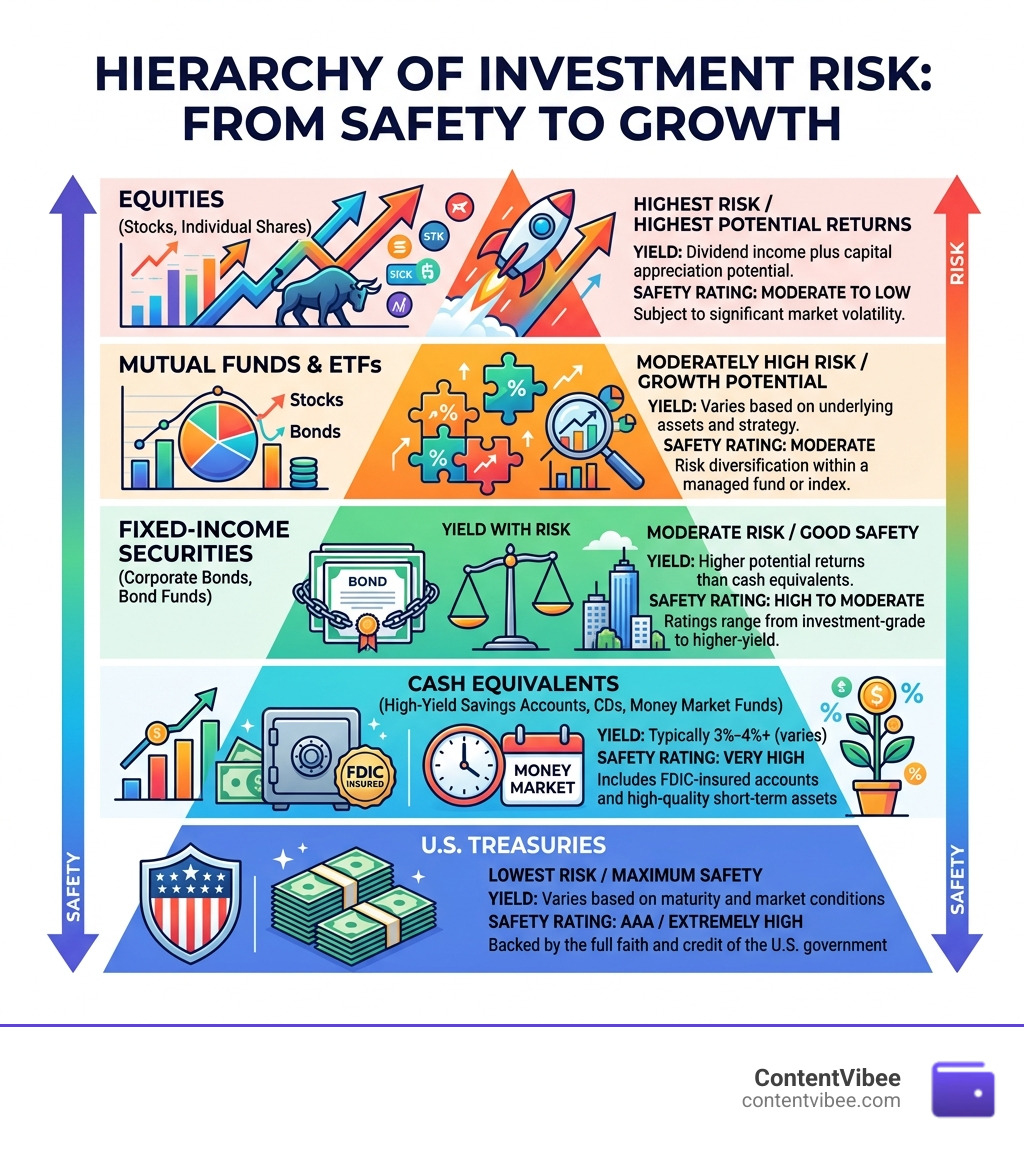
What is the safest investment you can make in 2026? The short answer: no investment is completely risk-free, but some come very close.
Here are the top options, ranked from lowest to highest risk:
- U.S. Treasury Securities — backed by the full faith and credit of the U.S. government; no default in history since 1776
- High-Yield Savings Accounts — FDIC-insured up to $250,000 per depositor, currently yielding 3%–4%+
- Certificates of Deposit (CDs) — FDIC-insured, fixed rates of 3%–4%+, guaranteed if held to maturity
- Money Market Funds — invest in short-term, high-quality assets; aim to maintain $1 per share value
- Series I Savings Bonds — inflation-adjusted, currently yielding 4.03% (as of November 2025–April 2026)
Every one of these carries some risk — whether that’s inflation eroding your purchasing power, interest rate changes, or liquidity constraints.
Here’s the core tension every conservative investor faces:
The safer the investment, the lower the return — and sometimes, “safe” investments quietly lose ground to inflation over time.
With 2026 markets still navigating interest rate uncertainty and economic volatility, picking the right low-risk option matters more than ever. Whether you’re protecting an emergency fund, planning for retirement, or simply trying to preserve capital without handing control to an automated app, this guide breaks down exactly what your options are — and what each one actually costs you in hidden risk.
What is the Safest Investment for Your Portfolio?
When we talk about capital preservation, we are looking for “safe assets.” According to Investopedia, a safe asset is an investment that carries minimal credit risk and remains liquid across all market cycles. In the United States, the “risk-free rate” is almost always defined by sovereign debt—specifically U.S. Treasuries.
But why do we call it the “risk-free myth”? Because while you might not lose your nominal principal (the actual dollar amount you put in), you can still lose value. If you put $1,000 into a safe account and prices for bread and milk go up by 5% while your account only earns 2%, you’ve effectively lost money. Understanding the difference between traditional vs alternative investments is key to seeing where safety truly lies.
For most of us, “safe” means the U.S. Government has our back. This is known as the “full faith and credit” of the United States. Since the government has the power to raise taxes or print money to pay its debts, the likelihood of a total default is considered nearly zero.
The Reality of Risk in 2026
Even in 2026, the “safest” investments aren’t immune to the world around them. We generally face four types of “safe” risks:
- Inflation Risk: The silent killer. If your investment earns 3% but inflation is 4%, your purchasing power is shrinking.
- Liquidity Risk: Some safe investments, like certain CDs or bonds, lock your money away. If you need it for an emergency, you might pay a penalty.
- Opportunity Cost: By playing it safe, you might miss out on the 10% long-term historical average return of the S&P 500.
- Interest Rate Fluctuations: If you buy a bond paying 3% and interest rates suddenly jump to 5%, your 3% bond is now worth less to everyone else on the market.
Why U.S. Treasuries Lead the Market
U.S. Treasuries are the gold standard for safety. They are considered the safest investment because they have a nearly zero default rate. Beyond safety, they offer a unique tax advantage: the interest you earn is generally exempt from state and local taxes, though you still owe Uncle Sam his cut at the federal level.
Top Low-Risk Assets to Consider in 2026
Choosing what is the safest investment often depends on when you need your money back. Are you saving for a vacation next month or a house in three years?
High-Yield Savings and FDIC Insurance
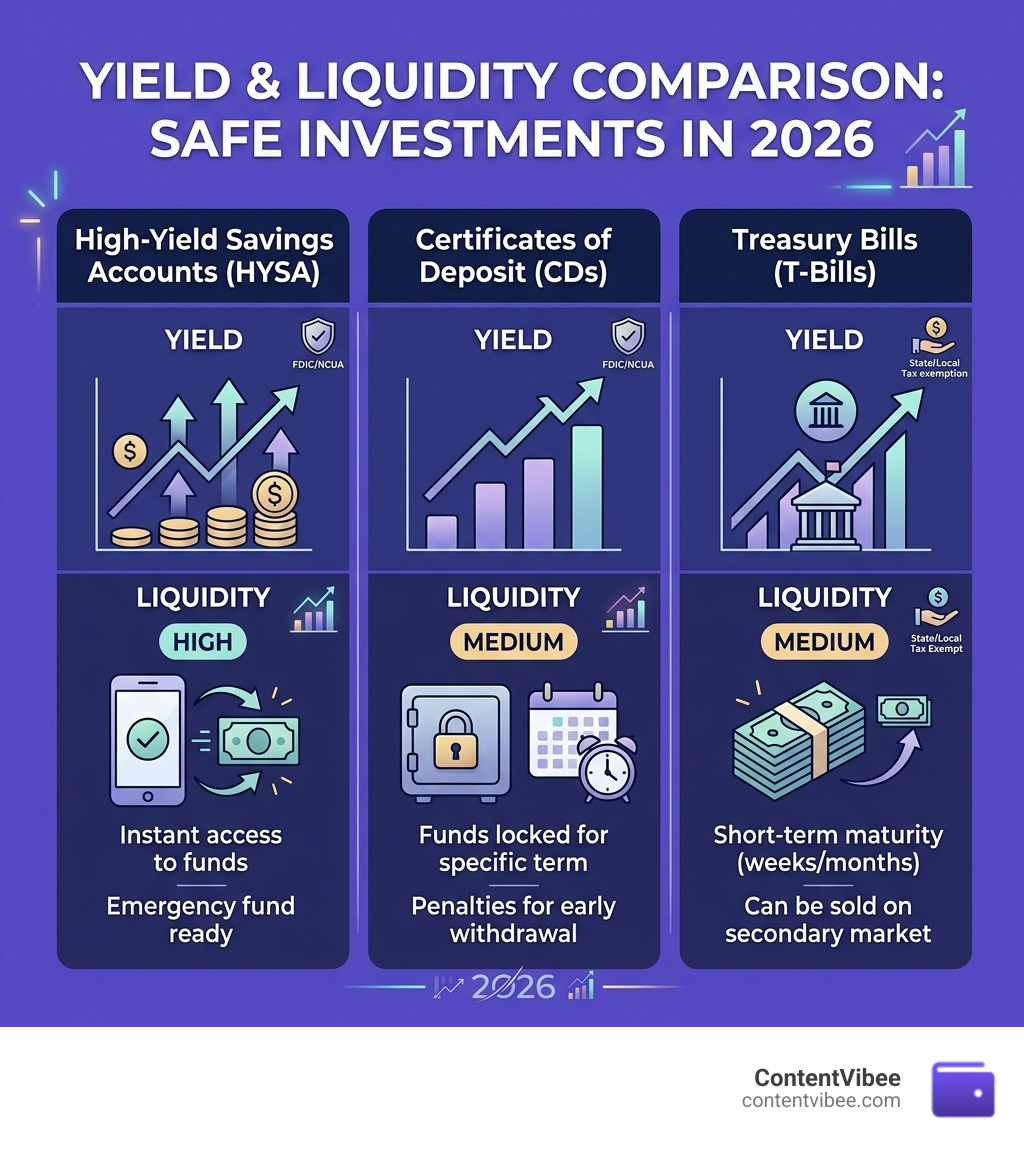
A High-Yield Savings Account (HYSA) is often the first stop for an emergency fund. These accounts are protected by the Federal Deposit Insurance Corporation (FDIC) for up to $250,000 per depositor, per institution. This means if the bank goes belly up, the government ensures you get your money back.
The beauty of a HYSA is instant liquidity. You can usually move your money to a checking account within a day or two. With high yield savings account interest rates hovering between 3% and 4% in 2026, they provide a respectable return for money you might need at a moment’s notice.
U.S. Treasury Securities and Government Backing
If you have a slightly longer timeline, Treasury securities are excellent. They come in three main flavors:
- T-Bills: Short-term (maturities of one year or less).
- T-Notes: Medium-term (2 to 10 years).
- T-Bonds: Long-term (20 to 30 years).
U.S. Treasury Bonds are particularly popular for conservative investors because they pay a fixed interest rate semiannually. In 2026, many investors use these as a “ballast” for their portfolio—when the stock market gets rocky, these bonds tend to hold their value or even rise.
For those worried about the long term, CD rates comparison matters for your savings because it helps you decide if locking in a rate for 5 years is better than the fluctuating rates of a savings account.
Hidden Risks in Conservative Portfolios
Just because an investment is “safe” doesn’t mean you can set it and forget it. We’ve seen many investors surprised by how much “safe” money can lose its edge.
How inflation impacts what is the safest investment
Inflation is the most persistent threat. If you are holding EE savings bonds, which currently offer a fixed rate of 2.70%, you are guaranteed that the bond will be worth at least its face value after 20 years. However, if the cost of living doubles in those 20 years, your “guaranteed” money won’t buy nearly as much as it used to.
To fight this, many look toward I bonds from TreasuryDirect. I bonds have a composite rate made of a fixed rate and an inflation rate that resets every six months. As of early 2026, they remain a favorite for those wanting to protect their purchasing power. You can also look into Googl Lly long term investment risk to see how even blue-chip companies carry different risks compared to government debt.
Liquidity and Early Withdrawal Penalties
Certificates of Deposit (CDs) offer great rates, but they come with strings attached. If you buy a 2-year CD and try to pull your money out after 6 months because of an emergency, you’ll likely lose several months of interest—and in some cases, a bit of your principal. Before committing, do a certificate of deposit rates comparison to find “no-penalty” options if you think you might need the cash sooner.
Protecting Your Safe Assets from Financial Fraud

In 2026, the “safest” investment can become the riskiest if your account security is compromised. We’ve seen a rise in sophisticated wire transfer fraud and unauthorized bank transactions targeting high-balance savings accounts.
Recovering from unauthorized bank transactions in 2026
If you notice an unauthorized bank transaction how to dispute and recover money USA 2026, time is of the essence. Under Regulation E, your liability for unauthorized transfers is limited, but only if you report it quickly.
- Step 1: Notify your bank immediately to freeze the account.
- Step 2: File a formal dispute within 60 days of the statement date.
- Step 3: Set up fraud alerts and credit monitoring.
For victims of identity theft credit report fraud how to fix and protect your score USA, the process involves contacting the three major credit bureaus and filing a report with the FTC. If you have been a wire transfer fraud victim what to do and recovery options USA 2026, you should know that recovery is difficult but possible through the FBI’s Internet Crime Complaint Center (IC3) and specialized financial recovery services for fraud victims USA 2026.
Implementation Strategies for Conservative Investors
Building a safe portfolio isn’t just about picking one asset; it’s about investment asset allocation strategy risk management. We recommend a “laddering” strategy for CDs and bonds. By buying bonds that mature at different times (e.g., 1-year, 2-year, and 3-year), you ensure that you always have cash becoming available at regular intervals.
Selecting what is the safest investment for retirees
For those in retirement, the goal shifts from growing wealth to not losing it. Retirees often face “sequence of returns risk”—the danger of a market crash right when they start taking withdrawals. To mitigate this, many turn to dividend-paying blue chips. While stocks are riskier than bonds, Schd dividend etf yield analysis and long term shows how steady income can provide a safety net that pure “safe” assets might lack.
Frequently Asked Questions about Safe Investing
Are money market funds FDIC insured?
No. Unlike money market accounts at a bank, money market funds are investment products typically held in brokerage accounts. While they aim to maintain a $1.00 Net Asset Value (NAV) and are considered very low-risk, they are not FDIC-insured. They are, however, covered by SIPC (Securities Investor Protection Corporation) insurance, which protects against the failure of the brokerage firm itself, not against a drop in the fund’s value.
What is the safest investment with the highest return?
This is the “Holy Grail” of investing. Generally, I-Bonds or brokered CDs currently offer the best balance. U.S. News notes that “safe” is relative; for instance, a short-term corporate bond from a AAA-rated company might pay more than a Treasury while still being exceptionally secure.
How do I dispute an unauthorized wire transfer in 2026?
The unauthorized wire transfer dispute process and recovery options USA 2026 is more complex than credit card disputes because wire transfers are often instantaneous. You must contact your bank’s fraud department immediately to initiate a “kill wire” or a recall request. If the money has already been picked up, you may need to seek wire transfer fraud recovery services and legal help USA. Utilizing financial protection tools to prevent wire fraud, such as dual-factor authentication and verbal confirmation for all transfers, is the best defense.
Conclusion
At ContentVibee, we believe that the best investment strategy is one that lets you sleep at night. While we’ve explored what is the safest investment, the truth is that your needs will change as the economy evolves.
If managing these moving parts feels overwhelming, our partners at Autopilot offer an investment app designed for the modern, self-directed investor. Autopilot provides automated portfolio management with a focus on fee transparency and risk reviews. They help you evaluate if your current “safe” assets are actually cost-worthy after accounting for management fees and inflation. Whether you are looking for more info about investment categories or ready to automate your growth, diversification is your greatest shield.
Stay safe, stay invested, and always keep an eye on the horizon.