


Are Fidelity Trading Fees Really Zero — Or Is There More to the Story?
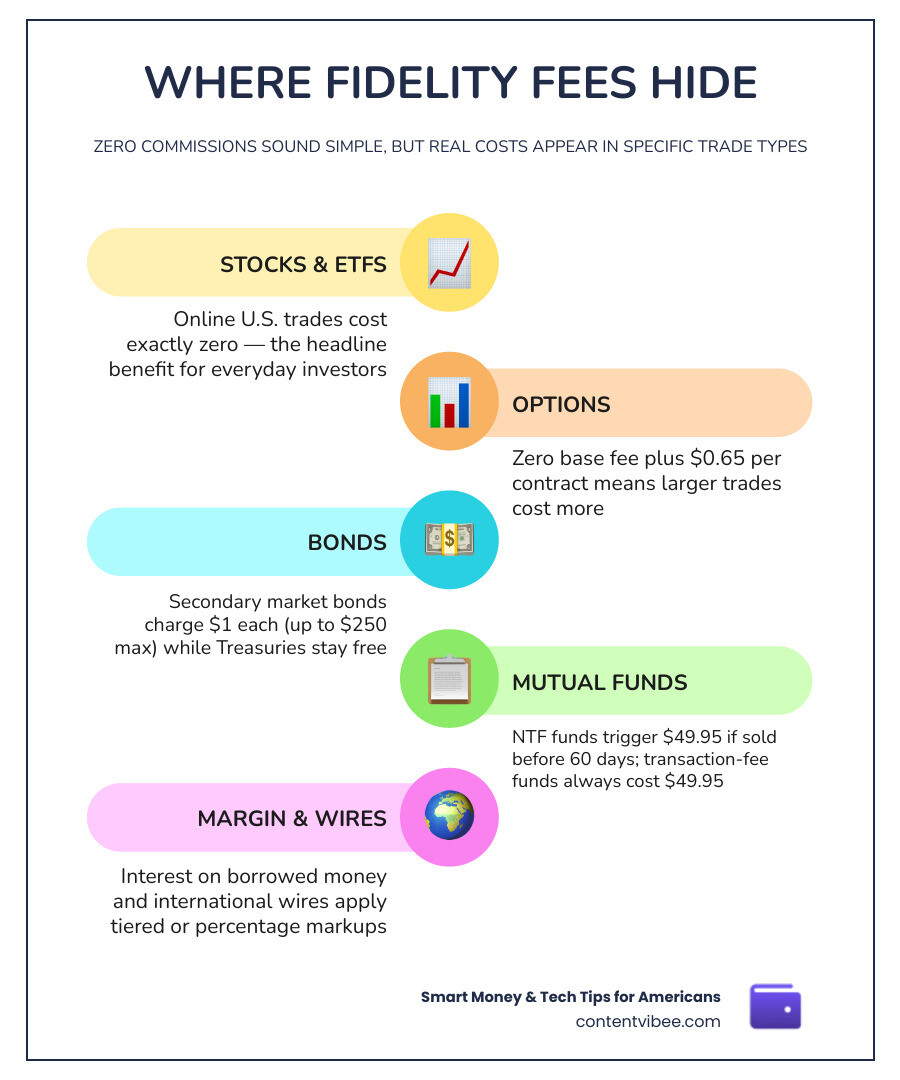
Fidelity trading fees are structured around a $0 commission model for online U.S. stock and ETF trades. Here’s a quick breakdown of what you actually pay:
| Trade Type | Online Cost |
|---|---|
| U.S. stocks & ETFs | $0 per trade |
| Options | $0 + $0.65 per contract |
| Bonds (secondary market) | $1 per bond (max $250) |
| U.S. Treasuries (online) | $0 |
| NTF mutual funds (held 60+ days) | $0 |
| NTF mutual funds (held under 60 days) | $49.95 short-term trading fee |
| Transaction-fee mutual funds | $49.95 per purchase online |
| Account service fee | $0 |
So for most everyday investors buying stocks or ETFs online — the cost really is zero.
But “free” rarely means no cost at all. It means the obvious costs are zero. There are still real fees hiding in margin rates, mutual fund rules, bond mark-ups, and international trades.
Fidelity’s own pricing page puts it plainly: the platform uses an “à la carte” model — you only pay for what you use. That sounds great. But if you don’t know what you’re using, you won’t know what you’re paying.
This guide breaks down every layer of Fidelity’s cost structure — from the genuinely free stuff to the fees that quietly chip away at your returns.
The Reality of $0 Commissions and Fidelity Trading Fees
When we talk about fidelity trading fees in May 2026, the headline is almost always the “Big Zero.” For the vast majority of retail investors, the days of paying $7 or $10 to click a “buy” button are long gone. At Fidelity, online trades for U.S. stocks and Exchange-Traded Funds (ETFs) cost exactly $0.00.
This isn’t just a marketing gimmick; it is the industry standard that Fidelity has embraced to remain competitive. Whether you are buying one share or one thousand, the commission remains zero. This also extends to fractional share trading, where you can invest in over 7,000 U.S. stocks and ETFs with as little as $1. This is a massive win for those of us practicing dollar-cost averaging on a tight budget.
However, the “free” experience depends heavily on how you trade. If you step away from the website or mobile app, the costs return. For example, using the FAST (Fidelity Automated Service Telephone) system costs $12.95 per trade, and if you need a human representative to place the trade for you, the fee jumps to $32.95.
Beyond the trade itself, Fidelity offers a unique value proposition with their “ZERO” line of index funds. These funds have a 0% expense ratio, meaning Fidelity is not even taking a small percentage of your assets to manage the fund. This level of transparency is rare, and you can dive deeper into how fee structures work in our Fidelity Cost Transparency Review.
To understand the full scope of these rules, it is always wise to consult the official Fidelity Brokerage and Commission Fee Schedule to see the fine print on regulatory offsets and specific security types.

Options Pricing and Fidelity Trading Fees
Options trading is where the “zero” starts to get some decimals attached. While there is no base commission to trade options online at Fidelity, there is a $0.65 per contract fee.
If you’re trading a single contract, it is pennies. If you are a high-volume options trader selling 100 covered calls, you are looking at $65 in fees. There is, however, a very friendly “buy-to-close” rule: if you are closing out a short option position and the price is $0.65 or less, the trade is commission-free and the per-contract fee is waived. This is a huge benefit for investors who want to clear out low-value positions to free up collateral without being nickeled and dimed.
One of the most competitive aspects of Fidelity’s options pricing is that they do not charge for exercises or assignments. If your call option gets exercised and you have to sell your shares, many brokers charge a fee for that “event.” Fidelity keeps this at $0. You can see how this fits into the broader pricing structure in the Trading Commissions and Margin Rates section of their site.
Professional Accounts and Fidelity Trading Fees
If you are not just an everyday investor but a high-volume professional, the fee structure shifts. Fidelity designates certain users as “Professional Equity Traders.” For these accounts, a commission of $0.001 per share applies (with a minimum of $0.01 per order).
This might seem like a step backward from $0, but professionals often require different execution paths and higher-speed tools. Even for these users, the goal remains Straightforward and Transparent Pricing. These fees are designed to cover the costs of institutional-grade access and order execution quality that goes beyond the standard retail experience.
Margin Rates and Fixed-Income Trading Costs
Margin is essentially a loan from the broker to buy more securities. This is one area where fidelity trading fees are very much alive and well. Fidelity uses a tiered interest rate system: the more you borrow, the lower your rate.
As of late 2025/early 2026, the base margin rate was approximately 10.575%. However, your effective rate changes based on your debit balance.
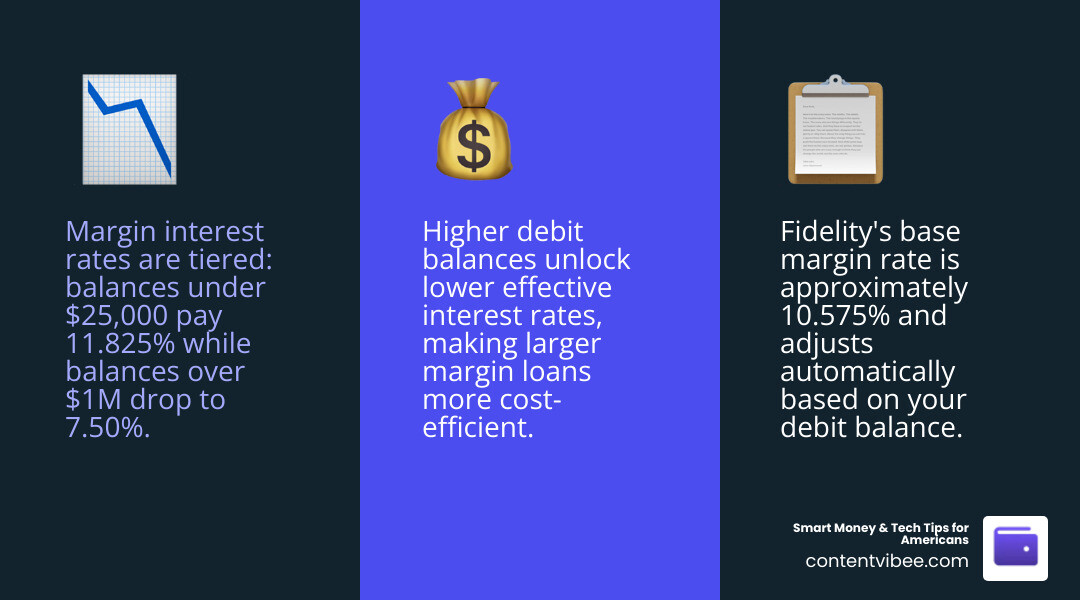
| Debit Balance | Effective Interest Rate (Approximate) |
|---|---|
| $0 – $24,999 | 11.825% |
| $25,000 – $49,999 | 11.325% |
| $50,000 – $99,999 | 10.075% |
| $1,000,000+ | 7.50% |
If you are an active trader using these margin features, Fidelity’s built-in tools will be enough for many investors, though some traders may prefer more specialized workflows. For most investors, the integrated margin tools are sufficient.
When it comes to bonds and fixed income, Fidelity is relatively affordable and transparent.
- U.S. Treasuries: $0 for online trades (new issues and secondary market).
- Secondary Market Bonds: $1 per bond (with a $19.95 minimum and $250 maximum).
Fidelity highlights mark-up transparency by showing investors what the bond costs versus what they are being charged.
Mutual Fund and International Trading Fees
Mutual funds at Fidelity are divided into two main camps: No Transaction Fee (NTF) and Transaction Fee (TF) funds.
Fidelity offers over 10,000 funds, many of which are NTF. However, there is a catch: the 60-day rule. If you buy an NTF fund and sell it within 60 days, Fidelity will hit you with a $49.95 short-term trading fee. This is designed to discourage “market timing” in funds that are meant for long-term holding.
For funds that aren’t in the NTF program (Transaction Fee funds), you’ll pay $49.95 per purchase online. If you do this via a phone representative, that fee can climb to 0.75% of the principal (up to $250). You can learn more about broader fee structures in our guide on Why Fidelity Investments Advisory Fees and how different account services are priced.
International Trading: The Global Cost
Trading stocks in foreign markets is where the “zero commission” world ends. If you want to buy a stock directly on the London or Tokyo stock exchange, you will encounter:
- Country-Specific Commissions: These vary by market.
- Currency Exchange Fees: Fidelity charges a markup on the exchange rate, which can be up to 1% for amounts under $100,000.
- Foreign Transaction Taxes: Some countries (like France or Italy) charge a small percentage tax on every purchase.
For those who don’t want to deal with international exchanges, you can often buy “Foreign Ordinary” shares (symbols ending in ‘F’) on the U.S. over-the-counter market. While these are “dollarized,” they sometimes carry a $50 fee if the security isn’t eligible for standard U.S. clearing.
Lastly, always be aware of account security. While you’re looking at fees, don’t forget to protect your assets; read up on Why the Fidelity Investment Login Security Breach concerns led to new security protocols.

Frequently Asked Questions about Brokerage Costs
What is the short-term trading fee for mutual funds?
The short-term trading fee is a $49.95 charge applied when you sell shares of a No Transaction Fee (NTF) fund that you have held for less than 60 days. This fee applies to online trades; if you sell through a representative, the cost is even higher. It is important to note that this fee does not apply to Fidelity’s own funds or money market funds.
Are there fees for wire transfers or account closures?
Fidelity is aggressive about keeping many common account fees at $0.
- Account Closures/IRA Closeouts: $0.
- Domestic Bank Wires: $0 (Fidelity doesn’t charge, though your receiving bank might).
- Electronic Statements: $0.
- Annual Account Service Fees: $0.
For a full breakdown, see our Why the Fidelity Investments Fees Comparison article.
How do margin interest rates work?
Margin rates are calculated by taking a Base Rate (which was 10.575% in late 2025) and either adding or subtracting a percentage based on your loan size. For small balances, you pay the base plus a premium. For very large balances (over $1 million), you pay the base minus a discount, leading to an effective rate of around 7.50%. Interest is calculated daily and charged monthly to your account.
Conclusion
At Smart Money & Tech Tips for Americans, we believe that understanding fidelity trading fees is the first step toward true financial literacy. Fidelity’s “à la carte” model is genuinely one of the most investor-friendly in the U.S. market today, especially for those who stick to online trading of stocks, ETFs, and Treasuries.
By eliminating account minimums, wire fees, and closure fees, Fidelity has made it remarkably easy to start investing. However, as we’ve explored, costs still exist in the “specialty” corners of the market—short-term fund trading, international stocks, and margin interest.
If you are a buy-and-hold investor using index funds and domestic stocks, Fidelity is as close to “free” as the industry gets. If you are an active margin trader or a global investor, those small percentages and $0.65 contracts will add up.
Stay informed, stay skeptical of “free,” and always check the fee schedule before trying a new investment strategy. Learn more about brokerage firm investment fees and account management to ensure your portfolio stays optimized for growth, not for paying fees.


