


What Is a Separately Managed Accounts Fee Structure — and Why It Matters
Understanding the separately managed accounts fee structure is the first step to knowing whether you’re getting a fair deal — or quietly losing returns to fees you didn’t fully understand.
Here’s a quick snapshot of what you’ll typically pay:
| Fee Type | Typical Range |
|---|---|
| Advisory / Wrap Fee | 1.00% – 3.00% of AUM annually |
| SMA Manager Fee | 0.00% – 0.45% per year |
| Fidelity Gross Advisory Fee | 0.20% – 0.70% per year |
| Platform Fee (e.g. Edward Jones) | 0.00% – 0.05% per year |
| Minimum Investment | $100,000 – $250,000+ |
The short answer: SMA fees are usually higher than mutual funds or ETFs on paper. But they can offer real value through tax savings, direct ownership, and portfolio personalization — if your account is large enough to benefit.
A separately managed account (SMA) is a professionally managed portfolio made up of individual securities that you actually own directly. Unlike a mutual fund, where your money is pooled with thousands of other investors, an SMA holds stocks or bonds in your name.
That distinction matters more than it sounds. It means your portfolio can be personalized — around your tax situation, your values, even specific companies you want to avoid.
But that personalization comes at a cost. And for busy investors already frustrated by fees eating into returns, it’s worth knowing exactly what you’re paying — and whether it’s worth it.
Breaking Down the Separately Managed Accounts Fee Structure
When we talk about the separately managed accounts fee structure, we aren’t just looking at one single number. Because SMAs provide a high level of service—including professional management, trading, and often financial planning—the fees are often “wrapped” into a single percentage of your assets under management (AUM).
As of May 2026, the industry standard for a “wrap fee” typically ranges from 1% to 3%. While that might sound like a lot compared to a dirt-cheap ETF, it’s important to remember what’s inside that wrap. It usually covers the advisor’s advice, the cost of the trades, and the institutional manager’s expertise.
To see how these are legally disclosed, you can look at documents like the Form ADV Wrap Fee Program Brochure Morgan Stanley Smith Barney LLC. These brochures are the “instruction manuals” for your fees. They tell you exactly who gets paid and for what.
We always recommend Understanding Wealth Management Fees before signing on the dotted line. If you don’t know the difference between a custodial fee and an advisory fee, you might be in for a surprise when your quarterly statement arrives. Furthermore, Why Brokerage Firm Investment Fees and Account structures vary so much is often down to the level of “discretion” you give the firm—meaning, do they ask you before every trade, or do they have the green light to manage it for you?
Components of a Separately Managed Accounts Fee Structure
If we peel back the layers of an SMA, we usually find three main “engine parts” that make up the total cost:
- The Program Fee: This is what the firm (like Edward Jones or Charles Schwab) charges to provide the “pipes” for the account. It covers things like account statements, technology, and the financial advisor’s time.
- The Platform Fee: This is a smaller slice that covers the administrative costs of the specific investment platform being used.
- The SMA Manager Fee: This goes to the institutional “brain” actually picking the stocks or bonds. For example, if you have a “Large Cap Growth” SMA, this fee pays the specialists who spend all day analyzing those specific companies.
According to the Edward Jones Advisory Solutions® Unified Managed Account (“UMA”) Models Schedule of Fees, these fees are often tiered. For the first $250,000, you might pay a program fee of 1.35%. But as your wealth grows—say, over $10 million—that fee can drop to as low as 0.50%. The manager fees themselves are quite reasonable, usually ranging from 0.00% to 0.45% depending on the strategy.
Learning How to Read a Financial Planning Fee Based statement is a superpower. It allows you to see if your manager is earning their keep or if the platform fees are slowly nibbling away at your retirement dreams.
How Strategy and Asset Class Impact Your Separately Managed Accounts Fee Structure
Not all SMAs are created equal. If you’re looking for a simple “Index SMA” that just mimics the S&P 500 but allows for some tax-loss harvesting, you’re going to pay a lot less than if you want a “High Yield Municipal Bond” strategy that requires constant, active oversight.
At Fidelity, for instance, gross advisory fees range between 0.20% and 0.70%. The exact number depends on how much you’ve invested and which strategy you’ve picked. Generally, equity (stock) strategies are cheaper to manage than fixed-income (bond) strategies because the bond market is more complex and less liquid.
When we look at Why the Fidelity Investments Fees Comparison is so popular, it’s because it shows that even within one firm, your costs can vary wildly. A “Core Bond Strategy” might have a different minimum and fee than an “International Growth” strategy.
To keep these costs from spiraling, many investors use a Why Portfolio Risk Management Tool to ensure they aren’t paying for overlapping strategies. There’s no point in paying two different SMA managers to buy the same tech stocks!
Comparing SMA Costs to Mutual Funds and ETFs
This is where the rubber meets the road. If you can buy an S&P 500 ETF for an expense ratio of 0.03%, why on earth would you pay 1.50% for an SMA?
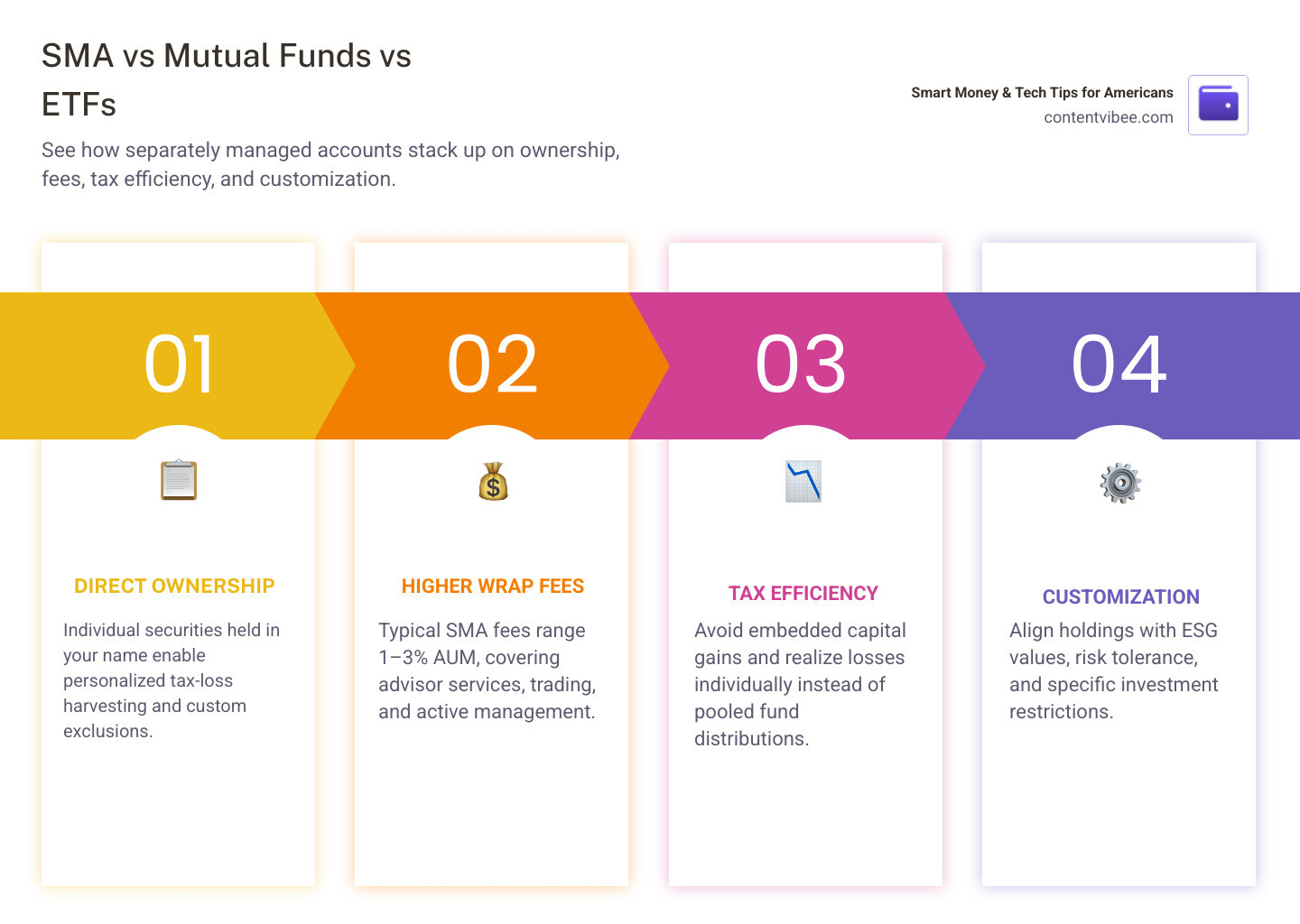
The answer isn’t in the gross fee; it’s in the net result. Mutual funds and ETFs are “pooled” vehicles. This means if the fund manager sells a stock for a gain, every shareholder gets hit with a capital gains distribution—even if you just bought the fund yesterday! This is known as “embedded capital gains,” and it’s a hidden tax that can significantly lower your actual returns.
In an SMA, you have direct ownership. If the manager sells a stock at a gain, they can often look for another stock in your portfolio that has a loss and sell it to “offset” that gain. This is called tax-loss harvesting, and it’s something mutual funds simply can’t do for you on an individual basis.
| Feature | Separately Managed Account (SMA) | Mutual Fund | ETF |
|---|---|---|---|
| Typical Fee | 1.00% – 3.00% (Wrap) | 0.50% – 1.50% (Expense Ratio) | 0.05% – 0.50% (Expense Ratio) |
| Ownership | Direct (You own the stocks) | Indirect (You own fund shares) | Indirect (You own fund shares) |
| Tax Efficiency | High (Individual tax-loss harvesting) | Low (Capital gains distributions) | Medium (Generally tax-efficient) |
| Customization | High (Can exclude stocks/sectors) | None | None |
| Minimums | High ($100k – $250k+) | Low ($1 – $3,000) | Very Low (Price of 1 share) |
Choosing the right vehicle depends on your goals. Why Choosing the Right Investment Portfolio involves looking at your tax bracket. If you’re in a high tax bracket, the 1% fee for an SMA might actually be “cheaper” than the tax bill from a mutual fund. We also explore this in Why Choosing the Right Portfolio Management—it’s about matching the tool to the job.
Evaluating the Value of Tax Management and Customization
Is the separately managed accounts fee structure “fair”? That depends on how much you value the “extra” stuff.
Imagine you’re an executive at a major tech company. You already have $2 million in company stock. If you buy a standard “Tech Mutual Fund,” you’re just doubling down on your risk. In an SMA, you can tell your manager, “Build me a growth portfolio, but exclude my employer’s stock.” You can’t do that with a mutual fund.
Then there’s the tax-loss harvesting. In an SMA, this happens year-round, not just in December. If a stock dips in March, the manager can sell it, realize the loss for your tax return, and buy a similar (but not identical) stock to keep your market exposure. Over a decade, this “tax alpha” can potentially add 0.50% to 1.00% to your annual net returns.
As noted in Separately Managed Accounts: A Comprehensive Analysis of … – Vestr, this level of control is why high-net-worth individuals flock to these accounts. It’s the difference between buying a suit off the rack (Mutual Fund) and having one custom-tailored to your exact measurements (SMA).
However, if you don’t have a complex tax situation, Why Managing Your Portfolio Manually or sticking to low-cost ETFs might be the smarter financial move. Don’t pay for a tailor if a standard size fits you perfectly!

How to Determine if an SMA is Right for Your Portfolio
So, are you the right candidate for an SMA? Usually, it comes down to two things: your account size and your need for control.
Most SMAs have a “barrier to entry.” At Fidelity, for example, the minimum investment ranges from $100,000 to $250,000 depending on the strategy. Other institutional managers might require $500,000 or even $1 million. Why? Because it’s hard to build a diversified portfolio of individual stocks with only $10,000. You’d end up owning two shares of Apple and one share of Amazon, which isn’t exactly “diversified.”
If you’re just starting out, Is Automated Portfolio Management Right for You might be a better question to ask. Robo-advisors offer some tax-loss harvesting for much lower fees, though they lack the deep customization of a human-managed SMA. You can read more about this in our Why Robo-Advisor Fees Comparison Matters guide.
Generally, we see the “break-even” point for an SMA at around $250,000. At that level, the tax benefits and the ability to customize your holdings start to outweigh the higher separately managed accounts fee structure.
Frequently Asked Questions about SMA Fees
What is the typical minimum investment for an SMA in 2026?
As of May 2026, the standard minimum is $100,000 for equity-based strategies and $250,000 for fixed-income (bond) strategies. Some “mini-SMAs” or digital versions are popping up with $50,000 minimums, but for a true, custom-managed institutional experience, expect to need at least a quarter-million dollars.
Are SMA fees negotiable for larger accounts?
Absolutely! This is one of the best-kept secrets in the industry. While mutual fund expense ratios are set in stone, SMA fees are often negotiable, especially if you have more than $1 million. Firms often use “tiered fee schedules,” meaning the more you invest, the lower your percentage. We discuss how software helps manage these complex arrangements in Why Investment Manager Software Fees.
Do SMAs have hidden costs beyond the advisory fee?
They can. While a “wrap fee” is supposed to cover everything, you should always check for “step-out trades.” This is when an SMA manager executes a trade through a different broker, which might result in extra commissions. You should also watch for custodial fees if your assets are held at a third-party bank. Even Why Credit Union Investment Services Fees differ is often down to these small, administrative “add-ons.” Always ask for a “Total Cost of Ownership” (TCO) estimate.
Conclusion
At Smart Money & Tech Tips for Americans, we believe that transparency is the best investment you can make. The separately managed accounts fee structure isn’t inherently “bad” or “expensive”—it’s simply a different pricing model for a more sophisticated service.
If you have a high net worth, a complex tax situation, or specific ethical requirements for your portfolio (like avoiding tobacco or weapons manufacturers), the 1% to 2% you pay for an SMA can be one of the best values in finance. You get professional oversight, direct ownership, and a tax bill that is optimized for your life, not the life of a random person in a mutual fund pool.
However, if you’re looking for the lowest possible cost and don’t care about customization, stick with ETFs. The key is knowing what you’re paying for. Before you make your next move, consider the debate of Why Asset Management vs Investment Management to decide which level of service fits your current wealth stage.
Remember: in investing, you don’t always get what you pay for—you get what you keep after fees and taxes. Make sure your SMA is helping you keep as much as possible!


