


What Is a Whiplash Injury Settlement Worth?
A whiplash injury settlement can range from roughly $2,500 to $10,000 for many mild or moderate claims, while cases involving lasting pain, extensive treatment, lost income, or clear complications may reach $30,000 to $100,000 or more.
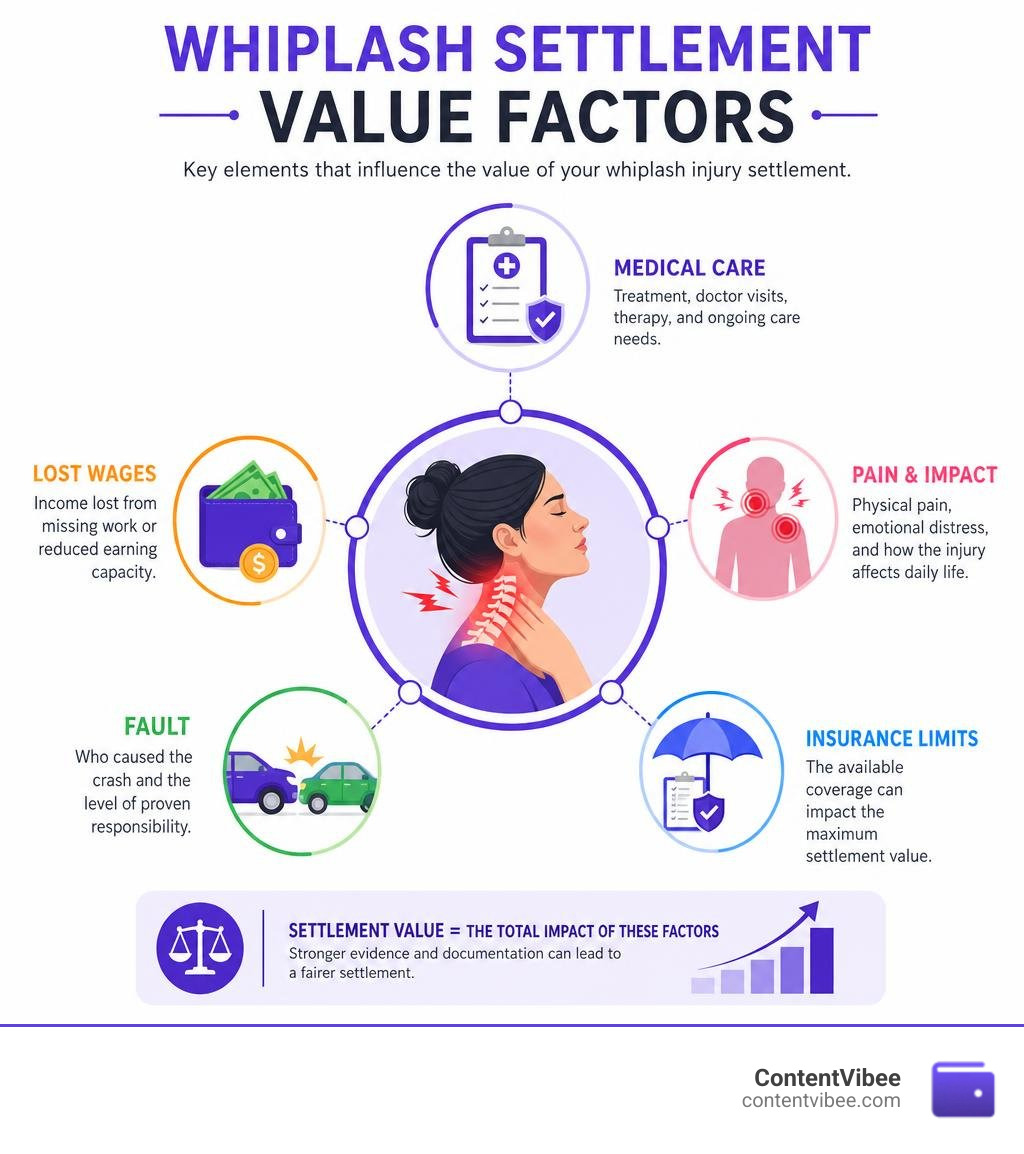
The actual value depends on the proof behind the claim, not just the crash itself. Medical records, fault, treatment needs, time away from work, insurance coverage, and the effect on daily life all matter.
Whiplash is common after a rear-end collision, when the head and neck snap forward and back. It is often called a “soft tissue” injury, but that label does not mean the injury is minor or that compensation is unavailable. Neck pain, headaches, stiffness, dizziness, and limited movement can disrupt work and family life for months. About half of people with whiplash report symptoms lasting longer than a year.
This guide explains what a reasonable settlement may look like, how insurers judge these claims, and what can help protect the value of your case.
Understanding Whiplash Injuries and Medical Symptoms
Whiplash, known medically as a cervical strain) or sprain, occurs when rapid acceleration-deceleration forces whip the neck back and forth. Rear-end collisions account for roughly 80% of all whiplash injuries, though side impacts and chain-reaction crashes can trigger them as well. Interesting epidemiological data shows that women are 1.5 to 3 times more likely to suffer whiplash in similar collisions due to differences in neck muscle architecture and seat design dynamics.
Common symptoms include:
- Neck pain, stiffness, and reduced range of motion
- Sharp or dull headaches starting at the base of the skull
- Shoulder, upper back, or arm soreness
- Numbness, tingling, or “pins and needles” in the hands
- Dizziness, fatigue, and sleep disturbances
- Difficulty concentrating or memory issues (often tied to whiplash-associated disorders)
One tricky aspect of a whiplash injury settlement is that symptoms rarely peak at the scene of the accident. Adrenaline floods your body during a crash, masking pain. It often takes 24 to 72 hours—and sometimes up to a week—for inflammatory responses to set in and reveal the true extent of the neck strain.
When you seek medical care, doctors use physical examinations, range-of-motion testing, and diagnostic tools like X-rays, CT scans, or MRIs. While soft tissue damage does not show up on a basic X-ray (which only shows bones), MRIs can highlight soft tissue swelling, disc herniations, or ligament tear details.
Soft Tissue Injuries vs Chronic Damage
Insurers love to throw around the phrase “it’s just a soft tissue injury” to downplay your pain. Soft tissue refers to muscles, tendons, and ligament sprains. Mild soft tissue strains heal within 4 to 8 weeks with conservative care like rest, ice, physical therapy, and anti-inflammatory medications.
However, whiplash isn’t always temporary. Approximately 50% of whiplash victims experience persistent pain or chronic symptoms lasting more than one year post-accident. When trauma damages neck ligaments or irritates cervical nerve roots, it can result in chronic pain, bulging discs, or permanent mobility limits. Long-term treatment may require epidural steroid injections, radiofrequency ablation, or months of specialized physical therapy. A severe, chronic case shifts your whiplash injury settlement into a much higher compensation tier because it impacts your future earning potential and quality of life.
Immediate Steps After an Accident to Protect Health and Claims
What you do in the hours and days following a crash directly impacts both your physical recovery and your financial payout. To protect your rights, follow this action sequence:
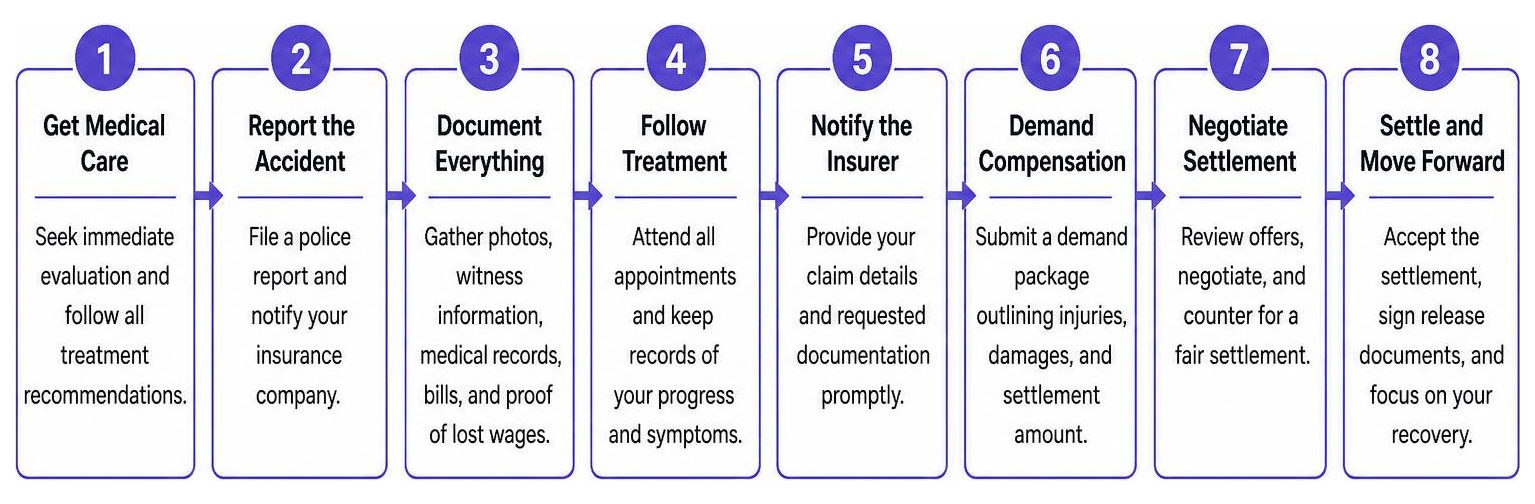
Here is a checklist of essential documentation we recommend keeping:
- Medical Records: ER reports, primary care visit summaries, physical therapy attendance records, and diagnostic imaging reports.
- Financial Paperwork: Itemized medical bills, pharmacy receipts, and proof of lost wages from your employer (pay stubs or tax records).
- Accident Scene Evidence: Photos of car damage, skid marks, road conditions, and contact details of driver and eyewitnesses.
- Symptom Journal: A daily log detailing your pain scores (1 to 10), sleep quality, missed work hours, and daily activities you cannot perform.
Key Factors That Determine a Whiplash Injury Settlement
Why does one person receive $5,000 while another receives $75,000 for a neck injury? No two accidents are identical, and insurance adjusters weigh several core variables:
- Clear Proof of Liability: If the fault of the other driver is uncontested (such as a rear-end hit at a red light), settlement discussions move faster. If liability is shared, comparative negligence laws in your state may reduce your settlement proportionately.
- Severity and Duration of Injury: Objective medical evidence showing disc herniations or muscle spasms commands higher compensation than subjective complaints of general soreness.
- Total Financial Losses (Economic Damages): Higher past and future medical bills, coupled with significant lost income, naturally push the baseline valuation higher.
- Insurance Policy Limits: Compensation is usually capped by the fault driver’s auto liability limits. If the at-fault driver carries a state minimum policy of $25,000 and has no personal assets, recovering more than that limit can be difficult unless you carry Underinsured Motorist (UIM) coverage.
Typical Whiplash Injury Settlement Ranges
Nationwide, whiplash injuries generate nearly 1.5 million auto insurance claims every year, costing the U.S. insurance industry an estimated $8.5 billion in medical expenses and lost output. Based on nationwide data in 2026, here is how typical settlement brackets break down:
| Injury Severity | Typical Medical Profile | Average Settlement Range |
|---|---|---|
| Mild Whiplash | Minor muscle strain, 2–4 weeks of treatment, full recovery. | $2,500 – $10,000 |
| Moderate Whiplash | Ligament sprain, physical therapy needed for 2–4 months, temporary lost work. | $10,000 – $30,000 |
| Severe / Chronic Whiplash | Disc herniation, nerve impingement, symptoms lasting over 12 months, ongoing injections or therapy. | $30,000 – $100,000+ |
Impact of Pre-Existing Conditions on Settlement Value
If you had prior neck trouble, arthritis, or a previous auto crash, insurance companies will attempt to use your medical history against you. Their favorite defense is arguing that your current pain is merely a pre-existing strain rather than a direct outcome of the new collision.
However, the law incorporates the “Eggshell Skull Rule.” Under this doctrine, the at-fault party takes the victim as they find them. If a collision aggravates or worsens a pre-existing condition, you are legally entitled to compensation for the additional pain and increased treatment required. Detailed medical records showing your baseline health before the crash versus your diminished state afterward are critical to overcoming causation defenses.
How to Calculate Your Whiplash Claim Value
Calculating a payout involves adding your direct financial losses (economic damages) to your non-physical losses (non-economic damages).
Economic damages include:
- Emergency room fees and ambulance transport
- Doctor visits, chiropractic adjustments, and physical therapy
- Diagnostic imaging (MRIs, X-rays)
- Prescription pain medications and neck braces
- Past lost wages and loss of future earning capacity
To jumpstart your financial calculations, you can explore our interactive Neck Injury Settlement Calculator or run broader figures through our Personal Injury Settlement Calculator.
The Multiplier Method for Non-Economic Damages
Placing a cash figure on pain, suffering, emotional distress, and loss of enjoyment of life is inherently subjective. The most popular calculation framework used by insurance adjusters and lawyers is the Multiplier Method.
Under this framework, your total economic damages (medical bills + lost wages) are multiplied by a number typically ranging between 1.5 and 5, depending on injury severity:
- 1.5 to 2.0: Mild soft tissue whiplash fully healed within weeks.
- 2.5 to 3.5: Moderate whiplash requiring months of therapy with clear impact on work and lifestyle.
- 4.0 to 5.0+: Chronic pain, permanent disc damage, or surgical intervention.
For an in-depth breakdown of how this formula functions in real-world negotiations, check out our guides on How The Multiplier Method Decides Your Accident Payout and Cracking The Code The Real Formula For Pain And Suffering Settlements.
Using Online Tools to Estimate Your Whiplash Injury Settlement
While software formulas give you a great baseline, every claim carries unique wrinkles. Online calculators take your medical totals, wage logs, and estimated pain levels to generate realistic ranges.

To see how your specific numbers stack up across different crash profiles, try utilizing our Car Accident Settlement Calculator alongside our Realistic Settlement Calculator.
Navigating Insurance Adjusters, Lawyers, and Negotiations
Insurance adjusters are not your friends. Their job performance is evaluated on how efficiently they minimize insurance payouts. When evaluating whiplash claims, adjusters routinely employ Colossus or similar computer valuation software. These programs input medical codes and downplay subjective pain ratings.
Common adjuster tactics include:
- Offering early lowball settlements: Pushing a $1,500 cash offer within days of the accident before you fully understand your injury.
- Requesting recorded statements: Tricking you into saying “I’m feeling okay today,” which they later use to claim you are fully healed.
- Delaying claim processing: Dragging out communication in hopes that financial pressure makes you desperate enough to settle cheap.
To safeguard your rights during initial conversations, consult our comprehensive Car Accident Settlement Guide 2026.
Role of a Personal Injury Lawyer in Claim Negotiations
If your injury is minor and resolves in three weeks, you may manage the claim on your own. However, if your medical bills exceed a few thousand dollars, if liability is contested, or if symptoms persist, having legal counsel can significantly increase your recovery amount.
A attorney helps by:
- Gathering medical evidence, expert opinions, and accident reconstruction reports
- Blocking aggressive insurance adjuster communications
- Accurate valuation of future medical requirements
- Negotiating aggressively and filing a formal lawsuit if initial offers remain unfair
To learn how attorney involvement shapes claim outcomes, review our Personal Injury Lawyers Complete Guide.
Attorney Fees and Contingency Percentages
Most personal injury attorneys work on a contingency fee basis. This means you pay zero dollars upfront or out of pocket. Instead, your attorney receives an agreed-upon percentage of your final financial settlement or trial award.
Typical contingency structures usually follow these industry averages:
- 33.3% (One-Third): Standard rate if your claim settles out of court before a lawsuit is filed.
- 40%: Standard rate if your case goes into formal litigation or trial.
To evaluate whether hiring legal representation makes financial sense for your situation, read our articles on How Much Does A Personal Injury Lawyer Charge and Demystifying Personal Injury Lawyer Fees And Contingency Percentages.
Frequently Asked Questions About Whiplash Claims
How Long Does It Take to Settle a Whiplash Claim?
A straightforward mild whiplash claim often settles within 3 to 6 months after your medical treatment finishes. However, moderate to severe chronic cases can take 12 to 24 months to resolve. You should never settle a claim until you reach Maximum Medical Improvement (MMI)—the point where your doctor confirms you are fully healed or that your condition has stabilized as much as it ever will. Settle too early, and you cannot ask for more money if you need future physical therapy or surgery.
Can I Get a Settlement for a Soft Tissue Whiplash Injury?
Yes, absolutely. Soft tissue injuries are legitimate injuries that cause severe pain and disruption. The key to securing compensation lies in establishing objective medical documentation. Regular doctor visits, physical therapy chart notes, daily prescription records, and consistent treatment histories prove to the insurer that your soft tissue injury is genuine and impacting your daily life.
What Is the Difference Between Settling and Going to Trial?
Over 95% of personal injury cases end in an out-of-court settlement. Settling means accepting a guaranteed sum of money from the insurance company in exchange for signing a liability release. Going to trial means presenting your case to a judge or jury; while a jury verdict could net a higher payout, it carries risk, takes significantly longer, and incurs substantial court and expert witness costs.
Conclusion
A whiplash injury settlement is designed to restore stability after an unexpected collision disrupts your health, work, and finances. Whether your neck pain subsides in a few weeks or lingers for months, understanding how insurance companies value claims ensures you do not settle for less than you deserve. Take control of your recovery by seeking immediate medical care, keeping thorough records, and calculating your damages accurately.
If you are navigating a complex claim, dealing with uncooperative adjusters, or seeking maximum financial recovery, explore our detailed Car Accident Lawyers Complete Guide to find the right legal partner for your journey.


