


SCHD Dividend ETF Yield Analysis and Long Term Income Strategy is one of the most searched topics among self-directed investors looking for reliable, growing income without handing control to expensive fund managers.
Here is a quick snapshot of what you need to know:
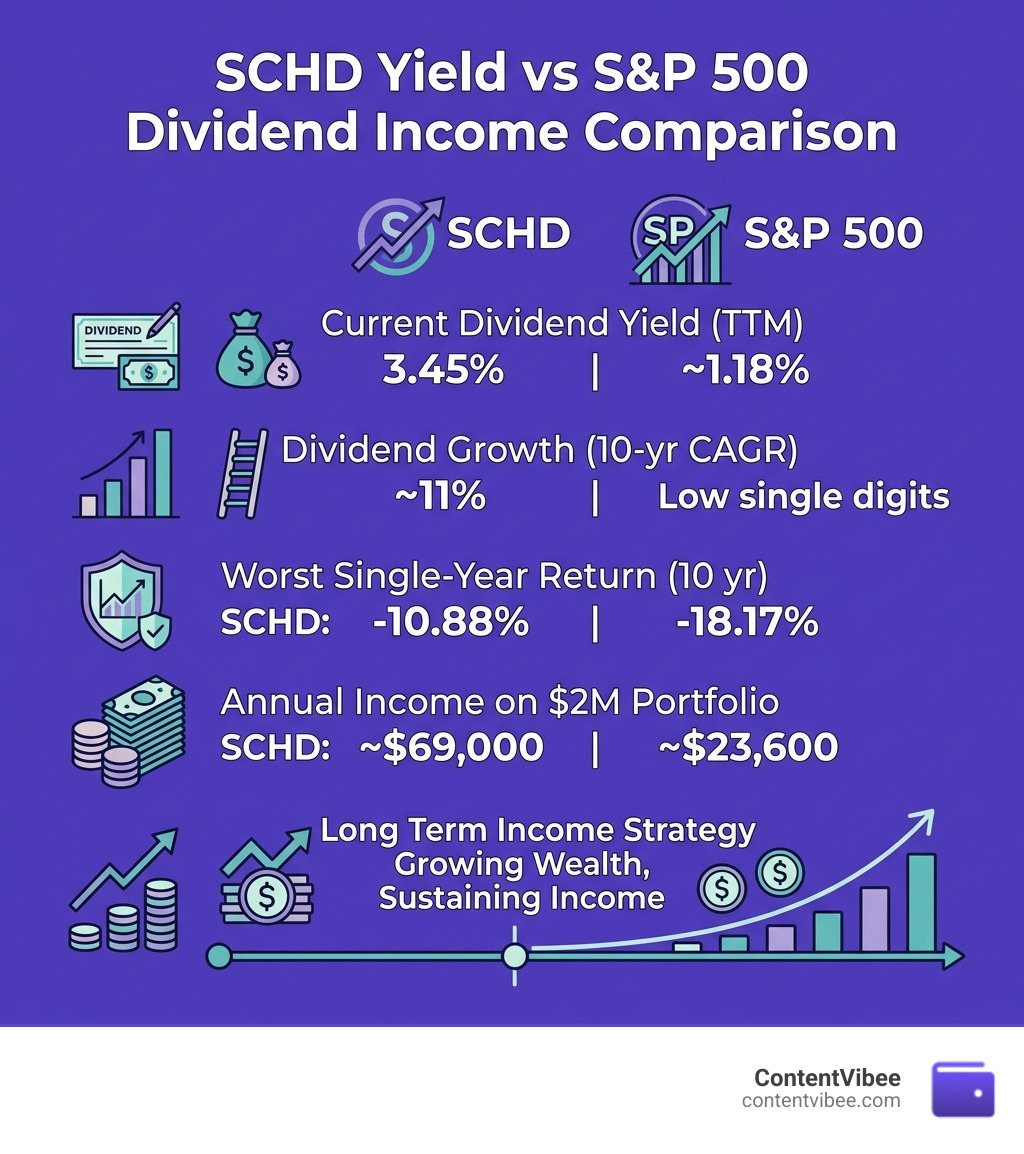
| Metric | SCHD | S&P 500 |
|---|---|---|
| Current Dividend Yield (TTM) | 3.45% | ~1.18% |
| 10-Year Annualized Total Return | 12.37% | ~12-14% |
| Expense Ratio | 0.06% | ~0.03% (VOO) |
| Worst Single-Year Return (10 yr) | -10.88% | -18.17% |
| Dividend Growth (10-yr CAGR) | ~11% | Low single digits |
| Annual Income on $2M Portfolio | ~$69,000 | ~$23,600 |
The short answer: SCHD offers roughly triple the dividend yield of the S&P 500, a proven 11% dividend growth rate over the past decade, and significantly better downside protection — all for just 0.06% per year in fees.
But yield alone does not tell the full story.
SCHD tracks the Dow Jones U.S. Dividend 100 Index, which screens companies on quality factors like return on equity, cash flow strength, and five-year dividend growth. That means you are not just chasing high yield — you are buying financially strong businesses that grow their payouts over time.
The fund currently holds $87.5 billion in assets (as of April 2026), has raised its dividend every year since 2011, and just completed a major reconstitution that added faster-growing names like UNH, ABT, and QCOM.
For investors worried about high fees, lack of control, or capital loss, SCHD’s structure addresses each concern directly — but it does come with trade-offs worth understanding before you commit.
This guide walks through everything: current yield data, how the index selects holdings, downside risks, and how to build a real income strategy around SCHD.
SCHD Dividend ETF Yield Analysis and Long Term Income Strategy

When we dive into a SCHD Dividend ETF Yield Analysis and Long Term Income Strategy, we have to look past the ticker price. As of April 2026, SCHD’s current dividend yield sits at a healthy 3.45% (TTM). For those of us watching the daily fluctuations, the 30-day SEC yield is slightly lower at 3.33%, reflecting the most recent income generated by the portfolio after expenses.
Historically, SCHD has maintained a yield range between 3% and 4%. This is a significant “yield spread” over the broader market. While the S&P 500 often struggles to break past a 1.3% yield, SCHD provides a consistent cash flow engine. However, the real magic isn’t just the starting yield; it’s the sustainability. According to recent SCHD: Tops Dividend Competitors On Value, Yield, And Sustainability analysis, SCHD outclasses many peers by focusing on companies that don’t just pay dividends, but have the balance sheet strength to keep paying them during a recession.
We often get asked how this fits into a broader portfolio. When Understanding Traditional Vs Alternative Investments, it’s clear that SCHD acts as a “bridge” asset—it offers the growth potential of traditional equities with the income characteristics often sought in alternative or fixed-income spaces.
Comparative SCHD Dividend ETF Yield Analysis
How does SCHD stack up against the other “Big Three” dividend ETFs?
- VYM (Vanguard High Dividend Yield): VYM usually offers a similar or slightly lower yield (around 2.8% – 3.1%). However, VYM is much broader, holding over 400 stocks. SCHD is more concentrated (approx. 100 stocks), which has historically led to higher dividend growth rates.
- DGRO (iShares Core Dividend Growth): DGRO focuses on dividend growth rather than high current yield. Its yield often hovers around 2.3% – 2.5%. While DGRO is great for younger investors, SCHD provides more immediate “spendable” cash.
- VIG (Vanguard Dividend Appreciation): VIG is the “quality king” but pays a meager yield, often near 1.8%. We find that VIG is often too conservative for those needing to replace a salary.
Methodology and Quality Screens of the Dow Jones U.S. Dividend 100 Index
The secret sauce of SCHD is its underlying index. It doesn’t just pick the 100 highest-yielding stocks—that would lead to “yield traps” (companies with high yields only because their stock price is crashing). Instead, it uses a multi-step quality filter.
Before any stock is considered, it must have at least 10 consecutive years of dividend payments. From there, the index ranks stocks based on four fundamental pillars:
- Free Cash Flow to Total Debt: Can the company pay its bills?
- Return on Equity (ROE): Is the management efficient with shareholder money?
- Dividend Yield: Does it pay enough to be worth our time?
- 5-Year Dividend Growth Rate: Is the paycheck getting bigger?
This rigorous approach is why Why Investment Calculator Accuracy And Financial planning is so critical. If you assume a 10% growth rate and the fund only delivers 5%, your retirement math breaks. SCHD’s methodology aims to keep that growth predictable.
Top Holdings and Reconstitution Impact
Every March, the fund goes through a “reconstitution.” It’s like a spring cleaning for your portfolio. In the 2026 rebalancing, we saw some massive moves. High-flying energy names that saw their yields drop (because their prices went up too much) were swapped for “beaten-down” quality names.
Current top holdings include:
- UnitedHealth Group (UNH): A massive addition that brings stability and high dividend growth.
- Abbott Laboratories (ABT): A “Dividend King” with over 50 years of increases.
- Qualcomm (QCOM): Providing a tech-sector tilt without sacrificing yield.
The portfolio turnover rate currently sits at 44.10%. While that sounds high, it ensures the fund isn’t holding onto “dead wood.” By capping any single sector at 25% and any single stock at 4%, the fund avoids becoming over-concentrated in volatile areas like Energy or Financials.
Risk Management: Protecting Your Portfolio from Financial Loss and Volatility

No investment is risk-free. Even with a SCHD Dividend ETF Yield Analysis and Long Term Income Strategy, you must be aware of “interest rate sensitivity.” When the Fed keeps rates high (around 3.5% – 3.75% as we see in early 2026), dividend stocks can sometimes underperform because investors can get a “safe” 4% from a Treasury bond.
However, SCHD provides “downside protection” that bonds can’t match. In the last decade, SCHD’s worst year was a loss of -10.88%, while the S&P 500 took a much harder hit of -18.17%. This is because dividend-paying companies tend to be more mature and less volatile.
We also have to consider the risk of “unauthorized bank transaction how to dispute and recover money USA 2026” scenarios in our broader financial lives. While SCHD protects your market value, you still need robust digital security. Some investors ask, Is Whole Life Insurance A Good Investment for protection? While insurance has its place, SCHD is generally a superior tool for wealth accumulation and inflation-beating income.
Strategic Projections: Executing a SCHD Dividend ETF Yield Analysis for Retirement
Let’s talk numbers. If you are planning to retire, you need to know exactly how much “mailbox money” you’ll receive. Using a Why A Compound Interest Calculator For Retirement strategy, we can model the next decade.
Suppose you have a $2 million portfolio. At a 3.45% yield, SCHD generates $69,000 in annual income. If the dividends grow at their historical 10-year CAGR of 10.99%, that income could double in roughly 6.5 years.
- Year 1: $69,000
- Year 7: ~$135,000 (assuming 10.5% growth)
This is the “yield-on-cost” effect. An investment made today at a 3.4% yield could effectively be paying you 10% or 15% on your original principal a decade from now.
Income Replacement and Salary Substitution
For many of our readers, the goal is to replace a $75,000 salary. To do this purely with SCHD dividends (at a 3.45% yield), you would need approximately $2.17 million.
However, many investors choose to reinvest dividends during their working years. This accelerates the process. When evaluating Why 401K Investment Companies Fees And Retirement impact, SCHD’s 0.06% fee is almost invisible compared to the 1% or 2% charged by active managers. Over 30 years, that fee difference alone could mean an extra $150,000 in your pocket.
Building a Resilient Long Term Income Strategy with SCHD
To build a truly resilient strategy, SCHD should be your “anchor,” but perhaps not your only ship. With $87.5 billion in Net Assets, it is incredibly liquid—meaning you can buy or sell millions of dollars worth of shares without moving the price.
A popular approach is the “Core and Satellite” strategy:
- Core (60-70%): SCHD for steady growth and 3.4% yield.
- Satellite A (15%): A high-yield ETF like JEPI for immediate 7-8% cash flow.
- Satellite B (15%): Individual “Dividend Aristocrats” or growth-heavy tech stocks.
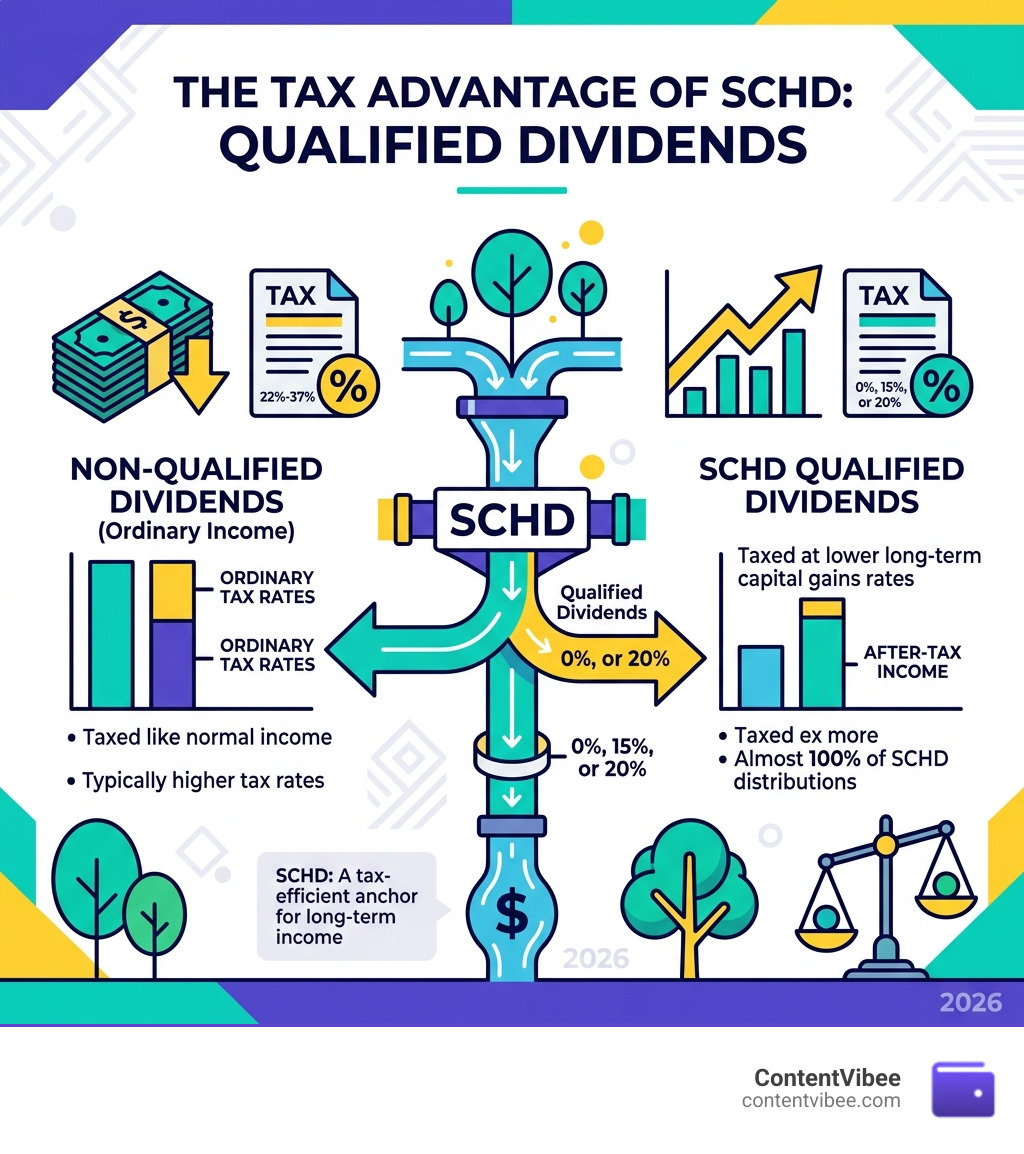
According to the official SCHD | Schwab U.S. Dividend Equity ETF page, the fund is also highly tax-efficient. Because it excludes REITs and MLPs, almost 100% of its distributions are “qualified dividends,” which are taxed at the lower long-term capital gains rate (0%, 15%, or 20%) rather than ordinary income rates.
Portfolio Allocation and Reinvestment Approaches
If you don’t need the cash right now, always turn on DRIP (Dividend Reinvestment Plan). Reinvesting that 3.45% yield allows you to buy more shares when the market is down, effectively “dollar-cost averaging” your way to a larger share count.
For those in high-tax brackets, “asset location” is key. Hold SCHD in a taxable brokerage account to take advantage of the qualified dividend tax rates, and keep high-yield (ordinary income) assets in your IRA or 401(k).
Frequently Asked Questions about SCHD Yield
What is the current dividend yield of SCHD in 2026?
As of April 17, 2026, the trailing twelve-month (TTM) yield is 3.45%. The 30-day SEC yield stands at 3.33%. This is significantly higher than the S&P 500’s yield of approximately 1.18%.
How often does SCHD pay dividends and are they qualified?
SCHD pays dividends quarterly (typically in March, June, September, and December). Yes, the vast majority of SCHD dividends are qualified dividends, making them more tax-efficient for U.S. investors in taxable accounts.
How does SCHD perform during high-inflation periods?
Historically, SCHD has excelled during inflation. In 2021 and 2022, when inflation spiked, SCHD’s dividends grew by over 10% annually. Because the companies it holds have “pricing power” (like Pepsi or Chevron), they can raise prices to maintain profit margins and continue growing their payouts even as the cost of living rises.
Conclusion
Executing a successful SCHD Dividend ETF Yield Analysis and Long Term Income Strategy requires more than just looking at a yield percentage. It requires an understanding of the quality filters that keep that yield safe and the growth engine that keeps it ahead of inflation.
At ContentVibee, we believe that the best investors are those who understand the “why” behind their holdings. Whether you are trying to solve a “zelle fraud transaction recovery steps and bank protection options USA” issue or simply trying to figure out if you have enough to retire, clarity is your best asset.
For those who want to take the guesswork out of their portfolio, tools like Autopilot offer a modern solution. Autopilot provides automated portfolio management with a focus on fee and risk reviews, ensuring your “cost-worthiness” is always optimized. By combining the rock-solid foundation of an ETF like SCHD with the automated oversight of Autopilot, you can build a retirement strategy that works while you sleep.
Ready to secure your financial future? Explore More info about investment security services to learn how to protect your hard-earned dividends from modern threats.