


What Is Bracket Creep? A Quick Answer
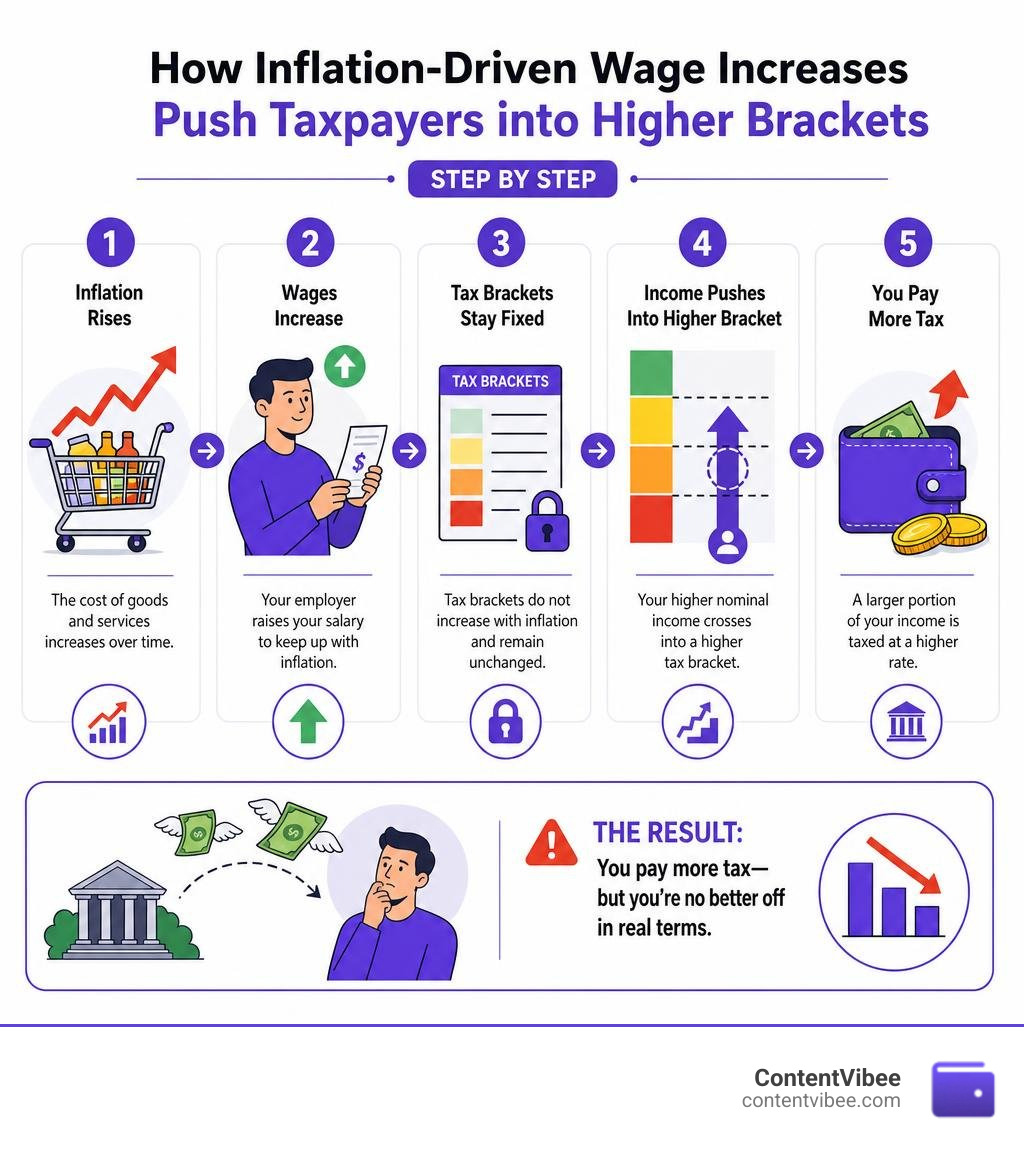
Bracket creep explained in plain terms: it is the process by which inflation pushes your income into a higher tax bracket — even when your real purchasing power stays the same or falls.
Here is what that means in practice:
- Your salary rises to keep up with inflation (a cost-of-living raise)
- Tax brackets stay fixed and do not move with inflation
- Your higher nominal income crosses into a higher bracket
- You pay more tax — but you are no better off in real terms
The result? The government collects more without passing a single new tax law.
Most people assume a pay rise means more money in their pocket. Often, it does not — at least not as much as expected. When inflation drives up wages while tax thresholds sit still, a growing slice of your paycheck flows to the government. This is bracket creep, and it affects nearly every worker in a progressive tax system.
Consider a simple example: an average New Yorker earning around $80,000 was estimated to pay an extra $225 in taxes during the 2022 and 2023 tax seasons — not because rates changed, but because bracket creep quietly pushed more of their income into a higher band.
For mid-career professionals watching their retirement savings, this matters. Every extra dollar lost to bracket creep is a dollar that cannot compound in a 401(k) or IRA.
Bracket Creep Explained: How Inflation Quietly Raises Your Taxes
To fully understand how this phenomenon works, we first need to look at how progressive tax systems operate. In a progressive tax system, like the ones used in the United States, Australia, and many European nations, tax rates increase as your income rises. The system is divided into income bands, or “brackets,” with each band taxed at a different rate.
Inflation is a gradual loss of purchasing power, which is reflected in a broad rise in prices for goods and services over time. When inflation runs hot, the cost of living spikes. To help workers cope, employers often grant wage increases or cost-of-living adjustments (COLAs).
However, there is a major catch: these wage increases are “nominal” (meaning they exist on paper), but they do not necessarily represent an increase in your “real” income (your actual purchasing power). If your salary goes up by 5% to match a 5% inflation rate, your standard of living remains exactly the same. You can buy the exact same basket of groceries, pay the same utility bills, and cover the same rent.
But if the tax thresholds do not change, that 5% nominal raise can push some or all of your new income into a higher tax bracket. As a result, you pay a larger percentage of your total income in taxes, leaving you with less real disposable income than you had before your raise. This invisible tax hike is known as Bracket creep .
The Mechanics of Bracket Creep Explained
To understand the mechanics, we must distinguish between two crucial terms: your marginal tax rate and your average tax rate.
- Marginal Tax Rate: The tax rate you pay on the very next dollar of income you earn.
- Average (or Effective) Tax Rate: The total amount of tax you pay divided by your total taxable income.
Bracket creep does not just affect people who cross over from one bracket to another. It actually increases the average tax rate for everyone whose nominal income increases, even if they stay within the same tax bracket. This is because a larger portion of their total income is now being taxed at their highest marginal rate rather than the lower, baseline rates.
Let us look at a simplified, hypothetical tax system to see exactly how this math plays out. Imagine a tax system with only two brackets:
- Bracket 1: 10% tax on income up to $50,000
- Bracket 2: 20% tax on all income above $50,000
Now, let us compare a worker’s situation before and after an 8% inflation-driven salary adjustment:
| Tax Metric | Before Inflation (Salary: $48,000) | After 8.3% Raise (Salary: $52,000) |
|---|---|---|
| Income in Bracket 1 (10%) | $48,000 | $50,000 |
| Income in Bracket 2 (20%) | $0 | $2,000 |
| Total Tax Owed | $4,800 | $5,400 ($5,000 + $400) |
| Average Tax Rate | 10.0% | 10.38% |
| Increase in Tax Bill | Baseline | 12.5% increase |
In this scenario, the worker’s nominal salary increased by 8.3% to help cover rising costs. However, because the $50,000 threshold did not adjust, their tax bill jumped by a staggering 12.5%. Their average tax rate rose from 10% to 10.38%. Even though their raise was meant to help them keep up with inflation, they are now worse off in real terms because the government took a larger bite out of their paycheck.
Why Stagnant Tax Brackets Create a Fiscal Drag
When governments do not adjust tax brackets to keep pace with inflation, the tax system creates what economists call fiscal drag.
Fiscal drag is the process where rising nominal incomes push taxpayers into higher brackets, automatically increasing government tax revenues without any legislative changes. This acts as an economic drag because it siphons money out of the private sector and into government coffers.
By reducing consumers’ disposable income, fiscal drag directly dampens purchasing power. When citizens have less money to spend on goods and services, consumer demand drops, which can ultimately stifle economic growth.
Historically, during the high-inflation era of the 1970s in the United States, median nominal incomes rose by 50% due to cost-of-living adjustments, but real disposable income flatlined. This was largely because stagnant federal tax brackets pulled millions of middle-class families into tax brackets originally designed only for wealthy households.

The Real-World Impact of Bracket Creep on Taxpayers
Bracket creep is often called a “stealth tax” because it requires no public debate, no legislative votes, and no official announcements. It simply happens in the background, slowly chipping away at your financial security.

The timing of this tax squeeze is particularly critical. In the United States, taxpayers are currently navigating the fallout of the TCJA Expiration Date and What It Means for Your Wallet. With many individual income tax provisions from the 2017 Tax Cuts and Jobs Act expiring, keeping a close eye on your tax brackets is more important than ever.
How Bracket Creep Affects Different Income Levels
While bracket creep affects almost all taxpayers, it does not impact everyone equally.
- The Middle-Class Burden: Middle-income earners often feel the sharpest pain from bracket creep. When you are living near a bracket threshold, a modest cost-of-living raise can easily push a portion of your income into the next tax tier (for example, jumping from the 12% bracket to the 22% bracket in the U.S. federal system). This represents a steep 10% marginal rate increase on those hard-earned dollars.
- High-Income Earners: For ultra-high earners, bracket creep has a diminishing impact. If someone is already earning $1,000,000 a year, the vast majority of their income is already taxed at the top marginal rate (37% in the U.S.). A cost-of-living raise will not push them into a higher bracket because they are already at the ceiling.
- The Alternative Minimum Tax (AMT) Danger: A classic historical example of bracket creep is the U.S. Alternative Minimum Tax. When the AMT was introduced in 1969, it was designed to target just 155 high-income households who were using loopholes to avoid paying tax. However, because the AMT thresholds were not indexed for inflation for decades, it began creeping down the income ladder. By 2010, under older tax laws, it was projected to impact nearly 20% of all households, including many middle-class families, before Congress finally stepped in to permanently index the AMT thresholds.
State-Level Bracket Creep and Regional Tax Burdens
While the federal government indexes its tax brackets for inflation, the story at the state level is entirely different.
Currently, only 24 states and the District of Columbia adjust their state income tax brackets for inflation. In the remaining 26 states with progressive income taxes, brackets remain completely stagnant. This means that even if your federal tax burden is protected against inflation, your state tax burden may be quietly increasing every year.
This regional disparity heavily influences your overall tax burden. If you live in a state without inflation indexing, you are highly vulnerable to local bracket creep. For a detailed breakdown of how different states stack up, you can read our guide on Which States Have the Lowest Tax Burdens? to see where your state stands.
Furthermore, state-level tax policies can heavily impact your long-term planning, especially as you approach retirement. To see how different regions treat your retirement income, check out the Best States for Taxes in Retirement Ranked as well as our deep dive into State Senior Tax Benefits to Slash Your Property Tax Bill.
How Governments Address Bracket Creep: Inflation Indexing
To prevent bracket creep from unfairly penalizing taxpayers, many governments use a policy called inflation indexing. Indexing automatically adjusts the income thresholds of tax brackets, standard deductions, and other tax provisions each year based on a chosen measure of inflation.
In the United States, federal inflation indexing officially began in 1985. Today, the IRS adjusts more than 60 tax provisions annually to ensure that taxpayers’ real tax burdens do not rise simply because of inflation.
The Role of Chained CPI in Bracket Creep Explained
The specific metric used to measure inflation has a massive impact on how effectively indexing prevents bracket creep.
Prior to 2018, the IRS used the standard Consumer Price Index (CPI) to calculate annual adjustments. However, with the passage of the Tax Cuts and Jobs Act of 2017, the federal government switched to the Chained Consumer Price Index (Chained CPI or C-CPI) starting in 2019.
What is the difference?
- Standard CPI measures the price changes of a fixed basket of goods over time.
- Chained CPI accounts for “consumer substitution.” If the price of beef spikes, Chained CPI assumes consumers will substitute beef with cheaper chicken.
Because it accounts for this substitution effect, Chained CPI typically reports a lower rate of inflation than standard CPI. By using Chained CPI, the IRS adjusts tax bracket widths upward at a slower rate. Over time, this slower adjustment means that tax brackets do not expand as quickly as actual inflation, resulting in a mild, built-in level of bracket creep that quietly increases federal revenues.
International Comparisons: US, Australia, and the EU
Different countries handle bracket creep in various ways, ranging from automatic indexing to manual political adjustments:
- United States: Uses automatic annual indexing based on Chained CPI for federal brackets, though state-level indexing varies widely.
- Australia: Does not automatically index its tax thresholds to inflation. Instead, the Australian government relies on periodic, manual policy interventions to cut tax rates or adjust thresholds. Personal income tax receipts driven by bracket creep have been a major tool for reducing government debt, which was projected to peak at 40.9% of GDP ($981 billion) by the end of 2024-25. To learn more about how this impacts Australian taxpayers, you can read the Australian Parliamentary Budget Office’s report on Bracket creep and its fiscal impact | pbo or check out the practical analysis in H&R Block’s guide on What Is Bracket Creep in Australia? | H&R Block .
- European Union: Europe presents a mixed bag. Fewer than half of European OECD countries adjust their personal income tax brackets annually for inflation, leaving many European citizens highly exposed to fiscal drag.
How to Mitigate Bracket Creep: Actionable Tax Planning Strategies
While you cannot control inflation or tax policy, you can take proactive steps to lower your taxable income and keep yourself from sliding into a higher tax bracket.
Maximizing Pre-Tax Retirement Contributions
The most effective way to combat bracket creep is to reduce your Adjusted Gross Income (AGI) through pre-tax contributions.
- Traditional 401(k) or 403(b) Plans: For 2026, contributing to an employer-sponsored retirement plan allows you to deduct those contributions directly from your current year’s taxable income. If you are on the boundary of a higher tax bracket, maximizing these contributions can easily pull you back down into a lower tax tier.
- Traditional IRAs: If you qualify, contributing to a traditional IRA is another excellent way to lower your taxable income while securing your retirement.
For those planning their retirement years, understanding how these savings will be taxed later is vital. Be sure to read The Ultimate Guide to State Pension Tax Breaks and Exemptions to optimize your long-term withdrawal strategy.
Utilizing Tax Credits and Deductions
Tax credits and deductions are powerful tools to offset a rising tax bill:
- Tax Deductions: Choose between the standard deduction or itemized deductions (such as mortgage interest or medical expenses) to lower your taxable income.
- Charitable Contributions: Donating to qualified 501(c)(3) organizations reduces your taxable income if you itemize your deductions.
- Tax Credits: Unlike deductions (which lower your taxable income), tax credits provide a dollar-for-dollar reduction of your actual tax liability. Look into credits like the Child Tax Credit, the American Opportunity Tax Credit, or clean energy credits to directly slash what you owe.
Frequently Asked Questions About Bracket Creep
Does bracket creep only affect you if you change tax brackets?
No. This is a common misconception! Even if your nominal salary increase does not push you over the line into a higher marginal bracket, bracket creep still increases your average tax rate.
Because your income above the tax-free threshold has increased, a larger proportion of your total earnings is taxed at your highest marginal rate rather than your lower, baseline rates.
How often does the IRS adjust tax brackets for inflation?
The IRS adjusts federal tax brackets, standard deductions, and dozens of other tax provisions once a year. These adjustments are typically announced in the autumn and take effect on January 1st of the following tax year.
What is the difference between CPI and Chained CPI?
Standard CPI tracks the cost of a fixed basket of goods, while Chained CPI assumes that as prices rise, consumers will substitute expensive items with cheaper alternatives. Because of this substitution assumption, Chained CPI rises at a slower rate, leading to smaller annual adjustments to tax brackets and a slow, gradual increase in tax liability over time.
Conclusion
At ContentVibee, we believe that understanding the mechanics of your money is the first step toward building lasting financial peace. Bracket creep is a quiet, invisible force, but with strategic planning—such as maximizing your pre-tax retirement accounts and utilizing state-specific tax breaks—you can protect your hard-earned purchasing power.
As you plan for the future, keep in mind that tax planning does not stop when you retire. To see how your future benefits will be affected by tax policy, check out our guide on Uncle Sam’s Cut: Understanding Taxes on Social Security, read The Golden State Guide: Deciphering CalPERS COLA and California Tax Adjustments for regional insights, or explore our comprehensive pillar page:
Taxing Your Golden Years: A Guide to Social Security Tax on Benefits


