


What Is the Car Accident Settlement Formula (and Why It Matters)
The car accident settlement formula is the method insurance companies and attorneys use to calculate how much money an injured person should receive after a crash. Here’s the quick version:
The Standard Formula:
- Add up your economic damages — medical bills + lost wages + property damage
- Multiply by a pain and suffering multiplier (typically 1.5x to 5x, based on injury severity)
- Subtract for your fault percentage (if you were partly to blame)
Quick example:
| Step | Amount |
|---|---|
| Medical bills + lost wages + property damage | $40,000 |
| Multiply by pain and suffering factor (3x) | $120,000 |
| Minus 20% fault (if applicable) | $96,000 net |
This is the baseline. But the real number you walk away with depends on a lot more — including where you live, how quickly you got medical care, and whether you have an attorney.
The national average car accident settlement sits at around $30,416 in 2026, but that number is almost meaningless on its own. New York’s average is $287,000. California’s is closer to $23,900 for many cases. The same injury in different states can produce wildly different results.
Insurance companies know this formula too — and they use it against you. Their first offers typically run 30 to 50% below what a case is actually worth.
This guide breaks down exactly how the formula works, how insurers manipulate it, and what you can do to get a fair number.
Understanding the Standard Car Accident Settlement Formula
When you are hurt in a car crash, the law does not automatically hand you a specific check. Instead, we have to calculate your losses. To arrive at a fair figure, the legal and insurance industries split your losses into two primary categories: economic damages and non-economic damages.
To build a solid claim, you must understand how these two categories interact. For a detailed breakdown of this process, see our comprehensive Car Accident Settlement Guide 2026.
Economic vs. Non-Economic Damages
- Economic Damages (Special Damages): These are the objective, easily calculable financial losses you incur. They come with receipts, invoices, pay stubs, and repair estimates. If you paid for it out of pocket or owe a hospital for it, it goes here.
- Non-Economic Damages (General Damages): These represent the subjective, non-monetary losses you experience. How do you put a price tag on waking up with chronic back pain, missing your child’s graduation because you were stuck in a hospital bed, or experiencing severe anxiety every time you merge onto the highway?
| Damage Category | What It Includes | How It Is Proven |
|---|---|---|
| Economic Damages | Medical bills, future medical care, lost wages, lost earning capacity, vehicle repairs. | Medical bills, payroll records, mechanics’ invoices. |
| Non-Economic Damages | Physical pain, emotional distress, loss of enjoyment of life, anxiety, PTSD. | Pain journals, expert testimony, psychiatric records. |
In California, calculating medical damages has a unique legal twist. Thanks to a landmark court ruling (Howell v. Hamilton Meats), you can only recover the amount your medical providers actually accepted as payment from your health insurance, rather than the initial, inflated sticker price billed by the hospital. This makes having accurate, finalized billing records incredibly important when calculating your baseline economic damages.
The Multiplier Method: The Core of the Car Accident Settlement Formula
The multiplier method is the most common way insurance adjusters and lawyers calculate non-economic damages. It serves as the mathematical engine behind most personal injury negotiations.
The formula is straightforward:
$$\text{Economic Damages} \times \text{Multiplier (between 1.5 and 5)} = \text{Pain and Suffering Value}$$
Once you have your pain and suffering value, you add it back to your economic damages to get the total gross value of your claim.
The multiplier chosen depends entirely on the severity of your injuries:
- 1.5x to 2x Multiplier: Used for minor, soft-tissue injuries like mild whiplash, minor bruising, or sprains that heal within a few weeks without surgery.
- 2x to 3x Multiplier: Used for moderate injuries, such as simple bone fractures, persistent disc bulges, or injuries requiring physical therapy for several months.
- 4x to 5x (or higher) Multiplier: Reserved for severe, catastrophic, or permanent injuries. This includes traumatic brain injuries (TBIs), spinal cord damage, amputations, or injuries requiring major surgeries and lifelong care.
For example, if you have $15,000 in medical bills and lost wages from a broken arm, and your attorney argues for a 3x multiplier due to the pain of surgery, your pain and suffering value is $45,000. Added together, your estimated gross settlement is $60,000.
To see how these numbers apply to your specific situation, you can use our interactive Tools/Settlement Calculators/Car Accident Settlement Calculator.
The Per Diem Method: An Alternative Car Accident Settlement Formula
While the multiplier method is highly popular, some cases are better suited for the per diem (daily rate) method. “Per diem” is Latin for “by the day.”
Under this method, we assign a specific, reasonable daily dollar value to your pain and suffering. We then multiply that daily rate by the exact number of days you spent recovering from your injuries.
$$\text{Daily Rate} \times \text{Days of Recovery} = \text{Pain and Suffering Value}$$
But how do you choose a “reasonable” daily rate? A common rule of thumb is to use your actual daily earnings from your job. The logic is that coping with the pain and limitations of an injury is at least as difficult as a hard day of work.
For example, if you earn $250 a day at your job, and it takes you 120 days of medical treatment and physical therapy to fully recover from your injuries, your per diem calculation would look like this:
$$\$250/\text{day} \times 120\text{ days} = \$30,000\text{ for pain and suffering}$$
The per diem method is highly effective for moderate injuries with a clear, documented start and end date of recovery. However, insurance adjusters often push back on high daily rates for long recovery periods. To learn more about proving these subjective losses, read our guide on How to Calculate Pain and Suffering Damages.
How Insurance Companies Use Colossus to Devalue Claims
If you think a human insurance adjuster is carefully reading your medical records, sympathizing with your pain, and manually applying a formula, we have some bad news. In 2026, the insurance industry relies heavily on automated claims evaluation software, with a program called Colossus leading the pack.
Colossus is a computer database used by major insurance carriers to standardize and minimize payouts. Here is how it actually works:
- Data Input: The insurance adjuster inputs specific data points from your medical records into Colossus. This includes diagnostic codes (ICD codes), the types of doctors you saw, and the treatments you received.
- Severity Points: The software assigns “severity points” to your injuries. For instance, a spinal injury gets more points than a sprained ankle.
- The Settlement Range: Colossus processes this data against historical settlement ranges for your geographic area and outputs a strict negotiation range. The adjuster is generally not allowed to offer you a penny more than the ceiling set by the computer.
Because Colossus is a cold, mathematical algorithm, it looks for excuses to slash your claim’s value. The biggest red flag for Colossus is a treatment gap.
If you wait two weeks after an accident to see a doctor, or if you miss three scheduled physical therapy appointments, Colossus assumes you are not actually hurt. It will immediately discount your medical bills by 20% to 40%, claiming the treatment was not medically necessary.
To beat the software, you must seek medical care immediately after an accident and follow your doctor’s treatment plan to the letter. If you are already facing an unfair computerized offer, read our article on First Offer Blues Navigating Auto Accident Settlement Averages to learn how to fight back.
Comparative Negligence and Other Factors That Shift Your Settlement Value
Even if you calculate a perfect gross settlement value using the multiplier method, several external factors can drastically shift the final amount of money you actually take home.
1. Comparative Negligence Laws
Your level of fault in the accident directly impacts your payout. Because we are operating in California, we must look at the state’s pure comparative negligence rules.
Under pure comparative negligence, you can recover compensation even if you were 99% at fault for the crash. However, your final settlement is reduced by your exact percentage of blame.
- Example: You are hit by a speeding driver, but you failed to use your turn signal. A claims adjuster determines you were 25% at fault, and the speeding driver was 75% at fault. If your total damages are $100,000, your payout is reduced by 25%, leaving you with a net settlement of $75,000.
2. Insurance Policy Limits
The at-fault driver’s insurance policy limits act as a hard ceiling on your settlement. In California, the minimum liability coverage required by law is only $15,000 for injury/death to one person and $30,000 per accident. If your medical bills are $50,000, but the driver who hit you carries only the state-minimum policy, the insurance company will not pay more than $15,000.
To recover the rest, you must look to your own Uninsured/Underinsured Motorist (UM/UIM) coverage, or search for other liable parties.
3. The Location Factor
Where your accident occurred matters. Juries and courts in urban, highly populated California counties (like Los Angeles or San Francisco) historically award much higher damages than those in rural counties. Insurance companies know this and adjust their Colossus parameters accordingly.
To understand how these moving parts shape your case, check out our guide on How Car Accident Settlements Are Calculated.
Why Initial Insurance Offers Are Low and How to Beat Them
It is a classic scenario: a week after your crash, an insurance adjuster calls you with a warm, friendly voice and offers you a quick $5,000 check to “wrap things up.”
Do not fall for it.
Insurance companies are profit-driven corporations. Their primary financial goal is to keep money in their accounts, not yours. They make low-ball initial offers for two reasons:
- To limit their liability: Once you sign a settlement release and cash that check, your claim is closed forever. If you discover next month that you need a $30,000 spinal surgery, you cannot go back and ask for more money.
- To take advantage of your stress: They know you have bills piling up and might be missing work. They count on you being desperate enough to accept a fast, low-ball offer.
How to Beat the Low-Ball Offer
To beat the insurance company at their own game, you must use strategic negotiation tactics:
- Reject the First Offer Politely: Send a written rejection stating that the offer does not fully cover your medical expenses and ongoing pain.
- Keep a Pain Journal: Document your pain levels, medication side effects, and activities you missed daily. This serves as powerful emotional evidence that a computer program cannot easily dismiss.
- Calculate Your Bottom Line: Know your minimum acceptable number before you start negotiating.
- Do Not Rush: The average car accident settlement takes time. Settling too quickly almost always means leaving money on the table.
For a step-by-step strategy on evaluating and rejecting these initial traps, read our guide Dont Cash That Check Yet How To Evaluate An Insurance Settlement Offer.
Frequently Asked Questions About Settlement Calculations
How long does it take to get a car accident settlement?
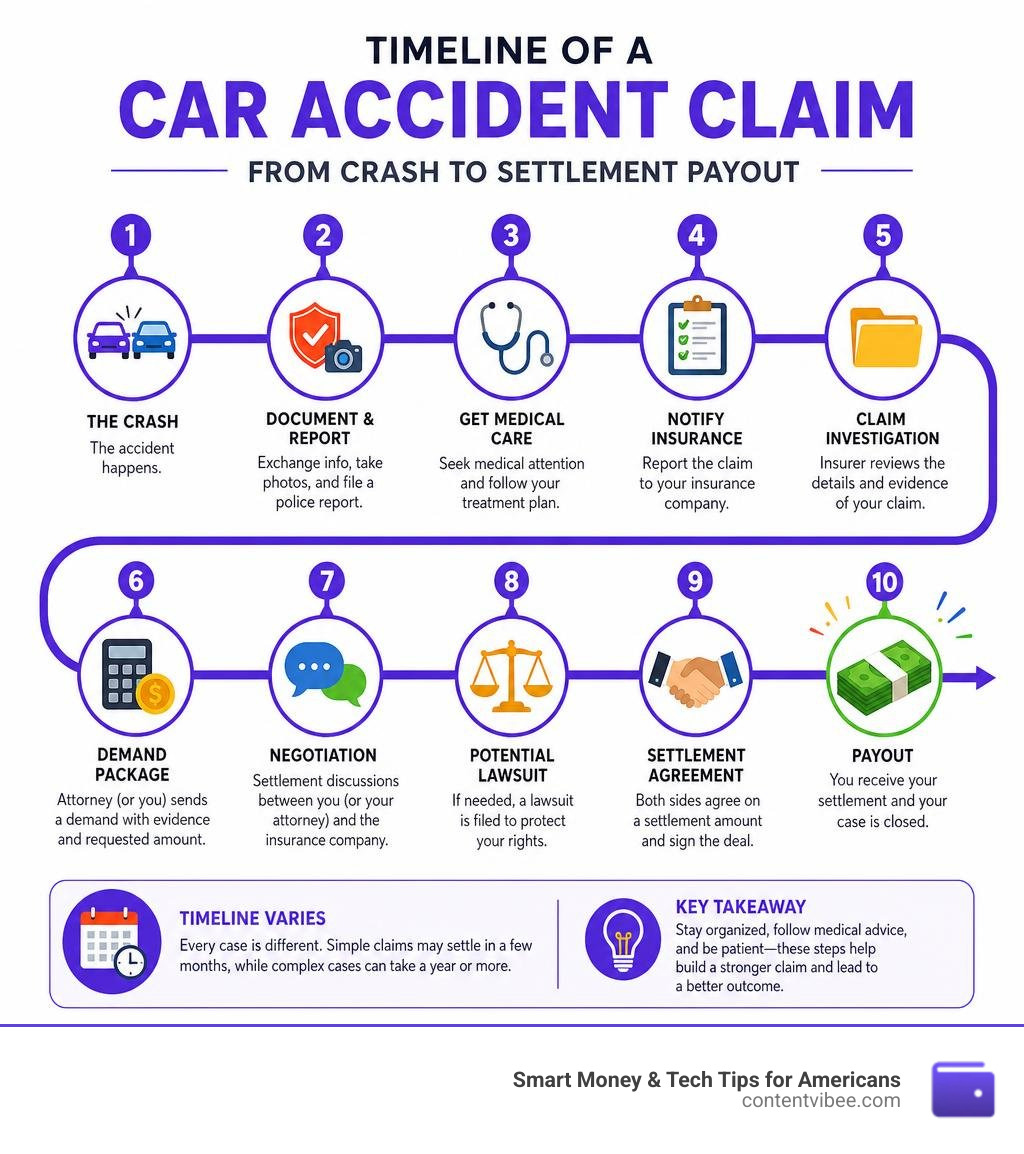
The average time from a car accident to a finalized settlement is 14.7 months.
While a minor, clear-cut claim with no lingering injuries can sometimes settle in 3 to 6 months, complex cases involving severe injuries, disputed fault, or high policy limits can take 1 to 3 years. You should never settle your claim until you have reached Maximum Medical Improvement (MMI)—the point where your doctors declare your recovery has plateaued. Settling before MMI means you risk paying for future medical treatments out of your own pocket.
Does hiring an attorney really increase my payout?
Yes, significantly. Data from the Insurance Research Council (IRC) consistently shows that accident victims who hire an attorney receive, on average, 3.5 times higher gross settlements than those who represent themselves.
Even after paying the attorney’s contingency fee (typically 33% to 40%), injured victims still walk away with substantially more net money in their pockets. An attorney knows how to bypass Colossus, gather expert medical testimony, and threaten a lawsuit if the insurer refuses to play fair.
To weigh your options, check out our analysis on Diy Vs Attorney Can You Handle Your Car Accident Settlement Alone.
What is the average car accident settlement in 2026?
In 2026, the national average car accident settlement is $30,416. However, averages are heavily skewed by millions of minor, soft-tissue bumper-scrapes.
Typical payouts vary wildly by injury type:
- Whiplash and Soft Tissue Injuries: $2,500 to $100,000+ (depending on severity and treatment).
- Moderate Bone Fractures: $30,000 to $75,000.
- Severe Spinal or Brain Injuries: $75,000 to $200,000+.
- Catastrophic or Wrongful Death Cases: $200,000 to $2,500,000+.
For a deeper dive into current market trends and state-specific averages, check out Car Accident Settlement 2026: Average Values.
Conclusion
Navigating the aftermath of a car crash is stressful, but you do not have to let insurance companies dictate what your recovery is worth. By understanding the car accident settlement formula, keeping meticulous records, avoiding treatment gaps, and knowing how to push back against automated systems like Colossus, you put yourself in the driver’s seat of your financial recovery.
Here at Smart Money & Tech Tips for Americans, we want to help you make the smartest financial decisions possible during life’s most challenging moments. To take the first step in estimating your claim’s true value, Explore our interactive settlement calculators today.


