


What Happens to Your Social Security Benefits If Your Husband Dies?
Understanding spouse social security benefits if husband dies is one of the most important financial topics for married couples approaching retirement — yet most people don’t learn the rules until they’re facing a loss.
Here’s the quick answer:
- You cannot collect both your own retirement benefit and your spouse’s survivor benefit at the same time. Social Security pays the higher of the two.
- You may receive up to 100% of your deceased husband’s Social Security benefit if you claim at your full retirement age (FRA).
- You can claim as early as age 60 (or age 50 if you have a qualifying disability), but your benefit will be reduced.
- You can switch benefits — for example, claim survivor benefits first, then switch to your own retirement benefit at age 70.
- More than 3.8 million widows and widowers were receiving survivor benefits as of September 2025.
The loss of a spouse is devastating enough on its own. But when one income disappears — especially if that was the larger Social Security check — the financial impact hits hard and fast.
The good news: Social Security survivor benefits exist specifically to protect you. And with the right strategy, you may be able to collect tens of thousands of dollars more over your lifetime just by understanding the rules and timing your claim wisely.
This guide walks you through everything — who qualifies, how much you’ll get, smart claiming strategies, and exactly how to apply.
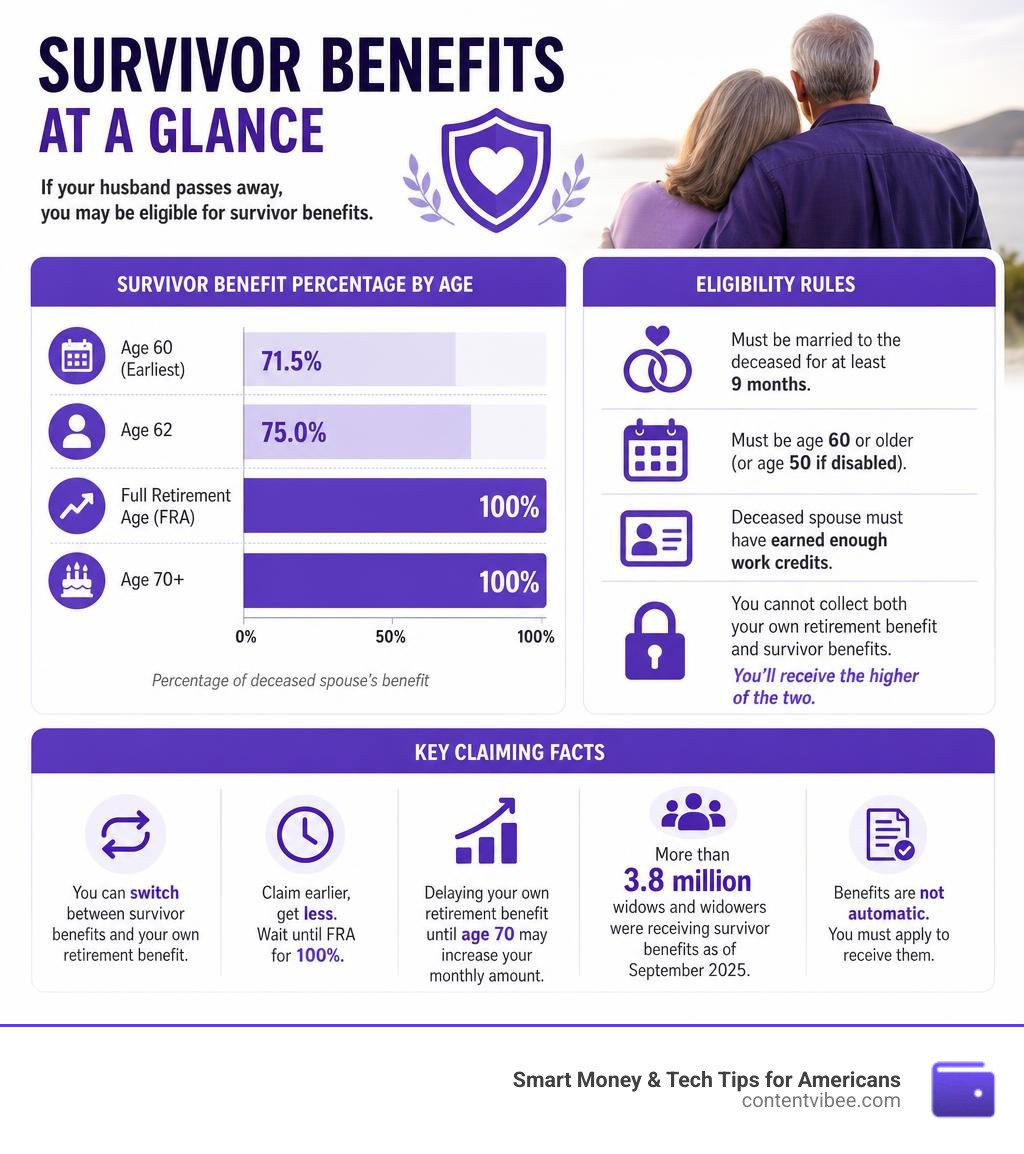
Spouse social security benefits if husband dies basics:
Understanding Spouse Social Security Benefits if Husband Dies
When a loved one passes away, navigating the bureaucratic maze of federal programs is probably the last thing you want to do. However, knowing your rights regarding spouse social security benefits if husband dies is essential to secure your financial future. Let’s break down who is eligible and what the baseline rules look like.
Who Qualifies for Spouse Social Security Benefits if Husband Dies?
The Social Security Administration (SSA) provides survivor benefits to help family members cope with the loss of a primary wage earner. To qualify for these benefits, your late husband must have worked and paid Social Security taxes long enough to accumulate retirement credits.
Generally, a worker needs 40 credits (roughly 10 years of work) for their family to be eligible. However, there is a special rule for younger workers: if your husband worked for at least one and a half years (6 credits) in the three years right before his death, certain benefits can still be paid to his family.
To see if you meet the criteria as a surviving spouse, you can check the official guidelines on Who can get Survivor benefits. For a deeper dive into the specific mechanics of these payouts, check out our guide on What You Need to Know About Spousal Survivor Benefits.
In general, the following individuals may qualify for survivor benefits on a deceased worker’s record:
- A widow or widower who meets the age and marriage duration requirements.
- A surviving divorced spouse, provided the marriage lasted at least 10 years (with some exceptions).
- Unmarried children under age 18 (or up to 19 if still in high school full-time).
- Disabled adult children who became disabled before age 22.
- Dependent parents age 62 or older who relied on the deceased worker for at least half of their financial support.
Marriage Duration and Age Requirements
To claim survivor benefits as a widow, you must meet specific age and marriage duration thresholds.
- The Nine-Month Rule: Under standard circumstances, you must have been married to your spouse for at least nine continuous months before his death. There are exceptions to this rule, such as accidental deaths or military deaths in the line of duty.
- The Age 60 Threshold: You can begin claiming standard survivor benefits as early as age 60. However, claiming at 60 means you will receive a permanently reduced monthly payout.
- The Age 50 Disability Exception: If you are disabled and your disability started before your husband’s death or within seven years of his passing, you can begin claiming survivor benefits at age 50.
- Caring for a Child Under 16: If you are caring for your late husband’s child who is under age 16 or disabled, you can claim survivor benefits at any age. In this scenario, you are eligible for 75 percent of his benefit amount, and the age-based reductions do not apply to you (though the family maximum rules might).
How Much Do Surviving Spouses Receive?
The amount of money you will receive from spouse social security benefits if husband dies depends heavily on two factors: how much your late husband paid into Social Security, and how old you are when you file your survivor claim.
How to Calculate Spouse Social Security Benefits if Husband Dies
If you wait until your own full retirement age (FRA) for survivor benefits, you will receive 100 percent of your late husband’s benefit.
Note: It is important to know that your FRA for survivor benefits may be slightly different from your FRA for standard retirement benefits. For example, if you were born in 1960 or later, your FRA for retirement is 67, but your FRA for survivor benefits might be slightly earlier depending on your exact birth year.
If you claim before reaching your full retirement age, your benefit will be reduced. At age 60, the benefit is reduced to 71.5 percent of the deceased husband’s primary insurance amount. The reduction scales gradually between age 60 and your FRA.
To get a precise estimate of what your payments might look like, you can use our resource to Calculate Survivor Retirement Benefits.
Here is a quick reference table showing how your claiming age affects the percentage of your late husband’s benefit you will receive:
| Claiming Age | Percentage of Deceased Spouse’s Benefit |
|---|---|
| Full Retirement Age (FRA) | 100% |
| Age 65 | Approx. 86% – 93% (depending on FRA) |
| Age 62 | 82.5% |
| Age 60 | 71.5% |
| Any age (caring for child < 16) | 75% |
| Disabled (ages 50 to 59) | 71.5% |
If your husband had already begun claiming reduced retirement benefits before he passed away, a special rule called the “widow’s limit” applies. This rule limits your maximum survivor benefit to the larger of:
- The reduced benefit your husband was receiving at the time of his death.
- 82.5 percent of his primary insurance amount (PIA).
Conversely, if your husband delayed claiming his retirement benefits past his full retirement age, he accumulated delayed retirement credits (up to age 70). Those extra credits are passed on to you, meaning your survivor benefit will include those generous increases!
The $255 Lump-Sum Death Payment
In addition to monthly survivor benefits, the SSA pays a one-time lump-sum death payment of $255.
To receive this payment, you must apply within two years of your husband’s death. Usually, if you are already receiving spousal benefits on his record, this payment is processed automatically once the death is reported. If not, you will need to apply for it specifically. For more details on managing these immediate steps, read the AARP guide on Social Security When a Spouse Dies.
Strategic Claiming: Survivor Benefits vs. Your Own Retirement
One of the biggest mistakes surviving spouses make is failing to coordinate their survivor benefits with their own personal retirement benefits. Because the rules allow you to switch between the two, a strategic approach can result in much higher lifetime income.
The Dual-Entitlement Rule
The Social Security Administration does not allow “double-dipping.” Under the dual-entitlement rule, you cannot simply add your late husband’s benefit to your own and receive two full checks every month.
Instead, the SSA will look at both benefits. If your own retirement benefit is higher than your survivor benefit, you will receive your own benefit. If the survivor benefit is higher, you will receive your retirement benefit plus an additional amount to bring the total up to the survivor benefit level. In practice, you simply receive a total monthly amount equal to the higher of the two.
For a comprehensive breakdown of how this dual structure functions, explore His, Hers, and Ours: The Ultimate Guide to Dual Social Security Benefits.
Switching Strategies to Maximize Lifetime Income
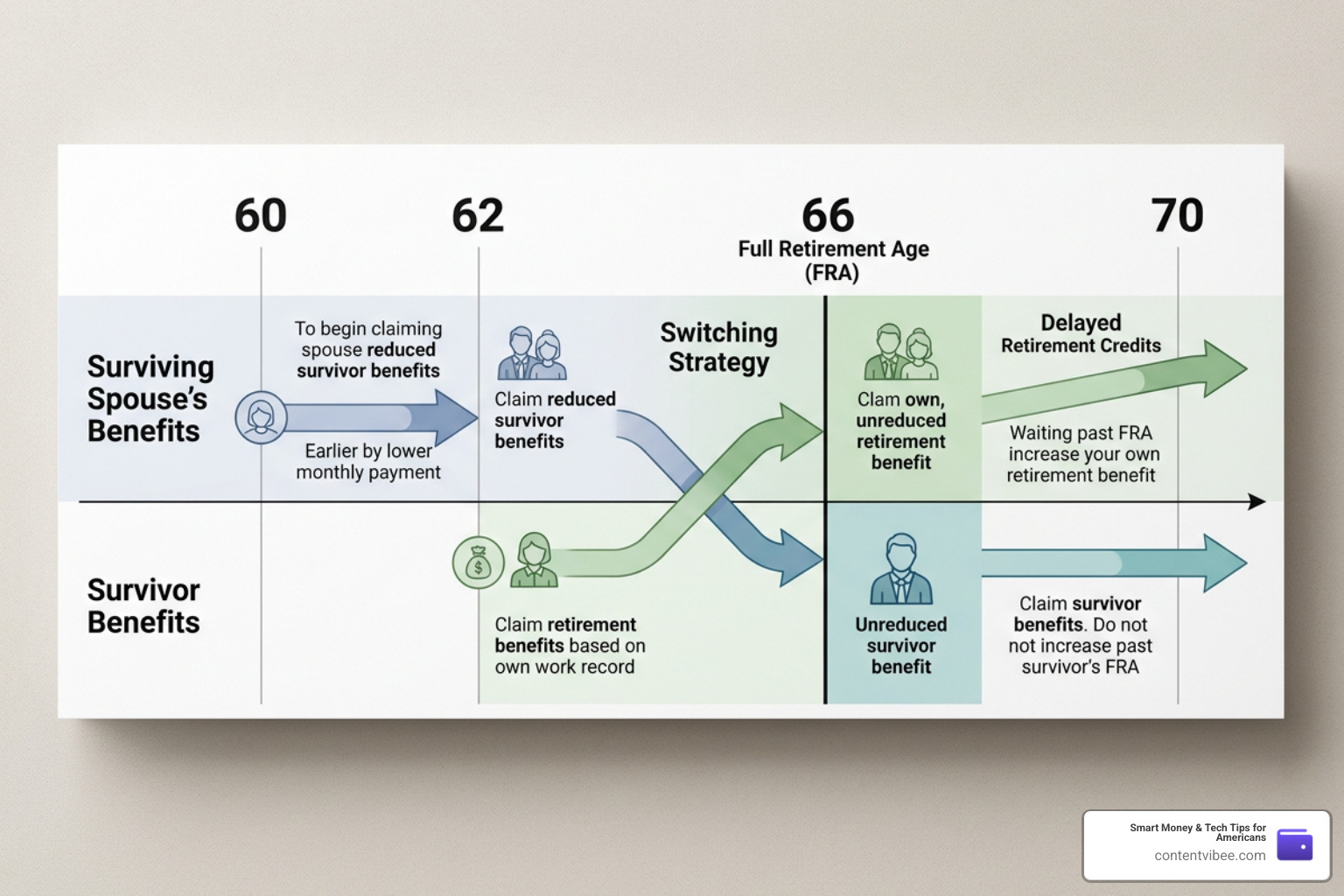
The real magic of survivor benefits is that they are legally treated as a separate bucket of money from your own retirement benefits. This means you can claim one benefit first while letting the other grow, and then switch to the larger one later.
Strategy: Claim Survivor Benefits First, Switch to Your Own at Age 70 If your own retirement benefit at age 70 will be larger than your survivor benefit, you can file for survivor benefits as early as age 60. While you are collecting that survivor income, your own retirement benefit will remain untouched and continue to earn delayed retirement credits (growing by 8% per year between your FRA and age 70). Once you turn 70, you can switch to your own maximized retirement benefit.
Strategy: Claim Your Own Retirement Benefit First, Switch to Survivor Benefits at FRA If your survivor benefit will be larger than your own retirement benefit ever could be, you can claim your own reduced retirement benefit at age 62. This gives you some income immediately while allowing your survivor benefit to grow to its full 100 percent value at your survivor FRA. Once you reach survivor FRA, you switch to the higher survivor benefit.
Note: Delayed retirement credits do not accrue on survivor benefits after you reach full retirement age. Therefore, there is no financial advantage to waiting past your survivor FRA to claim survivor benefits.
Special Rules: Remarriage, Working, and the Social Security Fairness Act
Social Security rules are famous for their “fine print.” When it comes to spouse social security benefits if husband dies, there are three major areas where unexpected rules can catch you off guard: remarriage, working while collecting benefits, and recent legislative changes.
How Remarriage Affects Your Survivor Benefits
If you decide to tie the knot again, the timing of your new marriage will determine whether you keep your survivor benefits.
- Remarrying Before Age 60: If you remarry before you turn 60 (or before age 50 if you are disabled), you lose your eligibility for survivor benefits on your late husband’s record. However, if your subsequent marriage ends later due to divorce or death, your eligibility to claim on your first husband’s record can be restored.
- Remarrying After Age 60: If you wait until age 60 or older to remarry, your subsequent marriage is “deemed not to have occurred” for eligibility purposes. This means you can continue to collect survivor benefits on your late husband’s record without any reduction or penalty.
For the exact legal wording and administrative policies governing these scenarios, you can refer to the official SSA – POMS: RS 00207.002 manual.
Working in Retirement and the Earnings Test
If you claim survivor benefits early (before your full retirement age) and continue to work, your benefits may be temporarily reduced if your earnings exceed the annual limits.
For the year 2026, the earnings test limits are as follows:
- If you are under FRA for the entire year: The earnings limit is $24,480. For every $2 you earn above this limit, the SSA will withhold $1 in benefits.
- In the year you reach FRA: The earnings limit is $65,160 (only counting earnings made in the months before you reach FRA). For every $3 you earn above this limit, the SSA will withhold $1 in benefits.
- Once you reach FRA: The earnings test no longer applies. You can earn as much as you want with zero reduction in your benefits.
Any benefits withheld under the earnings test are not lost forever; once you reach FRA, your monthly benefit will be adjusted upward to account for the months benefits were withheld. To see how these rules might impact your retirement income, check out our guide on Working in Retirement: Are Spousal Benefits Reduced by Working?.
The Impact of the Social Security Fairness Act
For years, public-sector workers—such as teachers, police officers, and firefighters—faced significant reductions in their spousal and survivor benefits due to the Government Pension Offset (GPO) and the Windfall Elimination Provision (WEP). These provisions reduced or completely eliminated Social Security benefits for individuals who also earned a pension from a job where they did not pay Social Security taxes.
However, legislative changes through the Social Security Fairness Act have eliminated these restrictive GPO and WEP rules. This historic shift ensures that surviving spouses who dedicated their careers to public service are no longer penalized and can receive the full survivor benefits they deserve based on their late spouse’s work history.
How to Apply for Survivor Benefits
Unlike standard retirement benefits, you cannot apply for survivor benefits online. The SSA requires you to speak with a representative directly to transition or establish these payments.
Required Documents for Your Application
To make the process as smooth as possible, you should schedule a phone appointment or visit your local SSA office. You can schedule an appointment by calling the SSA toll-free at 1-800-772-1213 (TTY 1-800-325-0778) between 8:00 AM and 7:00 PM, Monday through Friday.
To ensure your application is processed quickly, you should gather your documents beforehand. To make sure you have everything, review The Ultimate Checklist for Your Application for Spousal Benefits and the official SSA blog post on What You Should Know About Social Security.
Here is a checklist of documents you will generally need to provide:
- Proof of death (typically an official death certificate or notification from a funeral home).
- Your Social Security number and your deceased husband’s Social Security number.
- Your birth certificate (to verify your age).
- Your marriage certificate (to prove marriage duration).
- Divorce decrees (if you are applying as a surviving divorced spouse).
- Social Security numbers and birth certificates of any dependent children (if claiming child-in-care benefits).
- W-2 forms or self-employment tax returns for the deceased spouse for the most recent year.
- Your bank account details (routing number and account number) for direct deposit.
Tip: Do not delay your application just because you don’t have all of these documents. The SSA can often help you locate or verify missing records so you don’t miss out on timely payments.
Frequently Asked Questions about Survivor Benefits
Can a divorced spouse receive survivor benefits?
Yes! If you were married to your late ex-husband for at least 10 years before your divorce became final, you can qualify for the exact same survivor benefits as a current widow.
Crucially, claiming benefits as a surviving divorced spouse does not affect the benefits of a current widow or any other family members claiming on his record. It also remains completely confidential—the SSA will not notify his current spouse or family that you have filed a claim. To understand how these rules apply to your situation, read Can Divorced Spouse Get Social Security Benefits?.
Can I collect both my own retirement and survivor benefits at the same time?
No, the SSA does not allow you to combine or “stack” both benefits to receive a double payout. Under the dual-entitlement rule, they will evaluate both your own retirement benefit and your survivor benefit, and you will receive a total monthly amount equal to the higher of the two.
What happens if my spouse dies before claiming Social Security?
If your husband passed away before officially claiming his Social Security benefits, you are still fully entitled to survivor benefits. The SSA will calculate his benefit amount as if he had reached full retirement age at the time of his death (or his actual age if he died after FRA). Any credits he earned during his working years are preserved and used to calculate your monthly survivor income.
Conclusion
Losing a spouse is a profound emotional challenge, and the financial transition that follows shouldn’t add to your burden. Understanding how spouse social security benefits if husband dies work can help you secure the financial peace of mind you deserve during a difficult time.
Whether you are planning ahead or currently navigating a loss, coordinating your claiming options is key to maximizing your lifetime income. For a step-by-step roadmap to claiming your benefits, check out our comprehensive guide: Claiming What’s Yours: A Guide to Deceased Spouse Social Security.
Here at Smart Money & Tech Tips for Americans, we are dedicated to bringing you practical, timely guidance on the financial topics that matter most. Take your time, weigh your options, and don’t hesitate to reach out to the Social Security Administration or a trusted financial advisor to map out your personalized claiming strategy.


