


The Real Answer to “Do I Need a Lawyer for a Car Accident Settlement?”
Do you need a lawyer for a car accident settlement? It depends — and the answer could be worth tens of thousands of dollars either way.
Here’s a quick answer based on your situation:
| Your Situation | Do You Need a Lawyer? |
|---|---|
| Minor fender-bender, no injuries, clear fault | Probably not |
| Medical bills under $5,000, injuries fully healed | Likely not |
| Injuries requiring ongoing treatment | Yes |
| Disputed fault or multiple vehicles | Yes |
| Commercial vehicle involved | Yes |
| Insurance offering a quick, low settlement | Yes |
| Other driver is uninsured or underinsured | Yes |
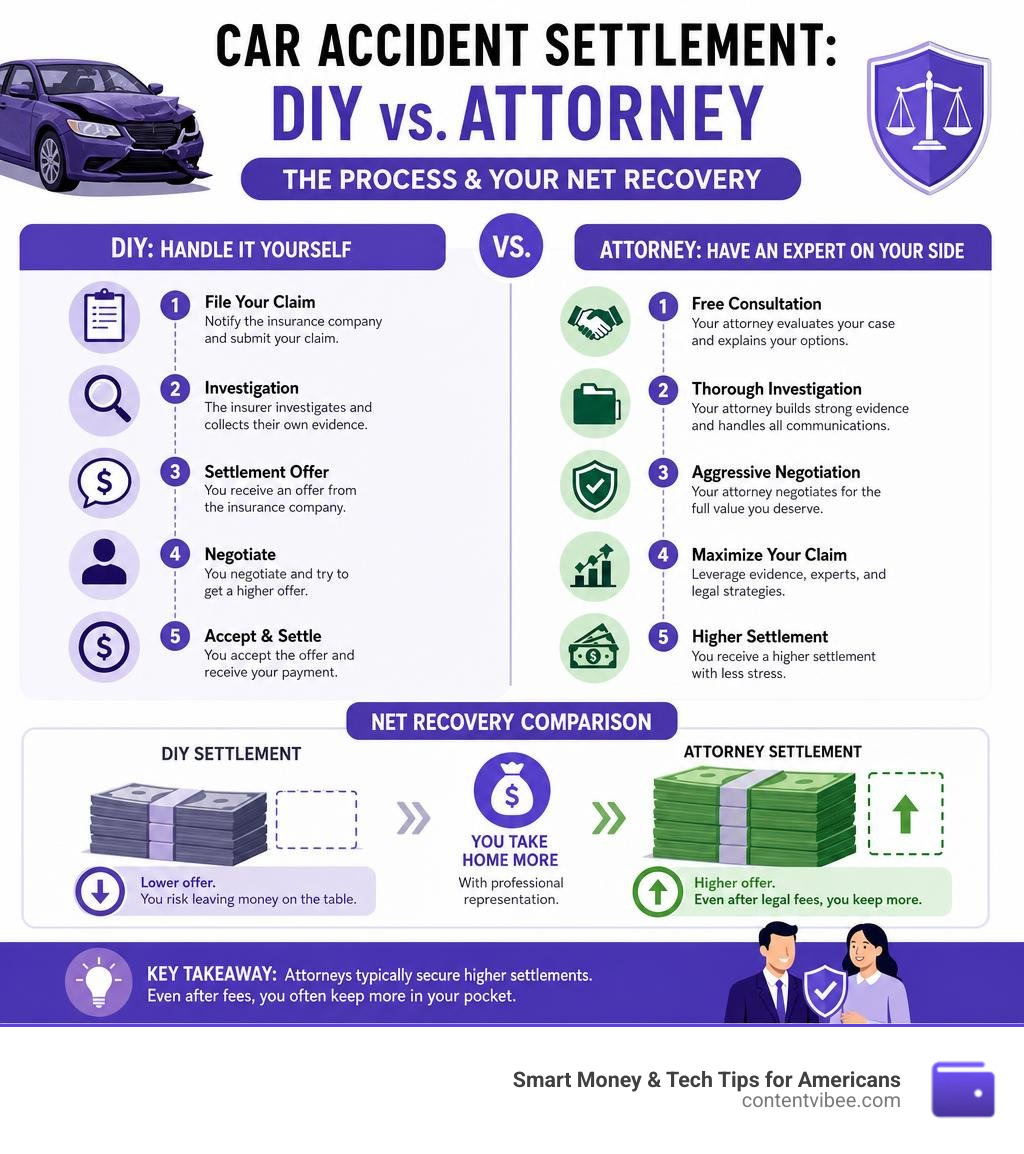
The stakes are high. Studies show that accident victims with attorneys receive settlements averaging 3.5 times higher than those who go it alone. And here’s the part most people miss: even after paying a lawyer’s fee, represented claimants typically still take home more money.
At the same time, not every accident needs legal firepower. For a simple fender-bender with no injuries and a fair offer on the table, handling it yourself can make perfect sense.
This guide breaks down exactly when you need a lawyer — and when you don’t — so you can make a smart, confident decision without leaving money on the table.
Do I Need a Lawyer for a Car Accident Settlement?

When you are sitting at home recovering from a collision, staring at a stack of medical bills and vehicle repair estimates, it is incredibly easy to feel overwhelmed. You might ask yourself: do i need a lawyer for a car accident settlement, or can I just let the insurance companies sort this out?
The short answer is that there is absolutely no law requiring you to hire an attorney. You are legally permitted to represent yourself, file your own claims, and negotiate directly with insurance adjusters. However, just because you can do something doesn’t mean you should.
To make the right choice, you must distinguish between property damage and bodily injury. If your accident only resulted in a bent bumper and zero physical injuries, you almost certainly do not need a lawyer. Property damage claims are straightforward; the insurance company will calculate the cost of repairs or the actual cash value of your vehicle, and they will write a check.
But the moment bodily injury enters the equation, the game changes entirely. Bodily injury claims involve subjective variables like pain and suffering, future medical care, and lost earning capacity. Insurance adjusters are trained to minimize these costs, which is why having an experienced advocate on your side is so critical. To understand the broader picture of how these decisions affect your payout, check out our guide on Should I Get a Lawyer for a Car Accident? (3.5x Higher Settlements 2026).
For a deeper dive into whether representation makes sense for your specific scenario, you can also read To Hire or Not to Hire: When a Car Accident Lawyer Is Actually Worth It.
When You Can Handle a Minor Car Accident Settlement Without a Lawyer
Let’s be completely honest: there are times when hiring a lawyer simply doesn’t make mathematical sense. If you were involved in a low-speed fender-bender and walked away with nothing more than a stiff neck that fully resolved after a single chiropractic visit, you can likely handle the claim yourself.
Here are the green lights that indicate you can safely go the DIY route:
- Minor Injuries, Fully Resolved: Your medical treatment was minimal, cost less than $5,000, and you have been medically cleared with zero ongoing pain or lingering symptoms.
- Clear, Undisputed Liability: The other driver was clearly at fault (for example, they rear-ended you while you were stopped at a red light), and their insurance company has already accepted 100% liability in writing.
- A Fair Offer is on the Table: The insurance company has offered a settlement that fully covers your medical bills, your out-of-pocket costs, your lost wages for the day or two of missed work, and leaves you with a reasonable amount for your inconvenience.
If your situation matches these criteria, you can save yourself the attorney’s fee by resolving the claim on your own. Learn the step-by-step process of managing this by reading our walkthrough on How to Settle a Car Accident Claim Without a Lawyer.
When to Ask: Do I Need a Lawyer for a Car Accident Settlement?
On the flip side, there are several “red flags” that should immediately prompt you to seek professional legal help. If your accident involves any of the following scenarios, attempting to handle the settlement yourself is highly risky:
- Severe or Permanent Injuries: If you suffered broken bones, head trauma, spinal injuries, or any condition requiring surgery, hospitalization, or ongoing physical therapy, you need a lawyer.
- Disputed Fault: If the other driver claims you ran the light, or if the police report is vague or incorrect, the insurance company will use this confusion to deny your claim or slash your payout.
- Complex Multi-Vehicle or Commercial Crashes: Accidents involving semi-trucks, delivery vans, rideshare drivers (like Uber or Lyft), or municipal vehicles involve layered insurance policies, federal regulations, and corporate legal teams that are impossible for an unrepresented individual to navigate.
If any of these red flags apply to your crash, you should immediately read When Should You Hire an Attorney After a Car Accident? to understand how to protect yourself before speaking to an adjuster.
The Financial Reality: How Much Does a Lawyer Cost and Is It Worth It?
One of the biggest hurdles preventing accident victims from calling an attorney is the fear of the cost. Many people assume they will have to pay hundreds of dollars per hour out of pocket just to get a lawyer to look at their case.
Fortunately, that is not how personal injury law works. To help you see the financial reality clearly, let’s look at a realistic breakdown of how represented settlements compare to self-represented settlements:
| Settlement Metric | Self-Represented (DIY) | Attorney-Represented |
|---|---|---|
| Average Gross Settlement | $15,000 | $52,500 (3.5x higher) |
| Attorney Fee (33.3%) | $0 | $17,500 |
| Medical Liens & Costs | $5,000 | $3,500 (negotiated down) |
| Your Net Take-Home Pay | $10,000 | $31,500 |
As this comparison shows, even after subtracting the attorney’s fee and medical costs, your net take-home recovery is often significantly higher when you have professional representation. For a detailed breakdown of these expenses, explore our article on How Much Does a Personal Injury Lawyer Cost.
To understand the legal mechanisms that drive these higher payouts, you should also read Will Hiring a Lawyer Actually Increase My Settlement Amount?.
Understanding the Contingency Fee Structure
Almost all car accident lawyers operate on a contingency fee basis. This means you pay absolutely nothing upfront, and you do not owe any hourly fees. Instead, the attorney’s payment is “contingent” on them winning your case. If they do not secure a settlement or court verdict for you, you owe them nothing.
If they do win, their fee is calculated as a percentage of your gross recovery:
- Pre-Litigation Fee (Typically 33.3%): If your lawyer settles your case with the insurance company without having to file a formal lawsuit, they will receive roughly one-third of the settlement.
- Litigation Fee (Typically 40%): If the insurance company refuses to play fair and your attorney has to file a lawsuit, prepare for trial, or actually go to court, the fee usually increases to 40% to cover the extensive extra labor and risk involved.
To get a transparent look at how these fees are structured and what additional case costs might be deducted, read The Truth About Lawyer Fees and What Percentage They Actually Take.
Calculating Net Recovery: Is a Lawyer Worth the Fee?
To determine if a lawyer is worth the fee, you must focus on one number: your net recovery (the amount of money that actually lands in your bank account after all fees, costs, and medical bills are paid).
Let’s look at the math. According to data from the Insurance Research Council (IRC), represented claimants receive settlements that average 3.5 times higher than unrepresented claimants.
If the insurance company offers you $10,000 on your own, and an attorney is able to negotiate that up to $35,000, here is how the math plays out:
- Gross Settlement: $35,000
- Attorney Fee (33.3%): -$11,655
- Case Expenses (records, postage): -$345
- Net to You: $23,000
By hiring a lawyer, you more than doubled your take-home money, and the attorney handled all the stressful phone calls, paperwork, and negotiations while you focused on healing. For help estimating what your specific injuries might be worth, check out our Crash Course on Estimating Your Car Accident Injury Settlement.
Risks of Handling a Car Accident Settlement Without a Lawyer

If you choose to handle your car accident claim without an attorney, you are playing on a field where the rules are written by the insurance companies. It is vital to remember that insurance adjusters are not your friends. They are professional negotiators whose primary job is to protect their company’s bottom line by paying you as little as possible.
When you go up against them unrepresented, you are at a massive disadvantage. To understand the risks of handling a case where the other driver was clearly at fault but their insurer is pushing back, read Should I Get A Lawyer For A Car Accident That Wasn’t My Fault?.
How Insurance Companies Reduce or Deny Claims
Insurance companies have a highly effective playbook designed to reduce the value of your claim. Here are the most common tactics they will deploy:
- The Recorded Statement Trap: Very shortly after the crash, an adjuster will call you, acting warm and empathetic. They will ask to record the call “just to get your version of events.” They will ask questions like, “How are you feeling today?” If you politely reply, “I’m doing okay,” they will later use that recording to argue that your injuries were not serious.
- The Blanket Medical Authorization: They will ask you to sign a release to gather your medical records related to the accident. Hidden in the fine print of that document is often a blanket authorization giving them access to your entire medical history. They will comb through records from ten years ago to find a minor back tweak and claim your current herniated disc is a “pre-existing condition.”
- Delay Until You Give Up: They will take weeks to return your calls, request duplicate documents, and drag out the process. They know that as your bills pile up and you miss work, you will become desperate enough to accept a lowball offer just to get some cash.
- Social Media and Surveillance Monitoring: Adjusters will actively monitor your public social media profiles. If you post a photo of yourself smiling at a family dinner, or standing at a backyard barbecue, they will present it as “proof” that your life has not been disrupted by pain.
Common Mistakes When You Do Not Have a Lawyer for a Car Accident Settlement
Unrepresented claimants frequently make critical, irreversible errors. The most common mistake is settling too early.
When you sign a settlement release, you give up your right to seek any additional compensation forever. If you accept a quick $3,000 check two weeks after the crash, and then discover three months later that you need a $50,000 spinal fusion surgery because your neck pain didn’t go away, you cannot go back and ask for more. You are entirely on your own.
Additionally, unrepresented victims often ignore medical liens. If your health insurance or Medicare paid for your emergency room visit, they have a legal right to be reimbursed from your liability settlement. If you settle your case for $10,000 and pocket the money without paying off your health insurance lien, you could face legal action and lose your coverage.
Before you agree to anything, make sure you read Don’t Cash That Check Yet: How to Evaluate an Insurance Settlement Offer.
Key Legal Factors: Damages, Deadlines, and Insurance Coverage
To successfully resolve a car accident claim, you must understand the legal framework that governs personal injury cases in the United States. This involves knowing what you are legally allowed to recover, how long you have to take action, and where the compensation will actually come from. For a comprehensive overview of this framework, check out our Should I Hire a Lawyer After a Car Accident? guide.
What Damages Can You Recover in a Settlement?
Under personal injury law, you are entitled to be “made whole” through financial compensation. These compensable losses are categorized into economic and non-economic damages:
- Economic Damages (Objective, quantifiable financial losses):
- Past, present, and future medical bills (surgeries, ER visits, physical therapy, medications)
- Lost wages for time missed from work
- Loss of future earning capacity if you can no longer work in your previous field
- Property damage (vehicle repairs or replacement, rental car costs)
- Non-Economic Damages (Subjective, non-monetary losses):
- Physical pain and suffering
- Emotional distress, anxiety, and PTSD caused by the crash
- Loss of enjoyment of life (inability to participate in hobbies, play with your children, etc.)
To learn how these damages are calculated and maximized under the law, read our comprehensive Car Accident Settlement Guide 2026.
Understanding the Statute of Limitations and Deadlines
You do not have forever to file a lawsuit or resolve your claim. Every state enforces a strict deadline known as the statute of limitations. If you miss this deadline, your right to seek compensation is permanently erased.
These deadlines vary dramatically by state:
- New York: You have 3 years from the date of the accident to file a lawsuit for bodily injuries. However, you only have 30 days from the accident to file for No-Fault insurance benefits.
- Texas: You have 2 years from the date of the collision to file a personal injury lawsuit.
- California: Under CCP § 335.1, you have 2 years from the date of the accident to file a lawsuit.
- Louisiana: Under Louisiana Civil Code (CC) §3493.1, you have a very short window of 2 years to file a lawsuit.
Because these deadlines are strict and missing them is fatal to your case, a lawyer is essential for keeping your claim on track.
What If the At-Fault Driver Is Uninsured or Underinsured?
What happens if the person who hit you has no insurance at all? Nationwide, approximately 14% of all drivers carry no insurance. In states like California, that number climbs to an estimated 16% to 20%.
If you are hit by an uninsured driver, you must turn to your own auto insurance policy’s Uninsured/Underinsured Motorist (UM/UIM) coverage. This coverage is designed to step into the shoes of the at-fault driver’s insurance and pay for your medical bills, lost wages, and pain and suffering.
However, even though you are dealing with your own insurance company, they will still try to minimize your payout. Negotiating a UM/UIM claim can be legally complex, making an attorney’s guidance highly valuable.
Steps to Protect Your Claim Immediately After a Crash
To give your case the best possible chance of success—whether you hire a lawyer or handle it yourself—you must take specific actions immediately following a collision:
- Seek Prompt Medical Attention: Go to the ER, urgent care, or your primary doctor immediately. Many injuries, like whiplash or internal bleeding, do not show symptoms until days later. If you wait weeks to see a doctor, the insurance company will argue that you were injured somewhere else, or that your injuries aren’t serious.
- Call the Police and Get a Report: Always have a police officer come to the scene to document the crash. The police report is a vital piece of evidence that notes the road conditions, weather, passenger statements, and often assigns citations to the at-fault driver.
- Preserve the Evidence: Take high-quality photos and videos of the accident scene, the damage to all vehicles, your physical injuries, and any road hazards. Collect contact details from any eyewitnesses before they leave.
- Do Not Post on Social Media: Refrain from posting anything about the crash, your injuries, or your recovery on platforms like Facebook, Instagram, or TikTok.
For a step-by-step checklist of what to do in the days following a minor crash, read Do I Need a Lawyer for a Minor Car Accident?.
How to Know If a Car Accident Settlement Offer Is Fair
You should never accept a settlement offer until you have reached Maximum Medical Improvement (MMI). MMI is the point at which your doctors declare that your injuries have fully healed, or that they have stabilized as much as they ever will.
If you settle before reaching MMI, you cannot know the true cost of your future medical care. A fair settlement is one that covers all of your outstanding medical bills, reimburses every dollar of lost income, and provides a reasonable sum to compensate you for the physical pain and disruption you experienced.
How a Free Consultation Answers: Do I Need a Lawyer for a Car Accident Settlement?
If you are still on the fence about whether to hire an attorney, the easiest way to get an answer is to schedule a free consultation.
Almost all reputable personal injury attorneys offer a 100% free, no-obligation case evaluation. During this meeting, you can present your police report, medical bills, and photos. The attorney will review the facts and give you an honest assessment of whether you need representation, what your case might be worth, and whether they can add enough value to justify their fee.
To prepare for this meeting, read How a Car Accident Lawyer Free Consultation Can Help You and check out our Car Accident Lawyer Free Consultation Guide 2026.
Frequently Asked Questions About Car Accident Settlements
Can I change my mind and hire a lawyer after starting the claim myself?
Yes, absolutely. You can hire a lawyer at any point during active negotiations, right up until the moment you sign a final settlement release. If you have been trying to negotiate with the insurance company on your own and they are ignoring your calls, disputing liability, or refusing to offer a fair amount, you can bring in an attorney to take over.
To learn how to find and transition your case to a qualified attorney, read our How to Find a Car Accident Lawyer Guide.
What is the average settlement for a minor car accident?
There is no single “average” settlement because every case depends on unique factors like the cost of your medical treatment, your state’s laws, and the available insurance policy limits. However, for a minor car accident with fully resolved soft-tissue injuries (like whiplash) and under $5,000 in medical bills, typical settlements generally range between $3,000 and $10,000.
Does a police report automatically prove fault in a settlement?
No. While a police report is an incredibly persuasive piece of evidence, it does not automatically bind the insurance company. Insurance adjusters will perform their own independent investigation. If they find traffic camera footage, witness statements, or vehicle telemetry data that contradicts the police officer’s report, they can and will dispute fault.
Conclusion
Deciding whether to handle your car accident claim on your own or hire an attorney is a major financial and personal decision. If you suffered minor injuries that have fully healed, and the insurance company is offering a fair settlement that covers your losses, the DIY route can save you time and money.
However, if you are facing ongoing pain, high medical bills, disputed fault, or complex insurance policies, trying to represent yourself is a massive risk. In those cases, hiring an experienced personal injury attorney is almost always the smartest move to protect your health and your financial future.
To learn more about how attorney fees are calculated before making your final decision, read our detailed guide on How Much Does a Personal Injury Lawyer Charge.


