


Why Most Couples Leave Thousands in Social Security on the Table
The best social security calculators for married couples are listed below — from official SSA tools to free third-party options — so you can start comparing strategies right away.
Top Social Security Calculators for Married Couples (Quick Reference):
| Calculator | Best For | Cost |
|---|---|---|
| SSA my Social Security | Official benefit estimates + spouse comparison | Free |
| SSA Quick Calculator | Fast estimates by birth year and earnings | Free |
| Open Social Security | Joint optimization, open-source | Free |
| AARP Social Security Calculator | Beginner-friendly, marital status inputs | Free |
| Benefora Spousal Benefits Calculator | Survivor + spousal coordination | Free |
| CalcFi Couples Edition | Break-even analysis, 62 vs FRA vs 70 | Free |
For married couples, Social Security isn’t just an individual decision — it’s a two-person math problem with three moving parts: your own benefit, your spousal benefit, and your survivor benefit.
Get the timing wrong, and you could permanently reduce your household income by hundreds of dollars a month. Get it right, and coordinated claiming can add $50,000 to $200,000 in lifetime benefits, according to Social Security planning experts.
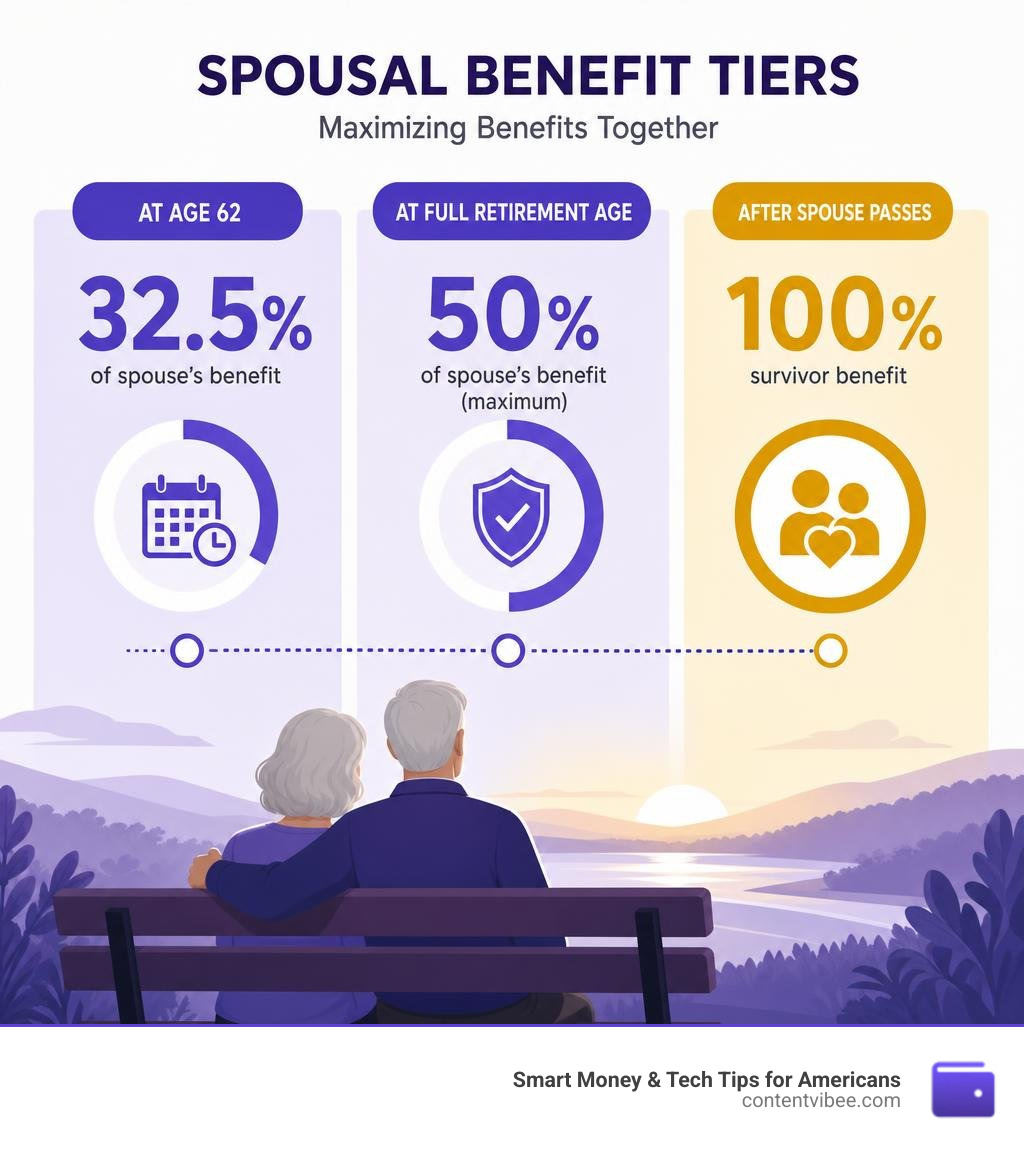
The challenge? The rules are genuinely complex. Spousal benefits cap at 50% of your spouse’s Primary Insurance Amount (PIA). Survivor benefits can reach 100% of what your spouse was receiving. And claiming even one month too early can lock in a permanent reduction.
That’s exactly why dedicated calculators built for couples — not just individuals — matter so much.
Why You Need Social Security Calculators for Married Couples
If you are planning your golden years with a partner, treating Social Security as a solo endeavor is one of the costliest mistakes you can make. The Social Security Administration (SSA) is incredibly efficient, but they are not in the business of automatically designing a custom, multi-decade joint optimization strategy for your household. That is up to you.
When you use dedicated social security calculators for married couples, you are no longer just looking at a single projection. Instead, you are modeling how two distinct lifespans, two earning histories, and multiple benefit types interact.

For starters, you must navigate the overlap between your own earned retirement benefits and potential spousal benefits. To do this correctly, you first need to understand how the SSA determines who gets what. Many couples ask: Can a Married Couple Both Collect Social Security? The answer is a resounding yes! In fact, most dual-earner couples do exactly that.
However, the math gets interesting when one spouse has a significantly higher lifetime earnings history than the other. In these cases, the lower-earning spouse might qualify for a spousal benefit that is higher than their own retirement benefit. If you are wondering how this applies to your situation, you can learn how to check your eligibility for spousal Social Security benefits to see if your household qualifies.
The ultimate goal of joint calculators is to answer the fundamental question: Do Both Spouses Collect Social Security based on their own records, or does one switch to a spousal record? By coordinate-modeling your Primary Insurance Amount (PIA) — which is your monthly benefit at Full Retirement Age (FRA) — these tools reveal the exact months and years you should both file to walk away with the largest possible pile of lifetime cash.
Official SSA Tools for Joint Planning
The natural starting point for your calculations is the source itself: the Social Security Administration. The SSA offers several tools that provide the baseline data you need before running advanced scenarios.
First and foremost, you should create a personal “my Social Security” account. This is the absolute gold standard for verifying your actual earnings history and viewing your real-time PIA. Once logged in, you can access the customized Retirement Calculator. Within this dashboard, you can select “Calculate a Benefit as a Spouse” or “Compare with Benefit as a Spouse.” This allows you to enter your partner’s estimated FRA benefit and see exactly how your choices affect one another. For a deeper dive into the setup, you can learn more about how to use a How Much Social Security Will I Get Calculator to pull these initial figures.
Beyond the main portal, the SSA provides several standalone tools:
- The Detailed Calculator: This is a highly accurate, downloadable software application designed for complex calculations. It is perfect if you have non-covered earnings or need to project exact monthly benefit adjustments. You can access it via the Benefit Calculators – Estimate Your Benefit page.
- The Social Security Quick Calculator: If you do not want to log in or do not have your statement handy, this tool provides a rapid estimate. It calculates your benefits in today’s dollars based on your current age and estimated future earnings. You can run quick scenarios on the Social Security Quick Calculator page.
- Spouse’s Benefit Estimates Tool: Once you have both of your PIAs estimated, you can use the official guidelines on the Spouse’s Benefit Estimates | SSA page to calculate the exact percentage reductions if either of you files before reaching Full Retirement Age.
High-Quality Free and Non-Profit Calculators
While the official SSA tools are unbeatable for raw data accuracy, they can be somewhat rigid. They do not easily let you drag sliders to compare claiming at 62 versus 70 side-by-side, nor do they run complex joint optimization math automatically. That is where high-quality, free, and non-profit calculators step in.
One of the most powerful free tools available is Open Social Security. Developed as an open-source project, this calculator is highly regarded by financial planners. It allows you to input both spouses’ birth dates, genders, and PIAs, and then runs a mathematical optimization program to find the claiming strategy that maximizes your combined lifetime payout. It even lets you adjust the discount rate (the value of money over time) and customize your life expectancies.
Another excellent, highly visual tool is the AARP Social Security Calculator. It is incredibly user-friendly and walks you through a series of simple questions about your marital status, health, and retirement goals. It produces clean, easy-to-read charts showing how your monthly income changes based on different claiming ages. You can test your own numbers directly using the Social Security Calculator: Estimate Your Benefits – AARP .
Using these tools is easy when you break it down. If you want a quick primer on how to gather your data and start projecting, take a look at how to Estimate Your Monthly Retirement Benefits In 5 Easy Steps.
Key Rules and Math Behind Spousal and Survivor Benefits
To get the most out of your social security calculators for married couples, you need to understand the underlying rules the software is programming. The math of Social Security is built on a series of strict percentages and timelines.

The most important concept to grasp is the 50% rule. Under this rule, a spouse can receive up to 50% of the higher-earning worker’s PIA. However, this is only true if the spouse waits until their own Full Retirement Age to claim.
If you decide to claim spousal benefits early, the SSA applies a steep reduction formula. While your own retirement benefit is reduced by 5/9 of 1% per month for the first 36 months before FRA, spousal benefits are slashed by 25/36 of 1% per month for those first 36 months. If you claim even earlier, any additional months are reduced by 5/12 of 1% per month.
What does this look like in the real world? If your FRA is 67 and you claim spousal benefits at age 62, your spousal benefit will be permanently reduced to just 32.5% of your partner’s PIA.
To make sense of how these rules apply to your household, it helps to read up on What Is a Social Security Spousal Benefit and check your eligibility details in The Ultimate Guide To Spousal Social Security Eligibility.
How Social Security Calculators for Married Couples Model Spousal Rules
When you input your information into a joint calculator, the software must account for several modern rules that catch many couples off guard.
The biggest rule is deemed filing. Under the Bipartisan Budget Act of 2015, the old “loopholes” (where one spouse could file a restricted application for spousal benefits while letting their own retirement benefit grow) were effectively eliminated for anyone turning 62 after January 1, 2016. Today, when you file for either your own retirement benefit or a spousal benefit, you are “deemed” to have filed for both. The SSA will automatically calculate both amounts and pay you the higher of the two. You do not get to double-dip or choose to receive one while delaying the other.
Furthermore, calculators must model the fact that spousal benefits do not earn Delayed Retirement Credits (DRCs). If you delay your own retirement benefit past your FRA, your monthly check grows by a guaranteed 8% per year up to age 70. However, a spousal benefit tops out at Full Retirement Age. There is absolutely zero financial benefit to delaying a spousal claim past your FRA.
Understanding these timing nuances is critical. If you are trying to pinpoint the exact month to file, check out our guide on At What Age Can I Claim My Spouses Social Security and see what the process looks like when Applying For Spousal Benefits.
Survivor Benefits vs. Spousal Benefits
While spousal benefits are designed to support a household while both partners are alive, survivor benefits are a completely different animal — and they are often where the biggest financial planning opportunities lie.
When one spouse passes away, the surviving spouse is entitled to 100% of the deceased spouse’s actual benefit (assuming the survivor has reached their own FRA). At that moment, the survivor’s smaller individual benefit stops, and they switch entirely to the larger benefit.
Because of this, the claiming age of the higher earner is the single most important factor in protecting the surviving spouse. If the higher earner delays claiming until age 70, they lock in a maximum monthly benefit (including those 8% annual delayed retirement credits). If they pass away first, that maximized, inflation-adjusted check is passed on to the surviving spouse for the rest of their life.
Conversely, if the higher earner claims early at age 62, they permanently shrink the survivor protection floor for their partner. For a comprehensive walkthrough on how to handle these tragic but vital planning scenarios, read our guide on Claiming Whats Yours A Guide To Deceased Spouse Social Security.
Divorced-Spouse and Marital Status Rules
Marital status changes can complicate your calculations, but the rules are surprisingly generous if you know how they work.
If you were married for at least 10 years, are currently unmarried, and are at least 62 years old, you can claim divorced-spouse benefits on your ex-spouse’s record. This benefit can be worth up to 50% of your ex-spouse’s PIA, exactly like a standard spousal benefit.
The best part? Your ex-spouse does not even need to have filed for their own benefits yet, as long as you have been divorced for at least two consecutive years. Plus, your claim has absolutely zero impact on their monthly benefit, nor does it affect what their current spouse (if they remarried) can claim.
If you are navigating this situation, make sure to read the Divorced Spouse Social Security Guide 2026 and find out if you qualify by reading Can Divorced Spouse Get Social Security Benefits.
Strategic Claiming Scenarios for Married Couples
Now that we have covered the rules, let’s look at how social security calculators for married couples model actual claiming strategies to maximize your household wealth.
For the vast majority of married couples, optimizing Social Security does not mean both partners filing at the exact same time. Instead, it involves a coordinated “split strategy.”
The most common and effective strategy is:
- The higher earner delays claiming until age 70. This maximizes the household’s primary income stream and secures the highest possible survivor benefit.
- The lower earner claims earlier (often at their FRA or even at age 62). This brings immediate cash flow into the household, helping to bridge the gap while the higher earner’s benefit grows by 8% per year.
To see how these moving parts fit together for your specific retirement timeline, read The Smart Couples Guide To Social Security Strategies and explore the data on the Best Age To Collect Ss.
Comparing Claiming Ages with Social Security Calculators for Married Couples
To understand the massive difference a few years can make, let’s look at a hypothetical couple where both partners have a Full Retirement Age of 67.
Assume Spouse A (the higher earner) has a PIA of $2,400, and Spouse B (the lower earner) has a PIA of $1,000.
| Claiming Scenario | Spouse A Monthly Benefit | Spouse B Monthly Benefit | Total Combined Monthly Benefit |
|---|---|---|---|
| Both Claim Early at 62 | $1,680 (30% reduction) | $700 (30% reduction) | $2,380 |
| Both Claim at FRA (67) | $2,400 | $1,000 | $3,400 |
| Split Strategy (B at 62, A at 70) | $2,976 (124% via DRCs) | $700 | $3,676 |
| Both Claim at 70 | $2,976 | $1,240 | $4,216 |
While claiming both at 70 yields the highest monthly check, it may not be practical due to cash flow needs or health concerns. The split strategy (Spouse B at 62, Spouse A at 70) often represents the sweet spot for many couples, offering early income while locking in Spouse A’s massive delay credits for future survivor protection.
Advanced Modeling: Age Gaps, Health, and Legislation
Advanced calculators do not just look at your birth years; they also factor in your health status, age gaps, and changing federal laws.
If there is a large age gap between you and your spouse, delaying the older, higher-earning spouse’s benefit becomes even more critical. If the older spouse passes away, the younger spouse could spend decades relying on that maximized survivor benefit.
Health and life expectancy also play a major role. If both spouses are in poor health, claiming earlier may make sense. However, if at least one spouse is expected to live past the average break-even age (typically 78 to 82), delaying the higher earner’s benefit is almost always the mathematically superior choice.
Your calculations must also account for whether you plan to continue working. If you claim benefits before your FRA and continue to earn an income, you may trigger the Social Security earnings test. For 2026, the earnings limit is $24,480 if you are under FRA. For every $2 you earn above that limit, the SSA will temporarily withhold $1 of your benefits. To see how this might impact your joint strategy, read Working In Retirement Are Spousal Benefits Reduced By Working.
Frequently Asked Questions about Spousal Benefits
Can both spouses collect Social Security at the same time?
Yes, both spouses can collect Social Security at the exact same time. If both partners have worked and earned enough credits, they can each receive their own individual retirement benefits. Alternatively, one spouse can collect their own retirement benefit while the other collects a spousal benefit based on the partner’s record. If you are ready to file, you can learn how to Claim Spousal Benefits to get started.
Do spousal benefits increase if I delay past Full Retirement Age?
No. Unlike your personal retirement benefit, which increases by 8% each year you delay past your Full Retirement Age up to age 70, spousal benefits do not earn delayed retirement credits. They are capped at a maximum of 50% of your spouse’s PIA once you reach your FRA. Therefore, there is no financial benefit to waiting past your FRA to claim a spousal benefit. You can run these exact calculations using a tool to Calculate Spouse Retirement Benefits.
How does the Social Security Fairness Act affect spousal benefits?
The Social Security Fairness Act is a major piece of bipartisan legislation aimed at eliminating the Government Pension Offset (GPO) and the Windfall Elimination Provision (WEP). Historically, these rules severely reduced (and sometimes completely eliminated) the spousal and survivor benefits of teachers, firefighters, police officers, and other public servants who earned non-covered government pensions.
With the passage of this legislation, public servants can now receive their full, unreduced spousal and survivor benefits. If you or your spouse has a government pension, make sure to check out Your Digital Guide To Form Ssa 2 And Online Spousal Claims to see how these updated rules apply to your filing process.
Conclusion
At Smart Money & Tech Tips for Americans, we believe that taking control of your financial future starts with having the right tools. When it comes to Social Security, guessing is simply too expensive.
By using a dedicated Social Security Spousal Benefit Calculator, you and your partner can easily model different scenarios, project your combined lifetime income, and find the exact strategy that fits your unique retirement goals.
While online calculators are incredible for mapping out your options, they are ultimately planning aids. Before making your final decision, we highly recommend verifying your records with the SSA and consulting a fee-only financial advisor to ensure your plan accounts for your entire financial picture, including taxes and investment portfolios.
Ready to secure every dollar you are entitled to? Review The Golden Rules Can A Spouse Collect Ss Spousal Benefits and start modeling your retirement strategy today!