


One Decision That Can Mean $100,000+ in Lifetime Income
Using a best age to take social security calculator is one of the smartest moves you can make before retirement — because when you claim can permanently change your monthly check for the rest of your life.
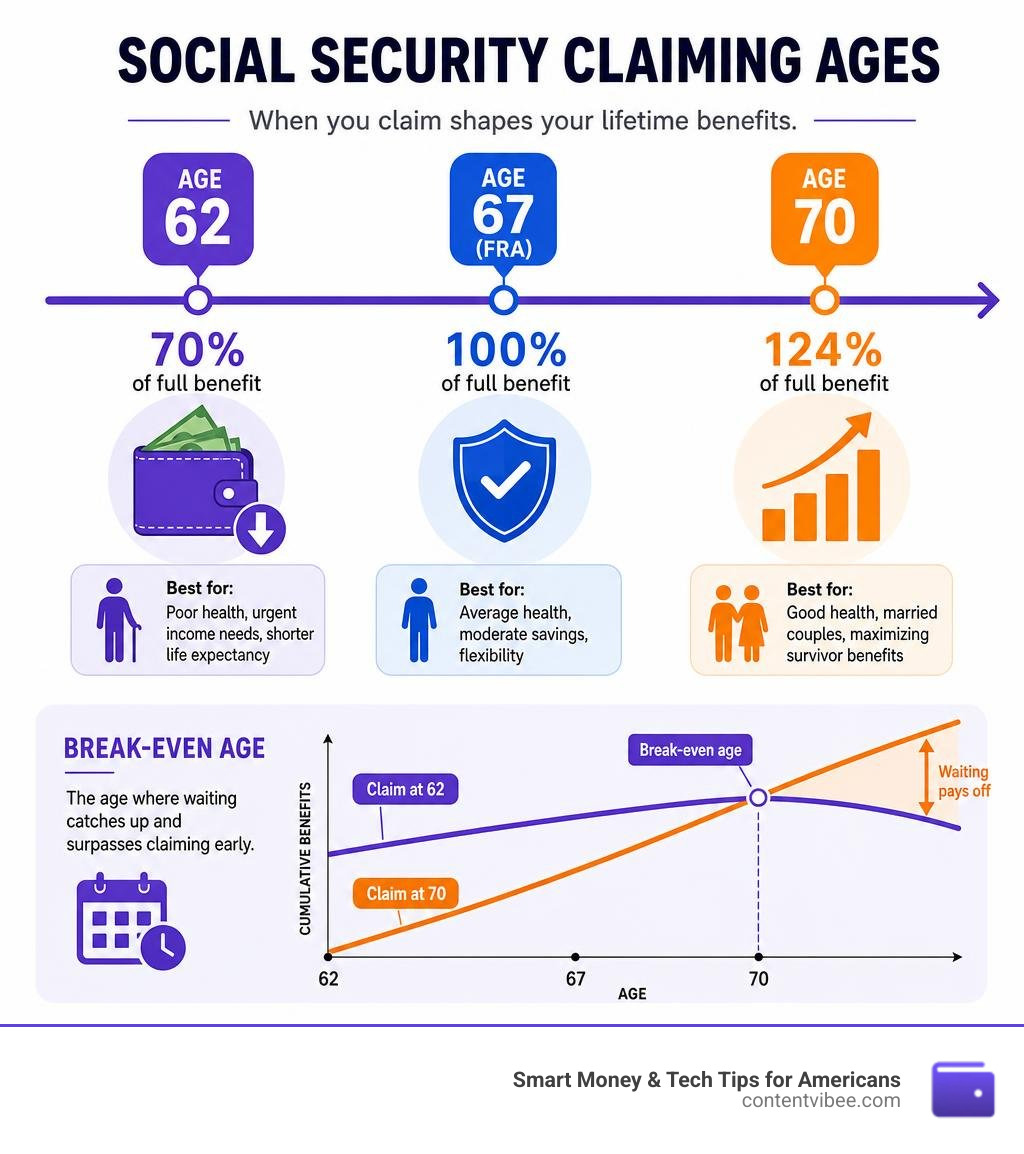
Quick answer: What is the best age to take Social Security?
| Claiming Age | Monthly Benefit (% of Full) | Best For |
|---|---|---|
| 62 | 70% of full benefit | Poor health, urgent income needs, shorter life expectancy |
| 67 (FRA) | 100% of full benefit | Average health, moderate savings, flexibility |
| 70 | 124% of full benefit | Good health, married couples, maximizing survivor benefits |
The single biggest factor is life expectancy. If you live past age 80-82, waiting pays off significantly. If you live to 90, delaying to 70 can mean $100,000 or more in extra lifetime income.
Here’s the problem most people face: the math isn’t obvious. Claiming early gives you more checks sooner. Waiting gives you bigger checks later. A calculator helps you find the crossover point — called the break-even age — based on your specific numbers.
And if you’re married, the decision gets even more important. The higher earner’s claiming age sets the survivor benefit. Getting that wrong can cost a surviving spouse tens of thousands of dollars.
This guide walks you through exactly how these calculators work, what inputs matter most, and how to make the right call for your situation.
What Is the Social Security Break-Even Age?
At its core, the decision of when to claim Social Security is a mathematical optimization problem wrapped in a personal longevity bet. The “break-even age” is the exact age at which the cumulative lifetime benefits of delaying your claim surpass the total cumulative benefits of claiming early.
Before this crossover point, the person who claimed early at age 62 has pocketed more total cash. After this point, the person who delayed their claim pulls ahead and remains ahead for the rest of their life.
When we run the numbers, the break-even age ranges typically fall into predictable windows:
- Claiming at 62 vs. 67 (FRA): The break-even age is typically around 78 to 80 years old. This represents roughly 140 months (11 years and 8 months) of receiving the larger unreduced benefit to recover the five years of missed early checks.
- Claiming at 62 vs. 70: The break-even age is roughly 80 to 82 years old. You forfeit 8 years of early checks (from age 62 to 70) to lock in a monthly benefit that is roughly 76% larger. It takes about 10.4 years of collecting the maximum check to break even.
To understand how this works over a lifetime, let’s use a net present value (NPV) approach. If we evaluate the pure dollar totals without accounting for inflation or investment returns, the math is straightforward. If you live past age 80, delaying your claim is almost always the winning strategy.
However, determining the best age to collect ss is about more than just raw cash. It is about managing risk, protecting your household against late-life poverty, and optimizing your guaranteed, inflation-adjusted retirement income.
How a Best Age to Take Social Security Calculator Models Longevity
A high-quality best age to take social security calculator does not simply add up monthly checks. It models your longevity using survival curves and health-adjusted life expectancy inputs.
Many people make the mistake of looking at average population lifespans and assuming they will not live long enough to make delaying worthwhile. However, population averages are heavily skewed by infant mortality and early-life deaths.
According to actuarial data, on average, a woman reaching age 65 today (in 2026) lives to age 87, and a man reaching age 65 lives to age 84. For healthy non-smokers with no major chronic conditions, living into the late 80s or 90s is highly common.
A sophisticated calculator allows you to input your health status, family medical history, and lifestyle habits to generate a personalized survival curve. Instead of a single “guess” at your death date, it calculates the probability of you living to various milestone ages.
By modeling these probabilities, the calculator shows you the statistical likelihood that delaying your claim will result in a higher lifetime payout. To get started with estimating your baseline figures, you can learn how to estimate your monthly retirement benefits in 5 easy steps using your actual earnings history.
Claiming Age Trade-Offs: 62 vs. FRA vs. 70
To make an informed decision, you must understand how the Social Security Administration (SSA) calculates your checks. Your benefits are anchored to your Primary Insurance Amount (PIA), which is the monthly benefit you are entitled to receive at your Full Retirement Age (FRA).
If you claim before your FRA, your monthly benefit is hit with a permanent reduction. If you delay past your FRA, you earn delayed retirement credits that permanently increase your monthly benefit until you reach age 70.
Let’s look at a comprehensive comparison of how claiming age affects monthly benefits and cumulative lifetime totals for an individual with a $2,000 monthly PIA at an FRA of 67.
| Claiming Age | Monthly Benefit | % of PIA | Cumulative Total at Age 75 | Cumulative Total at Age 85 | Cumulative Total at Age 90 |
|---|---|---|---|---|---|
| Age 62 | $1,400 | 70% | $218,400 | $386,400 | $470,400 |
| Age 67 (FRA) | $2,000 | 100% | $192,000 | $432,000 | $552,000 |
| Age 70 | $2,480 | 124% | $148,800 | $446,400 | $595,200 |
Note: This table assumes a constant dollar value for illustrative purposes. Actual cumulative benefits would be higher due to annual Cost-of-Living Adjustments (COLA).
As the math shows, the gap between claiming early and delaying widens dramatically the longer you live. By age 90, the individual who delayed until age 70 has collected $124,800 more in lifetime benefits than the individual who claimed at age 62.
For a deeper dive into these mechanics, check out a comprehensive guide to social security benefits or review the Guide on Taking Social Security: 62 vs. 67 vs. 70 | Charles Schwab .
The Cost of Claiming Early at Age 62
Claiming at age 62 is highly tempting. It represents the earliest possible age to claim retirement benefits, offering immediate cash flow and the freedom to retire early. However, this early gratification comes at a steep, permanent financial cost.
If your Full Retirement Age is 67, claiming at age 62 results in a permanent 30% reduction in your monthly benefit. The SSA calculates this reduction using a strict monthly formula:
- For the first 36 months before your FRA, your benefit is reduced by 5/9 of 1% per month (about 6.67% per year).
- For any additional months beyond 36 months, your benefit is further reduced by 5/12 of 1% per month (5% per year).
For an individual with a $2,000 PIA, claiming at 62 slices the monthly check down to $1,400. This reduction is locked in for life. While you will receive 60 extra checks between ages 62 and 67, each check is significantly smaller. If you live an average lifespan, this decision will permanently lower your lifetime retirement income.
Waiting for Your Full Retirement Age (FRA)
Your Full Retirement Age (FRA) is the age at which you are entitled to receive 100% of your Primary Insurance Amount with zero age-based reductions. For decades, the FRA was age 65. However, due to legislative changes passed by Congress in 1983 to preserve the system’s solvency as lifespans increased, the FRA has gradually climbed.
For anyone born in 1960 or later, the Full Retirement Age is 67. If you were born between 1955 and 1959, your FRA increases by two-month increments:
- 1955: 66 years and 2 months
- 1956: 66 years and 4 months
- 1957: 66 years and 6 months
- 1958: 66 years and 8 months
- 1959: 66 years and 10 months
Claiming at your FRA is a neutral baseline strategy. It avoids any early claiming penalties while giving you access to your full earned benefit. To find your exact FRA based on your birth year, you can consult the official SSA Retirement Age Calculator.
Maximizing Monthly Income at Age 70
If you have the financial means and the health to do so, waiting until age 70 to claim your benefits is one of the most powerful wealth-building strategies available in retirement.
For every month you delay claiming past your Full Retirement Age up to age 70, the SSA rewards you with delayed retirement credits. These credits accrue at a rate of 2/3 of 1% per month, which translates to a guaranteed 8% permanent increase per year.
If your FRA is 67 and you delay until age 70, your monthly check will be 124% of your unreduced PIA. Combined with compounding annual Cost-of-Living Adjustments (COLA), your monthly check at age 70 will be roughly 76% larger than it would have been had you claimed at age 62.
There is no financial benefit to waiting past age 70, as delayed retirement credits stop accruing once you reach your 70th birthday.
How Spousal and Survivor Benefits Impact Your Strategy

When you are single, optimizing Social Security is a solo math problem. But when you are married, claiming becomes a team sport. Coordinating your claiming ages as a couple is essential for maximizing household lifetime income and protecting the surviving partner.
To build a comprehensive plan, couples should consult the smart couples guide to social security strategies.
Coordinating Benefits for Married Couples
For married couples, there are two primary types of benefits to coordinate: retirement benefits based on your own work history, and spousal benefits based on your partner’s work history.
A spousal benefit allows a lower-earning spouse to claim up to 50% of the higher earner’s Primary Insurance Amount (PIA), provided the higher earner has already filed for their own retirement benefits.
- If the lower earner’s own retirement benefit is higher than 50% of the spouse’s PIA, they will receive their own benefit.
- If 50% of the spouse’s PIA is higher, the SSA will pay a combination of benefits that equals the higher spousal amount.
To understand how this works, we must answer: do both spouses collect social security? The answer is yes. Both spouses can collect their respective benefits simultaneously. In fact, can a married couple both collect social security on their own records? Absolutely, as long as both have earned enough work credits.
To optimize household benefits, couples often use a “split strategy.” The lower-earning spouse might claim their benefit early (at or near FRA) to provide immediate retirement cash flow. Meanwhile, the higher-earning spouse delays their claim until age 70.
This strategy does two things: it maximizes the guaranteed 8% delayed retirement credits on the larger benefit, and it locks in the highest possible survivor benefit for whichever spouse lives longer. To run these exact numbers for your household, you can use our Tools/Finance Calculator/Social Security Spousal Benefit Calculator.
Rules for Divorced and Surviving Spouses
Social Security provides strong safety nets for divorced individuals and surviving spouses, but the rules are highly specific.
If you were married for at least 10 years and are currently unmarried, you may be eligible to claim spousal benefits based on your ex-spouse’s earnings record. To understand your options, check out can divorced spouse get social security benefits.
Best of all, claiming on an ex-spouse’s record has absolutely zero impact on their benefits, nor does it affect the benefits of their current spouse if they have remarried.
For surviving spouses, the rules are even more generous. When a spouse dies, the surviving spouse is entitled to switch to a survivor benefit equal to 100% of the deceased spouse’s monthly benefit (including any delayed retirement credits earned), provided they have reached their own FRA. The smaller of the couple’s two individual checks disappears, and the survivor keeps the larger one.
Because the survivor benefit is based on what the deceased spouse was actually collecting, it is critical that the higher earner delays claiming as long as possible. If the higher earner claims at 62, they permanently reduce the survivor benefit for their spouse. If they wait until 70, they leave behind the largest possible inflation-protected safety net.
To model this, you can learn how to calculate survivor retirement benefits to ensure your partner is fully protected.
Key Factors to Input Into Your Best Age to Take Social Security Calculator

A simple online calculator might only ask for your birth year and estimated income. However, a truly robust tool requires a broader set of inputs to provide an accurate, personalized recommendation.
When you use a calculator, make sure you account for cost-of-living adjustments, investment opportunity costs, and your total retirement assets.
The Impact of the Social Security Earnings Test
If you plan to continue working in your 60s while collecting Social Security benefits early, you must account for the Social Security Earnings Test.
If you claim benefits before your Full Retirement Age and earn more than the annual limit, the SSA will temporarily withhold a portion of your benefits:
- In 2026, the earnings limit is $24,480. If you are under FRA for the entire year, the SSA will withhold $1 in benefits for every $2 you earn above this limit.
- In the year you reach FRA, the limit is higher ($59,520 in 2024 terms, adjusted for 2026). The SSA will withhold $1 in benefits for every $3 you earn above the limit, up to the month you reach FRA.
- Once you reach Full Retirement Age, the earnings test disappears. You can earn an unlimited amount of money with zero benefit withholding.
Many retirees mistakenly believe that these withheld benefits are lost forever. They are not. Once you reach your FRA, the SSA will recalculate your monthly benefit upward to account for the months your benefits were withheld.
However, working while claiming early can cause significant short-term cash flow disruptions and tax complications, making it a key variable to model in your calculator.
Tax Implications and the Tax Torpedo
Another critical factor is how your benefits are taxed. Social Security benefits are subject to federal income taxes based on your “provisional income” (calculated as your Adjusted Gross Income + any tax-exempt interest + 50% of your Social Security benefits).
- Single Filers:
- Provisional income between $25,000 and $34,000: Up to 50% of benefits are taxable.
- Provisional income above $34,000: Up to 85% of benefits are taxable.
- Married Filing Jointly:
- Provisional income between $32,000 and $44,000: Up to 50% of benefits are taxable.
- Provisional income above $44,000: Up to 85% of benefits are taxable.
This taxation structure creates a phenomenon known as the “Tax Torpedo.” As your other income increases, it pushes more of your Social Security benefits into the taxable category, resulting in extremely high effective marginal tax rates (sometimes exceeding 40% for middle-income retirees).
To mitigate this, many advisors recommend executing Roth conversions in your early 60s before you start claiming Social Security. This reduces your future Required Minimum Distributions (RMDs) and lowers your provisional income, protecting your Social Security checks from heavy taxation.
Additionally, under the “Big Beautiful Bill” provisions active from 2026 through 2028, an additional $6,000 standard deduction is available for beneficiaries age 65 and older, which can significantly reduce the tax burden on your benefits.
Health, Savings, and Immediate Income Needs
While delaying until age 70 is mathematically superior for most people, personal circumstances must always override pure math.
If you suffer from chronic health conditions that suggest a below-average life expectancy, claiming early at age 62 is often the correct financial move. It ensures you collect as many checks as possible while you can enjoy them.
Similarly, if you are cash-tight and have limited personal retirement savings, you may have no choice but to claim early to cover your basic living expenses.
However, if you have a traditional pension or a robust 401(k) balance, you can use those assets to “bridge the gap” in your 60s, drawing down on your investments to allow your guaranteed, inflation-protected Social Security benefit to compound at 8% per year until age 70.
Can You Change Your Mind After Claiming?
What happens if you file for Social Security early and realize you made a mistake? Fortunately, the system offers two primary “reset buttons” for retirees who change their minds.
Withdrawing Your Application Within 12 Months
If you regret your decision to claim early, you have a one-time option to withdraw your application.
To do this, you must file Form SSA-521 within 12 months of your initial approval. There is a catch: you must repay every single dollar you (and anyone claiming on your record, like a spouse) have received in benefits, including any withheld Medicare premiums.
If you can afford the repayment, this completely resets your record as if you had never filed, allowing your benefit to continue growing.
Suspending Benefits at Full Retirement Age
If you are past the 12-month withdrawal window, your next opportunity comes when you reach your Full Retirement Age.
Once you reach your FRA, you can request a voluntary suspension of your benefits. Your monthly checks will stop, and you will begin earning delayed retirement credits of 8% per year until you resume your benefits or reach age 70.
This is an excellent option for retirees who claimed early at 62, returned to work, and no longer need the immediate cash flow.
Frequently Asked Questions
How do I use a best age to take social security calculator to estimate my benefits?
To use a calculator effectively, first log into your “my Social Security” account on ssa.gov to retrieve your estimated Primary Insurance Amount (PIA).
Input this PIA, your birth year, your estimated retirement age, and your health status. You can use the Social Security Calculator: Estimate Your Benefits – AARP to compare different claiming ages side-by-side.
How does inflation affect my delayed retirement benefits?
Cost-of-Living Adjustments (COLA) compound on top of your base benefit. Because COLA is a percentage-based increase, delaying your claim to get a higher base benefit means your annual inflation adjustments will be larger in raw dollar terms.
For example, a 3% COLA on a $2,480 delayed benefit yields $74.40 more per month, whereas the same 3% COLA on a $1,400 early benefit yields only $42.00 more.
Can both spouses collect Social Security at the same time?
Yes, both spouses can collect their respective retirement benefits at the same time. If one spouse’s retirement benefit is lower than 50% of the other’s PIA, they can receive a spousal top-off.
To understand when you can start claiming these coordinated benefits, read about at what age can i claim my spouses social security.
Conclusion
At Smart Money & Tech Tips for Americans, we are dedicated to helping you navigate the complex world of retirement planning with confidence. Deciding when to claim Social Security is one of the most important financial decisions of your life, with over $100,000 of potential lifetime income hanging in the balance.
By utilizing a best age to take social security calculator, coordinating with your spouse, and factoring in your health and taxes, you can build a strategy that maximizes your guaranteed income and ensures long-term financial security.
Ready to see how much you could collect? Use our how much social security will i get calculator to start modeling your retirement future today.