


Why Maximizing Social Security Benefits Could Be the Most Important Financial Decision You Make
Maximizing Social Security benefits is one of the highest-impact moves you can make in retirement planning — and most Americans are leaving serious money on the table.
Here’s a quick answer to get you started:
Top ways to maximize your Social Security benefits:
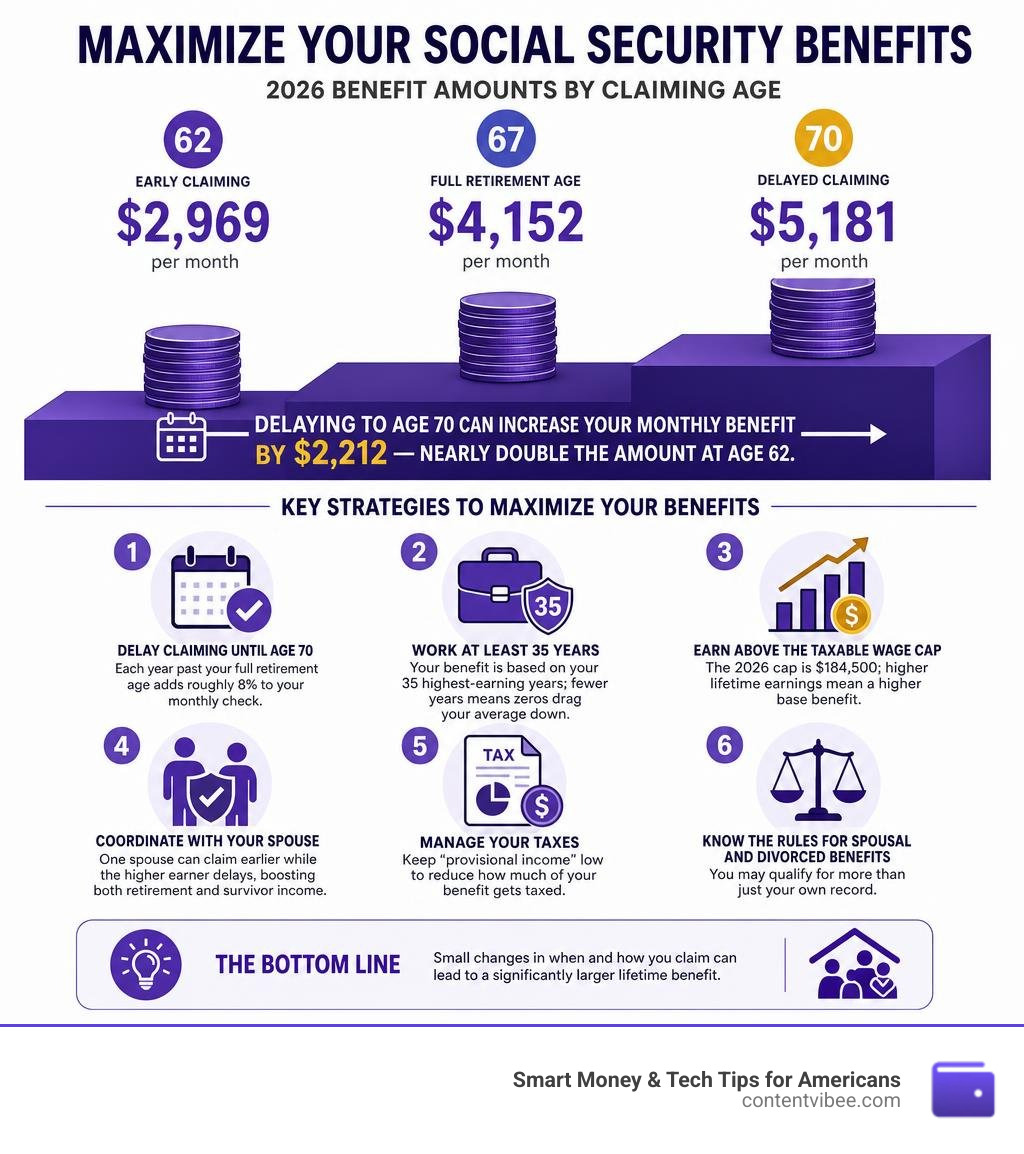
- Delay claiming until age 70 — each year past your full retirement age adds roughly 8% to your monthly check
- Work at least 35 years — your benefit is based on your 35 highest-earning years; fewer years means zeros drag your average down
- Earn above the taxable wage cap — the 2026 cap is $184,500; higher lifetime earnings mean a higher base benefit
- Coordinate with your spouse — one spouse can claim earlier while the higher earner delays, boosting both retirement and survivor income
- Manage your taxes — keep “provisional income” low to reduce how much of your benefit gets taxed
- Know the rules for spousal and divorced benefits — you may qualify for more than just your own record
The numbers make this urgent. In 2026, the maximum monthly benefit at age 62 is $2,969. Wait until your full retirement age and it rises to $4,152. Wait until 70 and it jumps to $5,181 — nearly double the early-claiming amount.
Yet research from the National Bureau of Economic Research shows only about 10% of workers wait past age 65 to collect. For the typical household, that gap in knowledge costs more than $180,000 in lifetime income.
And it’s not just about when you claim. Only 42% of people can correctly answer a basic question about how their monthly benefit is even calculated. If you don’t understand the formula, you can’t optimize it.
This guide breaks down everything — the math, the strategies, the special rules for spouses and divorced partners, and the common mistakes that quietly shrink your lifetime payout.
How the Social Security Formula and Claiming Age Affect Your Payout
To win a game, you must first understand the rules. Far too many retirees treat Social Security like a mysterious government lottery, hoping they claim at the “right” time without understanding the underlying math.
Your monthly benefit is not a random number, nor is it based solely on your final salary before you shake hands, accept your gold watch, and walk out the door. Instead, it is the product of a highly structured formula that looks at your entire career.
Let’s look at how your claiming age fundamentally alters your monthly check in 2026:
| Claiming Age | Maximum Monthly Benefit (2026) | Percentage of Primary Insurance Amount (PIA) |
|---|---|---|
| Age 62 (Early Claiming) | $2,969 | ~70% |
| Age 67 (Full Retirement Age) | $4,152 | 100% |
| Age 70 (Delayed Claiming) | $5,181 | 124% |
As you can see, the difference between claiming at 62 and waiting until 70 is a staggering $2,212 per month. Over a 20-year retirement, that decision alone is worth more than $530,000 in raw, inflation-adjusted income.
Calculating Your Primary Insurance Amount (PIA)
Your Primary Insurance Amount, or PIA, is the foundational building block of your Social Security benefit. It is the exact amount you are entitled to receive if you claim at your Full Retirement Age (FRA).
The Social Security Administration (SSA) calculates your PIA using a three-step process:
- Index Your Earnings: Your actual historical earnings are adjusted (indexed) to account for changes in average wages over time. This places your 1990 salary on equal footing with your 2025 earnings.
- Calculate Your AIME: The SSA takes your 35 highest-earning years and divides the total by 420 (the number of months in 35 years) to find your Average Indexed Monthly Earnings (AIME).
- Apply the Bend Points: The SSA applies a formula to your AIME using “bend points” (which change annually) to determine your PIA. For example, the formula replaces 90% of your earnings up to the first bend point, 32% up to the second, and 15% of any earnings beyond that.
Because this formula is progressive, it replaces a higher percentage of income for lower earners than for higher earners. If you want to dive deeper into the exact math behind this calculation, read our step-by-step guide on How to Calculate Your Social Security Benefit in 5 Simple Steps.
Why Your 35 Highest-Earning Years Matter for Maximizing Social Security Benefits
The magic number in Social Security calculations is 35. If you worked for 40 years, only your 35 highest-earning years are used to calculate your benefit. The other five years are thrown out.
However, if you only worked for 30 years, the SSA doesn’t average those 30 years. Instead, they still divide your total lifetime earnings by 35 years (420 months). This means they will insert five “zeros” into your calculation. Even a single zero can drag down your AIME and permanently shrink your monthly check.
To achieve maximum benefits, you must replace those low-earning or zero-earning years with high-earning years. This is why late-career earnings are so valuable. If you are earning a peak salary in your 60s, working just a few more years can erase low-paying jobs from your early 20s and substantially boost your PIA.
Furthermore, any wages you earn above the annual Social Security taxable wage cap do not count toward your benefit calculation. To maximize your base benefit, you want to earn as close to this cap as possible for at least 35 years. For more tips on how boosting your salary directly translates to retirement wealth, check out the resource Earn, Baby, Earn: The Key to Maximizing Your Social Security .
The Cost of Claiming Early at Age 62
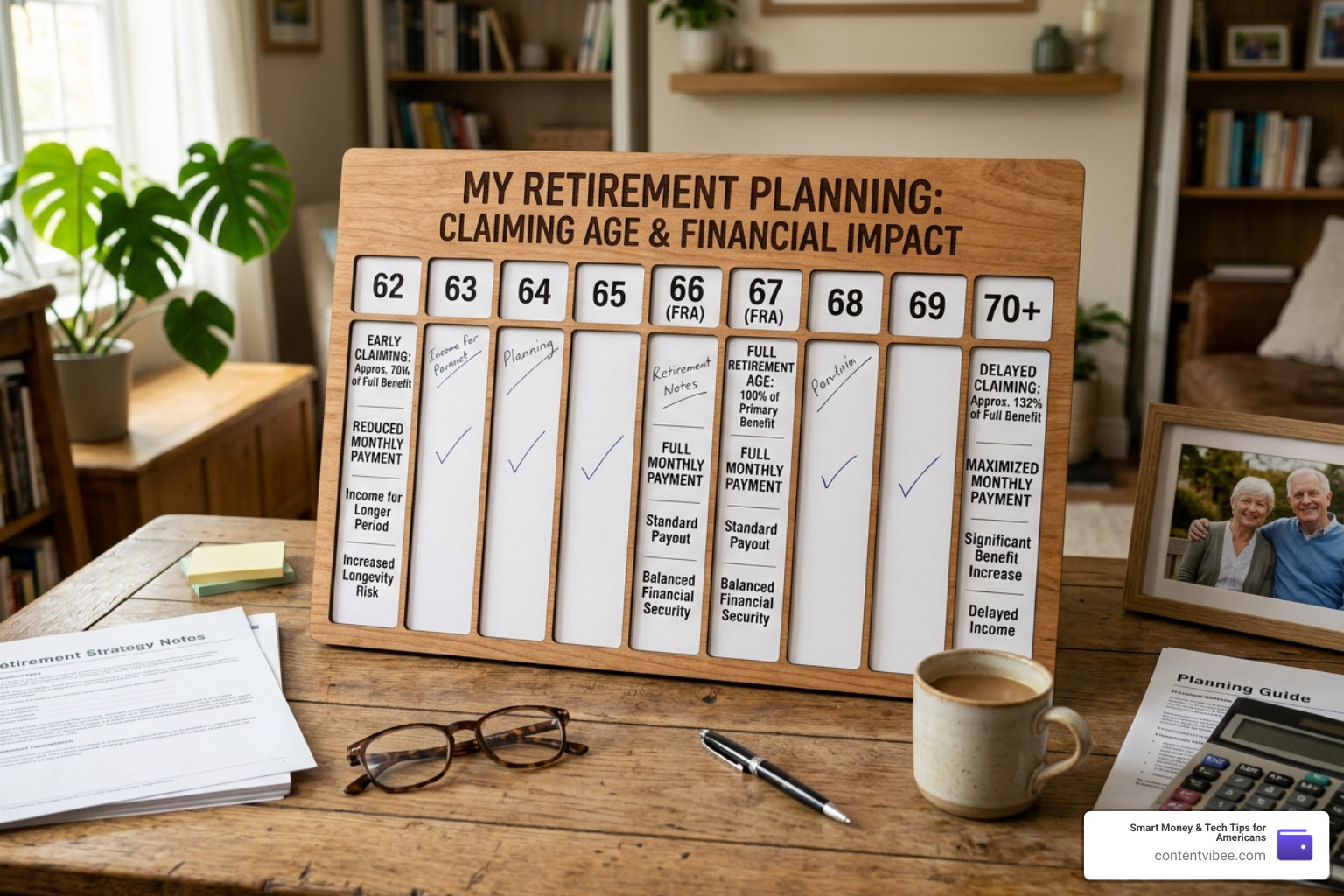
You are eligible to claim retirement benefits as early as age 62, but doing so comes with a heavy financial penalty. If your Full Retirement Age is 67 (which is the case for anyone born in 1960 or later) and you claim at 62, your monthly check is hit with a permanent 30% reduction.
This reduction is applied monthly. For every month you claim before your FRA, your benefit is shaved down. If you claim at 62, you are permanently locked into receiving just 70% of your PIA.
While claiming early might seem tempting if you want to leave the workforce immediately, it can severely damage your long-term financial security. This is particularly true if you live a long, healthy life and run the risk of outliving your other retirement savings. To understand the exact trade-offs of different filing ages, explore The Definitive Guide to Social Security Claiming Age.
The 8% Annual Reward for Delaying Until Age 70
On the flip side, patience pays off handsomely. For every year you delay claiming past your Full Retirement Age, your benefit increases by 8% per year in delayed retirement credits.
This annual 8% boost compound-increases your benefit until you reach age 70, at which point the credits stop accumulating. If your FRA is 67 and you wait until 70, you will receive 124% of your PIA for the rest of your life.
Think of this as a guaranteed, government-backed, inflation-adjusted 8% annual return on your money. No commercial annuity or investment portfolio can offer this level of risk-free growth. Delaying until 70 acts as the ultimate “longevity insurance,” protecting you against inflation and the rising costs of healthcare in your later years. To see why this delay is often the smartest mathematical move, read our analysis on Why Waiting for Social Security Age 70 Benefits Might Be Your Best Move.
Key 2026 Changes Affecting Your Monthly Check
As we navigate through 2026, several key adjustments have taken effect that directly impact your planning:
- The 2026 COLA: Beneficiaries received a 2.8% Cost-of-Living Adjustment (COLA). While smaller than the massive adjustments of previous years, this 2.8% increase adds roughly $56 per month to the average retiree’s check, helping to preserve purchasing power.
- The Taxable Earnings Cap: The maximum amount of earnings subject to the Social Security tax has risen to $184,500 in 2026. If you earn above this amount, you stop paying the 6.2% Social Security payroll tax for the year, and any earnings beyond this point will not increase your future benefit.
Advanced Strategies for Maximizing Social Security Benefits

Now that you know the basic framework, let’s explore advanced strategies to extract every possible dollar from the system. Maximizing Social Security benefits requires looking beyond simple claiming ages and integrating your benefits with your overall tax and withdrawal strategies.
Reaching the 2026 Maximum Benefit of $5,181
To receive the absolute maximum possible Social Security retirement benefit of $5,181 per month in 2026, you must hit a very high bar. Specifically, you must meet two conditions:
- You must have earned at or above the maximum taxable wage cap for at least 35 years of your working career.
- You must have delayed claiming your benefits until age 70.
For most people, achieving this exact figure is highly unlikely. However, understanding this goalpost reminds us of the core formula: work longer, earn more, and wait as long as possible to claim.
Defeating the Tax Torpedo and Managing Provisional Income
Many retirees are shocked to discover that their Social Security benefits can be taxed. Up to 85% of your benefits may be subject to federal income tax depending on your “provisional income.”
Provisional income is calculated using this simple formula:
$$\text{Provisional Income} = \text{Adjusted Gross Income (AGI)} + \text{Tax-Exempt Interest} + 50\% \text{ of Social Security Benefits}$$
The federal tax thresholds for provisional income have not been adjusted for inflation since they were introduced decades ago:
- Single Filers:
- Under $25,000: $0 of benefits are taxed.
- $25,000 to $34,000: Up to 50% of benefits are taxed.
- Over $34,000: Up to 85% of benefits are taxed.
- Married Joint Filers:
- Under $32,000: $0 of benefits are taxed.
- $32,000 to $44,000: Up to 50% of benefits are taxed.
- Over $44,000: Up to 85% of benefits are taxed.
This setup triggers the notorious “Tax Torpedo.” When your provisional income crosses these thresholds, taking an extra dollar out of your traditional IRA can suddenly make 50% to 85% of your Social Security benefits taxable, pushing your effective marginal tax rate over 40%.
To defeat the Tax Torpedo, we recommend three key tax-planning strategies:
- Roth Conversions: Convert traditional IRA or 401(k) funds into a Roth account during your early 60s, before you claim Social Security. Roth withdrawals are tax-free and do not count toward your provisional income.
- Qualified Charitable Distributions (QCDs): If you are over 70½, you can direct up to $105,000 annually from your traditional IRA directly to a charity. This satisfies your Required Minimum Distribution (RMD) without adding to your AGI or provisional income.
- Leverage the Senior Deduction: Be sure to utilize the temporary $6,000 senior tax deduction available through 2028 to help shield your retirement income from federal taxes.
Essential Software for Maximizing Social Security Benefits
Because the rules are highly complex, trying to calculate the optimal claiming strategy using basic spreadsheets is a recipe for missed opportunities.
Fortunately, specialized software can help you run unlimited “what-if” scenarios, calculate break-even dates, and map out coordinated filing plans. One of the leading tools in the industry is Maximize My Social Security: Home , which was developed by academic economists to handle complex household configurations, including spousal, divorced, and survivor benefits.
For married couples looking to compare free and paid tools to see which fits their planning needs best, we have compiled a detailed list in our guide: Do the Math: Top Social Security Calculators for Married Couples.
Coordinating Spousal, Survivor, and Divorced Partner Benefits
Social Security planning is not a solo sport. If you are married, widowed, or divorced, your claiming decisions are deeply intertwined with your partner’s earnings history.
Maximizing Spousal Benefits for Married Couples
Spousal benefits allow a lower-earning spouse to receive a monthly check worth up to 50% of the higher-earning spouse’s PIA (calculated at their Full Retirement Age).
To qualify for a spousal benefit:
- You must be married for at least one continuous year.
- The higher-earning spouse must have already filed for their own retirement benefits.
- The lower-earning spouse must be at least 62 years old.
If the lower-earning spouse claims their spousal benefit at their own Full Retirement Age, they will receive the full 50%. If they claim early (at 62), the spousal benefit is permanently reduced.
Coordinated Strategy: A highly effective approach for married couples is the “split strategy.” The lower-earning spouse claims their retirement benefit early to provide immediate household income. Meanwhile, the higher-earning spouse delays claiming their benefit until age 70. This allows the higher earner’s benefit to grow by 8% per year. Once the higher earner files at 70, the lower-earning spouse can step up to their spousal benefit if it is higher than their own retirement check.
To master this strategy and avoid leaving money on the table, read our comprehensive guides on Maximizing Spousal Benefits Without Leaving Money on the Table and His, Hers, and Ours: The Ultimate Guide to Dual Social Security Benefits. You can also explore expert wealth management perspectives on coordinating benefits in this helpful article: How to increase income from Social Security – TIAA .
Survivor Benefits and Sequencing Strategies for Widows and Widowers
Losing a spouse is emotionally devastating, but understanding survivor benefits can protect your financial future. As a surviving spouse, you are entitled to receive up to 100% of your deceased partner’s monthly benefit, provided you claim at your own Full Retirement Age.
Survivor benefits can be claimed as early as age 60 (or age 50 if you are disabled). However, claiming early will permanently reduce the monthly payout.
The Sequencing Strategy: Widows and widowers have a unique advantage: they can sequence their benefits. You can choose to claim a survivor benefit early (at age 60) while letting your own personal retirement benefit grow. Then, at age 70, you can switch to your own maximized personal benefit if it has grown larger than the survivor benefit. Alternatively, you can claim your own retirement benefit early at 62, and then switch to a 100% survivor benefit once you reach your Full Retirement Age.
Claiming Rules for Divorced Spouses
If you are divorced, you may still be eligible to claim spousal or survivor benefits based on your ex-spouse’s earnings record. The best part? Your claim will not reduce your ex-spouse’s benefit, nor will their current spouse be affected in any way.
To claim benefits on an ex-spouse’s record, you must meet the following criteria:
- Your marriage lasted for 10 years or longer.
- You are currently unmarried (if you remarry, you generally lose eligibility for divorced spousal benefits, unless the subsequent marriage ends).
- You are at least 62 years old.
- Your ex-spouse is eligible for retirement benefits (even if they haven’t filed yet, as long as you have been divorced for at least two continuous years).
If you qualify, you can receive up to 50% of your ex-spouse’s PIA. If they pass away, you can receive up to 100% of their benefit as a surviving divorced spouse.
Frequently Asked Questions About Social Security Optimization
What is the maximum Social Security retirement benefit payable in 2026?
The maximum possible monthly benefit in 2026 depends entirely on the age at which you choose to claim:
- Age 62: $2,969 per month
- Full Retirement Age (67): $4,152 per month
- Age 70: $5,181 per month
To qualify for these maximum figures, you must have earned the maximum taxable wage limit ($184,500 in 2026) for at least 35 years of your career.
Can I work while receiving Social Security benefits in 2026?
Yes, you can work while receiving benefits, but if you claim before your Full Retirement Age, your earnings are subject to the Social Security Earnings Test:
- If you are under FRA all of 2026: You can earn up to $24,480. For every $2 you earn above this limit, the SSA will withhold $1 in benefits.
- In the year you reach FRA (2026): You can earn up to $65,160 in the months leading up to your birthday. For every $3 you earn above this limit, the SSA will withhold $1.
- Once you reach FRA: The earnings test no longer applies. You can earn an unlimited amount with zero benefit reductions.
Note: Withheld benefits are not lost forever. Once you reach your FRA, the SSA recalculates your monthly check upward to account for the months your benefits were withheld.
How does the 2026 COLA adjustment affect my benefits?
The 2.8% COLA adjustment for 2026 automatically increases your monthly benefit check. For example, if you were receiving a monthly benefit of $2,000 in December 2025, your check increased to $2,056 starting in January 2026. This adjustment is automatically applied by the SSA, so you do not need to file any paperwork to receive it.
Conclusion
Optimizing your retirement income is not about guessing; it is about applying clear, mathematical strategies to your unique financial picture. At ContentVibee, we are dedicated to providing clear, actionable advice to help you navigate these complex rules and secure the maximum lifetime payout you deserve.
Are you ready to see exactly how much you can expect to receive based on your preferred claiming age? Use our free, interactive tool to run your numbers and start planning your perfect exit strategy:
Estimate Your Payout with the ContentVibee Social Security Calculator