


Wealthfront Investment Fees Robo Advisor Cost and Returns is one of the most searched topics among self-directed investors weighing whether a robo-advisor can genuinely compete with — or beat — traditional investing options on both cost and performance.
Here’s the quick answer:
| Fee Type | Cost |
|---|---|
| Automated Index Investing | 0.25% annually |
| Automated Bond Ladder | 0.15% annually |
| S&P 500 Direct Portfolio | 0.09% annually |
| Nasdaq-100 Direct Portfolio | 0.12% annually |
| Stock Investing Account | Free (no commissions, no PFOF) |
| Average ETF expense ratio | ~0.08% |
| Account minimum | $500 |
| Historical net-of-fees return (risk score 7.5) | 7.24% annually since inception |
No account opening fees. No withdrawal fees. No trading commissions.
So why does this matter? Because most investors dramatically underestimate what fees actually cost them over time.
Actively managed mutual funds charge an average of 3.01% per year in total fees. Wealthfront’s all-in cost — advisory fee plus ETF expense ratios — typically lands around 0.33%. That gap compounds into a massive difference over a 20- or 30-year investing horizon.
And Wealthfront’s tax-loss harvesting adds another layer. For most clients in recommended portfolios, the tax savings alone cover the 0.25% advisory fee more than 4.7 times over — meaning the platform can effectively pay for itself.
This guide breaks down every fee, every return figure, and every scenario so you can decide if Wealthfront is the right fit for your money.
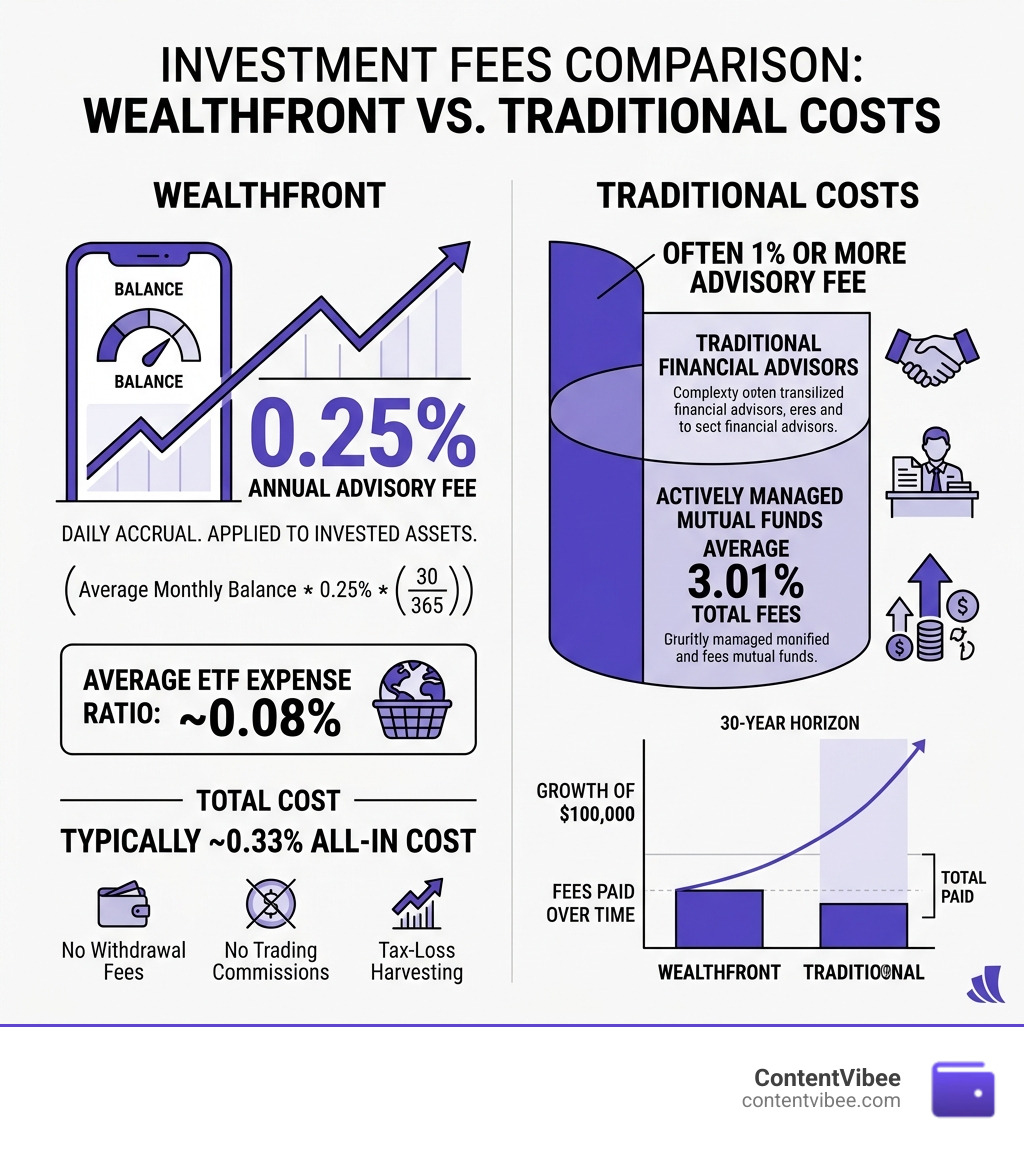
When we look at the core of Wealthfront’s value proposition, it all starts with the 0.25% annual advisory fee for its Automated Index Investing accounts. While traditional financial advisors often charge 1% or more, Wealthfront uses software to keep costs low.
But how does that actually look on your monthly statement? Wealthfront uses a daily accrual method. Every day, they take 1/365th of that 0.25% rate and apply it to the net market value of your invested assets. At the end of the month, the total is deducted directly from your account. For example, if you have an average monthly balance of $100,000, your monthly fee would be approximately $20.55 ($100,000 * 0.0025 * (30/365)).
It is important to note that this fee is pro-rated. If you deposit $35,000 mid-month, you aren’t charged for the full 30 days; you only pay for the days that money was actually managed. Furthermore, there is a legacy benefit for long-time users: accounts opened before April 1, 2018, still receive their first $10,000 managed for free.
Beyond the advisory fee, the only other cost is the expense ratio of the underlying ETFs. Wealthfront is highly selective, choosing low-cost funds that average an expense ratio of just 0.08%. When you combine the advisory fee and the ETF costs, your total cost of ownership is roughly 0.33%. This is a far cry from the high costs associated with traditional firms, where management fees and hidden costs can significantly erode your long-term returns.

Fee Breakdown by Portfolio Type
Wealthfront has expanded its offerings to include specialized portfolios with even lower advisory fees:
| Portfolio Type | Annual Advisory Fee |
|---|---|
| Automated Index Investing | 0.25% |
| Automated Bond Ladder | 0.15% |
| S&P 500 Direct Portfolio | 0.09% |
| Nasdaq-100 Direct Portfolio | 0.12% |
| Stock Investing Account | 0.00% (Free) |
For more details on how these are applied, you can visit the official Understanding Wealthfront fees page.
Specialized Portfolios and Advanced Tax Strategies
One of the reasons we find Wealthfront so compelling for larger accounts is its suite of advanced tax strategies. While most robo-advisors offer basic rebalancing, Wealthfront dives deep into “Direct Indexing.”
For accounts over $100,000, Wealthfront moves beyond just buying an S&P 500 ETF. Instead, they buy the individual stocks within the index. This allows the software to perform Tax-Loss Harvesting at the individual stock level. If Apple goes down while the rest of the market goes up, the software can sell Apple to realize a loss (which offsets your taxes) and immediately buy a correlated stock to keep your portfolio balanced.
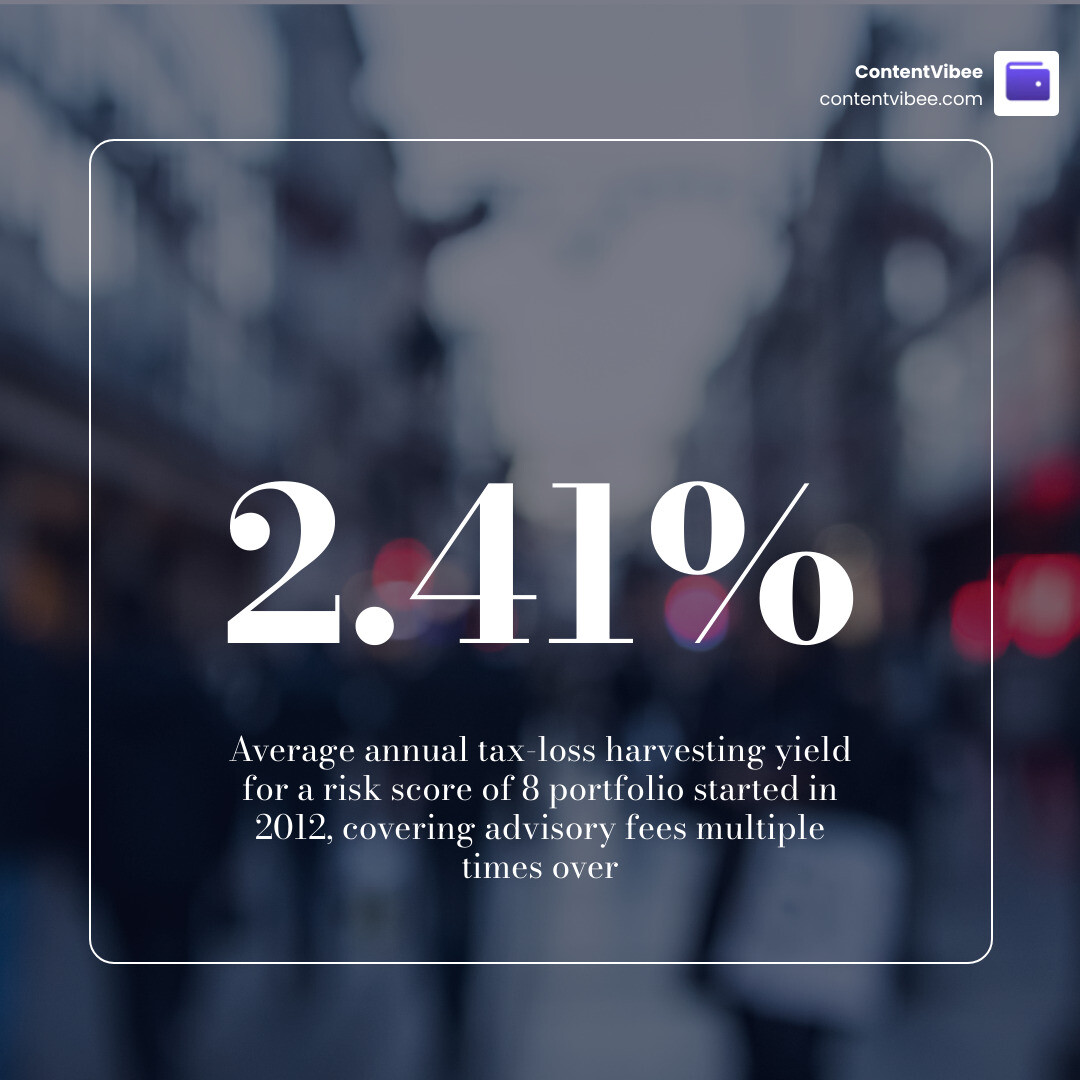
Research shows that for a client with a risk score of 8 who started in 2012, the average annual tax-loss harvesting yield was 2.41% of the portfolio value. When you consider the fee is only 0.25%, the tax savings cover the cost of the platform many times over.
Wealthfront also offers:
- Automated Bond Ladder (0.15% fee): This strategy uses U.S. Treasurys with staggered maturities to protect you against declining interest rates.
- Smart Beta: For accounts over $500,000, this feature weights the stocks in your portfolio more intelligently than a simple market-cap index, aiming for higher risk-adjusted returns.
- Tax-Minimized Transfers: If you are moving an existing brokerage account to Wealthfront, their software will intelligently sell your old securities over time to minimize the capital gains tax hit.
Historical Performance: Wealthfront Investment Fees Robo Advisor Cost and Returns
Performance is the other half of the Wealthfront Investment Fees Robo Advisor Cost and Returns equation. Wealthfront bases its strategy on Modern Portfolio Theory (MPT), which focuses on maximizing returns for a specific level of risk.
Since its inception, a Wealthfront portfolio with a risk score of 7.5 has seen an average annual net-of-fees, pre-tax return of 7.24%. It is vital to emphasize that these are net-of-fees returns, meaning the 0.25% has already been accounted for.
While the S&P 500 might return 10% in a “good” year, Wealthfront portfolios are globally diversified across emerging markets, real estate, and dividend growth stocks. This diversification is designed to prevent the “behavioral errors” that cause the average investor to underperform. According to Serious investing made seriously easy | Wealthfront, the goal isn’t just to beat the market in a single year, but to provide consistent, risk-adjusted growth over decades.
Account Security and Cash Management Costs
Wealthfront isn’t just for long-term investing; we also use it for daily cash management. The Wealthfront Cash Account is a standout feature because it carries zero monthly fees and offers a high APY that consistently beats traditional “big bank” savings accounts.
Security is a major priority here. The Cash Account offers up to $8 million in FDIC insurance through partner banks, which is 32 times the standard limit. For the investment side, Wealthfront is a member of SIPC, protecting your securities up to $500,000.
In an era of rising digital fraud, having these protections is essential. If you’ve ever dealt with an unauthorized bank transaction how to dispute and recover money USA 2026, you know how stressful it can be. Wealthfront provides robust fraud monitoring and 2FA (two-factor authentication) to ensure your identity and assets remain secure.

Cash Account Benefits:
- No-fee ATMs: Wealthfront offers a massive network of fee-free ATMs. If you do use an out-of-network ATM, they reimburse up to $7.50 for the first two domestic withdrawals each month.
- No PFOF: Unlike many “free” trading apps, Wealthfront does not accept Payment for Order Flow. This means they aren’t selling your trade data to high-frequency traders, ensuring you get the best possible execution price.
- Direct Deposit: You can get your paycheck up to two days early, and the account integrates seamlessly with the “Autopilot” feature to move excess cash into your investments automatically.
Comparing Value: Robo-Advisors vs. Traditional Options
To truly understand the Wealthfront Investment Fees Robo Advisor Cost and Returns, we have to compare it to the “old way” of doing things.
The traditional financial advisor model usually involves a 1% AUM (Assets Under Management) fee. On a $500,000 portfolio, that is $5,000 a year. Wealthfront would charge $1,250 for the same balance. Over 30 years, that $3,750 annual difference — if left to compound — could result in hundreds of thousands of dollars in extra wealth for you.
Furthermore, many traditional advisors put clients into actively managed mutual funds. According to Wealthfront: Mutual Fund Fee Research, these funds carry an average total fee of 3.01%. This includes management fees, 12b-1 marketing fees, and “embedded tax liabilities.”
Mutual funds are often tax-inefficient because when other investors sell their shares, the fund may have to sell securities and pass the capital gains tax on to you, even if you didn’t sell a single share. Wealthfront’s ETF-based approach eliminates this “opportunity cost,” keeping more of your money working for you. If you’re curious about other research-heavy options, you might ask, Is Zacks Investment Research Worth the Price Tag?, but for most passive investors, Wealthfront’s automated efficiency is hard to beat.
Final Verdict: Wealthfront Investment Fees Robo Advisor Cost and Returns
Is Wealthfront worth the 0.25% fee? In our opinion, yes—especially if you value your time. The automation handles rebalancing, dividend reinvestment, and tax optimization daily. To do this manually would require hours of work and a sophisticated spreadsheet.
For those just starting, the $500 minimum is a low barrier to entry. If you aren’t ready for a managed portfolio, the Stock Investing Account is completely free and allows you to buy fractional shares of individual companies with as little as $1. This makes it a great “learning” account without the risk of commission fees eating your profits.
Whether you are looking for long-term wealth or exploring alternative diversification, Wealthfront serves as an excellent “home base” for your liquid net worth.
Frequently Asked Questions
What is the minimum deposit to start with Wealthfront?
You need a $500 minimum to open an Automated Investing Account. This ensures there is enough capital to properly diversify across multiple asset classes. However, the Cash Account and the Stock Investing Account have a $1 minimum, making them accessible to almost everyone.
Does Wealthfront charge fees for withdrawals or account closing?
No. Wealthfront is incredibly transparent with its pricing. There are no withdrawal fees, no account-closing fees, and no fees to transfer your assets to another institution. They believe that if the service is good, you won’t want to leave—so they don’t “lock” you in with hidden costs.
How does tax-loss harvesting offset the advisory fee?
Tax-loss harvesting works by realizing “paper losses” to lower your tax bill. Wealthfront’s software does this automatically. For most clients, the tax savings generated are more than 4.7 times the 0.25% fee. In many taxable accounts, the software effectively pays for itself by reducing the amount you owe to the IRS each year.
Conclusion
At ContentVibee, we believe that understanding your costs is the first step toward financial freedom. The Wealthfront Investment Fees Robo Advisor Cost and Returns structure is designed for the modern investor who wants high-end features like direct indexing and tax-loss harvesting without the high-end price tag of a traditional firm.
By combining a low 0.25% fee with sophisticated automation, Wealthfront has built a platform that is hard to beat for long-term, passive wealth building. If you are looking to secure your financial future while keeping your costs at a minimum, Wealthfront is a top-tier contender.
Ready to dive deeper into other investment strategies? Explore more investment research categories to stay ahead of the market and protect your growing wealth. For those looking at retirement specific plans, check out What You Need to Know About FRS Investment Plan for more localized insights.