

Alphabet AI infrastructure investment is one of the biggest financial stories of 2026 — and if you’re trying to understand what it means for investors, here’s the short version:
Quick Answer: Key Facts About Alphabet’s AI Infrastructure Investment
| Topic | Key Detail |
|---|---|
| 2026 Capex Target | $180–190 billion (more than double 2025’s ~$91 billion) |
| Primary Use | Data centers, servers, TPUs, and AI compute |
| Google Cloud Backlog | $240 billion (up over 100% year-over-year) |
| Cloud Revenue Growth | 48% year-over-year in Q4 2025 |
| Gemini Monthly Users | 750 million |
| Financing Strategy | $20 billion bond sale, including a rare 100-year sterling bond |
| Key Semiconductor Winners | Broadcom, TSMC, Nvidia, Marvell |
This isn’t a small bet. Alphabet is planning to spend more on AI infrastructure in a single year than most countries spend on national defense.
And yet, CEO Sundar Pichai has said the spending still keeps him up at night — not because it’s too much, but because it might not be enough.
The pressure is real. Alphabet’s AI infrastructure team operates under a mandate to double AI serving capacity every six months. That kind of growth requires an almost unimaginable amount of hardware, power, land, and supply chain coordination.
For investors, this raises important questions. Where exactly is the money going? Who benefits? And is the return on investment actually there?
The answers are more concrete than you might think — backed by a $240 billion cloud backlog, surging enterprise demand, and a semiconductor ecosystem racing to keep up.
The Scale and Timeline of Alphabet AI Infrastructure Investment
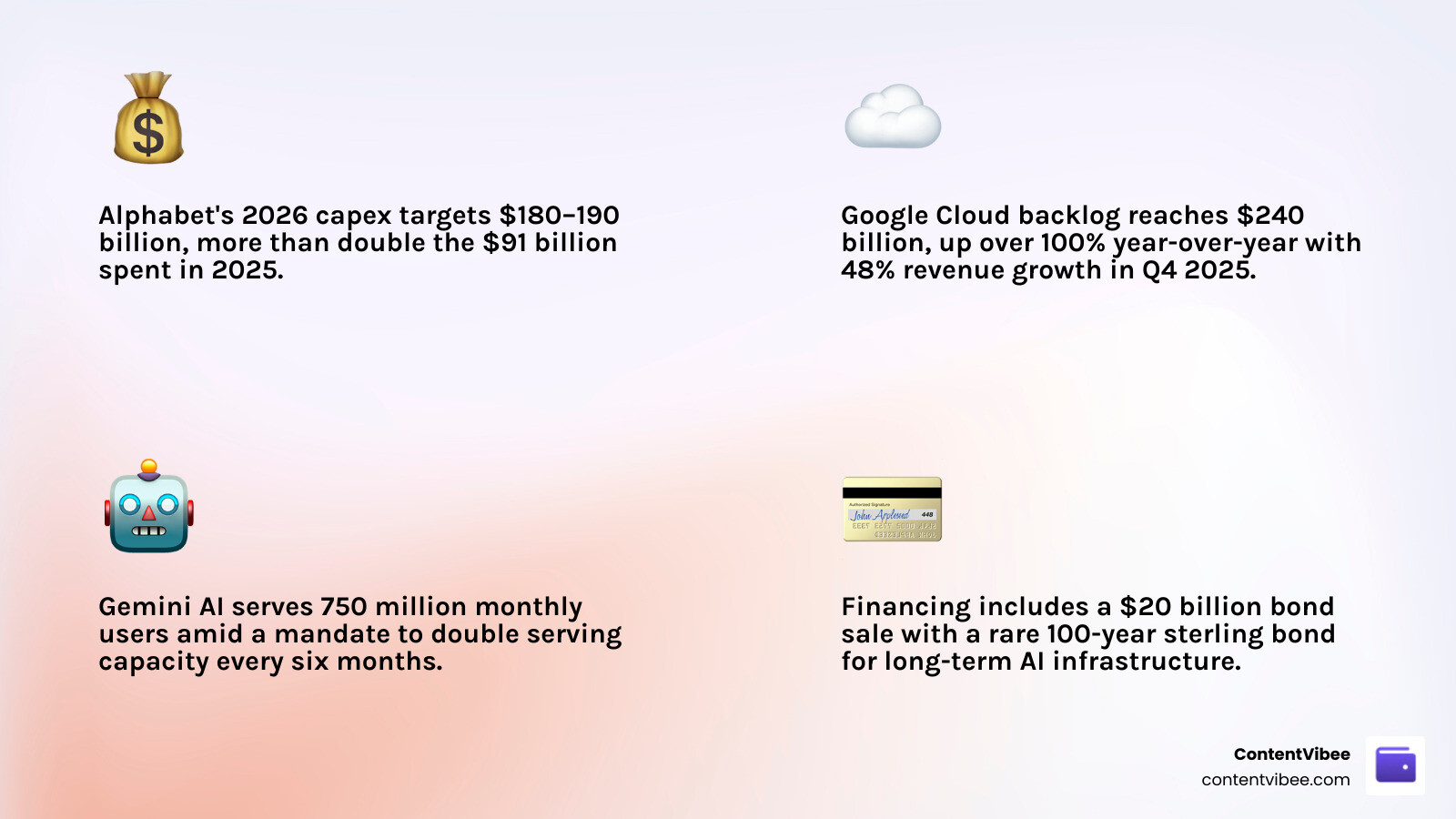
As we look at the landscape in May 2026, the sheer volume of capital moving through Alphabet’s accounts is staggering. We are witnessing a historic pivot. Alphabet expects its 2026 capital expenditures (capex) to land in the range of $180 billion to $190 billion. To put that in perspective, this is more than double the $91.45 billion spent in 2025.
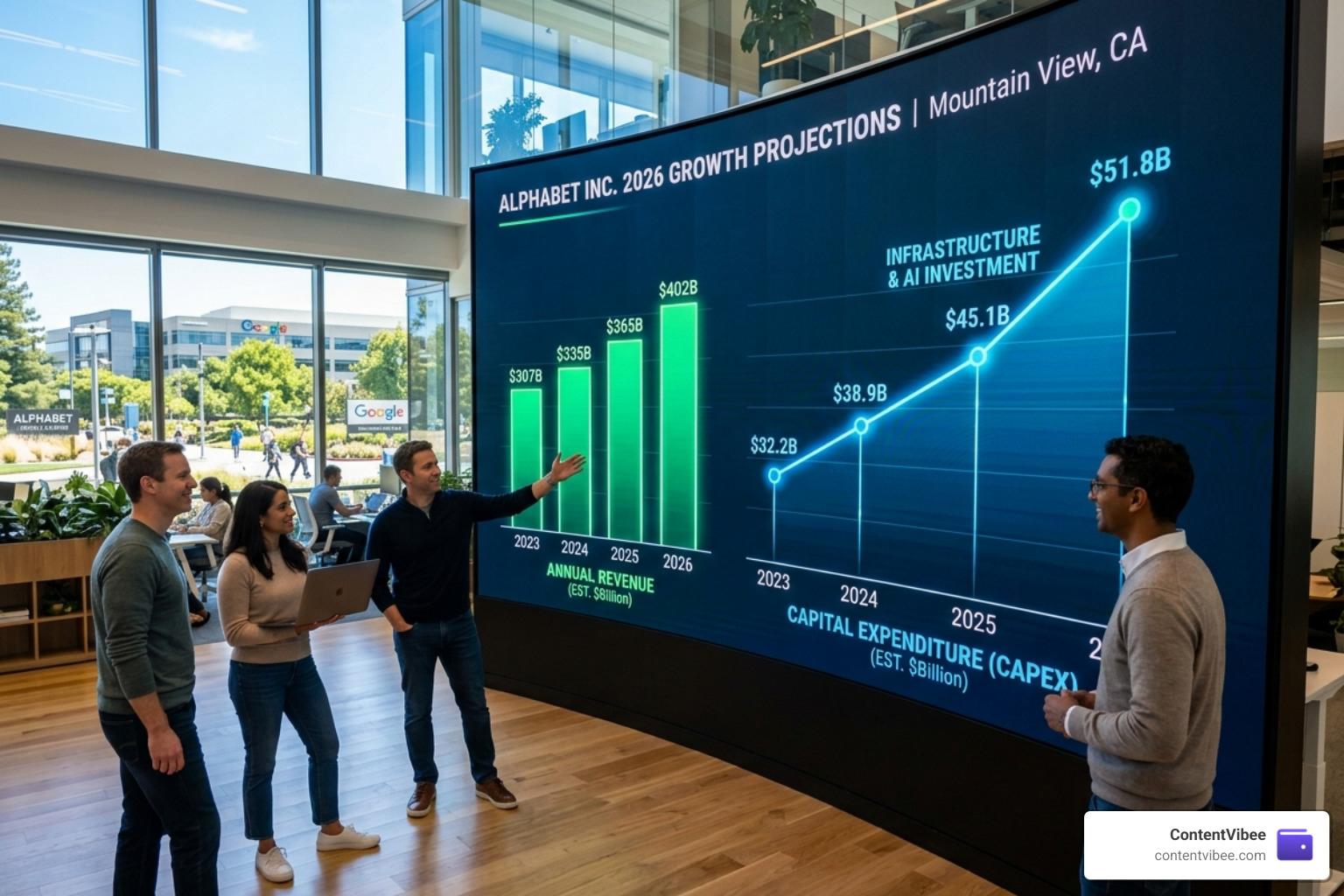
This aggressive timeline isn’t just about 2026; management has already signaled that 2027 spending will likely increase significantly as well. Alphabet is essentially riding the AI infrastructure S-curve, a period of exponential growth where being “first to scale” determines the winners for the next decade.
How Alphabet Compares to Hyperscaler Peers
Alphabet isn’t alone in this race, but it is certainly resetting the bar. Here is how the 2026 capex forecasts look across the “Big Four”:
| Company | Estimated 2026 Capex |
|---|---|
| Alphabet | $180–190 Billion |
| Amazon | ~$146.6 Billion |
| Meta | $115–135 Billion |
| Microsoft | ~$130+ Billion (Projected) |
While all hyperscalers are spending heavily, Alphabet’s upward revision of its guidance suggests a unique urgency. This urgency stems from “infrastructure bottlenecks”—the physical limits of how fast one can build a data center or secure enough power to run it.
Strategic Drivers: Why Alphabet is Doubling Down on AI
We often get asked: Why spend nearly $200 billion in a single year? The answer lies in the data. Alphabet isn’t spending speculatively; it is spending to clear a massive, growing mountain of demand.
Google Cloud has become the primary engine for this growth. By the end of Q4 2025, the Google Cloud backlog reached a record $240 billion, surging 55% sequentially. When customers sign contracts for $240 billion worth of future services, you have to build the “digital factories” to deliver them. This is a similar logic to the Amazon Anthropic investment strategy, where infrastructure is built specifically to house massive AI models.
Furthermore, Alphabet is reimagining its core products through Gemini 3 and DeepMind research. Every time a user gets an “AI Overview” in a Google search, it costs more in compute power than a traditional link-based search. With Gemini monthly active users hitting 750 million, the need for “inference” (running the AI models) has become a constant, high-volume expense.
Meeting Global Demand for Alphabet AI Infrastructure Investment
The demand isn’t just coming from individual users; it’s coming from the enterprise sector. Google Cloud revenue grew 48% year-over-year to $17.7 billion in late 2025, outperforming its main rivals. To keep this momentum, the company has a “6-month scaling mandate.” Essentially, they must double their AI serving capacity every half-year just to stay level with user growth.
This relentless pace is also why we see Alphabet exploring high-value partnerships, much like the Alphabet SpaceX investment value story, which highlights the need for global connectivity and data processing at the edge.
The Semiconductor Ecosystem and Alphabet AI Infrastructure Investment
Alphabet doesn’t just buy chips; it designs them. To reduce its reliance on third parties and lower costs, Alphabet has leaned heavily into custom silicon.
- Broadcom: A key partner that helps design Alphabet’s custom Tensor Processing Units (TPUs). Broadcom’s deal with Alphabet was recently extended through 2031.
- Marvell: Alphabet recently added Marvell as a third partner (alongside Broadcom and MediaTek) to focus on memory and inference chips. You can read more about these types of deals in our analysis of the Nvidia Marvell 2 billion strategy.
- TSMC: The “foundry” that actually manufactures these advanced chips.
- Nvidia: Despite its custom TPUs, Alphabet remains a massive customer of Nvidia GPUs. The demand for compute is so high that Alphabet takes every chip it can get its hands on.
Infrastructure Components: Servers, TPUs, and Data Centers
When we look at where the $190 billion actually goes, it follows a roughly 60/40 split. Approximately 60% is invested in technical infrastructure—specifically servers and high-end chips like the Ironwood TPU. The remaining 40% goes into the “shell”: the data centers, networking equipment, and land.
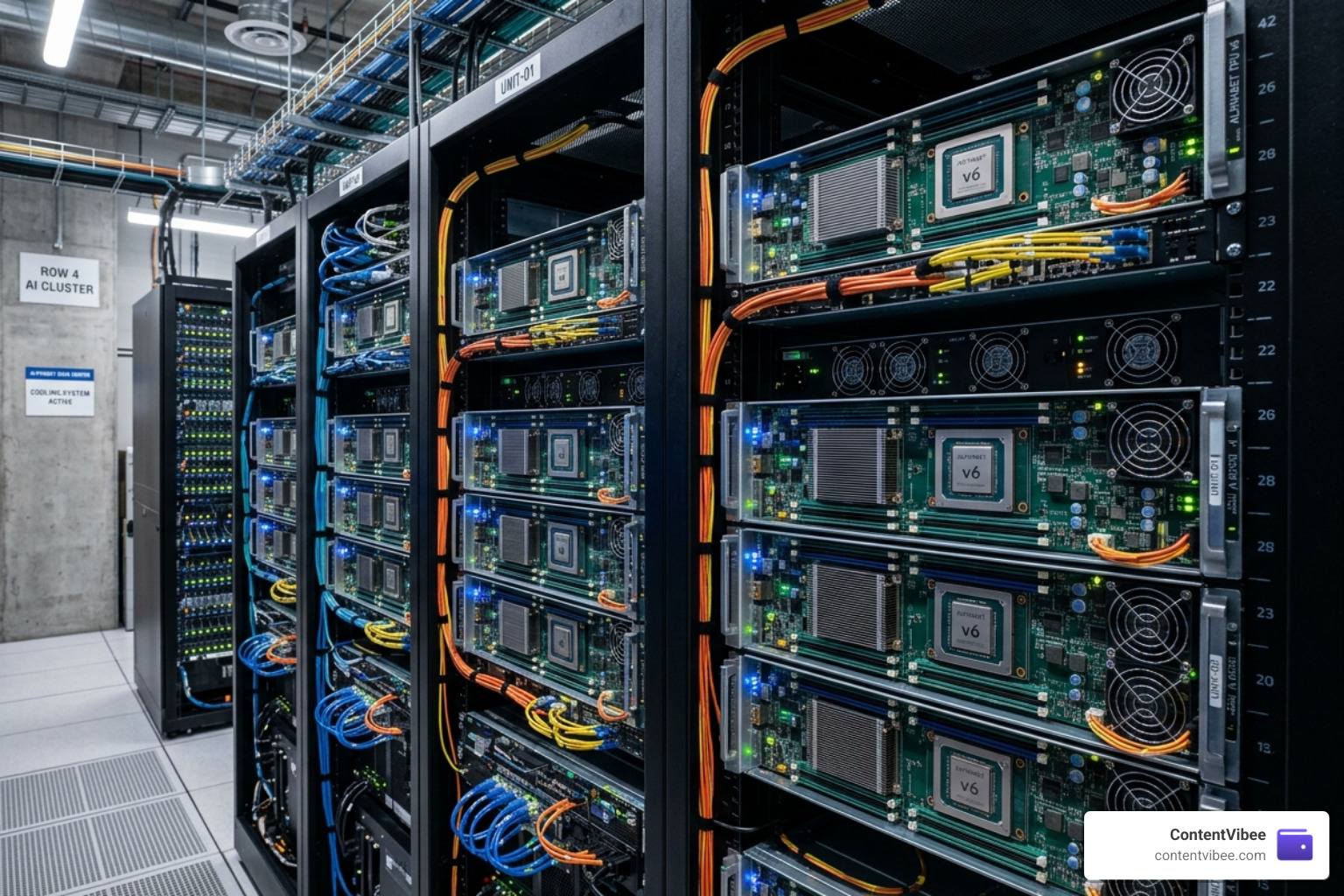
Alphabet’s infrastructure story is getting bigger because they are moving toward “inference-optimized” hardware. The Ironwood TPU, for instance, is designed specifically for the “inference era,” delivering 42.5 exaflops in a single superpod. This allows Alphabet to serve AI results to millions of users simultaneously without the system lagging.
To speed up this build-out, Alphabet recently acquired the data center company Intersect for $4.75 billion. This was a strategic move to secure existing land and power permits, which are often harder to get than the chips themselves. This mirrors the high-stakes hardware moves seen in the Nvidia Xanadu investment story.
Financing the Future: Bonds and the Gigawatt Supercycle
How do you pay for a $190 billion bill? While Alphabet generates massive cash from advertising (over $400 billion in annual revenue), it is also tapping the debt markets in creative ways.
In early 2026, Alphabet issued a rare “Century Bond”—a £1 billion sterling bond that doesn’t mature until the year 2126. This signals that Alphabet is positioning AI as a permanent, utility-like layer of the global economy, much like the railroads of the 19th century. This century bond play allows them to lock in long-term capital to fund projects that might take decades to fully pay off.
The Gigawatt Supercycle
The biggest challenge we see today isn’t just money; it’s power. We are currently in what experts call the “Gigawatt Supercycle.” Data centers are consuming so much electricity that Alphabet is now acquiring power companies and investing in clean energy to ensure its “AI brains” don’t go dark.
Securing land and energy is now just as important as securing software engineers. This shift in asset-heavy investing is a major change for a company that used to be “asset-light.” Investors should watch these energy plays closely, as they are a prerequisite for the high return stories we see elsewhere in Big Tech.
Frequently Asked Questions about Alphabet’s AI Spending
How much will Alphabet spend on AI infrastructure in 2026?
Alphabet has officially raised its capex guidance to between $180 billion and $190 billion for 2026. This represents a near-doubling of its 2025 spend. The majority of this (about 60%) is dedicated to technical infrastructure like servers and custom TPUs.
What is the purpose of the 100-year century bond?
The £1 billion century bond (maturing in 2126) is a way for Alphabet to secure long-term, relatively low-cost financing. It demonstrates the company’s belief that its AI infrastructure will be a foundational “utility” for the next hundred years, allowing them to fund massive build-outs today without draining all their immediate free cash flow.
What are the primary risks to Alphabet’s AI investment strategy?
The three biggest risks are power availability, supply chain constraints, and utilization rates. If Alphabet builds $190 billion worth of data centers but enterprise demand slows down, the “free cash flow” could take a significant hit. However, with a $240 billion backlog, that risk currently seems manageable.
Conclusion
The Alphabet AI infrastructure investment of 2026 is a defining moment for the company. By doubling its capital expenditure and securing its own chip supply chain through partners like Broadcom and Marvell, Alphabet is attempting to build an unassailable lead in the AI race.
While the costs are high—and the “Gigawatt Supercycle” presents real energy challenges—the revenue growth in Google Cloud and the massive user base for Gemini suggest that the ROI is within reach. For those looking at the long-term horizon, understanding these infrastructure “moats” is essential.
At ContentVibee, we believe that staying informed about these massive shifts is the key to successful investing. Whether it’s the long-term risks of Alphabet stock or the broader tech landscape, we’re here to provide the insights you need.
Explore more financial insights and investment guides


