


Remote Retirement Customer Service Jobs Are Growing — Here’s What You Need to Know
Retirement customer service jobs are one of the most accessible ways to keep earning in 2026 — especially if you want flexible hours and the option to work from home.
Here’s a quick look at what these roles offer:
| What You Want to Know | Quick Answer |
|---|---|
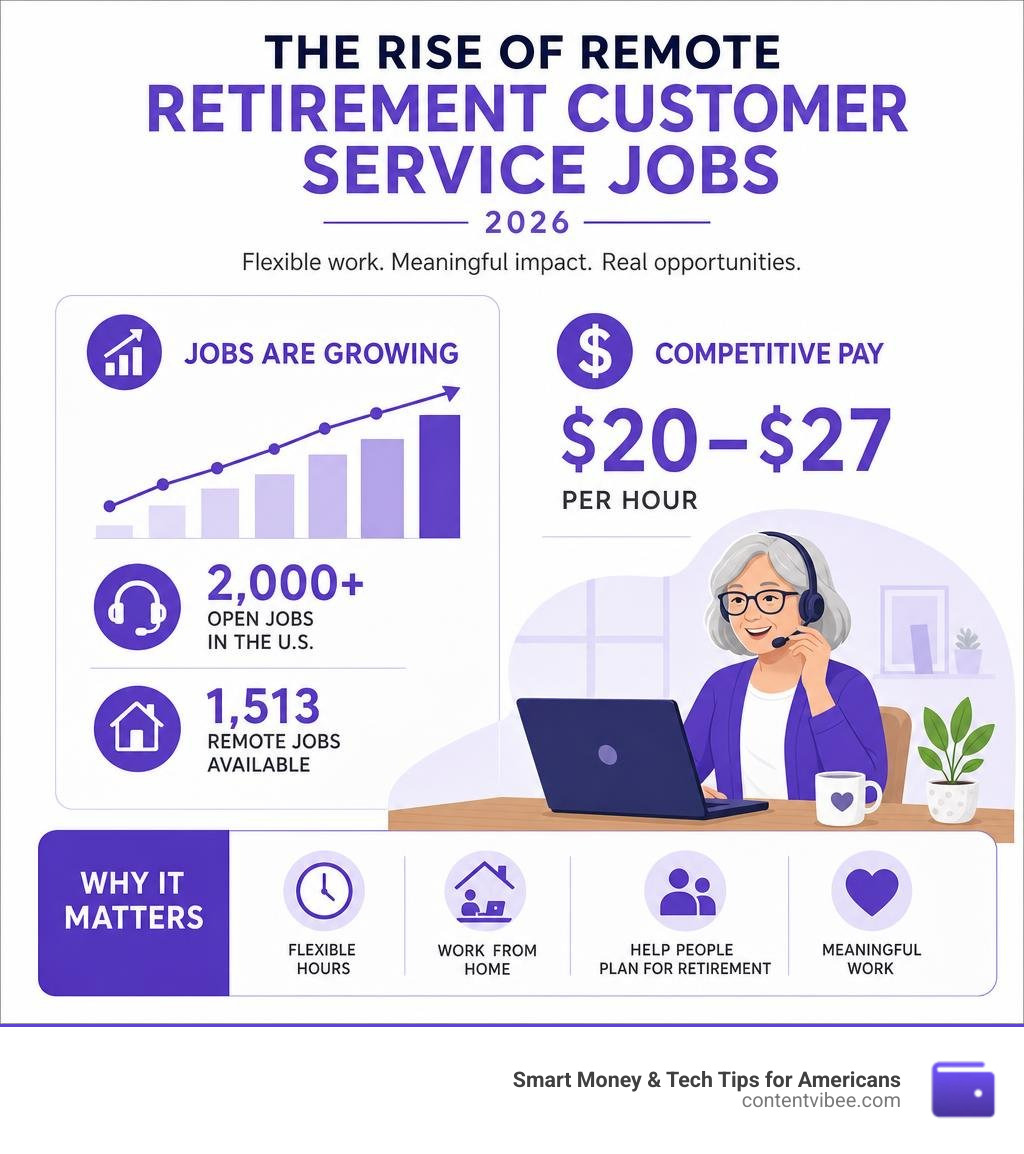
| Typical pay | $20–$27/hour |
| Remote work available? | Yes — many roles are fully remote |
| Degree required? | No — high school diploma or GED is enough |
| Experience needed? | 0–3 years in customer service |
| Top employers hiring | Lincoln Financial, Fidelity, Empower, Alerus |
| Open jobs right now | 2,000+ in the U.S., 1,513 remote |
These aren’t just any call center jobs. You’d be helping real people navigate their 401(k) plans, distributions, and retirement account questions — work that actually matters.
And if you’re nearing retirement yourself, the timing makes sense. About 38% of adults 65 and older worked part time in 2024, and many do it for purpose and connection, not just a paycheck.
The good news? Most of these roles start with paid training, no finance degree required.
What to Expect in Retirement Customer Service Jobs

If you are looking for a career that combines personal finance, problem-solving, and direct human connection, retirement customer service jobs offer a unique and stable path. Unlike generalized retail customer service, working in the retirement sector means you are dealing with people’s life savings, future security, and long-term financial plans.
Every day, you will act as a critical guide for plan participants who may be stressed, confused, or simply looking for clarity on how to access their funds. You aren’t expected to be a licensed stockbroker on day one. Instead, you will act as a clear, empathetic communicator who can translate complex financial rules into plain language.
The daily workflow is structured but highly active. In a typical call center environment, you can expect to handle between 60 and 90 inbound calls per day, alongside responding to secure emails and live chats. To understand how these roles function in practice, you can look at structured postings like the Client Service Center Associate, Retirement and Benefits | Hirevector role, which highlights how representatives serve as a single point of contact for retirement plan inquiries, guiding users through complex software and regulatory landscapes.
Key Responsibilities of Retirement Customer Service Jobs
The day-to-day responsibilities in these roles go far beyond simply resetting passwords (though you will certainly do some of that). You will be helping clients navigate major life transitions. Here is a breakdown of what you will handle:
- Explaining Plan Provisions: Every employer-sponsored 401(k), 403(b), or pension plan has its own unique rules. You will help participants understand vesting schedules, employer matching thresholds, and contribution limits.
- Processing Account Distributions and Rollovers: When employees change jobs or retire, they need to move their money. You will guide them through the process of direct rollovers to IRAs, automatic rollovers, or taking cash distributions.
- Navigating IRS and DOL Regulations: Retirement accounts are heavily regulated by the Internal Revenue Service (IRS) and the Department of Labor (DOL). You will explain the tax implications of early withdrawals, how Required Minimum Distributions (RMDs) work once a participant reaches a certain age, and the strict timelines required to complete rollovers without incurring penalties.
- Managing Health and Wealth Integrations: Many modern retirement packages are bundled with health benefits. You may answer questions regarding Health Savings Accounts (HSAs), Flexible Spending Accounts (FSAs), and Health Reimbursement Arrangements (HRAs), helping clients understand how these accounts interact with their overall retirement strategy.
- Multitasking Across Systems: While speaking with a client, you will need to rapidly navigate internal databases, customer relationship management (CRM) software like Salesforce, and plan administration platforms to find accurate data in real time.
How to Qualify for Remote Retirement Customer Service Jobs
You do not need an background in Wall Street trading to qualify for these positions. In fact, most employers prioritize soft skills, coachability, and a strong work ethic over pre-existing financial expertise.
To land one of these roles, you generally need to meet the following requirements:
- Education: A high school diploma or GED is the standard baseline. However, having an Associate’s or Bachelor’s degree is highly preferred by top-tier employers and can give you a competitive edge during the hiring process.
- Experience: Most entry-level positions require 0 to 1+ years of general customer service or office experience, though 2+ years in a call center, financial services, or benefits administration setting is highly valued.
- Technical Proficiency: You must be comfortable working with the Microsoft Office Suite and learning specialized database programs. Because these are often work-from-home roles, you must possess strong computer literacy to troubleshoot minor tech issues independently.
- Internet Bandwidth: For remote setups, companies have strict technical requirements to ensure call quality and security. You will typically need a hardwired internet connection (no Wi-Fi allowed during work hours) with a minimum download speed of 12 Mbps, though 25 Mbps is highly preferred.
- Communication and Soft Skills: You need an empathetic phone presence, active listening skills, and the ability to remain calm and professional under pressure. Many callers may be dealing with difficult life events, such as the death of a spouse or an unexpected job loss, requiring high emotional intelligence.
If you want to see how these requirements look in a real-world job listing, check out the Customer Service Representative, Retirement (Remote) Job Details | Lincoln Financial posting, which details the specific technical, educational, and communication requirements expected of remote applicants.
Compensation, Benefits, and Work Arrangements
When considering retirement customer service jobs, the financial and lifestyle rewards are highly competitive compared to standard retail or hospitality customer service roles. Because financial services is a highly regulated and profitable industry, employers are willing to invest more in their customer-facing staff.
Let’s look at how compensation, training, and work models generally compare across the industry:
| Employer Type | Typical Starting Pay | Training Structure | Work Arrangement | Key Perks |
|---|---|---|---|---|
| Major Financial Firms | $20.00 – $22.00 / hour | 8 weeks paid virtual or onsite classroom training | Highly Remote / Hybrid options | Bilingual premiums, tuition reimbursement, licensing sponsorship |
| State Retirement Systems | Varies by state | Structured state-guided training program | Often Hybrid (e.g., 2 days onsite, 3 days remote) | Excellent public pensions, robust job security |
| Third-Party Plan Administrators | $21.00 – $22.00 / hour | Fast-paced remote onboarding | Fully Remote (with geographic preferences) | Comprehensive health packages, HSA/FSA administration exposure |
The median hourly pay for a customer service representative across all sectors is $26.59, but entry-level financial service roles typically start in the $20.00 to $22.00 range, with rapid opportunities for increases as you gain experience or certifications.
Additionally, many companies offer a bilingual premium. For example, if you are fluent in both English and Spanish, you can often earn an additional $1.00 per hour premium on top of your base pay.
Beyond hourly wages, these roles come with robust benefits packages, including:
- Comprehensive medical, dental, and vision insurance.
- Generous 401(k) matching programs (often matching up to 6% or more).
- Paid Time Off (PTO) and paid parental leave.
- Tuition assistance and fully funded degree programs.
- Company-provided computer hardware, monitors, and security equipment for your home office.
To explore current active listings and compare pay scales directly, you can browse the latest listings on Retirement jobs in Remote – Indeed.
Training and Remote Work Setup
One of the greatest benefits of entering the retirement services field is that employers do not expect you to know everything on day one. Almost all reputable firms offer fully paid training programs.
These training programs typically last between 6 to 8 weeks and are conducted in a structured, cohort-based environment. You will join a class of fellow new hires and learn through virtual classrooms, interactive modules, and practice phone calls. During this period, you will study retirement account mechanics, IRS regulations, systems navigation, and communication strategies.
However, remote work does come with strict professional expectations:
- Onsite vs. Remote Training: Some companies require you to complete your initial training onsite at a regional office before you are allowed to transition to a work-from-home model. Others offer 100% virtual training from day one, provided you live within a certain geographic radius of an office.
- Fixed Post-Training Schedules: Once training is complete, your shift schedule is usually fixed. Call centers often operate from 8:00 AM to 8:00 PM EST, and new hires are frequently assigned mid-day or closing shifts (such as 11:15 AM to 8:00 PM EST).
- Home Office Standards: You must have a dedicated, quiet, and distraction-free workspace with a closing door. Because you will be handling highly sensitive financial and personal data, companies require that no one else in your household can view your screens or overhear your conversations. You will also need to remain on camera during team meetings and training sessions.
Career Paths and Advancement Opportunities

Starting out in an entry-level customer service role in the retirement industry is not a dead-end job. In fact, it is one of the most reliable launching pads for a lucrative, long-term career in wealth management, corporate operations, or financial planning.
Many major financial firms actively use their customer service centers as a talent pipeline. They prefer to promote from within because customer service representatives develop a deep, foundational understanding of plan rules, client pain points, and internal systems.
There are currently over 2,000 Retirement Plan Specialist jobs listed across the United States, with a massive portion of them offering clear upward mobility. You can review the volume and variety of these career opportunities on 1,000+ Retirement Plan Specialist jobs in United States – LinkedIn.
Unlicensed vs. Licensed Roles
As you build your career in retirement services, your path will generally split into two distinct directions: unlicensed professional paths and licensed financial advisor paths.
1. Unlicensed Career Paths
If you prefer to avoid the stress of taking regulatory exams, there are plenty of high-paying operational and leadership roles available. From an entry-level customer service representative, you can advance to:
- Subject Matter Expert (SME) or Tier 2 Support: Handling complex escalations and assisting newer team members.
- Team Leader or Call Center Manager: Overseeing a team of representatives, monitoring performance metrics, and coaching staff.
- Retirement Plan Administrator: Working directly with corporate clients to manage their employee benefits plans, ensure compliance, and oversee annual plan testing.
- Implementation Specialist: Helping corporate clients transition their retirement plans from a competitor to your firm’s platform.
2. Licensed Career Paths
If you want to maximize your earning potential and work directly in financial planning, many employers will fully fund your journey to obtain professional securities licenses. Roles like Customer Relationship Advocate or Workplace Planning Associate serve as stepping stones.
Your employer may pay for your study materials, provide paid study hours during the workweek, and cover the exam fees for critical certifications, including:
- Securities Industry Essentials (SIE): The introductory exam required to take specialized representative exams.
- Series 7 License: The General Securities Representative license, which allows you to buy and sell securities and advise clients on investment strategies.
- Series 63 License: The state law exam required for conducting securities business within specific states.
Obtaining these licenses instantly qualifies you for specialized wealth management positions, financial advisor roles, and private client service careers, drastically increasing your salary potential.
Key Challenges and Rewards of the Role
Like any career, working in retirement customer service comes with its own unique set of pros and cons. Understanding these challenges upfront can help you decide if this is the right path for your skills and personality.
The Challenges
- High Call Volume: Managing 60 to 90 calls a day can be mentally exhausting. You must be prepared for a environment where one call begins almost immediately after the previous one ends.
- Strict Scheduling and Metrics: Call centers operate on tight schedules. Your breaks, lunches, and shift times are monitored down to the minute. You will also be evaluated on performance metrics such as Average Handle Time (AHT), Quality Assurance (QA) scores, and customer satisfaction ratings.
- Navigating Complex Regulations: You cannot simply guess an answer. Giving incorrect information regarding IRS rules or plan distributions can have serious financial and tax consequences for the client, meaning you must be highly detail-oriented and precise.
- Dealing with Frustrated Callers: Money is a highly emotional topic. You will occasionally deal with clients who are stressed about market downturns, delayed distributions, or complex paperwork, requiring you to maintain a calm, professional, and empathetic demeanor.
The Rewards
- Making a Real-World Impact: You aren’t just selling a product; you are helping people secure their financial futures. Explaining a complex rollover process to a widow or helping a retiree access their hard-earned pension is deeply meaningful work.
- Paid Professional Development: The financial service sector offers unparalleled training. Getting paid to learn about tax laws, investment vehicles, and even earn securities licenses is an incredible benefit.
- Excellent Work-Life Balance: Unlike retail, hospitality, or healthcare, retirement call centers rarely operate on weekends or major holidays. You will enjoy a stable Monday-through-Friday schedule.
- Low Physical Demands: These roles require very little physical exertion, with statistics showing that customer service representatives spend only about 6.3% of their time standing or walking. This makes it an ideal remote option for older workers or retirees looking to transition into a comfortable home-office setting.
Frequently Asked Questions about Retirement Customer Service
What is the average pay for retirement customer service roles?
While the broader customer service category has a median hourly pay of $26.59, entry-level retirement-specific customer service roles typically start between $20.00 and $22.00 per hour. Bilingual representatives often earn an additional $1.00 per hour premium. As you gain experience, transition to tier-two support, or obtain securities licenses, hourly rates can quickly exceed $30.00 per hour.
Can I work completely from home in these positions?
Yes, a massive portion of the job market has shifted to remote work. Out of over 2,000 active retirement specialist listings, more than 1,513 are fully remote. However, keep in mind that many employers require you to live within a specific geographic hiring radius (often within 50 to 100 miles of a regional office) for hybrid training, occasional team-building events, or state tax compliance. To explore companies that offer flexible career paths in this space, you can review opportunities listed on Careers – PCS Retirement.
Do I need a financial background to get hired?
Absolutely not. Most employers design their hiring process to identify candidates with strong communication skills, empathy, and technical aptitude. They provide robust, fully paid virtual training programs that cover everything you need to know about retirement plans, IRS regulations, and software systems before you ever take your first live call.
Conclusion
Landing a retirement customer service job is an excellent way to secure a stable, rewarding, and flexible remote career in 2026. Whether you are looking to enter the corporate financial world, build a career as a licensed advisor, or simply find a fulfilling work-from-home role that leverages your natural empathy and communication skills, the retirement sector offers incredible opportunities.
At ContentVibee, we are committed to providing you with clear, actionable advice to help you maximize your personal finance, retirement, and career goals. If you are planning to work during your retirement years, it is crucial to understand how your earnings might impact your retirement benefits. To make sure you don’t accidentally reduce your income, check out our comprehensive guide: Learn how working in retirement affects your spousal benefits.